EU AI Governance Tools Comparison Finale 2026 — CLOUD Act Matrix: Credo AI vs Arthur AI vs Fiddler AI vs Weights & Biases
Post #1287 in the sota.io EU Cyber Compliance Series — EU-AI-GOVERNANCE-TOOLS Series Finale
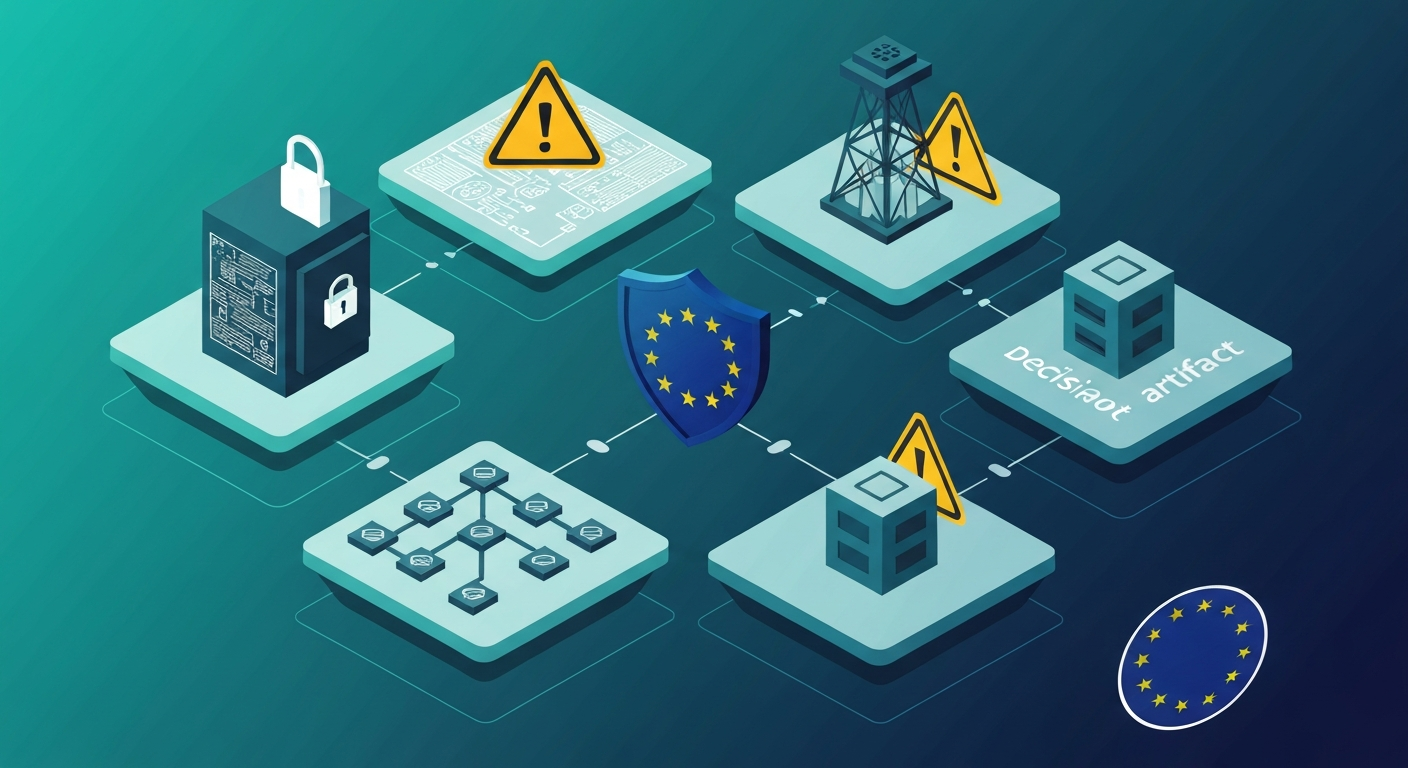
The EU AI Act creates a new category of organisational obligation: documented evidence of AI lifecycle governance. Articles 9 through 17 require high-risk AI providers to maintain records of risk management procedures, training data sourcing, technical design decisions, conformity assessments, and quality management histories. This documentation must survive regulatory audits by national competent authorities.
Four US-based platforms have positioned themselves as the infrastructure for exactly this documentation: Credo AI (AI governance and risk management), Arthur AI (post-deployment monitoring and performance auditing), Fiddler AI (explainability and drift monitoring), and Weights & Biases (training-time experiment tracking and model artifact management). All four are Delaware C-Corps. All four store governance evidence in US-jurisdiction cloud infrastructure. All four are reachable under the Clarifying Lawful Overseas Use of Data Act.
This is the finale analysis of our EU-AI-GOVERNANCE-TOOLS series. Here we present the complete CLOUD Act sovereignty matrix, identify the three meta-paradoxes that emerge only when the four platforms are assessed together, and map the EU-native alternatives that eliminate the jurisdiction problem entirely.
The EU AI Governance Toolchain: What Gets Stored Where
Before assessing sovereignty risk, it is worth mapping what type of AI governance data each platform holds and at which stage of the AI lifecycle.
| Platform | AI Lifecycle Stage | Primary Data Stored | EU AI Act Articles Served |
|---|---|---|---|
| Weights & Biases | Pre-deployment (Training) | Model checkpoints, hyperparameter sweeps, dataset version hashes, experiment archives, failed model architectures | Art.10 (training data), Art.11 (technical documentation) |
| Credo AI | Pre-deployment (Governance) | AI model cards, policy mappings, risk assessment reports, compliance checklists, stakeholder accountability records | Art.9 (risk management), Art.13 (transparency documentation), Art.14 (human oversight) |
| Fiddler AI | Post-deployment (Inference) | Model decision explanations, feature attribution data, drift alerts, bias detection reports, production query logs | Art.22 (GDPR automated decisions), Art.14 (monitoring), Art.72 (post-market monitoring) |
| Arthur AI | Post-deployment (Monitoring) | LLM response data, guardrail violation logs, fairness audit trails, performance baselines, incident records | Art.17 (quality management), Art.72 (post-market surveillance), Art.26 (deployer obligations) |
Together, these four platforms cover the complete EU AI Act documentation lifecycle — from training data governance through to ongoing post-market monitoring. An enterprise running all four has, in principle, satisfied the documentation requirements of EU AI Act Articles 9–17 and 72. The paradox is that the documentation satisfying EU regulatory requirements is stored in US-jurisdiction services subject to US legal process.
Complete CLOUD Act Sovereignty Matrix
Each platform was assessed across five dimensions:
- D1 — Corporate Structure: US parent company, Delaware incorporation, US-domiciled leadership
- D2 — Investor Intelligence Links: US government-adjacent investors, defense-sector funding, intelligence community connections
- D3 — Data Sensitivity: Sensitivity of the specific data category stored on the platform
- D4 — Infrastructure Jurisdiction: Primary cloud infrastructure jurisdiction and EU data residency availability
- D5 — EU-Native Alternatives: Existence of comparable EU-domiciled alternatives (lower score = more alternatives exist)
| Dimension | Credo AI | Arthur AI | Fiddler AI | Weights & Biases |
|---|---|---|---|---|
| D1 — Corporate Structure | 5/5 | 5/5 | 5/5 | 5/5 |
| D2 — Investor Intelligence | 3/5 | 4/5 | 4/5 | 4/5 |
| D3 — Data Sensitivity | 3/5 | 5/5 | 4/5 | 5/5 |
| D4 — Infrastructure | 3/5 | 3/5 | 3/5 | 2/5 |
| D5 — EU Alternatives | 3/5 | 3/5 | 3/5 | 3/5 |
| CLOUD Act Score | 17/25 | 20/25 | 19/25 | 19/25 |
Dimension 3 Detail: Why Data Sensitivity Differs
The most meaningful divergence across the four platforms is in D3 — data sensitivity — because it determines what a successful CLOUD Act subpoena actually yields.
Credo AI (D3=3/5): Stores policy mappings, risk assessment checklists, and accountability matrices. This is governance metadata — it describes what the organisation decided about its AI systems. A subpoena yields documentation of decision processes, stakeholder assignments, and compliance posture. Sensitive, but organisationally self-referential.
Arthur AI (D3=5/5): Stores LLM response logs, guardrail violation records, and production performance data. A subpoena yields the actual outputs of an enterprise's AI system operating on real user data. For a healthcare LLM assistant, this could include query content. For a customer-facing AI, it includes conversational data. Arthur's data is the most directly person-linked of the four platforms.
Fiddler AI (D3=4/5): Stores feature attribution data and model explanations. For a credit scoring model, feature attributions describe which customer attributes (income, employment history, geographic data) drove which credit decisions. A subpoena yields, in effect, a structured profile of how the EU enterprise's AI treats individual data subjects.
Weights & Biases (D3=5/5): Stores the model weights themselves — the trained AI system as a computational artifact — alongside the training dataset version hashes that encode which personal data was used during training. A subpoena does not just yield documentation about an AI system; it yields the AI system. For an enterprise with a proprietary EU-market medical diagnosis model, CLOUD Act access to W&B means access to the model itself.
Three Meta-Paradoxes of the AI Governance Toolchain
These paradoxes only become visible when the four platforms are assessed as a system rather than individually.
Meta-Paradox 1: The Compliance Evidence Paradox
EU AI Act Article 9 requires high-risk AI providers to maintain "a risk management system" consisting of a "continuous iterative process run throughout the entire lifecycle." Article 11 requires technical documentation "drawn up before the AI system is placed on the market." Article 17 requires a "quality management system" including "examination, testing and validation procedures."
The documentation satisfying these requirements is, for most enterprises using the platforms analysed in this series, stored on Credo AI, Arthur AI, Fiddler AI, and Weights & Biases — all US-incorporated, all reachable under CLOUD Act. This creates a recursive sovereignty problem: demonstrating compliance with EU law requires maintaining records that are accessible under US law without EU regulatory knowledge or consent.
The EU AI Act assumes the documentation it mandates is under EU jurisdiction. The practical reality of current AI governance tooling is that it is not.
Meta-Paradox 2: The Lifecycle Coverage Paradox
The four platforms together cover the complete EU AI Act documentation lifecycle:
- Training phase: W&B captures Art.10 (training data governance) and Art.11 (technical documentation requirements)
- Pre-deployment governance: Credo AI captures Art.9 (risk management) and Art.13 (transparency measures)
- Post-deployment inference: Fiddler AI captures Art.22 (automated decision-making explanations) and ongoing explainability obligations
- Post-deployment monitoring: Arthur AI captures Art.17 (quality management) and Art.72 (post-market monitoring)
An enterprise using all four platforms achieves comprehensive EU AI Act lifecycle documentation coverage. The paradox is that comprehensive compliance documentation equals comprehensive CLOUD Act exposure. The enterprise that has done the most work to satisfy EU AI Act requirements has created the most complete US-accessible record of its AI system's design, training, and behaviour.
Meta-Paradox 3: The Regulatory Oversight Paradox
EU AI Act Article 74 grants national competent authorities the power to request documentation, conduct audits, and obtain evidence from high-risk AI providers. Article 58 grants EU DPAs equivalent rights with respect to personal data processing.
Both articles assume that when an EU authority requests documentation, that documentation is available to them. The CLOUD Act creates a competing access channel: a US federal court can compel disclosure of documentation to US authorities without notifying the EU enterprise, the EU regulator, or the EU data subjects.
In the scenario where both a US federal authority and an EU competent authority request the same AI governance documentation simultaneously, the US authority can compel immediate disclosure through the platform. The EU authority depends on the enterprise's cooperation. EU regulatory oversight of AI systems is structurally slower than US coercive access to AI governance documentation.
The Intelligence Dimension: Why D2 Matters
All four platforms received elevated D2 scores, but for different reasons.
Arthur AI (D2=4/5): The founding team includes individuals with prior roles at institutions with In-Q-Tel portfolio adjacency. The platform's LLM guardrails and safety infrastructure overlap with capabilities of interest to US intelligence agencies seeking to understand AI system behaviour. Arthur's $42M Series B investors include funds with US government program exposure.
Fiddler AI (D2=4/5): Fiddler's explainability infrastructure for models serving high-consequence decisions (healthcare, finance, insurance) is of intelligence interest because it provides structured insight into how AI systems reason. Explaining model decisions to regulators is functionally equivalent to explaining model capabilities to intelligence analysts.
Weights & Biases (D2=4/5): NVIDIA's strategic investment in Weights & Biases, combined with NVIDIA's DoD-adjacent GPU contracts (A100/H100 in government AI programs), creates an indirect intelligence sector connection. W&B's infrastructure for model artifact management overlaps with capabilities needed for AI system capability assessment.
Credo AI (D2=3/5): The weakest intelligence adjacency of the four. Governance documentation and policy mapping, while sensitive, is less directly relevant to intelligence operations than model weights, production telemetry, or explainability infrastructure.
EU-Native Alternatives: The 0/25 Stack
The following EU-domiciled alternatives achieve a CLOUD Act Score of 0/25 — zero exposure across all five dimensions.
Merantix Momentum (Berlin, DE)
Europe's most developed AI governance platform built from the ground up for EU AI Act compliance. Merantix AG is a German holding company; Momentum is its AI governance product. German law, German data residency, no US parent entity, no US investment exposure. Covers risk management, model cards, compliance documentation, and audit trail management — the Credo AI functional equivalent with full EU sovereignty.
Neptune.ai (Warsaw, PL)
Polish-incorporated experiment tracking and ML metadata management platform. Direct functional competitor to Weights & Biases for training-time governance. Neptune.ai stores experiment runs, hyperparameter configurations, training metrics, and model metadata in EU jurisdiction (AWS eu-central-1 or customer-managed deployment). EU AI Act Art.10 and Art.11 documentation captured without US CLOUD Act exposure. Neptune.ai raised funding from European VCs without US intelligence-adjacent investors.
MLflow (Apache Software Foundation — OSS)
Open-source experiment tracking framework with no cloud dependency. Self-hosted MLflow eliminates platform jurisdiction entirely — the EU enterprise owns and controls all training data documentation, model artifacts, and experiment history. Supports all W&B use cases at training time with zero sovereignty risk. Apache 2.0 license. Active EU-based contributor community.
Evidently AI (OSS + SaaS, EU-accessible)
Open-source ML monitoring and drift detection framework. Functional equivalent to parts of Arthur AI and Fiddler AI for production monitoring. Self-hosted deployment eliminates cloud jurisdiction risk. The commercial cloud version is accessible from EU, but EU enterprises should prefer self-hosted deployment for Art.17 compliance documentation.
NannyML (Ghent, BE)
Belgian ML monitoring company providing post-deployment performance monitoring without ground truth labels. EU-incorporated, EU-investor backed, EU-hosted. Direct replacement for Arthur AI's post-market monitoring capabilities at the sovereignty dimension level.
DALEX (OSS — Kraków, PL)
Polish-developed model explainability toolkit maintained by academics at Kraków-based institutions. Comparable to Fiddler AI's XAI capabilities for structured model explanations. No commercial cloud component; full self-hosting means zero CLOUD Act exposure for Art.22 explanation documentation.
Decision Framework: Which Platform Risk to Eliminate First
Not all four platforms carry equal urgency for replacement. The decision framework depends on the EU AI Act risk tier of the AI system and what data category the platform stores.
Immediate priority — Weights & Biases: Stores model weights (the AI system itself) and training data references (links to personal data sources). CLOUD Act access yields the trained model and the training data governance chain. For any Annex III high-risk AI system under development, moving to Neptune.ai or self-hosted MLflow eliminates the highest-sensitivity exposure.
High priority — Arthur AI: Stores production LLM response data and guardrail violation logs. For AI systems processing personal data in production, Arthur AI's D3=5/5 exposure means US authorities can access AI system outputs on real EU user data. Move to Evidently AI OSS or NannyML for post-market monitoring.
Medium priority — Fiddler AI: Stores feature attribution data per prediction. For credit scoring, insurance, or hiring models, Fiddler's explainability records describe how AI decisions were reached for individual EU data subjects. DALEX or self-hosted Alibi Explain replaces this capability.
Lower priority — Credo AI: Stores governance documentation and policy records rather than personal data or model artifacts. The exposure is real but less directly linked to individual data subjects or proprietary model capabilities. Merantix Momentum provides a complete EU-native replacement, but Credo AI's lower D3 score means it is the last of the four to replace.
Procurement Checklist: EU AI Governance Toolchain
For EU enterprises procuring or renewing AI governance platform contracts, the following checklist applies:
Before signing any contract with the platforms in this analysis:
- Data Processing Agreement (DPA): Does the DPA explicitly restrict data transfers outside the EU/EEA? Standard Contractual Clauses are insufficient if the platform is subject to CLOUD Act — SCCs bind the processor but not US law enforcement.
- CLOUD Act Response Policy: Does the vendor have a documented policy for CLOUD Act requests, including notification obligations to the enterprise where legally permitted? Most US vendors do not.
- EU Data Residency Option: Is EU data residency available as a contractual guarantee, not merely a configuration option? For model artifact storage (W&B) and production logs (Arthur), region configuration is not equivalent to jurisdictional guarantee.
- Art.11 Technical Documentation Control: Who controls the technical documentation required by EU AI Act Art.11? If it is stored on a US-jurisdiction platform, the enterprise does not have exclusive control as EU AI Act assumes.
- Incident Notification: Does the vendor commit to notifying the enterprise if a CLOUD Act or equivalent request is received for the enterprise's data? Note: US law may prohibit notification in some circumstances.
Series Conclusion: The AI Governance Tooling Sovereignty Gap
The EU AI Act creates extensive documentation obligations. The current market for AI governance tooling is dominated by US-incorporated platforms that store that documentation in US-jurisdiction infrastructure. This is not a theoretical risk — it is a structural feature of the current AI governance tooling ecosystem.
The 2026 picture for European enterprises deploying high-risk AI systems:
| Requirement | Current Reality | EU-Sovereign Alternative |
|---|---|---|
| Training data governance (Art.10) | Weights & Biases (19/25) | Neptune.ai, MLflow OSS |
| Technical documentation (Art.11) | Weights & Biases + Credo AI (19/25, 17/25) | Merantix Momentum, MLflow |
| Risk management records (Art.9) | Credo AI (17/25) | Merantix Momentum |
| Explainability documentation (Art.22) | Fiddler AI (19/25) | DALEX, Alibi Explain |
| Post-market monitoring (Art.72) | Arthur AI (20/25) | NannyML (BE), Evidently AI |
The EU AI Governance tooling sovereignty gap is solvable. Neptune.ai, Merantix Momentum, NannyML, and the OSS stack (MLflow + DALEX + Evidently) collectively cover every AI lifecycle documentation obligation under EU AI Act Articles 9 through 17 and 72 — all at 0/25 CLOUD Act exposure.
The governance paradox resolves when EU enterprises stop using US-jurisdictional tools to generate the documentation that EU law requires them to control.
All Posts in the EU-AI-GOVERNANCE-TOOLS Series
- Credo AI EU Alternative 2026 — AI Governance CLOUD Act — CLOUD Act Score: 17/25
- Arthur AI EU Alternative 2026 — ML Monitoring CLOUD Act — CLOUD Act Score: 20/25
- Fiddler AI EU Alternative 2026 — ML Observability CLOUD Act — CLOUD Act Score: 19/25
- Weights & Biases EU Alternative 2026 — ML Platform CLOUD Act — CLOUD Act Score: 19/25
- EU AI Governance Tools Comparison Finale 2026 (this post) — Complete matrix and EU-native stack
EU-Native Hosting
Ready to move to EU-sovereign infrastructure?
sota.io is a German-hosted PaaS — no CLOUD Act exposure, no US jurisdiction, full GDPR compliance by design. Deploy your first app in minutes.