Fiddler AI EU Alternative 2026 — ML Observability and XAI Under CLOUD Act
Post #1285 in the sota.io EU Cyber Compliance Series
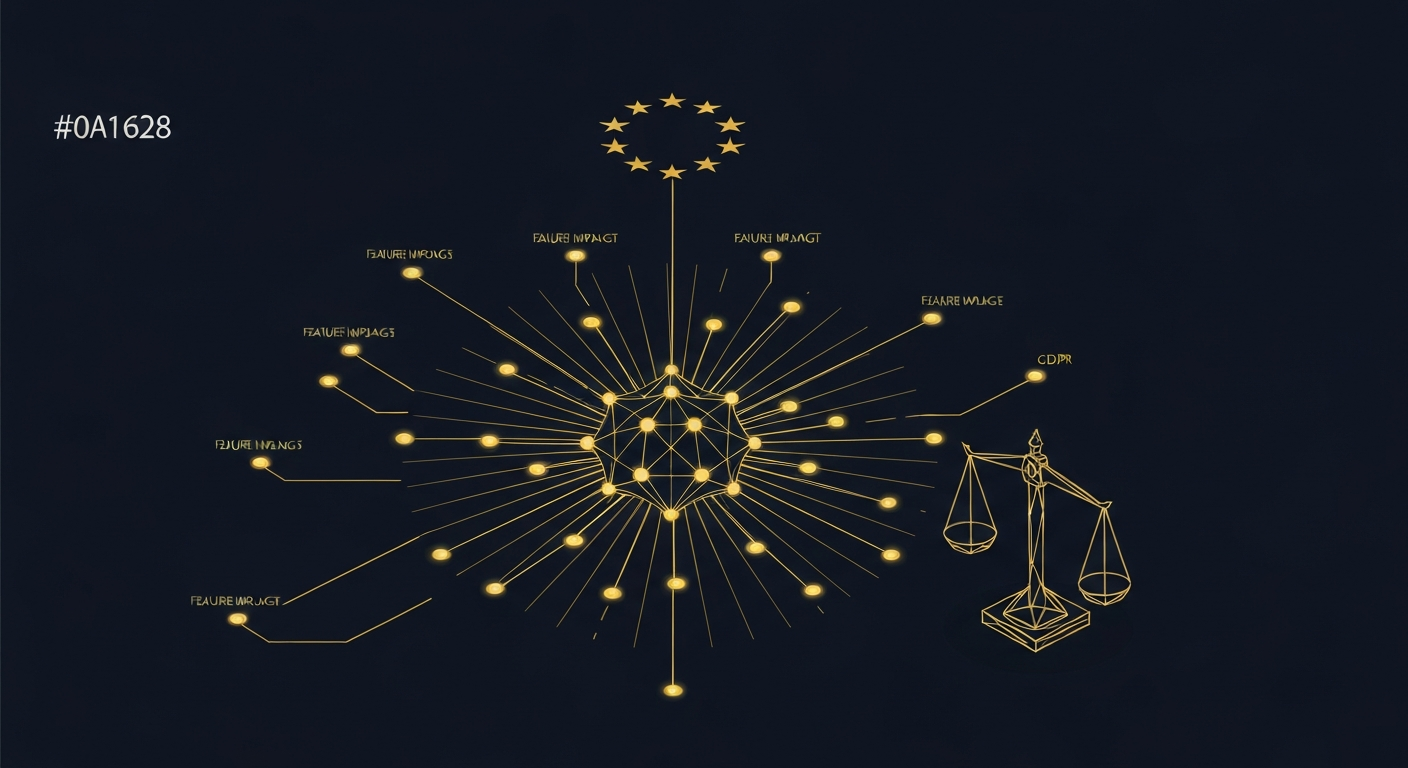
Fiddler AI has built its market position on a specific and legally significant capability: making machine learning models explainable. The Explainable AI (XAI) foundation of Fiddler's platform — SHAP value calculations, feature importance rankings, counterfactual explanations — is precisely what GDPR Art.22 and EU AI Act Art.13 require European enterprises to maintain for automated decision-making systems. The platform designed to generate the evidence of EU legal compliance is itself a Delaware C-Corp operating under US CLOUD Act jurisdiction.
For European enterprises deploying high-risk AI systems under the EU AI Act, this creates a structural paradox that no contractual arrangement can fully resolve. The individual SHAP explanations generated for each automated decision — explaining why a credit application was rejected, why a job candidate was screened out, why a medical diagnostic AI produced a specific output — constitute both GDPR Art.22 rights infrastructure and CLOUD Act-accessible data. The right to receive a meaningful explanation of an automated decision and the US government's right to compel disclosure of the explanation infrastructure are simultaneously valid.
Company Profile: Fiddler AI
Fiddler AI was founded in 2018 by Krishna Gade (CEO) and Krishnaram Kenthapadi (Chief Scientist), headquartered in Menlo Park, California. The company is incorporated as a Delaware C-Corp and has raised approximately $76.5 million in total funding, including a $41 million Series C round in August 2022.
Founding team background:
Krishna Gade previously led the News Feed ranking infrastructure team at Facebook, where he worked on the engineering systems that underpin large-scale recommendation and personalisation models. Krishnaram Kenthapadi served as a principal researcher at Microsoft Research and LinkedIn, where his work focused on algorithmic fairness, privacy-aware machine learning, and responsible AI — directly relevant to the EU AI Act compliance use cases Fiddler targets.
The founding team's expertise in fairness-aware ML and responsible AI deployment is operationalised in the product's XAI focus: Fiddler's core differentiator is not just monitoring model performance, but making model behaviour interpretable for compliance purposes.
Investor structure:
- Andreessen Horowitz (a16z) — Menlo Park, CA; one of the largest US venture capital firms, with substantial enterprise software and AI infrastructure investments
- Lightspeed Venture Partners — Menlo Park, CA; US VC with significant enterprise AI portfolio
- Salesforce Ventures — San Francisco, CA; corporate VC of Salesforce, Inc. (NYSE: CRM), a US public company
- NVIDIA — Santa Clara, CA; US corporation (NASDAQ: NVDA) investing strategically in AI infrastructure platforms
- Lux Capital — New York, NY; US venture capital focused on deep tech and science-based companies
All material equity holders operate exclusively under US jurisdiction. NVIDIA's strategic investment is particularly noteworthy: as a US public company with existing Department of Defense relationships through GPU contracts, NVIDIA's equity stake in Fiddler creates an additional layer of US institutional connectivity beyond standard VC relationships.
Product suite:
- Fiddler Auditor: Core ML model monitoring platform. Tracks prediction quality, data drift, feature distribution shift, and model performance degradation over time for production AI systems.
- Fiddler Explainability (XAI): SHAP-based feature importance and counterfactual explanation engine. Generates per-record explanations of individual model predictions, enabling GDPR Art.22 compliance documentation.
- Fiddler Fairness: Continuous fairness monitoring segmenting model performance by demographic subgroups. Detects disparate impact in real-time production AI systems.
- Fiddler for LLMs: Newer product line monitoring large language model outputs for hallucinations, prompt injection, and policy violations.
The Explainability Paradox: GDPR Art.22 and EU AI Act Art.13
Fiddler's market position is built on a specific EU regulatory need. Two overlapping legal frameworks require European enterprises to maintain explainability infrastructure for automated decision-making:
GDPR Article 22 grants data subjects rights regarding automated individual decision-making, including the right "to obtain human intervention on the part of the controller, to express his or her point of view and to contest the decision." To fulfil this right, controllers must maintain "meaningful information about the logic involved" in automated decisions — the definition of what Fiddler generates.
EU AI Act Article 13 requires that high-risk AI systems be "designed and developed in such a way as to ensure that their operation is sufficiently transparent to enable deployers to interpret the system's output and use it appropriately." Article 14 requires human oversight, which presupposes interpretable AI outputs. Fiddler's XAI platform directly operationalises these requirements.
The result is that Fiddler is not just a monitoring tool — it is the legal compliance infrastructure for automated decision rights under EU law. And this infrastructure is stored in a Delaware C-Corp's US-jurisdiction cloud.
CLOUD Act Score Analysis: Fiddler AI
Dimension 1 — Legal Incorporation: 5/25
Fiddler AI is incorporated as a Delaware C-Corp with principal offices in Menlo Park, California. There is no EU-incorporated subsidiary, no EU data processing entity with structural separation from the US parent, and no contractual architecture that removes CLOUD Act jurisdiction.
Under 18 U.S.C. § 2713, US law enforcement can compel Fiddler AI to produce customer data — including all SHAP explanation records, feature importance values, and model monitoring telemetry for EU AI systems — regardless of where that data is physically hosted.
Score: 5/5 (maximum CLOUD Act exposure)
Dimension 2 — Investor and Ownership Structure: 4/25
All five institutional investors — a16z, Lightspeed, Salesforce Ventures, NVIDIA, Lux Capital — operate under US jurisdiction and are subject to US legal process. NVIDIA's strategic position as a US public company with defence and intelligence community adjacency through GPU contracts elevates the institutional connectivity of Fiddler's investor base beyond typical VC relationships.
Unlike In-Q-Tel-connected founding teams, Fiddler's intelligence community exposure is indirect — through NVIDIA's broader institutional relationships rather than a direct founding connection. This reduces D2 slightly from the maximum.
Score: 4/5 (all-US investor base, NVIDIA strategic investment with DoD adjacency)
Dimension 3 — Data Sensitivity: 4/25
Fiddler captures AI compliance evidence of high legal sensitivity:
SHAP explanation data (per-record):
- For each individual automated decision (credit, hiring, medical, insurance), Fiddler generates SHAP values showing which personal features drove the outcome
- These per-record explanations contain the inferred relationship between an individual's personal attributes and the AI model's decision about them
- Under GDPR Art.4(1), this constitutes personal data — it is information about an identified person derived from automated processing of their personal data
- Bulk SHAP explanation data across all EU individuals processed by an AI system constitutes a systematised record of why every person received every automated decision
Fairness monitoring data:
- Demographic subgroup performance data, potentially derived from GDPR Art.9 special category data (race, gender, health status)
- Required to be maintained under EU AI Act Art.10(2)(f)
Model drift and performance telemetry:
- Production performance records that may constitute EU AI Act Art.72 incident logs
- Counterfactual explanations revealing AI decision boundaries
The data sensitivity is high but slightly less concentrated than platforms capturing raw LLM conversation transcripts in their primary product (as Arthur Shield does). Fiddler's core data exposure is derived-feature data rather than raw input streams.
Score: 4/5 (high — GDPR Art.22 explanation infrastructure, fairness data, EU AI Act compliance evidence)
Dimension 4 — Cloud Infrastructure: 3/25
Fiddler AI operates primarily on AWS infrastructure. There is no publicly documented EU data residency option, EU-specific deployment tier, or contractual architecture separating EU customer data from US-jurisdiction infrastructure. Enterprise customers may negotiate data residency terms, but the absence of a published EU data processing framework means no structural isolation exists by default.
As with all US SaaS companies, CLOUD Act compelled disclosure runs to the US entity — Fiddler AI, Inc. — not to the AWS physical infrastructure. An EU data residency clause does not create a CLOUD Act barrier.
Score: 3/5 (AWS US-primary, no documented EU infrastructure isolation)
Dimension 5 — EU-Native Alternative Availability: 3/25
The ML observability and explainability market has viable open-source alternatives deployable entirely within EU infrastructure:
Open-source explainability libraries (0/25 CLOUD Act when self-hosted):
- SHAP (Lundberg & Lee, open-source) — the same SHAP methodology Fiddler uses is available as an open-source Python library deployable on EU-hosted infrastructure
- LIME (Local Interpretable Model-agnostic Explanations) — open-source interpretability library
- Alibi Explain (Seldon, UK) — commercial-grade open-source explainability toolkit; Seldon is a UK company with EU operations
- DALEX (DrWhy.AI) — Polish academic project providing model-agnostic explanation tools for R and Python
EU-native commercial monitoring:
- NannyML (Brussels, Belgium) — commercial ML monitoring startup focusing on production performance estimation; EU-incorporated
- Evidently AI — open-source ML monitoring with enterprise support; deployable on EU infrastructure
The open-source SHAP library is functionally equivalent to Fiddler's core explainability capability and deployable on any EU-hosted infrastructure. The trade-off is engineering effort to build the monitoring pipeline and UI layer that Fiddler provides as managed SaaS.
Score: 3/5 (viable open-source equivalent to core XAI capability; thin EU-native commercial market)
Total CLOUD Act Score: 19/25 — Critical Exposure
| Dimension | Score | Rationale |
|---|---|---|
| D1 — Legal entity | 5/5 | Delaware C-Corp, Menlo Park CA |
| D2 — Investors | 4/5 | All-US VCs + NVIDIA strategic stake |
| D3 — Data sensitivity | 4/5 | SHAP explanations, fairness data, EU AI Act compliance evidence |
| D4 — Infrastructure | 3/5 | AWS US-primary, no documented EU isolation |
| D5 — EU alternatives | 3/5 | Open-source SHAP/LIME viable; thin EU commercial market |
| Total | 19/25 | Critical — unsuitable for EU high-risk AI compliance without structural safeguards |
Three EU AI Act Paradoxes
Paradox 1: The Right-to-Explanation Sovereignty Paradox
GDPR Art.22(3) grants data subjects the right to "obtain human intervention on the part of the controller, to express his or her point of view and to contest the decision." To exercise this right meaningfully, individuals must receive "meaningful information about the logic involved" in the automated decision. The EU legislator intended this as a fundamental right protecting individuals from opaque algorithmic governance.
Fiddler AI stores the operational infrastructure generating these explanations: the SHAP value computations, the feature importance rankings, the counterfactual analysis pipelines. For a European bank using Fiddler to monitor its credit scoring AI, every individual SHAP explanation — showing that this applicant's debt-to-income ratio contributed -0.43 to a rejected credit decision — exists as a record in Fiddler's US-jurisdiction cloud.
A US law enforcement request under CLOUD Act could compel Fiddler to produce bulk SHAP explanation records across all EU data subjects processed by that bank's AI system. The requesting authority would receive a comprehensive record of why every EU citizen received every automated decision — systematised across the entire customer base.
This creates a rights inversion: the EU data subject's individual right under GDPR Art.22 to receive their explanation can only be exercised by requesting their data from the controller. But the US government's right to compel bulk disclosure of the same explanation infrastructure under CLOUD Act can be exercised without notification to the data subject, the controller, or any EU regulatory authority. Mass access to EU automated-decision explanation data is legally available to US law enforcement before individual EU citizens can exercise their individual fundamental rights.
Paradox 2: The Model Decision Boundary Intelligence Paradox
Fiddler's counterfactual explanation engine answers a specific question: "What would have to be different about this individual's data for the AI model to reach a different conclusion?" For a credit model: "If the applicant's annual income were €8,000 higher, the credit application would have been approved." For a hiring AI: "If the candidate had three additional months of relevant experience, they would have advanced to the interview stage."
Counterfactual explanations are required under EU AI Act Art.13 (transparency) and form part of the human oversight infrastructure under Art.14. They are legally necessary for deployers to understand the system's decision logic and intervene appropriately.
Accumulated counterfactual explanation data constitutes a systematic map of an AI model's decision boundaries: the precise thresholds at which the model changes its outputs. For proprietary AI systems — credit scoring models, fraud detection algorithms, insurance underwriting AIs — this decision boundary map is commercially sensitive intellectual property and, simultaneously, the operational documentation required by EU AI Act.
Under CLOUD Act, a US court order could compel Fiddler to produce all counterfactual explanation data for a European bank's credit scoring AI. The receiving party would obtain a comprehensive map of the model's decision logic: exactly which feature combinations produce approvals versus rejections, at what thresholds, across every customer segment. This is not abstract risk — it is a structured, queryable dataset derived from regulatory compliance documentation.
The EU AI Act requires this compliance documentation to exist. Storing it in Fiddler's US cloud makes it simultaneously available to the EU regulatory framework it serves and to US discovery processes that operate without EU oversight or notification requirements.
Paradox 3: The Audit Trail Completeness Paradox
EU AI Act Art.17 requires providers of high-risk AI systems to establish a quality management system including "procedures for post-market monitoring" and documented records of performance changes over time. National competent authorities may request access to this documentation under Art.74(4) as part of market surveillance.
Fiddler's temporal model monitoring generates exactly this audit trail: when model performance began degrading, when data drift exceeded thresholds, when fairness metrics deteriorated, when retraining was triggered and what effect it had. This is the documented history of how a high-risk AI system has behaved throughout its operational life — the foundation of an EU AI Act Art.17 quality management record.
Art.74(4) establishes the EU regulatory pathway: national market surveillance authorities request the quality management records from the AI system operator. The records may be subpoenaed by national courts in enforcement proceedings. The EU data subject affected by a discriminatory AI system may seek the records through judicial review.
CLOUD Act establishes a parallel pathway: US law enforcement compels Fiddler to produce the same audit trail without notifying the EU operator, the EU market surveillance authority, or the affected data subjects. US government access to an EU AI system's complete performance history — including evidence of when it first began exhibiting discriminatory patterns — is available through CLOUD Act before EU judicial or regulatory processes can compel the same disclosure.
The EU regulatory architecture assumes that compliance evidence flows through EU legal channels. Fiddler's platform creates a condition where the US government can access the complete EU AI Act quality management record of any Fiddler customer's AI system through a legal process that entirely bypasses EU institutional channels.
EU-Native Alternatives: CLOUD Act Score 0/25
The EU-native ML observability and XAI market is primarily open-source but technically capable of meeting EU AI Act requirements:
| Solution | Type | Jurisdiction | EU AI Act Coverage |
|---|---|---|---|
| SHAP (open-source) | Library (self-hosted) | Community-governed | Full SHAP explanations, feature importance — identical to Fiddler's core methodology |
| LIME (open-source) | Library (self-hosted) | Community-governed | Local interpretable model-agnostic explanations |
| Alibi Explain | Open-source (Seldon, UK) | United Kingdom | Anchors, integrated gradients, TreeSHAP, counterfactuals |
| DALEX | Open-source (DrWhy.AI) | Polish academic | Model-agnostic explainability, fairness checks |
| NannyML | Commercial (Belgian startup) | Belgium (EU) | Production monitoring, CBPE performance estimation |
| Evidently AI | Open-source (self-hosted) | International | Drift detection, data quality, fairness metrics |
The recommended EU-compliant architecture for GDPR Art.22 and EU AI Act Art.13 compliance:
- SHAP (open-source) for per-record explainability, deployed within EU-hosted ML infrastructure
- Evidently AI for continuous drift and fairness monitoring, self-hosted on EU cloud
- NannyML for production performance monitoring without ground truth labels
- EU-hosted logging (Elasticsearch/OpenSearch on Hetzner, Gcore, or IONOS) for audit trail retention
This stack provides equivalent EU AI Act compliance capabilities with zero CLOUD Act exposure. The engineering overhead versus Fiddler's managed SaaS is the primary trade-off.
Practical Recommendations for EU Enterprises
Risk stratification by AI system type:
| AI System | Fiddler Risk Level | Recommended Action |
|---|---|---|
| High-risk AI (Annex III: credit, hiring, medical) | Critical | Migrate XAI infrastructure to EU-hosted open-source stack |
| Automated decision-making under GDPR Art.22 | Critical | Replace Fiddler with self-hosted SHAP + Evidently AI |
| Fairness monitoring for GDPR Art.9 special categories | Critical | EU-hosted fairness monitoring only |
| Non-personal-data model monitoring | Medium | Negotiate EU data residency DPA |
| Internal R&D experimentation | Low | Standard contractual safeguards sufficient |
Data Processing Agreement minimum requirements:
- Explicit EU data residency clause with named EU AWS/Azure/GCP regions
- SHAP explanation data classified as personal data under the DPA with GDPR Art.28 processing restrictions
- CLOUD Act notification clause (note: legally unenforceable under US law — Fiddler cannot guarantee prior notice of US court orders)
- Sub-processor list restricted to EU entities for SHAP/explainability data processing
- Standard contractual clauses (SCCs) per Commission Implementing Decision (EU) 2021/914
For EU AI Act Art.22 right-to-explanation compliance:
- Per-record SHAP explanation data should be stored in EU-jurisdiction systems exclusively
- The explanation-generation infrastructure should operate on EU-hosted compute to prevent US discovery of model decision logic
- Counterfactual explanation records should be treated as legally sensitive documents and stored under the same data governance as the underlying personal data
Conclusion
Fiddler AI's XAI platform addresses a genuine and growing EU compliance need. The combination of SHAP explainability, fairness monitoring, and drift detection makes it technically well-suited to EU AI Act Art.13, Art.14, and Art.22 requirements. But the structural CLOUD Act exposure — created by Fiddler's Delaware C-Corp incorporation and all-US investor base — means that the platform designed to generate EU fundamental rights compliance documentation is itself outside EU legal protection.
The 19/25 CLOUD Act score reflects the specific nature of Fiddler's data exposure: not the highest-sensitivity category (raw LLM conversations), but legally significant data that sits at the intersection of GDPR Art.22 individual rights, EU AI Act compliance documentation requirements, and US discovery processes. For EU enterprises operating high-risk AI systems under EU AI Act Annex III, this intersection is precisely where CLOUD Act exposure is most consequential.
The EU-native alternative path — SHAP + Evidently AI + NannyML deployed on EU-hosted infrastructure — achieves the same EU AI Act compliance coverage with zero CLOUD Act exposure. The trade-off is engineering investment to build and maintain a self-hosted observability stack. For AI systems making automated decisions about EU citizens' credit, employment, or healthcare, that engineering investment is the price of regulatory certainty.
CLOUD Act Score methodology: Five dimensions (D1: Legal entity, D2: Investor structure, D3: Data sensitivity, D4: Cloud infrastructure, D5: EU-native alternative availability), each scored 1-5. Score of 19/25 indicates critical CLOUD Act exposure. Scores above 15/25 indicate the platform requires substantial contractual safeguards before use in EU high-risk AI deployments. EU-native alternatives listed score 0/25 when deployed on EU-hosted infrastructure.
EU-Native Hosting
Ready to move to EU-sovereign infrastructure?
sota.io is a German-hosted PaaS — no CLOUD Act exposure, no US jurisdiction, full GDPR compliance by design. Deploy your first app in minutes.