Weights & Biases EU Alternative 2026 — ML Experiment Tracking Under the CLOUD Act
Post #1286 in the sota.io EU Cyber Compliance Series
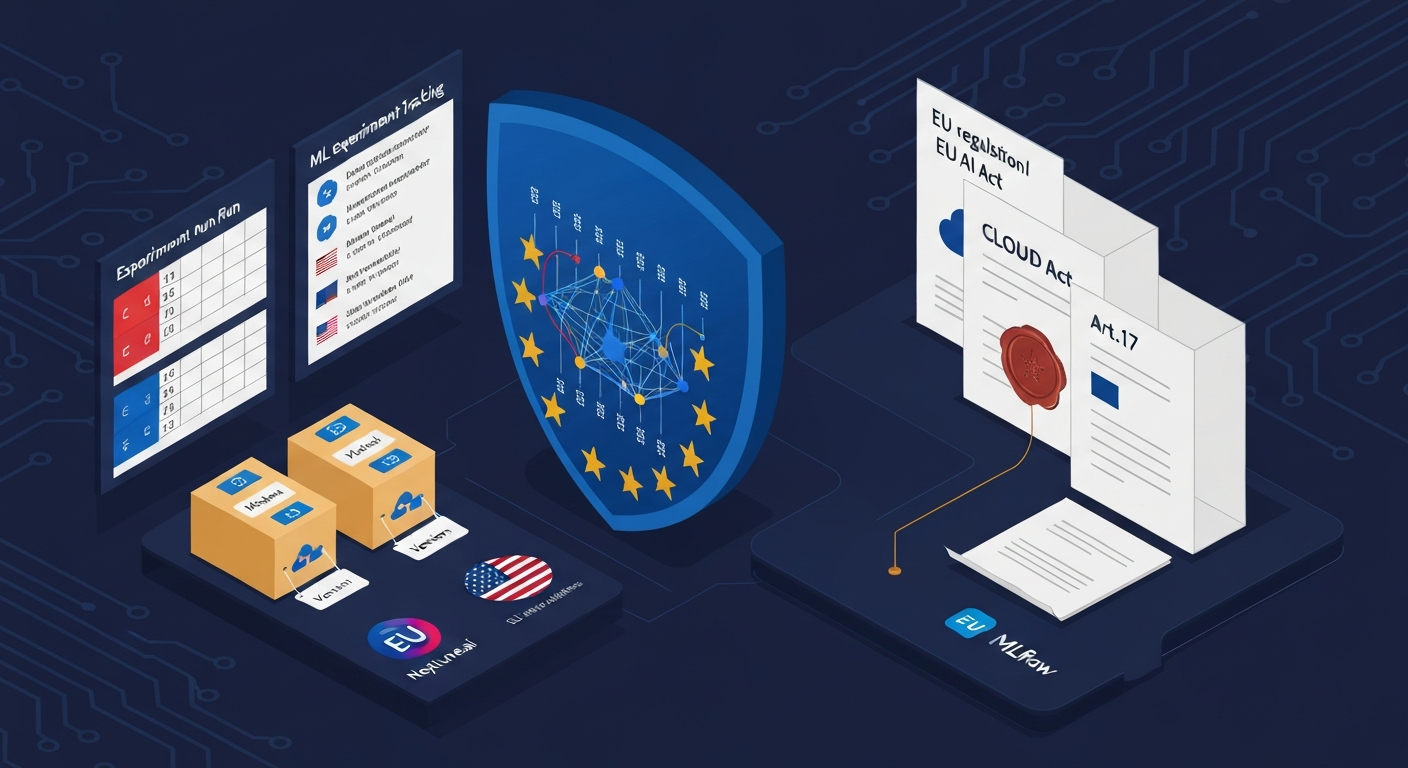
Weights & Biases operates at a moment in the AI lifecycle that all other monitoring and governance platforms do not: training time. While tools like Arthur AI and Fiddler AI analyse what a deployed model does at inference, Weights & Biases records what a model becomes during training — the dataset versions used, the hyperparameter decisions made, the model architectures tried and rejected, and the model weights that define the trained AI system itself.
This training-time position creates a specific and rarely discussed CLOUD Act exposure. Under EU AI Act Article 10, providers of high-risk AI systems must document their training data governance: sourcing methodology, quality assessments, and the explicit connection between training dataset composition and model outputs. Under Article 11, technical documentation must include "the design specifications of the system, namely the general logic of the AI system and of the algorithms." Under Article 17, quality management records must capture how the model evolved over its development lifecycle.
Weights & Biases is the infrastructure where this documentation lives. And it is a Delaware C-Corp with headquarters in San Francisco, California.
For European enterprises developing high-risk AI systems under EU AI Act Annex III — credit scoring, medical diagnostics, hiring algorithms, critical infrastructure monitoring — this creates a structural compliance paradox. The evidence required to demonstrate EU AI Act compliance to national competent authorities is stored in a platform that US courts can compel to disclose without notifying the EU enterprise, the EU regulator, or the EU data subjects whose personal data appears in the training set references.
Company Profile: Weights & Biases
Weights & Biases was founded in 2018 by Lukas Biewald (CEO), Chris Van Pelt, and Shawn Lewis, headquartered in San Francisco, California. The company is incorporated as a Delaware C-Corp and operates the Wandb platform under the wandb.ai domain. The company has raised over $200 million in total funding and reached unicorn status following its Series C round.
Founding background:
Lukas Biewald previously founded CrowdFlower (now Appen), a data labelling platform that became a foundational part of the ML training data supply chain. His background in the data annotation and training data space directly informs Weights & Biases' focus on the pre-deployment phases of ML development — where training data quality, experiment reproducibility, and model versioning are the operational concerns.
The company name reflects the fundamental parameters of neural network training: weights (the learned parameters that define model behaviour) and biases (the offset terms in each neuron). This is not marketing nomenclature — it describes precisely what the platform stores. The actual trained parameters of ML models are, under enterprise plans, stored as Weights & Biases Artifacts: versioned, retrievable, and subject to US legal process.
Investor structure:
- Y Combinator — Mountain View, CA; US accelerator, S17 batch participant
- NEA (New Enterprise Associates) — Baltimore/Menlo Park, MD/CA; one of the largest US venture capital firms with substantial technology portfolio
- Coatue Management — New York, NY; major US technology-focused hedge fund with over $15 billion AUM; significant positions in AI infrastructure companies
- Insight Partners — New York, NY; US growth equity and venture capital with over $75 billion AUM; specialises in software and SaaS companies
- NVIDIA — Santa Clara, CA; US corporation (NASDAQ: NVDA); strategic investor in AI infrastructure platforms as part of its AI ecosystem development strategy
- Howard Street Partners — San Francisco, CA; US early-stage technology investor
The investor concentration is exclusively US-institutional. Coatue Management's hedge fund structure and Insight Partners' growth equity scale mean that Weights & Biases operates within a financial ecosystem where US legal and regulatory processes have full jurisdictional reach. NVIDIA's strategic investment, consistent with its broader ML ecosystem participation (also a Fiddler AI investor), creates additional connectivity to US defence-adjacent infrastructure networks.
Product suite:
- Wandb Runs: Core experiment tracking. Logs training metrics (loss, accuracy, validation curves), system metrics (GPU utilisation, memory), hyperparameters, and code state for each training run.
- Wandb Artifacts: Versioned dataset and model management. Stores and tracks datasets, model checkpoints, and evaluation results as versioned artifacts with full dependency tracking.
- Wandb Sweeps: Hyperparameter optimisation. Manages distributed hyperparameter search experiments, storing all trial configurations and results.
- Wandb Reports: Collaborative experiment documentation. Enables teams to document training decisions and findings for internal and regulatory reporting.
- Wandb Model Registry: Centralised model versioning and stage management. Tracks model lineage from experiment to staging to production, including who approved stage transitions and when.
- Wandb Weave: LLM evaluation and tracing. Newer product line for tracking LLM application experiments, prompt engineering decisions, and evaluation results.
The Training-Time Position: Why W&B Exposure Differs from Monitoring Tools
The distinction between training-time and inference-time platforms is legally and technically significant for CLOUD Act analysis.
Monitoring platforms like Arthur AI and Fiddler AI observe models that have already been deployed. Their data consists of inference requests, prediction outputs, drift metrics, and explanation records — all derived from production AI systems operating on live data. This data is sensitive, but it is derivative: it reflects what the model does, not what the model is.
Weights & Biases operates at the moment when the model is being created. The data it stores includes:
Training dataset references and lineage: W&B Artifacts can store or reference the exact dataset versions used in each training run, including checksums, file paths, and preprocessing configurations. For AI systems trained on EU personal data (customer records, medical imaging, employee performance data), these references document the connection between GDPR-protected data and specific model training decisions.
Model checkpoints (weights and biases): Enterprise W&B deployments can store model checkpoints — the actual trained parameters of the ML model — as Artifacts. A model checkpoint is not metadata about the AI system; it is the AI system. Under CLOUD Act, a US court order compelling W&B to produce stored model checkpoints would give the receiving party the functional AI model, not just documentation about it.
Hyperparameter history and ablation studies: Every variation tested during hyperparameter search is logged. This includes configurations that produced worse performance and were discarded — the "failure archive" of the training process. For proprietary commercial AI systems, this represents competitive intelligence: exactly which architectural decisions the developer considered and why they were rejected.
Training data quality metrics: Preprocessing statistics, data distribution analysis, class balance measurements — all stored per training run. For AI systems trained on GDPR-special-category data (health, ethnicity, political opinion), these metrics constitute documentation of how protected characteristics were represented in training data and whether balanced representation was achieved or attempted.
The legal consequence is that CLOUD Act access to a W&B enterprise account provides not just compliance documentation about an AI system, but potentially the AI system itself.
CLOUD Act Score Analysis: Weights & Biases
Dimension 1 — Legal Incorporation: 5/5
Weights & Biases is incorporated as a Delaware C-Corp with principal offices in San Francisco, California. There is no EU-incorporated subsidiary, no structural separation between the US parent and EU customers' data, and no contractual mechanism that removes the platform from US CLOUD Act jurisdiction.
Dimension 2 — Investor Structure: 4/5
The investor base is exclusively US-institutional across all meaningful equity positions. Coatue Management's hedge fund structure reflects a category of US institutional capital with deep connectivity to US financial regulatory infrastructure. Insight Partners' scale (>$75 billion AUM) reflects a major US institutional actor. NVIDIA's strategic investment is consistent with its pattern of acquiring AI infrastructure influence through equity positions — a pattern that also appears in Fiddler AI's investor structure.
NVIDIA does not currently have disclosed contracts with the US Department of Defense at the scale of companies like Palantir or Anduril, but its GPU hardware underpins the vast majority of US AI defence development through DARPA grants, NSF-funded research, and commercial cloud providers. The strategic AI infrastructure relationship between NVIDIA and US defence research establishes a connectivity that investor-level analysis must acknowledge. D2=4 rather than 5 reflects the absence of direct US government contractual relationships at the corporate level.
Dimension 3 — Data Sensitivity: 5/5
Weights & Biases stores the highest-sensitivity category of ML platform data: the training-time provenance chain of the AI system itself.
Under EU AI Act Article 10, high-risk AI system providers must document their training data governance. The training dataset references stored in W&B Artifacts constitute this documentation — they link specific GDPR-protected data sources to specific model training decisions. EU AI Act Art.10(2)(f) explicitly requires documentation of "the data collection and data preparation processes, such as annotation, labelling, cleaning, enrichment and aggregation."
Under EU AI Act Article 11, technical documentation must include "the general logic of the AI system and of the algorithms" and "the main design choices including the rationale and the assumptions made, also with regard to persons or groups of persons on which the system is intended to be used." W&B experiment logs are where these design choices are recorded as they are made — not reconstructed after the fact.
Under GDPR Article 5(1)(e), personal data "shall be kept in a form which permits identification of data subjects for no longer than is necessary." W&B training run logs may contain references to personal data used in training, including references that permit indirect identification of data subjects whose data was used to train a model. These references may be stored for the lifetime of the model — years beyond the original data retention policy — as part of the training lineage.
Model checkpoints stored as W&B Artifacts represent the highest-sensitivity data category: the trained parameters are not documentation about the AI system, they are the AI system. D3=5.
Dimension 4 — Cloud Infrastructure: 2/5
Weights & Biases operates as a cloud-native SaaS platform with primary infrastructure on AWS (US-East). The platform offers a self-hosted "W&B Server" deployment option for enterprise customers, which would permit EU-hosted deployment. However, the managed cloud SaaS — the default product used by the majority of W&B's enterprise customer base — operates on US-jurisdiction infrastructure with no documented EU data residency option.
The self-hosted option requires significant engineering investment to deploy, maintain, and update. It is not the standard enterprise offering. The evaluation reflects the managed SaaS product as the baseline: no EU cloud region, no EU data residency commitment, no structural separation from US-jurisdiction infrastructure. D4=2.
Dimension 5 — EU-Native Alternatives: 3/5
The EU-native ML experiment tracking market has a credible managed SaaS alternative and a mature open-source stack:
- Neptune.ai (Warsaw, Poland) — Founded 2017, EU-incorporated, EU-hosted SaaS. Direct W&B competitor with experiment tracking, model registry, and metadata storage. Score: 0/25 when deployed on EU infrastructure.
- MLflow (Apache Software Foundation, open-source) — Mature, widely deployed, self-hostable on EU cloud infrastructure. Industry standard alongside W&B. Score: 0/25 when self-hosted in EU.
- DVC (Data Version Control) (Iterative.ai, open-source) — Open-source data and model versioning with experiment tracking capabilities. US-incorporated developer but open-source license permits EU self-hosting. Score: 0/25 when self-hosted.
- Aim (Aimstack, open-source) — Lightweight, self-hosted experiment tracker. Score: 0/25.
Neptune.ai's existence as an EU-native managed SaaS makes the alternative landscape stronger than many US ML platform categories. D5=3, reflecting that a managed EU alternative exists at commercial viability, though with a smaller feature set than mature W&B.
Total CLOUD Act Score: 19/25 — Critical CLOUD Act exposure. The training-time data sensitivity (D3=5) combined with the absence of EU cloud deployment options (D4=2) creates the highest model provenance exposure in the EU-AI-GOVERNANCE-TOOLS series to date.
The Three W&B Paradoxes
Paradox 1: The Training Data Lineage Sovereignty Paradox
EU AI Act Article 10 establishes comprehensive requirements for training data governance. High-risk AI system providers must document the training, validation, and testing data sets used, including the data collection and preparation processes. Article 10(3) requires that these data sets "meet appropriate standards of quality" and that "any biases that are likely to cause risks to the health and safety or fundamental rights of natural persons" be identified.
Article 58 gives national competent authorities the power to request this documentation from AI system providers: market surveillance authorities may require full access to training data documentation to assess whether Article 10 requirements have been met.
Weights & Biases is where this documentation exists in its most granular and authoritative form. A W&B enterprise account contains: the exact dataset versions used in training (via Artifact checksums), preprocessing configurations applied, data quality metrics computed, and the chronological history of how training data composition evolved across model iterations.
Under CLOUD Act, a US law enforcement authority may compel Weights & Biases to produce this complete training data documentation — including dataset references that may link to GDPR-protected personal data — without notifying the EU enterprise, the EU national competent authority, or the data subjects whose personal data was used in training.
The result is that US legal process can access the EU AI Act Article 10 compliance evidence — the documentation of training data governance — before EU competent authorities exercise their Article 58 supervisory powers. An EU market surveillance investigation triggered by an AI system causing harm to EU citizens may find that the primary evidence repository has already been produced to US law enforcement through a parallel CLOUD Act process, with no notice obligation under US law.
For AI systems trained on GDPR-special-category data — medical imaging datasets, employment records segmented by protected characteristics, financial history with demographic correlates — the training data lineage documentation stored in W&B constitutes both EU AI Act compliance evidence and direct GDPR-protected personal data references. Both are simultaneously accessible under CLOUD Act.
Paradox 2: The Model Artifact Sovereignty Paradox
W&B Artifacts provides versioned storage for the binary outputs of the training process: model checkpoints, trained model weights, evaluation artifacts, and deployment-ready model packages. Enterprise W&B customers routinely store model checkpoints in Artifacts as part of their experiment reproducibility and model governance workflow.
A model checkpoint is not documentation about an AI system. It is the AI system. The checkpoint file contains the exact numerical parameters — hundreds of millions to billions of floating-point numbers — that define the model's behaviour when given any input. Possessing the checkpoint means possessing the functional AI system, with the ability to run inference, extract model behaviour, and reverse-engineer training data via model inversion attacks.
EU AI Act Article 9 requires providers of high-risk AI systems to implement a risk management system including "ongoing iterative process planned and run throughout the entire lifecycle." Storing model checkpoints in W&B is the natural implementation of this requirement: versioned model artifacts provide the audit trail of how the model changed over its development lifecycle. This is what Article 9 asks for.
But W&B Artifacts operated as a managed US-cloud service means the model checkpoints — potentially including the production-version model weights of deployed EU high-risk AI systems — are stored in US-jurisdiction infrastructure. A CLOUD Act subpoena served on Weights & Biases could compel the production of model checkpoints, giving the receiving party:
- The functional AI system — capable of being deployed and operated independently of the EU enterprise
- The model's complete capability profile — enabling extraction of decision boundaries, training data inference, and competitive model analysis
- Historical model versions — revealing how the AI system's capabilities changed over time, including version iterations that may have been deliberately restricted or modified for EU compliance purposes
The EU enterprise deploying a high-risk AI system retains the model weights on its own infrastructure and typically also in W&B as the model registry of record. Under CLOUD Act, the W&B copy is accessible to US legal process. The EU enterprise cannot prevent US court-ordered production of model checkpoints stored in W&B without migrating entirely to EU-hosted experiment tracking infrastructure.
Paradox 3: The Experiment Archive and EU AI Act Article 11 Technical Documentation Paradox
EU AI Act Article 11 requires technical documentation for high-risk AI systems including "the main design choices including the rationale and the assumptions made." Article 13 requires that high-risk AI systems be designed to enable deployers "to understand the relevant outputs of the AI system." Recital 73 notes that technical documentation must allow competent authorities to "assess the compliance of the AI system with the requirements."
Weights & Biases stores this technical documentation in its most granular and evidentially authoritative form. W&B experiment logs contain not just the final model training run, but the entire experimental history: every configuration tested during hyperparameter sweeps, every architectural variant evaluated during ablation studies, every data augmentation strategy trialled. The experiment log is the contemporaneous record of the design decision process described in Article 11.
Critically, W&B stores the failed experiments — the configurations that produced worse performance and were discarded — alongside the successful ones. This failure archive has two legally significant properties:
For EU AI Act compliance, the failure archive is evidence that the developer conducted genuine risk management exploration as required by Article 9: they tested alternatives, evaluated trade-offs, and made documented design choices. The experiment history is the proof that Article 11 technical documentation is authentic rather than retrospective reconstruction.
For competitive intelligence, the failure archive reveals the developer's complete understanding of their model's capability space. Every experiment run reveals what the developer believed the model could do: which hyperparameter ranges were explored, which architectural variants were considered capable, which data configurations were evaluated. This is the most comprehensive view of a developer's AI capabilities short of having direct access to the development team's internal communications.
Under CLOUD Act, a US court order served on Weights & Biases produces both: the EU AI Act Article 11 technical documentation (the compliance record) and the competitive model intelligence (the complete capability exploration history). These are inseparable in W&B's data model. The experiment archive cannot be produced in a form that satisfies the compliance documentation request without simultaneously revealing the full capability intelligence contained in the failure archive.
For EU enterprises developing commercially sensitive AI systems in regulated sectors — pharmaceutical AI, financial services algorithms, medical diagnostic models — this dual exposure is commercially significant. The EU AI Act compliance requirement to maintain technical documentation creates an obligation to keep records that, if stored in W&B, are simultaneously accessible to US legal process as competitive intelligence.
EU-Native Alternatives: CLOUD Act Score 0/25
| Solution | Type | Jurisdiction | EU AI Act Art.10/11 Coverage |
|---|---|---|---|
| Neptune.ai | Managed SaaS (EU-hosted) | Warsaw, Poland (EU) | Experiment tracking, model registry, metadata storage — full W&B functional equivalent |
| MLflow | Open-source (self-hosted) | Apache Software Foundation | Experiment tracking, model versioning, model registry — industry standard |
| DVC | Open-source (self-hosted) | Iterative.ai (OSS license) | Data version control + experiment tracking, Git-native lineage |
| Aim | Open-source (self-hosted) | Aimstack (OSS license) | Lightweight experiment tracking, self-hosted |
| ClearML | Open-source / SaaS (self-hosted) | Check Point Software spinoff (OSS-first) | Full MLOps experiment tracking, self-hostable EU deployment |
Neptune.ai is the strongest EU-native managed alternative. Founded in 2017 and headquartered in Warsaw, Poland, Neptune.ai provides experiment tracking and model registry functionality that covers the core W&B use cases. As an EU-incorporated company with EU-hosted infrastructure, Neptune.ai provides the same training-time metadata management with zero CLOUD Act exposure. The trade-off is a smaller ecosystem and feature set relative to W&B's more mature product.
MLflow, maintained under the Apache Software Foundation, is technically equivalent to W&B for experiment tracking and model registry use cases and is already widely deployed as a self-hosted alternative at enterprise scale. The Apache governance model means no single jurisdiction controls the software. Self-hosted on EU cloud infrastructure (Hetzner, IONOS, OVHcloud, or EU-region AWS/Azure/GCP), MLflow provides complete EU AI Act Art.10/11 documentation capabilities with zero CLOUD Act exposure.
The EU-compliant ML experiment tracking architecture:
- Neptune.ai (EU-hosted managed SaaS) or MLflow (self-hosted on EU cloud) for experiment tracking and hyperparameter management
- DVC (open-source, self-hosted) for dataset versioning and training data lineage documentation
- EU-hosted object storage (Hetzner Object Storage, Scaleway S3, OVHcloud Object Storage) for model artifact and checkpoint storage
- EU-hosted model registry (MLflow Model Registry self-hosted, or Neptune.ai Model Registry) for stage management and deployment governance
This stack addresses all three paradoxes: training data lineage is stored in EU-jurisdiction systems, model artifacts (including checkpoints) remain under EU legal protection, and the experiment archive is not accessible to US CLOUD Act process.
Practical Recommendations for EU Enterprises
Risk classification by W&B usage pattern:
| W&B Usage | CLOUD Act Risk Level | Recommended Action |
|---|---|---|
| Artifact storage of model checkpoints for production AI systems | Critical | Migrate to EU-hosted artifact storage (MLflow + EU object storage) immediately |
| Training data lineage tracking for GDPR-personal-data training sets | Critical | Move dataset versioning to DVC self-hosted on EU infrastructure |
| Experiment tracking for EU AI Act Annex III high-risk systems | High | Migrate to Neptune.ai or self-hosted MLflow within compliance review cycle |
| Hyperparameter sweeps for commercial AI products | High | Neptune.ai (EU-hosted) or MLflow self-hosted — competitive intelligence exposure |
| Internal R&D experimentation without personal data | Medium | Standard DPA contractual safeguards; consider EU migration for consolidation |
| Open-source model experiments with public datasets | Low | CLOUD Act risk is manageable; standard SCCs sufficient |
Data Processing Agreement requirements for continued W&B use:
- Explicit classification of model checkpoint data as proprietary technical documentation under the DPA
- EU data residency clause — note: W&B managed SaaS does not currently offer a documented EU cloud region; this clause cannot be fulfilled with the standard product
- Training dataset reference data classified as GDPR-processed data when training datasets include EU personal data, with full Art.28 processor obligations
- CLOUD Act notification clause (note: not legally enforceable — W&B cannot guarantee prior notice of US court orders)
- Model artifact production restrictions — W&B cannot contractually prevent CLOUD Act compliance; enterprises should not rely on contractual protections for model checkpoint confidentiality
- Standard Contractual Clauses (SCCs) per Commission Implementing Decision (EU) 2021/914 for international data transfer — required but insufficient as sole protection against CLOUD Act
EU AI Act compliance architecture recommendations:
For high-risk AI systems under EU AI Act Annex III, the technical documentation required by Articles 9-17 should be stored in EU-jurisdiction systems:
- Art.10 training data governance documentation → EU-hosted DVC + EU object storage
- Art.11 technical documentation (design choices, algorithms) → EU-hosted MLflow experiment logs or Neptune.ai
- Art.17 quality management records (model version history, approval logs) → EU-hosted model registry with EU audit trail
- Art.9 risk management process records (evaluation results, bias assessments) → EU-hosted experiment tracking
The principle is that EU AI Act compliance evidence — documents that prove compliance to EU competent authorities — should not be simultaneously accessible to US legal process through CLOUD Act. Storing compliance evidence in a US-jurisdiction platform creates a condition where the evidence for EU regulatory compliance is more accessible to US law enforcement than to EU regulatory authorities through their own enforcement channels.
Conclusion
Weights & Biases occupies a unique position in the CLOUD Act risk landscape for EU AI development. Unlike monitoring and governance platforms that observe deployed AI systems, W&B operates at the moment of creation — capturing the training data provenance, model development decisions, and trained model parameters that define what an AI system is and how it came to be.
The 19/25 CLOUD Act score reflects this training-time specificity: the data sensitivity is at the maximum (D3=5) because W&B stores model weights themselves, not just metadata about model behaviour. The infrastructure exposure is also at the high end (D4=2) because the managed SaaS offering has no documented EU data residency option.
For European enterprises developing AI systems under EU AI Act Annex III, this creates a specific risk that contractual safeguards cannot resolve. The Articles 9-17 compliance documentation required by EU AI Act — the evidence that must be produced to national competent authorities — exists in W&B in its most authoritative and comprehensive form. Storing this evidence in W&B means storing it under US CLOUD Act jurisdiction.
The EU-native alternative path is credible. Neptune.ai provides a managed EU-hosted W&B equivalent. MLflow provides a self-hosted open-source solution that covers the core experiment tracking and model registry requirements. DVC provides training data lineage tracking that can satisfy Article 10 documentation requirements. The engineering investment to migrate from W&B to an EU-native stack is real, but for enterprises developing high-risk AI systems where EU AI Act conformity assessment is a legal requirement, that investment is the cost of maintaining control over compliance evidence.
The training data that trained the model, the decisions made while training it, and the model weights that resulted from training are all, under EU law, the enterprise's to govern. Under the current W&B architecture, they are also the US government's to compel.
CLOUD Act Score methodology: Five dimensions (D1: Legal entity, D2: Investor structure, D3: Data sensitivity, D4: Cloud infrastructure, D5: EU-native alternative availability), each scored 1-5. Score of 19/25 indicates critical CLOUD Act exposure. Scores above 15/25 indicate the platform requires substantial contractual safeguards before use in EU high-risk AI deployments. EU-native alternatives listed score 0/25 when deployed on EU-hosted infrastructure.
EU-Native Hosting
Ready to move to EU-sovereign infrastructure?
sota.io is a German-hosted PaaS — no CLOUD Act exposure, no US jurisdiction, full GDPR compliance by design. Deploy your first app in minutes.