EU Data Governance Tools Comparison Finale 2026: Collibra vs Alation vs Atlan vs BigID
Post #1282 in the sota.io EU Cyber Compliance Series — EU-DATA-GOVERNANCE-TOOLS #5/5 COMPLETE
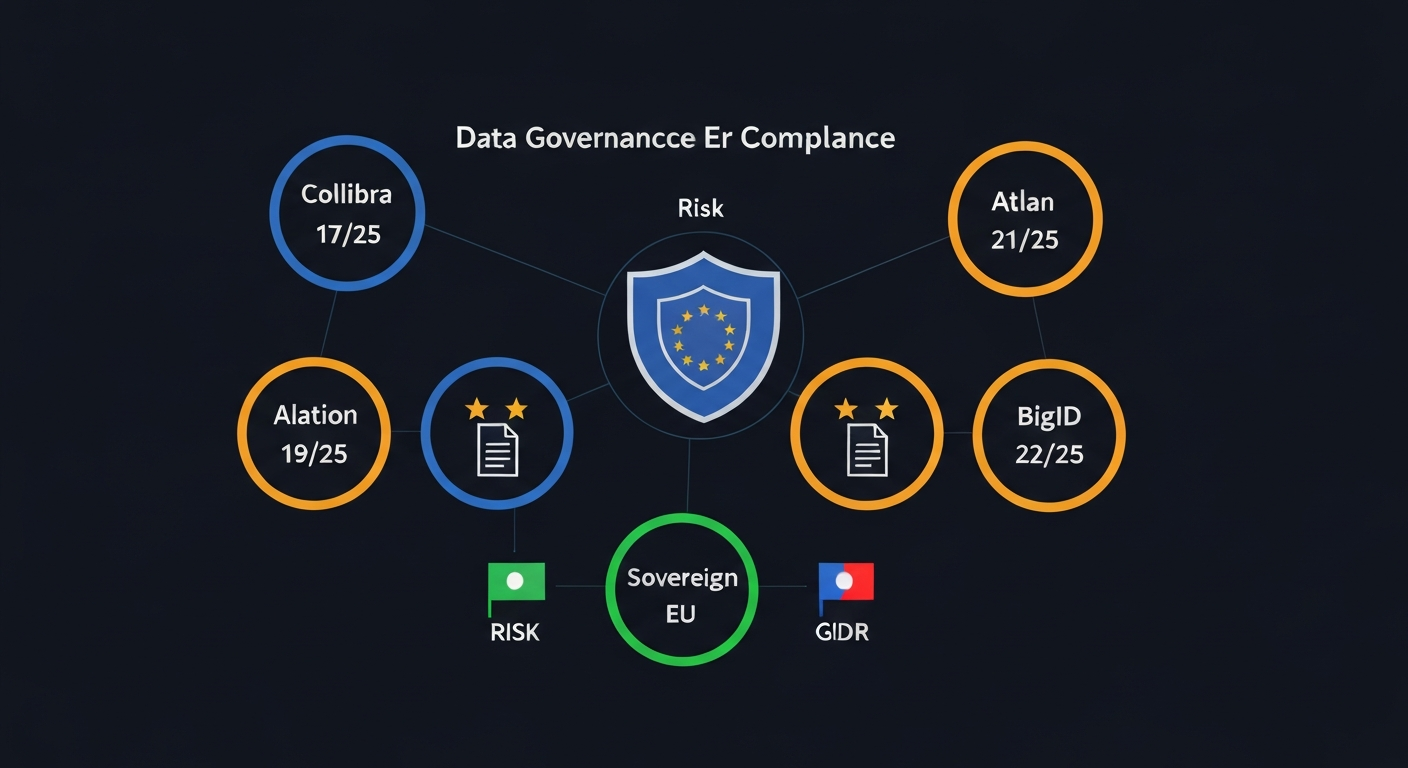
Every enterprise deploying a data governance platform does so to understand and control its data. Where does sensitive data live? Who can access it? What does GDPR Article 30 require you to document? How do you prove compliance with data minimisation, purpose limitation, and the right to erasure?
The four platforms in this series — Collibra, Alation, Atlan, and BigID — answer these questions. They build the map of your data estate. They classify your personal data, trace its lineage, document your processing activities, and generate the Records of Processing Activities that GDPR requires.
They are also Delaware C-Corporations (or controlled by one) under US CLOUD Act jurisdiction.
This creates what we call the Sovereignty Map Paradox: the tool you use to document your EU data sovereignty is itself the sovereignty risk. The intelligence a data governance platform accumulates about your data assets — where personal data resides, how it flows, who processes it, what classification labels it carries — is exactly the intelligence that US law enforcement could access under 18 U.S.C. § 2703. The CLOUD Act exposure payload of a data governance platform is the data map itself.
This finale closes the EU Data Governance Tools series. We score all four platforms against our five-dimension CLOUD Act exposure framework, identify the three meta-paradoxes unique to this category, and map the EU-native sovereign alternatives that European organisations can deploy without US jurisdictional exposure.
Why Data Governance Creates a Unique CLOUD Act Risk Category
Most CLOUD Act risk analyses focus on the sensitivity of data that an application processes. A payroll system processes salary data; a CRM processes customer contact information; a SIEM processes security event logs. The CLOUD Act risk is a function of what data the application stores.
Data governance platforms are structurally different. Their product value is derived from building intelligence about data across every other system in your organisation. A data catalog does not store patient records — it stores the catalog of where your patient records live, who can access them, what data quality scores they carry, and how they flow between systems. This meta-intelligence is simultaneously less sensitive than the underlying data and more dangerous: a CLOUD Act request against your EHR system yields patient records; a CLOUD Act request against your data catalog yields the complete map of your data estate.
This distinction matters for GDPR risk management in three ways:
GDPR Article 30 Records of Processing Activities (RoPA): GDPR Art.30 requires data controllers to maintain records of processing activities — purpose, categories of data, categories of recipients, retention periods, security measures. Data governance platforms generate and store these RoPA records. Under CLOUD Act compelled disclosure, US authorities receive not just your RoPA records but the underlying catalog data that generated them: data lineage maps, classification results, entitlement matrices, data flow diagrams.
GDPR Article 35 Data Protection Impact Assessments (DPIAs): DPIAs are required for high-risk processing activities. Data governance platforms store DPIA documentation, including identification of high-risk processing activities and their mitigating controls. This documentation tells US authorities which of your processing activities your own DPO assessed as highest risk.
GDPR Article 17 Right to Erasure: Compliance with erasure requests requires knowing where data lives — exactly what data governance platforms provide. BigID's automated erasure verification creates documented trails of which personal data was deleted and from which systems. These erasure evidence trails are themselves CLOUD Act-accessible.
The regulatory framework that creates demand for data governance platforms — GDPR's documentation and accountability requirements — also creates the documentation that maximises CLOUD Act disclosure payload.
CLOUD Act Exposure Matrix — All Four Vendors
| Dimension | Collibra | Alation | Atlan | BigID |
|---|---|---|---|---|
| D1: Corporate Jurisdiction | 3/5 | 5/5 | 5/5 | 5/5 |
| D2: Investor Dependencies | 4/5 | 4/5 | 5/5 | 5/5 |
| D3: Data Sensitivity | 5/5 | 4/5 | 4/5 | 5/5 |
| D4: Engineering & Infrastructure | 2/5 | 3/5 | 3/5 | 3/5 |
| D5: Technical Architecture | 3/5 | 3/5 | 4/5 | 4/5 |
| Total CLOUD Act Score | 17/25 | 19/25 | 21/25 | 22/25 |
Higher score = higher CLOUD Act risk. EU-native alternatives (DataGalaxy, Castor, OpenMetadata): 0/25.
The progressive disclosure pattern — 17→19→21→22 — is not coincidence. It reflects a structural relationship between AI capability and CLOUD Act exposure. The more intelligent the platform, the more comprehensive its intelligence about your data estate, and the higher the CLOUD Act disclosure payload:
- Collibra (17): Manual-first governance workflow with structured catalog. Belgian NV holding structure provides partial (but legally insufficient) EU corporate shelter. Lower D1 score reflects this partial mitigation.
- Alation (19): Behavioral analytics — query logs, stewardship intelligence, usage patterns — elevate the data sensitivity beyond pure catalog metadata. Full Delaware C-Corp, no corporate structure mitigation.
- Atlan (21): Active Metadata captures behavioral analytics, embedded AI conversations, and real-time collaboration on data assets. Singapore Pte. Ltd. + Delaware C-Corp dual structure adds D1 complexity without reducing CLOUD Act exposure. Cloud-only SaaS eliminates on-premises mitigation path (D5: 4/5).
- BigID (22): AI-native automated PII discovery creates the complete map of all personal data across all systems. Goldman Sachs Growth Equity's SIFI status amplifies D2. The Privacy Intelligence Paradox: the most sophisticated GDPR compliance tool carries the highest CLOUD Act score.
Vendor Profiles
Collibra — 17/25 (Lowest in Series)
The Belgian Paradox. Collibra was founded in Brussels, Belgium. Its holding entity, Collibra NV, is incorporated under Belgian law. Its operational entity, Collibra Inc., is a Delaware C-Corporation that runs the SaaS platform and controls customer data. The CLOUD Act applies to the entity that controls the data — Collibra Inc. (DE). Belgian NV incorporation at the holding level does not create a legal shield against US compelled disclosure.
This dual-entity structure generates the series' only D1 score below 5/5 (3/5): the Belgian holding creates genuine legal complexity that distinguishes Collibra from the pure-US-C-Corp vendors. It does not eliminate CLOUD Act exposure. It creates a legal ambiguity that would require litigation to resolve — the kind of ambiguity that sophisticated EU buyers can include in risk assessments as a partial mitigant, while understanding it is not a complete solution.
D4 Score (2/5): Collibra's default infrastructure routes data through AWS us-east-1 (Virginia). EU region deployment (AWS eu-central-1/Frankfurt) requires explicit enterprise-tier opt-in with contractual commitments on metadata residency — lineage graphs, search indexes, and quality scan results. Default configuration is the lowest-resistance path for new deployments, and the default exposes EU metadata to US infrastructure. Collibra's lower D4 score reflects this default-US-routing risk.
What Collibra holds: GDPR Art.30 RoPA records, data lineage maps, classification results, entitlement matrices, data quality scan outputs, and data stewardship workflow histories. The D3 score is 5/5 — maximum — because even without BigID-level automated PII discovery, Collibra's catalog of manually curated data assets represents the complete intelligence map of what data an organisation knows it has and where it lives.
Alation — 19/25
The Metadata Paradox. Alation does not store your data. It stores intelligence about your data: query logs capturing every SQL query run against every connected data source, behavioral analytics showing which analysts access which tables and when, stewardship assignments documenting who is responsible for which data assets, PII classification labels generated by the Alation catalog for every column in every connected database.
This metadata-about-data is the Metadata Paradox: Alation argues it does not hold your sensitive data, only metadata about it. The CLOUD Act operates on a different principle — metadata about data access patterns is itself sensitive intelligence. A CLOUD Act request against Alation yields: a complete map of which employees query which data sources, which data assets your organisation has classified as containing personal data, which stewards are responsible for which GDPR-relevant datasets, and the behavioral patterns of your data engineering team. This is actionable intelligence regardless of whether it includes the underlying customer records.
Investor Profile: Alation raised $123M Series D in 2021 with Salesforce Ventures and Tableau Software (Salesforce subsidiary) as strategic investors. Snowflake Ventures and Databricks also hold minority stakes from strategic partnership rounds. These are technology-ecosystem investors rather than PE or intelligence-adjacent, keeping D2 at 4/5 rather than 5/5.
On-premises option: Alation offers an on-premises deployment tier that allows organisations to run catalog infrastructure in their own data centres. This is a partial mitigation — it reduces CLOUD Act exposure for catalog metadata stored locally but does not address the corporate jurisdiction of Alation Inc. (Delaware). D5 scores 3/5 to reflect the on-premises option as a genuine (if incomplete) architectural mitigation.
Atlan — 21/25
The Singapore Paradox. Atlan operates through two legal entities: Atlan Pte. Ltd. (Singapore) and Atlan Inc. (Delaware C-Corporation). The Singapore entity is the founding entity; the Delaware C-Corp is the controlling entity that runs the SaaS platform. Singapore's Personal Data Protection Act (PDPA) is not the GDPR. PDPA provides adequacy-equivalent protections for data transfers from some jurisdictions but does not address CLOUD Act jurisdiction, which is determined by the corporate structure of the US entity, not the Singapore entity.
Atlan's "Singapore headquarters" framing in investor communications is technically accurate — Atlan was founded in Singapore, and the Pte. Ltd. entity exists. It does not reduce CLOUD Act exposure. The Delaware C-Corp structure gives US federal courts jurisdiction over data controlled by Atlan Inc. regardless of where the founding entity is incorporated.
Insight Partners + Sequoia (D2: 5/5): Atlan's Series B and C investors include Insight Partners (New York, $90B AUM) and Sequoia Capital (Menlo Park, flagship US VC). This is the series' highest D2 investor profile alongside BigID. Both Insight Partners and Sequoia maintain US institutional operations that create standard D2 amplification. No intelligence-adjacent relationships identified, but the concentration of US institutional capital at controlling-investor level warrants the maximum D2 score.
Active Metadata architecture (D3: 4/5, D5: 4/5): Atlan's product proposition is Active Metadata — not static catalog metadata but real-time behavioral data captured from data asset usage: which queries are run, which assets are viewed, what conversations happen in embedded Slack-like threads attached to data assets, what AI-generated recommendations are generated and acted upon. Active Metadata is richer than traditional catalog data but less than BigID's automated PII discovery: D3 scores 4/5. The cloud-only SaaS architecture (no on-premises option) eliminates the infrastructure mitigation path that Alation's on-premises tier provides, elevating D5 to 4/5.
BigID — 22/25 (Highest in Series)
The Privacy Intelligence Paradox. BigID is not a data catalog. BigID is an AI-native PII discovery platform that automatically scans every connected data source — structured databases, unstructured file shares, cloud object storage, email archives, collaboration tools — and builds a complete map of where personal data exists across your organisation. It discovers PII automatically, classifies it by data subject category, generates GDPR Art.30 Records of Processing Activities, manages DSAR fulfilment workflows, and creates erasure verification trails.
This comprehensive PII intelligence is BigID's product value. It is also the most dangerous CLOUD Act disclosure payload in the data governance category.
Goldman Sachs Growth Equity (D2: 5/5): Goldman Sachs Growth Equity is the US lead investor in BigID's later funding rounds. Goldman Sachs is designated as a Systemically Important Financial Institution (SIFI) under Dodd-Frank, subject to Federal Reserve oversight and US government coordination requirements that standard VC firms do not face. This SIFI amplification elevates D2 to 5/5 alongside Atlan — but with a qualitatively different risk profile: SIFI-supervised financial institutions operate under a broader US government regulatory umbrella than PE or VC firms.
D3: 5/5 — Maximum Sensitivity: BigID is the only platform in the series to score D3 at 5/5. The distinction is the automated, comprehensive, AI-driven nature of BigID's data discovery: Collibra holds the data map of what your organisation manually curated; BigID holds the data map of what AI scanning found that your organisation did not know it had. A CLOUD Act request against BigID yields not just your GDPR compliance documentation but the complete inventory of undisclosed or poorly-managed personal data that BigID's AI discovered in your systems — including legacy systems, forgotten file shares, and third-party-integrated data sources that your DPO may not have included in manual RoPA documentation.
D5: 4/5: BigID is cloud-first with limited on-premises options available only at Enterprise tier with significant deployment complexity. The cloud-first architecture, like Atlan, eliminates the infrastructure mitigation path for most customers.
The Three Meta-Paradoxes of EU Data Governance
These paradoxes are category-structural — they cannot be resolved by contractual adjustments from any individual vendor.
Paradox 1 — The Sovereignty Map Paradox
Data governance platforms are the only category of enterprise software whose primary product value is the systematic documentation of where data lives, what it contains, and who can access it. Every other software category processes data as a means to an end; data governance platforms create intelligence about data as the end itself.
This makes data governance platforms the highest-value CLOUD Act disclosure target in the enterprise software stack — not because of what they store (they don't store your customer records), but because of what they know (they know exactly where all your customer records live and what they contain). A CLOUD Act request against a data governance platform yields the complete intelligence briefing a regulator or law enforcement agency would need to identify, locate, and access any GDPR-covered data in your organisation.
The Sovereignty Map Paradox cannot be resolved by encrypting your customer records, deploying EU-region cloud infrastructure for operational systems, or implementing strict access controls on production databases — all the standard GDPR technical measures. As long as the map of those records sits with a US-incorporated vendor, US authorities can obtain the map under compelled disclosure and use it to direct subsequent legal proceedings.
Paradox 2 — The Compliance Evidence Paradox
GDPR creates affirmative documentation obligations: Art.30 RoPA records, Art.35 DPIAs, Art.33 breach notification records, Art.17 erasure verification trails. These compliance documents are not optional — GDPR requires organisations to maintain them and demonstrate them to supervisory authorities on request.
Data governance platforms generate and store these compliance documents. Under CLOUD Act compelled disclosure, US authorities receive the same compliance documentation that EU supervisory authorities are entitled to review under GDPR. The evidence your DPO maintains to demonstrate GDPR compliance becomes evidence in US proceedings — without the procedural protections of EU-to-EU supervisory cooperation, without GDPR Article 44 transfer mechanism requirements, and without notice to the data subjects whose personal data is documented in those records.
There is a further irony: your most thorough GDPR compliance documentation creates the most complete CLOUD Act disclosure. An organisation that has invested in comprehensive data governance — detailed RoPA entries for every processing activity, complete data lineage maps, well-maintained DSAR fulfilment records — has created a CLOUD Act disclosure payload that is proportional to the quality of its GDPR compliance effort.
Paradox 3 — The AI Discovery Inversion
The progressive CLOUD Act scores in this series — 17→19→21→22 — demonstrate a structural relationship between AI capability and CLOUD Act exposure. Collibra's manual governance workflow scores lowest because it knows only what your data stewards manually catalogued. BigID's AI-native discovery scores highest because it knows everything the AI found — including data your organisation did not know it had.
This creates the AI Discovery Inversion: the most capable AI data governance platforms are the most dangerous CLOUD Act exposure vectors. The value proposition of AI-driven data discovery — finding personal data you didn't know existed, classifying data at scale without manual curation, generating comprehensive PII inventories across legacy systems — is inseparable from the CLOUD Act risk it creates.
An organisation that deploys BigID to achieve comprehensive GDPR Art.30 documentation has simultaneously created the most complete intelligence map of its personal data under US CLOUD Act jurisdiction. The more thoroughly BigID discovers and classifies your personal data, the more valuable the CLOUD Act disclosure becomes.
AI-native data governance is not a compliance shortcut. For European organisations, it is a compliance-sovereignty trade-off: automated AI discovery of EU personal data, stored as intelligence in US-controlled infrastructure.
EU-Native Sovereign Alternatives
All four vendors in this series scored 0/25 on the CLOUD Act risk framework from European alternatives. These platforms have no US corporate structure, no US investor control, and no dependency on US cloud infrastructure.
DataGalaxy (France) — 0/25
DataGalaxy SAS is incorporated in Bordeaux, France. Backed by Bpifrance (the French public investment bank), Revaia (formerly Gaia Capital Partners, EU growth equity), and other European institutional investors. No US investor board representation. Cloud infrastructure: OVHcloud (FR) and AWS EU-West regions under DataGalaxy SAS as French data controller. Revenue reported at €10-15M ARR (2024), primarily French and EU enterprise customers.
Capabilities: Data catalog and business glossary with collaborative governance workflows. Data lineage tracking across connected systems. GDPR Art.30 RoPA generation. Data quality scoring and issue management. Workflow automation for data governance processes.
CLOUD Act assessment: DataGalaxy SAS has no US corporate structure. No US investor holds board representation or control rights. OVHcloud primary infrastructure is under EU jurisdiction (French data controller). CLOUD Act risk: structural 0/25. French data sovereignty framework (RGPD + ANSSI SecNumCloud) applies.
Limitation vs US vendors: DataGalaxy's AI-assisted classification and automated PII discovery capabilities are less mature than BigID's AI-native offering. For organisations requiring automated discovery at BigID scale, DataGalaxy requires more manual data stewardship effort.
Castor (Netherlands) — 0/25
Castor is incorporated in Amsterdam, Netherlands (EU Member State). Focused on data catalog and metadata management for analytics-heavy organisations — particularly data engineering and data science teams using modern data stack tooling (dbt, Airflow, Snowflake, BigQuery, Databricks). EU-based VC backing. Primary cloud infrastructure in EU regions.
Capabilities: Automated data catalog built around the modern data stack. dbt-native lineage (extracts lineage from dbt manifest files automatically). Column-level lineage tracking. AI-assisted documentation suggestions. Slack and collaboration tool integrations for data asset context. GDPR metadata tagging workflow.
CLOUD Act assessment: Dutch BV incorporation, no US parent entity, EU-based investor structure. CLOUD Act risk: structural 0/25. Subject to Dutch national data protection law and GDPR under EU regulatory jurisdiction.
Limitation vs US vendors: Castor is optimised for modern data stack environments. Organisations running legacy data warehousing, mainframe-connected systems, or Oracle-heavy environments may find coverage gaps compared to Collibra's or Alation's enterprise connectors. Governance workflow automation is less mature than Collibra's full policy and stewardship workflow engine.
OpenMetadata (Apache OSS) — 0/25
OpenMetadata is an Apache-licensed open-source data catalog and governance platform. Initially developed by Collate (a US company), OpenMetadata's governance model is the Apache Software Foundation — a US non-profit whose technical governance is community-driven and license-based rather than corporate. The codebase is open source under Apache 2.0; European organisations self-hosting OpenMetadata have no external corporate data controller.
Capabilities: Comprehensive metadata catalog with 80+ connectors. Column-level lineage. Data quality framework. ML metadata management. Role-based access control for governance workflows. GDPR classification tagging. Self-hosted deployment with full data residency control.
CLOUD Act assessment: Self-hosted OpenMetadata operates under the EU organisation's own corporate structure and jurisdiction. No vendor corporate entity has access to catalogued metadata. CLOUD Act risk: 0/25 by structural architecture — no US entity controls your data governance intelligence. Collate (the primary commercial backer) is a US company but does not have access to self-hosted customer data.
Limitation vs US vendors: Requires internal deployment and operational overhead. No managed SaaS offering with the same GDPR-safe profile — Collate's cloud offering introduces US corporate risk. Enterprise support requires Collate engagement. Automated PII discovery (equivalent to BigID) is available through integration with open-source classification engines (e.g., Piiano Vault, OpenDP) rather than native AI.
Ataccama (Czech Republic) — 2/25
Ataccama is incorporated in Prague, Czech Republic (EU Member State). Primary investor: Ardian (Paris-based private equity, one of Europe's largest PE firms). Ataccama operates a US sales subsidiary (Ataccama USA Inc.), generating a minor D1/D2 exposure score of 2/25 — the only EU-headquartered vendor in any series to carry a non-zero CLOUD Act score, reflecting the US subsidiary structure without US-controlled governance.
Capabilities: Enterprise data management platform covering data catalog, data quality, master data management (MDM), and data governance. More comprehensive than pure-catalog solutions — Ataccama competes with both Collibra (governance) and Informatica (data quality and MDM). Strong European enterprise customer base in financial services and healthcare.
CLOUD Act assessment: Czech BV primary jurisdiction, Ardian (FR) PE governance. US subsidiary carries minor CLOUD Act exposure for data processed through US subsidiary operations. D1 and D2 partial scores only: 2/25 total. Materially lower CLOUD Act risk than any of the four US vendors (17/25 minimum), while offering more comprehensive governance functionality than DataGalaxy or Castor.
Best fit: Organisations requiring enterprise MDM + data quality + governance in an EU-sovereignty-compliant stack. Ataccama's 2/25 CLOUD Act score reflects a EU-primary company with minor US presence — a materially different risk profile from Delaware C-Corps scoring 17-22/25.
Decision Framework for EU CISOs and DPOs
| Requirement | Recommended Sovereign Path | CLOUD Act Score |
|---|---|---|
| Modern data stack catalog (dbt, Airflow) | Castor (NL) | 0/25 |
| Self-hosted governance with full control | OpenMetadata (OSS, self-hosted) | 0/25 |
| Collaborative governance workflow + French ecosystem | DataGalaxy (FR) | 0/25 |
| Enterprise governance + data quality + MDM | Ataccama (CZ) | 2/25 |
| If US vendor required (lowest risk) | Collibra (17/25, Belgian NV partial mitigation, EU-region opt-in) | 17/25 |
| If US vendor required (broadest catalog, US metadata risk) | Alation (19/25) | 19/25 |
| Avoid for EU-sovereign deployments | Atlan (21/25), BigID (22/25) | 21-22/25 |
The AI Capability Trade-off: EU-native alternatives lag behind BigID's AI-native PII discovery in automation capability. For organisations with mature data stewardship teams capable of manual curation, DataGalaxy or Castor provide full governance coverage with 0/25 CLOUD Act risk. For organisations requiring automated PII discovery at scale across legacy and cloud-native systems, the EU-native options require supplementary tooling (open-source classification engines, custom ETL pipelines) to match BigID's automation level. The GDPR compliance benefit of comprehensive automated PII discovery must be weighed against the CLOUD Act risk of storing that discovery intelligence with a Delaware C-Corp.
The Collibra Fallback: If a US vendor is required — due to existing enterprise contracts, specific connector requirements, or feature gaps in EU-native alternatives — Collibra's Belgian NV structure (17/25, lowest in series) provides the most legal complexity for potential CLOUD Act compelled disclosure and the clearest path to EU-region data residency with explicit contractual metadata residency commitments. It is not a sovereign solution; it is the least-risky US-vendor option.
Series Summary: EU-DATA-GOVERNANCE-TOOLS
| Vendor | Jurisdiction | CLOUD Act Score | Series Position |
|---|---|---|---|
| Collibra | Belgium NV / Delaware Inc. | 17/25 | Lowest US exposure |
| Alation | Delaware C-Corp | 19/25 | Metadata intelligence risk |
| Atlan | Singapore Pte. / Delaware Inc. | 21/25 | Singapore Paradox |
| BigID | Delaware C-Corp | 22/25 | Maximum exposure — AI Discovery Inversion |
| DataGalaxy | France (SAS) | 0/25 | Sovereign alternative |
| Castor | Netherlands (BV) | 0/25 | Modern data stack sovereign |
| OpenMetadata | Apache OSS (self-hosted) | 0/25 | Maximum sovereignty, self-hosted |
| Ataccama | Czech Republic | 2/25 | EU-primary, minor US subsidiary |
The EU-DATA-GOVERNANCE-TOOLS series demonstrates a principle that extends beyond data governance to the entire enterprise software stack: the more intelligent and automated a US-controlled platform becomes, the higher its CLOUD Act exposure for European deployments. AI-native platforms create intelligence payloads that manual tools do not. The regulatory mandate driving organisations to deploy more sophisticated data governance — GDPR's accountability and documentation requirements — creates the commercial demand that drives AI capability investment by US vendors, which creates higher CLOUD Act exposure.
European organisations have a structural choice: deploy EU-native platforms at a capability trade-off, self-host open-source tooling with engineering investment, or accept the CLOUD Act exposure of US-controlled AI-native platforms as a calculated risk alongside GDPR SCCs and EU-region infrastructure commitments. None of these positions eliminates EU data governance risk entirely. Understanding the trade-off — rather than accepting vendor marketing at face value — is the beginning of EU data sovereignty compliance.
This analysis applies the five-dimension CLOUD Act exposure framework: D1 Corporate Jurisdiction, D2 Investor Dependencies, D3 Data Sensitivity, D4 Engineering & Infrastructure, D5 Technical Architecture. Scores represent structural CLOUD Act exposure risk, not regulatory compliance status. EU-native alternatives receive 0/25 by structural analysis — absence of US corporate structure, US investor control, and US infrastructure dependency.
Previous posts in this series: Collibra · Alation · Atlan · BigID
EU-Native Hosting
Ready to move to EU-sovereign infrastructure?
sota.io is a German-hosted PaaS — no CLOUD Act exposure, no US jurisdiction, full GDPR compliance by design. Deploy your first app in minutes.