EU AI Act vs UK AI Framework 2026: Side-by-Side Compliance Comparison for SaaS Developers
Post #1401 in the sota.io EU AI Compliance Series — EU-AI-ACT-INTERNATIONAL-COMPLIANCE-2026 #3/5
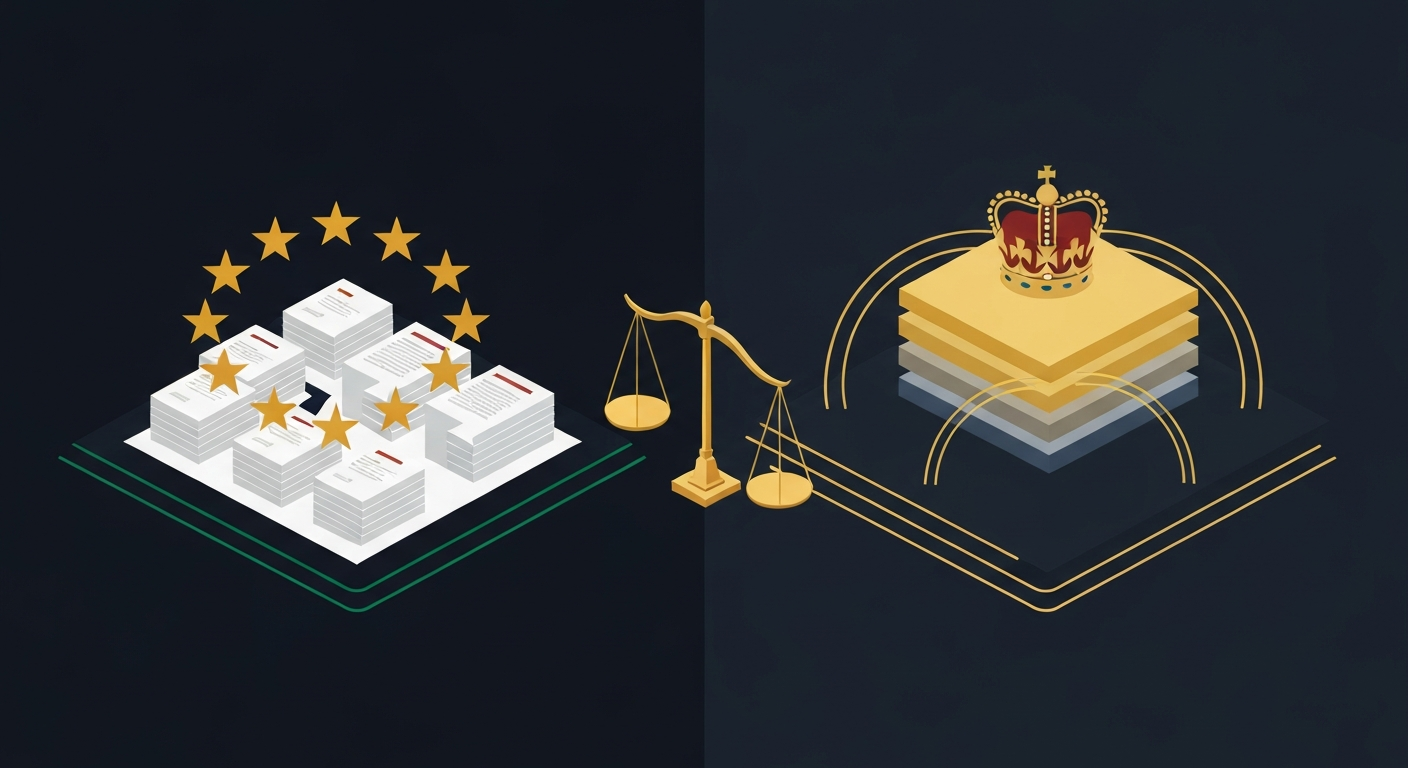
If your organisation operates in both EU and UK markets — or if you are a UK-based SaaS company serving EU customers — you face a specific compliance challenge in 2026: two fundamentally different regulatory philosophies applied to the same AI systems.
The EU AI Act is a horizontal regulation with binding legal obligations, specific articles, CE marking requirements, and fines of up to €30 million or 6% of global turnover. The UK has taken a deliberate opposite approach: a pro-innovation, sector-led, principle-based framework that avoids a single AI Act entirely.
This guide maps the UK AI framework principles against the EU AI Act provider obligations that apply to high-risk AI systems. The practical question for dual-market SaaS developers: can UK compliance work serve as a foundation for EU AI Act readiness, and where are the legal gaps that UK principles cannot close?
The EU AI Act enforcement deadline is August 2, 2026.
The UK's Pro-Innovation AI Approach
In March 2023, the UK government published "A Pro-innovation Approach to AI Regulation" — deliberately rejecting the horizontal legislation approach taken by the EU. The framework rests on five cross-sector AI principles that existing regulators apply within their current remit:
| Principle | Description | UK Regulator Examples |
|---|---|---|
| Safety, Security, and Robustness | AI systems should function securely and not pose unacceptable safety risks | FCA, CMA, MHRA, HSE |
| Appropriate Transparency and Explainability | Stakeholders should be able to understand AI decisions | ICO, FCA, Ofcom |
| Fairness | AI systems should not undermine equal treatment or create unlawful discrimination | Equality and Human Rights Commission, ICO |
| Accountability and Governance | Clear ownership and governance structures for AI systems | FCA, ICO, CMA |
| Contestability and Redress | Affected parties should be able to challenge AI decisions and seek redress | Courts, Ombudsman, ICO |
The UK approach intentionally avoids creating new legislation or a new regulator. Instead, the ICO applies AI principles to data protection, the FCA applies them to financial services AI, Ofcom to communications, and so on. The Digital Regulation Cooperation Forum (DRCF) coordinates cross-sector consistency.
The AI Safety Institute (AISI), established in November 2023 and subsequently renamed the AI Security Institute (DSIT), focuses specifically on frontier AI model safety — a different scope to the EU AI Act's high-risk application classification.
Framework Architecture Comparison
Before diving into specific obligation mapping, understanding the structural difference is critical:
| Dimension | EU AI Act | UK AI Framework |
|---|---|---|
| Legal nature | Binding regulation (enforceable law) | Voluntary principles (non-binding) |
| Structure | Horizontal, single regulation | Sector-led, existing regulators |
| Scope | All AI systems in EU market | AI in UK-regulated sectors |
| High-risk classification | Annex III list (specific applications) | No equivalent classification |
| Provider obligations | Specific articles (Art.9–17, Art.49, Art.73) | Principles applied contextually |
| Conformity assessment | Mandatory (Art.43) for high-risk AI | No mandatory assessment process |
| EU Database registration | Mandatory (Art.49) | No equivalent |
| CE marking | Required for EU market | Not required |
| Fines | Up to €30M / 6% turnover | Sector-specific (not AI-specific) |
| Frontier AI focus | GPAI provisions (Title VIII) | Primary AISI/DSIT focus |
| Post-market monitoring | Mandatory (Art.72, Art.73) | Recommended, not mandated |
The fundamental difference: EU AI Act compliance is verifiable — you either have the technical documentation, the conformity assessment, and the registration, or you do not. UK AI framework compliance is contextual — regulators assess whether you embedded the principles in a proportionate way.
Mapping UK Principles to EU AI Act Obligations
UK Principle 1: Safety, Security, and Robustness
Where it maps to EU AI Act:
The EU AI Act encodes safety requirements across multiple articles with specific deliverables:
- Art.9 Risk Management System: You must establish and document a risk management system identifying known and reasonably foreseeable risks, estimating and evaluating those risks, and identifying risk mitigation measures. The system must operate on an ongoing basis. The UK principle addresses "safety" but does not require this specific documented process.
- Art.15 Accuracy, Robustness, and Cybersecurity: High-risk AI systems must achieve appropriate levels of accuracy and remain resilient to errors, faults, and adversarial inputs. The regulation requires specific accuracy metrics and resilience testing evidence to be documented in technical documentation.
The gap:
UK regulators apply the safety principle contextually — what FCA considers adequate for credit-scoring AI differs from what MHRA requires for medical AI. The EU AI Act's Art.9 requires the same documented risk management system format regardless of sector. If you have a sector-specific safety assessment under UK requirements, it likely does not produce the artefacts (risk register, mitigation documentation, residual risk assessment) that Art.9 demands.
UK Principle 2: Appropriate Transparency and Explainability
Where it maps to EU AI Act:
- Art.13 Transparency and Provision of Information: Providers of high-risk AI systems must ensure systems are designed so that deployers can interpret outputs and use them appropriately. The regulation specifies information that must be provided in instructions for use, including system purpose, performance levels, known limitations, data requirements, and human oversight measures.
- Art.50 Transparency for GPAI and Chatbots: For AI systems that interact directly with natural persons, providers must ensure those persons are informed they are interacting with an AI system (unless obvious from context).
The gap:
The UK transparency principle is principle-based — ICO guidance on explainability under UK GDPR covers automated decision-making, but does not specify the content format for AI system instructions for use. Art.13 requires specific structured documentation that your UK transparency programme likely does not produce in the required form.
UK Principle 3: Fairness
Where it maps to EU AI Act:
- Art.10 Data and Data Governance: The EU AI Act requires training data to be relevant, representative, sufficiently free of errors, and appropriate for the intended purpose. Providers must implement data governance practices including examination of biases that could affect health, safety, or fundamental rights, with particular requirements for special-category personal data.
The gap:
UK fairness guidance (primarily from the ICO and Equality and Human Rights Commission) focuses on equalities law and data protection. The EU AI Act's Art.10 imposes specific data governance documentation obligations — bias examination logs, dataset curation records, and representativeness assessments — that go beyond equalities compliance. An equalities impact assessment does not satisfy Art.10.
UK Principle 4: Accountability and Governance
Where it maps to EU AI Act:
- Art.17 Quality Management System: Providers of high-risk AI systems must implement a documented quality management system covering AI policy, procedures for conformity assessment, data management, risk management, post-market monitoring, incident reporting, and product change management.
- Art.11 Technical Documentation: Providers must maintain comprehensive technical documentation demonstrating conformity with all applicable requirements.
The gap:
UK governance requirements are sector-specific. FCA regulated firms have governance obligations for model risk management (through the Senior Managers and Certification Regime and relevant supervisory statements); ICO-regulated organisations have privacy governance obligations. Neither produces the specific quality management system artefacts that Art.17 mandates, nor the technical documentation in the format Annex IV specifies.
UK Principle 5: Contestability and Redress
Where it maps to EU AI Act:
- Art.26 Deployer Obligations: Deployers (not providers) must implement human oversight measures and allow affected persons to request explanation and challenge decisions where the regulation requires.
- Art.14 Human Oversight: High-risk AI systems must be designed and developed to be effectively overseen by natural persons during the period of use, including the ability to interrupt, stop, or override the system.
The gap:
The EU AI Act's approach to contestability is embedded in the technical design requirements for providers (Art.14) and operational requirements for deployers (Art.26). UK contestability principles operate through existing legal channels (courts, ombudsman, sector-specific complaints procedures). As a provider, your obligation under Art.14 is to build the override and interruption capabilities into the system itself — not just to point users at a complaints procedure.
EU AI Act Obligations with No UK Equivalent
These are requirements under the EU AI Act for which the UK pro-innovation framework has no equivalent mechanism:
Conformity Assessment (Art.43)
High-risk AI systems must undergo a conformity assessment procedure before being placed on the EU market. For most Annex III applications, providers can conduct an internal conformity assessment based on a quality management system. Some applications (biometric identification, critical infrastructure) require third-party assessment by a notified body.
UK equivalent: None. UK market entry for AI systems does not require any conformity assessment procedure.
EU Database Registration (Art.49)
Before placing a high-risk AI system on the EU market, providers must register the system in the EU database established under Art.71. The database is publicly accessible.
UK equivalent: None. There is no equivalent AI system registry in the UK.
CE Marking
High-risk AI systems must carry CE marking confirming compliance with the EU AI Act and other applicable directives. The CE marking declares conformity to the EU single market.
UK equivalent: UK Conformity Assessed (UKCA) marking exists but applies to product safety under separate UK product legislation — there is no AI-specific UKCA requirement.
Incident Reporting (Art.73)
Providers must report serious incidents to the relevant national competent authority. The timelines are specific: initial notification within 2 working days of becoming aware of a life-threatening incident, 15 days for other serious incidents.
UK equivalent: Sector-specific incident reporting (FCA, Ofcom, ICO) may apply to AI-related incidents but is not AI-Act-equivalent. No unified AI incident reporting obligation exists.
Post-Market Monitoring (Art.72)
Providers must implement a post-market monitoring system that actively collects and reviews data on the operation of high-risk AI systems, feeding into the quality management system and risk management process.
UK equivalent: UK regulators recommend post-deployment monitoring but do not mandate the specific system Art.72 describes.
Where Existing UK Work Can Help EU Compliance
Despite the structural differences, UK-regulated companies often have compliance investments that reduce EU AI Act implementation effort:
| UK Programme | EU AI Act Benefit | Remaining Gap |
|---|---|---|
| ICO AI Auditing Framework | Demonstrates data governance thinking (Art.10) | Does not produce Art.10 documentation artefacts |
| FCA AI model risk management | Risk assessment foundation (Art.9) | Does not produce Art.9 continuous risk management system |
| DRCF algorithmic transparency guidelines | Supports Art.13 instructions for use | Different format — needs restructuring |
| ISO 27001 certification | Supports Art.15 cybersecurity requirements | Does not address AI-specific accuracy and robustness |
| Senior Managers regime accountability maps | Supports Art.17 governance documentation | Does not produce the QMS Art.17 requires |
| EHRC equalities assessments | Supports Art.10 bias examination | Different scope and format |
The Dual-Market Reality: Operating in Both UK and EU
For SaaS companies operating in both markets, the compliance calculus works as follows:
EU AI Act compliance is the higher bar — every EU-compliant system is also UK-compliant (you have exceeded the principle-based requirements). The reverse is not true.
You cannot achieve EU AI Act compliance by demonstrating UK framework adherence. The EU will not accept a "we comply with UK principles" argument as a substitute for missing technical documentation, absent conformity assessment, or no database registration.
Strategic recommendation: Build your AI governance programme to EU AI Act standard as the baseline. Layer UK regulatory engagement (sector regulator guidance, DRCF reporting) on top. The marginal cost of doing this versus building separate UK and EU programmes is low, and EU AI Act compliance is the more formally verifiable outcome.
30-Item Dual-Compliance Checklist: EU AI Act + UK AI Framework
Foundation (Both Frameworks)
- 1. AI system inventory documented with purpose, deployment context, and intended user population
- 2. High-risk classification assessment completed (EU AI Act Annex III; UK sector-regulator guidance)
- 3. Responsible AI governance owner appointed with documented accountability
- 4. Internal AI ethics / review committee or equivalent established
- 5. AI system change management process defined and documented
Data Governance (EU Art.10 + UK Fairness Principle)
- 6. Training dataset provenance documented (sources, collection methodology, curation process)
- 7. Representativeness assessment completed for each high-risk use case
- 8. Bias examination conducted for all protected characteristics relevant to use case
- 9. Data quality metrics tracked and logged throughout training pipeline
- 10. Special-category data handling documented with lawful basis and derogation assessment
Risk Management (EU Art.9 + UK Safety Principle)
- 11. Risk management system documented covering identification, estimation, evaluation, and mitigation
- 12. Known risks enumerated for each deployment context and user population
- 13. Residual risk assessed and accepted or mitigated with evidence
- 14. Risk management system reviewed after each material system change
- 15. Pre-deployment risk review sign-off process defined and followed
Technical Documentation (EU Art.11 + UK Accountability Principle)
- 16. Technical documentation in Annex IV format maintained for each high-risk system version
- 17. System architecture, model architecture, and training methodology documented
- 18. Accuracy, robustness, and cybersecurity testing results documented (Art.15)
- 19. Human oversight interface and override capability described and tested
- 20. Instructions for use prepared covering all Art.13 required content fields
Quality Management System (EU Art.17 + UK Accountability Principle)
- 21. QMS documented covering all Art.17 required elements
- 22. Post-market monitoring plan established with data collection and review procedures
- 23. Internal audit cadence for AI system performance against documented specifications
- 24. Product change and version management process linked to documentation updates
Conformity and Registration (EU-Specific)
- 25. Conformity assessment procedure identified and completed (internal or third-party per Art.43)
- 26. EU declaration of conformity drafted and signed by authorised representative
- 27. CE marking affixed to documentation and accompanying materials
- 28. EU database registration completed before market placement (Art.49)
Incident Response (EU Art.73 + UK Sector-Regulator Requirements)
- 29. Incident classification criteria defined distinguishing serious incidents from operational issues
- 30. Incident reporting workflow established with 2-day (life-threatening) and 15-day (other serious incident) notification paths to relevant national competent authority
What UK Businesses Must Do Before August 2, 2026
If you are a UK-based SaaS company selling to EU customers, the EU AI Act applies to you. Jurisdiction is determined by where the AI system is used, not where the provider is incorporated. A UK provider placing a high-risk AI system on the EU market must comply with all EU AI Act provider obligations.
The practical steps:
-
Map your EU customer base to identify which systems are used by EU persons in EU member states. These are in scope.
-
Classify your systems under Annex III. If any system falls into a listed high-risk category, EU AI Act provider obligations apply immediately.
-
Appoint an EU authorised representative (required if you have no EU establishment) to interface with EU national competent authorities.
-
Build EU-standard documentation for each in-scope system. Do not rely on UK framework compliance work — it does not produce the required artefacts.
-
Register in the EU database and obtain CE marking before you next update or re-release any high-risk system to EU customers.
The Strategic Opportunity
The UK's pro-innovation approach creates a differentiation opportunity for EU-compliant SaaS companies marketing into the UK. If you have invested in EU AI Act compliance — technical documentation, risk management system, conformity assessment — you can credibly demonstrate to UK enterprise buyers that your AI governance exceeds the domestic baseline.
Large UK enterprises (especially those with EU operations, FCA-regulated entities, NHS suppliers, and public sector contractors) are increasingly requesting evidence of AI governance maturity as part of procurement. EU AI Act compliance documentation provides exactly the governance evidence they need.
The argument to UK buyers: "We are EU AI Act compliant, which means our AI systems have been through mandatory risk management, conformity assessment, and technical documentation processes that no UK regulation requires of our competitors."
Summary
The EU AI Act and UK AI framework represent fundamentally different regulatory philosophies: mandatory legal obligations versus voluntary principles. UK framework compliance cannot substitute for EU AI Act obligations — the specific artefacts, processes, and registrations required by the EU regulation simply do not exist in the UK approach.
For SaaS developers operating in both markets:
- Build to EU AI Act standard — it is the higher, more formally verifiable bar
- Layer UK regulatory engagement on top (sector-specific guidance, regulator relationships)
- Do not assume UK compliance translates to EU readiness — it provides useful foundations but not required outputs
- Register in the EU database and obtain CE marking before August 2, 2026 for any high-risk system with EU users
The enforcement deadline is fixed. The 30-item checklist above covers both frameworks. Start with the EU AI Act requirements — they are specific enough to execute against — and your UK compliance will follow naturally.
Post #1401 in the sota.io EU AI Compliance Series. Previous: EU AI Act vs ISO 42001 | Next: EU AI Act vs Singapore AI Governance Framework (coming soon).
EU-Native Hosting
Ready to move to EU-sovereign infrastructure?
sota.io is a German-hosted PaaS — no CLOUD Act exposure, no US jurisdiction, full GDPR compliance by design. Deploy your first app in minutes.