EU AI Act vs ISO 42001: AI Management System Compliance Mapping for SaaS Developers 2026
Post #1400 in the sota.io EU AI Compliance Series — EU-AI-ACT-INTERNATIONAL-COMPLIANCE-2026 #2/5
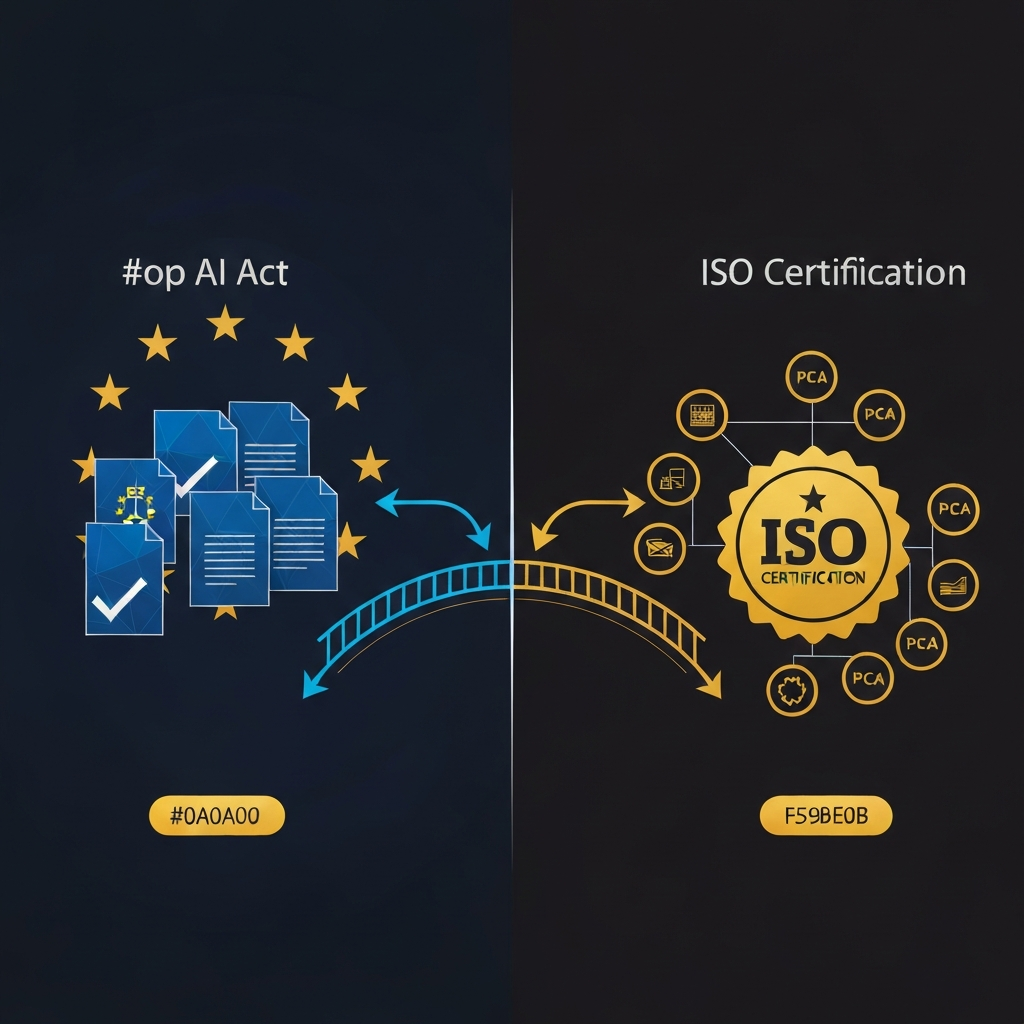
If your organisation is pursuing ISO/IEC 42001:2023 certification — or already holds it — you face a specific question heading into August 2026: how much of your ISO 42001 management system satisfies EU AI Act requirements, and where are the legal gaps that a voluntary standard cannot close?
This guide maps every ISO 42001 clause and Annex A control against the EU AI Act provider obligations that apply to high-risk AI systems. The short answer: ISO 42001 provides the strongest management-system foundation of any international AI standard, but the EU AI Act imposes mandatory legal obligations — conformity assessment procedures, CE marking, EU database registration, and post-market reporting — that fall entirely outside the scope of any ISO certification.
The enforcement deadline is August 2, 2026. That is 63 days away as of this writing.
What ISO/IEC 42001:2023 Actually Is
ISO/IEC 42001 (published December 2023) is the first international management system standard for artificial intelligence. Think of it as the AI counterpart to ISO 27001 for information security: it provides a Plan-Do-Check-Act framework for governing AI development and deployment across an organisation.
The standard follows the ISO Annex SL high-level structure, covering ten clauses:
| Clause | Topic | What It Requires |
|---|---|---|
| 4 | Context of the organisation | Understand internal/external factors, interested parties, AI system scope |
| 5 | Leadership | AI policy, top management commitment, roles and responsibilities |
| 6 | Planning | AI objectives, risk assessment, AI impact assessment planning |
| 7 | Support | Resources, competence, awareness, communication, documentation |
| 8 | Operation | AI system lifecycle implementation, data management, testing, deployment |
| 9 | Performance evaluation | Monitoring, internal audit, management review |
| 10 | Improvement | Nonconformity, corrective action, continual improvement |
The normative Annex A provides 38 controls organised across nine sections (A.2 to A.10), covering AI policies, organisational roles, resource management, impact assessments, system lifecycle management, data governance, deployer information, organisational AI use, and third-party AI relationships.
What ISO 42001 Does NOT Cover
ISO 42001 is a voluntary management system standard. It does not:
- Prescribe the legal classification of your AI system (prohibited/general-purpose/high-risk)
- Mandate specific conformity assessment procedures with notified bodies
- Require registration in the EU AI database
- Specify CE marking requirements
- Define reporting timelines for incidents to national competent authorities
- Create enforceable rights for affected persons
These are EU AI Act requirements that exist entirely outside the ISO 42001 scope.
EU AI Act Provider Obligations: The Legal Baseline
Under the EU AI Act, a provider is any natural or legal person that develops a high-risk AI system or GPAI model and places it on the EU market. Provider obligations for high-risk AI systems include:
| Obligation | Article | What It Requires |
|---|---|---|
| Risk management system | Art.9 | Continuous, documented risk identification and mitigation throughout lifecycle |
| Data governance | Art.10 | Training/validation/testing data practices, bias examination, special categories handling |
| Technical documentation | Art.11 | Comprehensive technical file before market placement (Annex IV) |
| Record-keeping | Art.12 | Automatic logging of system operation (where technically feasible) |
| Transparency to deployers | Art.13 | Instructions for use, intended purpose, performance metrics, limitations |
| Human oversight measures | Art.14 | Monitoring capabilities, override mechanisms, stop functions |
| Accuracy and robustness | Art.15 | Documented performance thresholds, cybersecurity measures |
| Quality management system | Art.17 | QMS covering design, development, post-market (Annex IX scope) |
| Conformity assessment | Art.43 | Self-assessment (Annex VI) or third-party notified body (Annex VII) |
| EU declaration of conformity | Art.47 | Signed declaration before market placement |
| CE marking | Art.48 | Affix CE mark on system and/or documentation |
| Registration | Art.49 | Register in EU AI database before placement on market |
| Post-market monitoring | Art.72 | Systematic data collection plan, proactive monitoring |
| Serious incident reporting | Art.73 | Report to NCAs within 2/10/15 calendar days depending on severity |
Side-by-Side Mapping: ISO 42001 → EU AI Act
Clause 4: Context → Art.9 Risk Management Foundation
ISO 42001 §4 requires organisations to determine internal and external factors that affect their ability to achieve AIMS objectives, identify interested parties, and define the scope of the AI management system.
EU AI Act Art.9 requires a risk management system that is an iterative, continuous process throughout the entire lifecycle of a high-risk AI system.
Mapping quality: STRONG PARTIAL (70%)
ISO 42001 §4 context analysis provides an excellent foundation for the Art.9 risk register and stakeholder analysis. However, the EU AI Act requires more specific outputs:
- Risk management documentation must address the specific risks listed in Annex III (biometric identification, critical infrastructure, education, employment, essential services, law enforcement, migration, justice)
- Risk assessment must cover risks to fundamental rights (not just operational risks)
- Residual risk documentation must align with what will appear in the Annex IV technical file
Gap: ISO 42001 does not require an Annex III classification decision or a fundamental rights impact assessment.
Clause 5: Leadership → Provider Accountability Structure
ISO 42001 §5 requires top management to demonstrate leadership by establishing an AI policy, ensuring AIMS integration into business processes, and assigning roles/responsibilities.
EU AI Act is silent on internal governance structure but places liability on the legal entity that places the system on the market (typically the company, not individual roles).
Mapping quality: STRONG (85%)
The ISO 42001 leadership clause maps well to the EU AI Act's provider definition. An organisation with a functioning AI policy, defined roles, and management commitment has the governance foundation needed for EU AI Act compliance.
Gap: ISO 42001 §5 does not require designation of an EU representative if the provider is established outside the EU (Art.22 obligation). Non-EU SaaS companies must name an EU-established representative regardless of their ISO 42001 implementation status.
Clause 6: Planning → Art.9 + Art.17 QMS Design Phase
ISO 42001 §6 requires the organisation to address risks and opportunities, establish AI objectives, and plan how to achieve them.
EU AI Act Art.9 requires a risk management system that includes: risk identification and analysis, risk evaluation against specific criteria, and adoption of risk management measures.
EU AI Act Art.17 requires a Quality Management System covering design, development, production, and post-market phases.
Mapping quality: GOOD (75%)
ISO 42001 §6 planning activities map directly to the Art.17 QMS design phase requirements. The planning outputs (risk assessment results, AI objectives, action plans) correspond to the QMS documentation requirements in Art.17 §1.
Gap: The EU AI Act Art.17 §1 specifies explicit QMS components including strategies and procedures for conformity assessment compliance, post-market monitoring systems, and human oversight measures — which are more prescriptive than ISO 42001's planning requirements.
Clause 7: Support → Art.11 Technical Documentation (Partial)
ISO 42001 §7 covers resources, competence, awareness, communication, and documented information requirements.
EU AI Act Art.11 requires technical documentation in accordance with Annex IV to be drawn up before market placement and kept up to date.
Mapping quality: PARTIAL (45%)
ISO 42001 §7 documentation requirements cover AIMS-related processes and decisions. Some of this (design documentation, testing records, decision logs) can contribute to the Art.11 technical file.
Gap: Annex IV requires very specific documentation categories that go significantly beyond ISO 42001's documentation requirements:
- Description of intended purpose with specific use cases
- Interaction with hardware/software components
- Design specifications (algorithmic logic, model type, training data description)
- Architecture diagrams showing component interactions
- Deployed system version history
- Validation and testing procedures with results
- Instructions for use (deployer guidance)
- Predetermined changes to the system post-deployment
Most ISO 42001 implementations will have partial coverage of Annex IV but will need significant supplementation for full Art.11 compliance.
Clause 8: Operation → Art.10 Data + Art.13 Transparency
ISO 42001 §8 covers operational planning and control, including Annex A controls on data management (A.7) and information for deployers (A.8).
ISO 42001 Annex A.7 (Data for AI systems) requires documentation of data sources, data quality measures, data governance procedures, and data-related risk controls.
EU AI Act Art.10 requires specific data governance practices including: examination of datasets for biases, mitigation of biases that could affect fundamental rights, assessment of availability/representativeness/errors in data, addressing known limitations, compliance with Union law on data protection when using special categories of data.
Mapping quality: GOOD (70%) for data; STRONG (80%) for transparency
The ISO 42001 Annex A.7 data controls align well with Art.10 data governance but the EU AI Act adds the explicit fundamental rights bias examination requirement that most ISO 42001 implementations do not explicitly address.
Annex A.8 (information for deployers) maps strongly to Art.13 transparency obligations — both require clear documentation of intended purpose, limitations, performance metrics, and necessary user competencies.
Gap: Art.10 §5 specifically requires testing with real-world operational data where available. This level of specificity (operationally validated dataset documentation) goes beyond typical ISO 42001 Annex A.7 implementations.
Clause 9: Performance Evaluation → Art.72 Post-Market Monitoring
ISO 42001 §9 requires monitoring, measurement, analysis, and evaluation of AIMS performance, including internal audits and management review.
EU AI Act Art.72 requires a post-market monitoring system with a documented plan (part of the technical documentation), systematic data collection from deployers and users, and proactive risk identification after market placement.
Mapping quality: PARTIAL (55%)
ISO 42001 §9 monitoring activities can be adapted to serve as the Art.72 post-market monitoring system. The internal audit function maps partially to Art.72's systematic data collection requirement.
Gap: Art.72 §4 requires the post-market monitoring plan to specify data collection mechanisms that reach actual deployers and users post-deployment. ISO 42001 §9 is internally focused — it measures AIMS effectiveness, not operational AI system performance in the field.
Clause 10: Improvement → Art.73 Incident Reporting Foundation
ISO 42001 §10 requires nonconformity management and corrective action processes for AIMS failures.
EU AI Act Art.73 requires providers to report serious incidents to the national competent authority of the member state where the incident occurred within specific timeframes: initial notification within 2 calendar days of awareness (for life-threatening incidents), detailed initial report within 10 calendar days, and final report within 15 calendar days.
Mapping quality: FOUNDATION ONLY (25%)
ISO 42001 §10 corrective action processes provide a foundation for internal incident management. However, Art.73 imposes legal reporting obligations with specific timelines, recipients (national competent authorities), and content requirements (Annex VII to the delegated regulations) that are entirely outside the scope of ISO 42001.
Gap: The 2/10/15-calendar-day reporting timelines, the definition of "serious incident" (a malfunction causing death, serious harm, or significant disruption to critical infrastructure), and the requirement to notify specific national authorities are legal requirements that no ISO standard addresses.
Complete Mapping Matrix
| ISO 42001 Element | Coverage | EU AI Act Obligation Covered | Gap Remaining |
|---|---|---|---|
| §4 Context | 70% | Art.9 risk register foundation | Annex III classification, fundamental rights scope |
| §5 Leadership | 85% | Provider accountability | EU representative (Art.22) if non-EU |
| §6 Planning | 75% | Art.9, Art.17 QMS design | Art.17 prescriptive components |
| §7 Support (docs) | 45% | Art.11 partial | Annex IV specific content requirements |
| §8 Operation | 70% | Art.10, Art.13 | Operational data validation, fundamental rights bias |
| §9 Performance | 55% | Art.72 foundation | Field monitoring, deployer data collection |
| §10 Improvement | 25% | Internal incident handling | Art.73 legal reporting (2/10/15 days to NCAs) |
| A.5 Impact assessment | 65% | Art.9 risk analysis | Fundamental rights impact assessment scope |
| A.6 System lifecycle | 80% | Art.9, Art.11 lifecycle | Post-deployment change management (Art.11 §1(j)) |
| A.7 Data management | 70% | Art.10 | Operational data validation, special categories Art.10 §5 |
| A.8 Deployer information | 80% | Art.13 | Specific Annex IV §1(d) content requirements |
| Not in ISO 42001 | 0% | Art.43 Conformity assessment | Entire requirement — notified body or self-assessment |
| Not in ISO 42001 | 0% | Art.47 Declaration of conformity | Entire requirement — legal document |
| Not in ISO 42001 | 0% | Art.48 CE marking | Entire requirement — physical marking |
| Not in ISO 42001 | 0% | Art.49 Registration | Entire requirement — EU AI database |
| Not in ISO 42001 | 0% | Art.73 NCA reporting | Legal reporting timelines entirely outside scope |
The Four EU AI Act Requirements ISO 42001 Cannot Address
1. Conformity Assessment (Art.43)
Art.43 requires providers of high-risk AI systems listed in Annex III to complete a conformity assessment before placing the system on the market. This means either:
- Self-assessment (Annex VI procedure) for systems not using biometric identification: the provider draws up technical documentation confirming the system meets requirements in Annex I
- Third-party assessment (Annex VII procedure) for biometric identification systems: assessment by a notified body
ISO 42001 certification does not substitute for, accelerate, or overlap with Art.43 conformity assessment. They are separate processes. Some notified bodies have announced they will consider ISO 42001 certification as evidence during their Art.43 Annex VII assessments, but this is discretionary — not guaranteed.
2. EU Declaration of Conformity (Art.47)
Art.47 requires providers to draw up an EU declaration of conformity before market placement. This is a legal document in which the provider confirms the high-risk AI system conforms to all applicable EU AI Act requirements. It must be signed, dated, kept on file for 10 years, and updated when the system changes.
There is no ISO 42001 equivalent. An AIMS certificate is a third-party attestation that the management system conforms to ISO 42001 — it is not a legal declaration about product conformity.
3. CE Marking (Art.48)
Art.48 requires providers to affix the CE marking to the high-risk AI system or its documentation before market placement. The CE marking under the EU AI Act will follow the standard CE marking rules established by Regulation (EC) No 765/2008.
ISO 42001 certification marks (certification body logos) are entirely separate from CE marking. A certified AIMS does not permit or substitute for CE marking.
4. EU AI Database Registration (Art.49)
Art.49 requires providers to register their high-risk AI systems in the EU AI database (managed by the EU AI Office) before market placement. Registration requires specific data fields including provider details, system description, intended purpose, training data description, and conformity assessment references.
ISO 42001 implementations do not generate registration obligations or registration content automatically. Organisations must prepare registration data separately as part of their EU AI Act compliance programme.
Practical Assessment: What ISO 42001 Gets You Toward EU AI Act Compliance
If your organisation has implemented ISO 42001 to a mature level (beyond a paper AIMS), you have completed approximately 55–65% of the groundwork for EU AI Act high-risk compliance:
Strong head start (ISO 42001 directly useful):
- Risk management framework → Art.9 risk management system
- AI policy and governance → Art.17 QMS foundation
- Data governance controls → Art.10 data governance
- Deployer information controls → Art.13 transparency
- Performance monitoring → Art.72 post-market monitoring foundation
- Incident management process → Art.73 internal escalation chain (but not legal reporting)
- Technical documentation practices → Art.11 partial (needs Annex IV supplementation)
Requires new work regardless of ISO 42001 status:
- Annex III classification decision and documentation
- Fundamental rights impact assessment
- Annex IV technical documentation (specific content requirements)
- Conformity assessment procedure (Art.43)
- EU declaration of conformity (Art.47)
- CE marking (Art.48)
- EU AI database registration (Art.49)
- NCA reporting procedures with 2/10/15-day timelines (Art.73)
- EU representative designation (if non-EU provider, Art.22)
30-Item Dual-Compliance Checklist: ISO 42001 + EU AI Act
Use this checklist to identify where your ISO 42001 implementation already satisfies EU AI Act requirements and where dedicated EU AI Act work remains.
Context and Governance (ISO 42001 §4–5 + EU AI Act Art.9, Art.17)
- 1. ISO 42001 §4 context analysis documents the specific Annex III category of your AI system
- 2. AI policy (§5.2) explicitly references EU AI Act compliance as an organisational objective
- 3. Top management has designated an EU AI Act compliance owner with defined authority
- 4. If provider is outside the EU: EU representative designated and documented (Art.22)
- 5. Interested party analysis (§4.2) includes EU market surveillance authorities (NCAs) as external parties
Risk Management (ISO 42001 §6 + EU AI Act Art.9)
- 6. Risk assessment scope includes fundamental rights impacts for affected EU residents
- 7. Risk register references specific harm categories from Annex III context
- 8. Risk management system documented as a continuous lifecycle process (not point-in-time assessment)
- 9. Residual risk documentation prepared for inclusion in Annex IV technical file
- 10. Art.9 risk management measures documented with effectiveness verification methods
Data Governance (ISO 42001 A.7 + EU AI Act Art.10)
- 11. Training/validation/testing datasets documented with sources, size, and quality metrics
- 12. Bias examination procedure documented, covering impacts on fundamental rights
- 13. Special categories of personal data (GDPR Art.9) identified; derogation basis documented where used
- 14. Data lineage documented to the level required for Annex IV §1(c)(vi)
- 15. Operational data validation procedure specifies real-world performance data collection
Technical Documentation (ISO 42001 §7 + EU AI Act Art.11)
- 16. Technical documentation covers all Annex IV §1 categories (description, design specs, training data, testing, monitoring, standards compliance)
- 17. Algorithm description includes model type, architecture, key hyperparameters, and training approach
- 18. Version control for technical documentation established, with change log requirements
- 19. Testing methodology and results documented at the level required by Annex IV §1(e)
- 20. Instructions for use prepared per Art.13 requirements (intended purpose, limitations, performance metrics)
Transparency and Human Oversight (ISO 42001 A.8 + EU AI Act Art.13, Art.14)
- 21. Deployer instructions explicitly identify which decisions require human review before action
- 22. Override/stop mechanism documented in both technical file and deployer instructions
- 23. Performance metrics (accuracy, error rates, confidence thresholds) documented and communicated to deployers
- 24. Known limitations and foreseeable misuses explicitly documented (Art.13 §3(b)(v))
Conformity and Market Placement (EU AI Act Art.43, Art.47, Art.48, Art.49)
- 25. Conformity assessment procedure (Art.43 Annex VI or Annex VII) completed before market placement
- 26. EU declaration of conformity (Art.47) drafted, signed, dated, and retained
- 27. CE marking (Art.48) applied to system documentation/packaging
- 28. System registered in EU AI database (Art.49) before market placement
Post-Market and Incident Reporting (ISO 42001 §9–10 + EU AI Act Art.72, Art.73)
- 29. Post-market monitoring plan (Art.72) documents data collection from deployers and users with specific collection mechanisms and review frequency
- 30. Incident response procedure includes Art.73 reporting: NCA contacts for each EU member state you operate in, 2/10/15-calendar-day escalation matrix, serious incident definition checklist
Integration Strategy: Building on Your ISO 42001 Foundation
If you have ISO 42001 certification or a mature implementation in progress, the most efficient path to EU AI Act compliance follows this sequence:
Phase 1: Gap Analysis (Weeks 1–2)
Run the 30-item checklist above against your existing AIMS documentation. For each item marked as not met, classify it as:
- AIMS enhancement: Can be addressed by improving existing ISO 42001 processes
- New EU AI Act artefact: Requires new documentation or procedures with no ISO 42001 equivalent
Typically, items 1–24 fall in the first category; items 25–30 fall in the second.
Phase 2: AIMS Enhancement (Weeks 3–5)
For items in the first category, update your existing AIMS documentation:
- Add EU AI Act compliance to your AI policy objectives (§5.2)
- Extend the risk assessment scope to include fundamental rights impacts
- Add Annex IV content requirements to your technical documentation template
- Enhance post-market monitoring procedures to include field data collection mechanisms
Phase 3: EU AI Act Artefact Creation (Weeks 4–7, parallel)
For items in the second category, create new artefacts:
- Annex III classification memo (which Annex III category applies, with reasoning)
- Fundamental rights impact assessment (FRIA) procedure and initial assessment
- Conformity assessment file (Annex VI self-assessment or initiate Annex VII notified body engagement)
- EU declaration of conformity template
- CE marking procedure
- EU AI database registration preparation
- Art.73 incident reporting procedures with NCA contact list
Phase 4: Integration Review (Week 8)
Review all new artefacts against your AIMS documentation to ensure consistency. Your ISO 42001 internal audit programme should incorporate EU AI Act compliance checks. Management review agenda items should include EU AI Act compliance status alongside AIMS KPIs.
Key Takeaways
ISO 42001 is genuinely valuable for EU AI Act compliance — more so than NIST AI RMF, because it is a management system standard that generates the same type of documentation artefacts (policies, risk registers, procedures, records) that the EU AI Act requires.
ISO 42001 certification does not equal EU AI Act compliance. The conformity assessment, declaration of conformity, CE marking, and registration obligations are entirely outside the scope of any management system standard.
The legal gap is concentrated in the market placement obligations (Art.43, Art.47, Art.48, Art.49) and the incident reporting obligations (Art.73 NCA reporting timelines). Organisations with mature ISO 42001 implementations have strong foundations for everything else.
Post-market monitoring is the weakest overlap area. ISO 42001 §9 monitors AIMS performance internally; Art.72 requires systematic data collection from external deployers and users. This requires new instrumentation regardless of ISO 42001 maturity level.
The August 2, 2026 deadline is hard. If you have ISO 42001 certification, you are significantly ahead of most SaaS companies entering EU AI Act compliance programmes today — but dedicated EU AI Act artefacts are still required before you can legally place a high-risk AI system on the EU market.
Resources
- EU AI Act full text (EUR-Lex)
- ISO/IEC 42001:2023 standard (ISO Store)
- EU AI Office — Provider Obligations Guide
- EU AI Act vs NIST AI RMF Mapping (Post #1399 in this series)
- EU AI Act Art.9 Risk Management System Provider Requirements (Post #1394)
- EU AI Act Provider Sprint Finale: Art.15, Art.17 & Art.72 (Post #1398)
EU-Native Hosting
Ready to move to EU-sovereign infrastructure?
sota.io is a German-hosted PaaS — no CLOUD Act exposure, no US jurisdiction, full GDPR compliance by design. Deploy your first app in minutes.