EU AI Act Transparency Compliance Stack Finale 2026: Complete Art.50 + GPAI Developer Toolkit
Post #1343 in the sota.io EU AI Act Compliance Series — EU-AI-ACT-TRANSPARENCY-2026 Finale (#5/5)
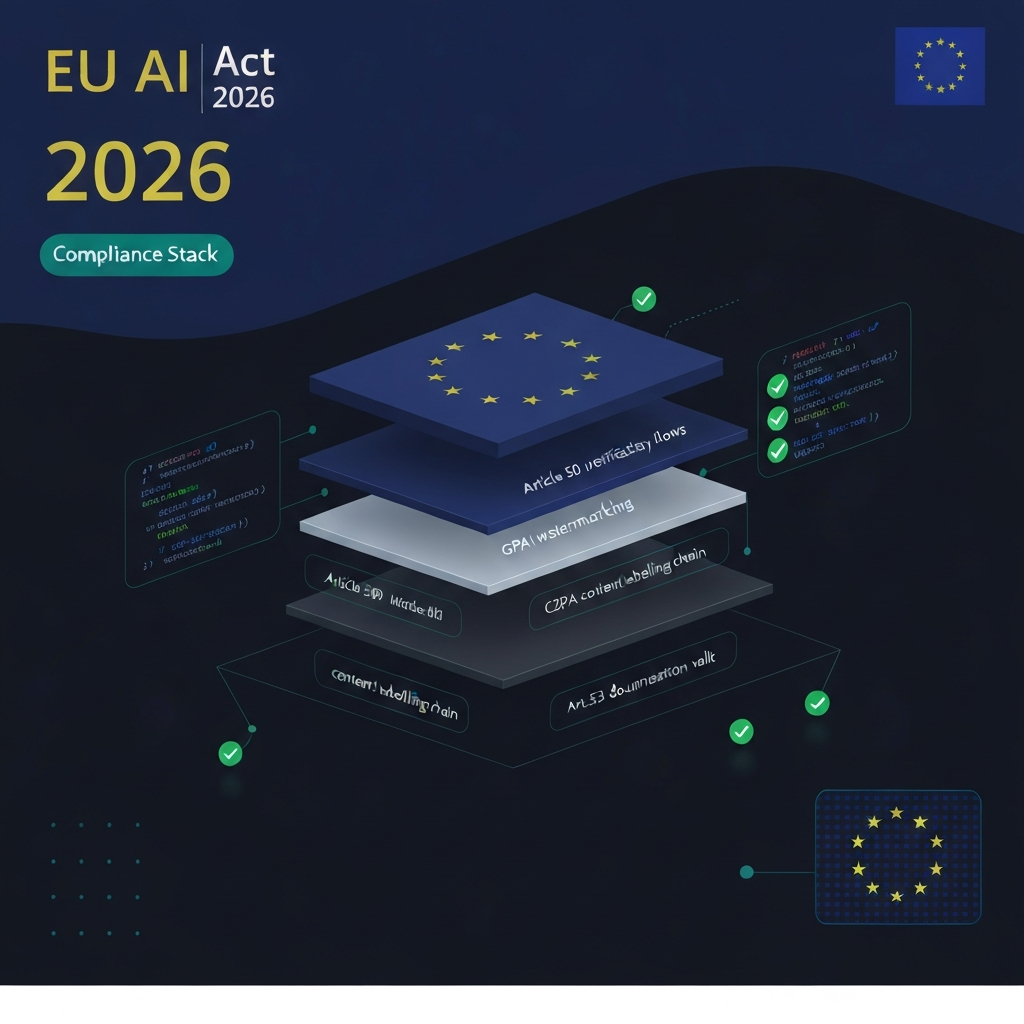
August 2, 2026 is the hard deadline for EU AI Act Article 50 transparency obligations. If you build AI-powered SaaS, deploy GPAI models, or fine-tune foundation models for EU users, this deadline applies to you — and the penalty for non-compliance is up to €15 million or 3% of global annual turnover.
This is the final post in our five-part EU AI Act Transparency series. Rather than covering new ground, this article does something more useful: it synthesises the entire compliance stack into one actionable developer toolkit. You'll get the complete picture — what you must implement, in what order, using which tools — to be compliant by August 2026.
What the Series Covered
Over the past four posts, we built up the full transparency picture layer by layer:
| Post | Article | Requirement | Key Tools |
|---|---|---|---|
| #1339 — User Notifications | Art.50(1-3) | Disclose AI interaction, chatbot identity, emotion recognition | UI banners, consent flows, audit logs |
| #1340 — GPAI Watermarking | Art.50(5) | Machine-detectable watermarks in AI-generated content | C2PA Python, SynthID, Imatag |
| #1341 — Content Labelling | Art.50(4) | Human-readable labels on AI-generated images, audio, video, text | C2PA credentials, DALL-E metadata, D-Trust |
| #1342 — Model Documentation | Art.53 | Technical reports, capability evals, copyright summaries, systemic risk | Model cards++, EU AI Office templates |
This finale ties these four layers into one integrated stack with a clear implementation roadmap.
The Three Compliance Personas
Before diving into the stack, identify which persona applies to you. The requirements differ significantly.
Persona A — SaaS Developer using GPAI APIs
You call OpenAI, Anthropic, Mistral, or similar APIs. You don't own or fine-tune the model. Your obligations are:
- Art.50(1): Inform users they are interacting with an AI system (not a human)
- Art.50(2): If you use emotion recognition, disclose this explicitly
- Art.50(3): If you deploy an AI chatbot, ensure it cannot claim to be human
- Art.50(4): Label AI-generated content in your UI — images, audio, video output must carry visible labels
- Art.50(5): If you integrate image/audio/video generation, ensure machine-readable watermarks are embedded (typically handled upstream by the GPAI provider, but you must verify and preserve them)
What you do NOT need to do: Art.53 model documentation (that's the GPAI provider's job, not yours — unless you fine-tune).
Persona B — GPAI Model Provider
You train or release a general-purpose AI model (Llama fine-tune, custom LLM, diffusion model) and make it available via API or download. Your obligations stack on top of Persona A:
- Art.53(1)(a): Maintain technical documentation (model architecture, training data, compute, performance benchmarks)
- Art.53(1)(b): Provide information and tools for downstream operators
- Art.53(1)(c): Publish copyright compliance summary (what training data, what licenses, what opt-outs honored)
- Art.53(1)(d): If systemic risk threshold crossed (10^25 FLOPs): adversarial testing, serious incident reporting, cybersecurity measures
- Art.50(5): Embed machine-detectable watermarks in all generated content (image, audio, video — and text where technically feasible)
Persona C — Fine-Tuner / Operator
You take a base GPAI model and fine-tune or adapt it for a specific use case. You inherit Persona A obligations plus partial Persona B obligations depending on whether you release the fine-tuned model externally:
- If you deploy fine-tuned model internally only: Persona A obligations plus basic model documentation for audit purposes
- If you release fine-tuned model to third parties: Full Art.53 documentation obligations apply to you, not just the base model provider
The Complete Transparency Stack
Here is the full EU AI Act transparency stack, layer by layer, with implementation guidance:
┌─────────────────────────────────────────────────────────────┐
│ LAYER 5: GOVERNANCE & DOCUMENTATION (Art.53)                │
│ Technical reports • Capability evals • Copyright summary    │
│ Systemic risk assessments • EU AI Office registration       │
├─────────────────────────────────────────────────────────────┤
│ LAYER 4: WATERMARKING (Art.50(5))                           │
│ C2PA credentials • SynthID • Invisible watermarks           │
│ Machine-detectable provenance • Cross-platform persistence  │
├─────────────────────────────────────────────────────────────┤
│ LAYER 3: CONTENT LABELLING (Art.50(4))                      │
│ Human-readable labels • UI disclosure badges                 │
│ Platform labels • Metadata injection • CDN preservation     │
├─────────────────────────────────────────────────────────────┤
│ LAYER 2: INTERACTION DISCLOSURE (Art.50(1-3))               │
│ AI interaction banners • Chatbot identity disclosure        │
│ Emotion recognition notices • Consent workflows             │
├─────────────────────────────────────────────────────────────┤
│ LAYER 1: AUDIT & LOGGING (Cross-cutting)                    │
│ Disclosure event logs • Watermark embedding logs            │
│ Documentation version control • Retention (10 years)       │
└─────────────────────────────────────────────────────────────┘
Layer 1: Audit Logging — the Foundation
Before implementing any visible feature, set up your audit infrastructure. Every compliance action must be logged with sufficient detail to demonstrate compliance to an NCA (national competent authority) inspector.
import uuid
import hashlib
from datetime import datetime, timezone
from dataclasses import dataclass, field
from typing import Literal

ComplianceEvent = Literal[
    "disclosure_shown",
    "chatbot_identity_disclosed",
    "emotion_recognition_noticed",
    "content_label_applied",
    "watermark_embedded",
    "watermark_verified",
    "documentation_updated",
    "user_consent_recorded",
]

@dataclass
class AuditLogEntry:
    event_id: str = field(default_factory=lambda: str(uuid.uuid4()))
    timestamp: str = field(default_factory=lambda: datetime.now(timezone.utc).isoformat())
    event_type: ComplianceEvent = "disclosure_shown"
    user_session_id: str = ""        # pseudonymised, not raw user_id
    content_hash: str = ""           # SHA-256 of the content disclosed/labelled
    article_reference: str = ""      # e.g. "Art.50(1)"
    jurisdiction: str = "EU"
    system_version: str = ""
    additional_context: dict = field(default_factory=dict)

    def to_dict(self) -> dict:
        return {k: v for k, v in self.__dict__.items()}


class ComplianceAuditLogger:
    """Append-only audit log for EU AI Act Art.50 + Art.53 compliance events."""

    def __init__(self, storage_backend):
        self.backend = storage_backend  # PostgreSQL, S3, Elasticsearch

    def log(self, entry: AuditLogEntry) -> str:
        record = entry.to_dict()
        # Immutable hash chain: each entry references the hash of the previous
        record["chain_hash"] = self._compute_chain_hash(record)
        self.backend.append(record)
        return record["event_id"]

    def _compute_chain_hash(self, record: dict) -> str:
        last_hash = self.backend.get_last_chain_hash() or "genesis"
        content = f"{last_hash}:{record['event_id']}:{record['timestamp']}"
        return hashlib.sha256(content.encode()).hexdigest()

    def verify_chain_integrity(self) -> bool:
        """NCA audit-readiness check — call before any regulatory inspection."""
        return self.backend.verify_chain()
Retention: EU AI Act does not specify a retention period for Art.50 logs, but the general principle under GDPR + NIS2 suggests minimum 3 years. For Art.53 technical documentation, retain for the lifetime of the model plus 10 years after it is taken off the market.
Layer 2: Interaction Disclosure (Art.50(1-3))
Art.50(1) — AI Interaction Disclosure
Any system that interacts with natural persons must inform them they are interacting with an AI system — unless this is "obvious from context." The burden of proving it was obvious falls on you.
Safe implementation (no ambiguity):
// React component — show before or during first AI interaction
interface AIDisclosureBannerProps {
  onAcknowledge: () => void;
  systemName: string;
  capabilities: string[];
}

export function AIDisclosureBanner({
  onAcknowledge,
  systemName,
  capabilities,
}: AIDisclosureBannerProps) {
  return (
    <div
      role="dialog"
      aria-label="AI system disclosure"
      className="eu-ai-disclosure-banner"
    >
      <p>
        <strong>You are interacting with an AI system</strong> ({systemName}).
        This system uses artificial intelligence to{" "}
        {capabilities.join(", ")}.
      </p>
      <p>
        Responses are generated automatically and may not always be accurate.
        A human is not available in this interaction.
      </p>
      <button onClick={onAcknowledge} aria-label="I understand">
        I understand
      </button>
    </div>
  );
}
Log the acknowledgement:
logger.log(AuditLogEntry(
    event_type="disclosure_shown",
    user_session_id=pseudonymise(session_id),
    article_reference="Art.50(1)",
    additional_context={"system_name": "ChatAssistant", "acknowledged": True}
))
Art.50(2) — Emotion Recognition Disclosure
If your system uses emotion recognition (classifying anger, happiness, stress etc. from voice, video, or text sentiment), you must inform the people subject to it — before processing begins.
def process_customer_call(audio_stream, session_id: str):
    # MUST disclose BEFORE emotion analysis begins
    if EMOTION_RECOGNITION_ENABLED:
        send_realtime_notice(session_id, {
            "type": "emotion_recognition_active",
            "message": (
                "This call is being analysed for emotional tone "
                "to improve service quality. You may opt out by "
                "pressing * at any time."
            ),
            "opt_out_mechanism": "keypress_star",
        })
        logger.log(AuditLogEntry(
            event_type="emotion_recognition_noticed",
            article_reference="Art.50(2)",
            user_session_id=pseudonymise(session_id),
        ))

    # Only then proceed with emotion analysis
    return analyse_audio(audio_stream)
Art.50(3) — Chatbot Identity (No Impersonation)
AI chatbots must not claim to be human when sincerely asked. This means a runtime check on chatbot responses, not just a disclosure banner.
IMPERSONATION_INDICATORS = [
    "i am human", "i'm human", "i am a person", "i'm a person",
    "i am not an ai", "i'm not an ai", "i am not a bot",
    "i'm not artificial", "i am real", "i'm real",
]

def safety_check_response(response: str) -> tuple[str, bool]:
    """Returns (safe_response, was_modified)."""
    lower = response.lower()
    for indicator in IMPERSONATION_INDICATORS:
        if indicator in lower:
            corrected = (
                f"I should clarify: I am an AI assistant, not a human. "
                f"My responses are generated by an AI system.\n\n{response}"
            )
            return corrected, True
    return response, False
Layer 3: Content Labelling (Art.50(4))
AI-generated images, audio, video, and text must carry human-readable labels informing the viewer/listener that the content was AI-generated.
Mandatory Label Scope
| Content Type | Label Required? | Notes |
|---|---|---|
| AI-generated images | ✅ Yes | Mandatory for any image where generation is not immediately obvious |
| AI-generated audio | ✅ Yes | Deepfakes, synthetic speech, AI music |
| AI-generated video | ✅ Yes | Deepfakes, synthetic video, AI avatars |
| AI-generated text | ✅ Yes (Art.50(4) explicitly covers text) | Policy texts, marketing copy, legal summaries |
| AI-assisted content (human edited) | ⚠️ Grey area | Recommendation: label as "AI-assisted" |
| AI detection/classification output | ❌ No | This is your system's output, not AI-generated content |
Label Implementation
// Overlay label on AI-generated images
export function AIContentLabel({
  contentType,
  generatedAt,
  modelProvider,
}: {
  contentType: "image" | "audio" | "video" | "text";
  generatedAt: string;
  modelProvider: string;
}) {
  const labels = {
    image: "AI-generated image",
    audio: "AI-generated audio",
    video: "AI-generated video",
    text: "AI-generated text",
  };

  return (
    <div className="ai-content-disclosure" aria-label="AI content notice">
      <span className="ai-badge">🤖 {labels[contentType]}</span>
      <span className="ai-detail">
        Generated by {modelProvider} · {new Date(generatedAt).toLocaleDateString()}
      </span>
    </div>
  );
}
CDN Preservation Warning
A common implementation failure: you correctly embed metadata and labels at generation time, but your CDN strips metadata headers during caching/transformation. Test this explicitly:
# Check if C2PA manifest survives your CDN
curl -sI "https://your-cdn.example.com/ai-image.jpg" | grep -i "c2pa\|content-provenance\|x-ai"

# Check if metadata survived image transformation
python3 -c "
import c2pa
manifest = c2pa.Reader('path/to/cdn-cached-image.jpg')
print('C2PA manifests intact:', len(manifest.manifests))
"
If manifests are stripped, configure your CDN to preserve Content-Provenance headers and avoid lossy transformations on JPEG/PNG that would destroy embedded steganographic watermarks.
Layer 4: Watermarking (Art.50(5))
Machine-detectable watermarks enable automated verification that content is AI-generated, even if the human-readable label is removed or the content is screenshot/re-compressed.
GPAI Provider Requirements
If you provide a GPAI model that generates images, audio, or video, you must embed watermarks. The EU AI Office Codes of Practice for GPAI (expected Q2 2026) will specify approved technical standards — C2PA is the frontrunner.
from c2pa import Builder, SigningConfig

def embed_watermark(
    content_bytes: bytes,
    content_type: str,
    model_id: str,
    generation_timestamp: str,
) -> bytes:
    """Embed C2PA manifest as machine-detectable watermark."""

    manifest = {
        "claim_generator": f"your-company/{model_id}",
        "assertions": [
            {
                "label": "c2pa.ai_generated",
                "data": {
                    "generator": model_id,
                    "generated_at": generation_timestamp,
                    "eu_ai_act_compliant": True,
                    "article_reference": "Art.50(5)",
                }
            },
            {
                "label": "c2pa.training_and_data_mining",
                "data": {
                    "use": "notAllowed",  # or "allowed" based on your training policy
                }
            }
        ]
    }

    signing_config = SigningConfig.from_file(
        cert_path="/path/to/eu-signing-cert.pem",
        private_key_path="/path/to/signing-key.pem",
        algorithm="es256",
        tsa_url="http://timestamp.dfn.de/",  # EU-based TSA
    )

    builder = Builder(manifest)
    return builder.sign(content_bytes, content_type, signing_config)
Stacking Watermarks: Visible + Invisible
For maximum robustness (content may be screenshot, re-encoded, or stripped), stack two watermark types:
- C2PA manifest (cryptographic, verifiable, file-bound — but can be stripped)
- Steganographic watermark (embedded in pixel/audio data, survives re-encoding)
def embed_dual_watermark(image_bytes: bytes, payload: WatermarkPayload) -> bytes:
    # Layer 1: Cryptographic C2PA manifest
    with_c2pa = embed_c2pa_manifest(image_bytes, payload)

    # Layer 2: Invisible steganographic signal (e.g. using Imatag or open-source)
    with_stego = embed_steganographic_signal(
        with_c2pa,
        signal_id=payload.content_id,
        strength=0.3,  # balance between imperceptibility and robustness
    )

    return with_stego
Layer 5: Model Documentation (Art.53)
If you are a GPAI model provider, Art.53 requires a structured technical documentation package. This is not a model card — it is a formal regulatory document.
Documentation Package Checklist
EU AI Act Art.53 Documentation Package
━━━━━━━━━━━━━━━━━━━━━━━━━━━━━━━━━━━━━━

□ 1. Model Architecture Report
  □ Architecture description (transformer / diffusion / hybrid)
  □ Parameter count (total + active)
  □ Context length / modalities
  □ Training compute (FLOPs, verified)
  □ Hardware used (GPU type, count, location)
  □ Training duration

□ 2. Training Data Documentation
  □ Datasets used (name, version, URL where public)
  □ Data volume (tokens / images / hours)
  □ Geographic distribution
  □ Temporal range of data
  □ Known data quality issues

□ 3. Copyright & IP Compliance Summary (Art.53(1)(c))
  □ Text and Data Mining (TDM) opt-outs honored (Art.4 DSM Directive)
  □ Process for identifying and removing opted-out data
  □ Contact mechanism for rights holders
  □ License compatibility analysis

□ 4. Capability Evaluations
  □ Standard benchmarks (MMLU, HumanEval, etc.)
  □ Safety evaluations (refusal rates, jailbreak resistance)
  □ Bias / fairness assessments
  □ Multilingual performance (EU languages minimum)
  □ Evaluation methodology (who ran, when, how)

□ 5. Systemic Risk Assessment (if > 10^25 FLOPs training compute)
  □ Risk identification and classification
  □ Adversarial testing results (red-teaming)
  □ Mitigation measures implemented
  □ Residual risk statement

□ 6. Downstream Operator Guide
  □ Acceptable use policy
  □ Prohibited use cases
  □ Integration documentation
  □ Rate limits and access controls
  □ Incident reporting contact
Automation: Keeping Documentation Current
Model documentation that is accurate at release but stale six months later is a compliance risk. Automate update triggers:
from dataclasses import dataclass
from datetime import datetime

@dataclass
class DocumentationUpdateTrigger:
    event: str
    requires_update: list[str]

TRIGGERS = [
    DocumentationUpdateTrigger(
        event="model_weights_updated",
        requires_update=["architecture_report", "capability_evaluations"],
    ),
    DocumentationUpdateTrigger(
        event="training_data_changed",
        requires_update=["training_data_documentation", "copyright_summary"],
    ),
    DocumentationUpdateTrigger(
        event="new_capability_detected",
        requires_update=["capability_evaluations", "systemic_risk_assessment"],
    ),
    DocumentationUpdateTrigger(
        event="security_incident",
        requires_update=["systemic_risk_assessment"],
    ),
]

class DocumentationVersionController:
    def on_model_event(self, event: str, metadata: dict):
        for trigger in TRIGGERS:
            if trigger.event == event:
                self.flag_for_update(trigger.requires_update, metadata)
                self.notify_compliance_team(trigger, metadata)
                self.create_audit_entry(event, trigger.requires_update)
Integrated Compliance Architecture
Here is the complete integrated architecture showing how all five layers work together in a production deployment:
User Request
     │
     ▼
┌────────────────────────────────────────────────────────┐
│ API Gateway (EU-hosted)                                 │
│                                                        │
│  ┌─────────────────────────────────────────────────┐  │
│  │ Pre-request: Disclosure Check                   │  │
│  │ • First interaction? → Show Art.50(1) banner    │  │
│  │ • Emotion recognition active? → Show Art.50(2)  │  │
│  │ • Log disclosure event                          │  │
│  └─────────────────────────────────────────────────┘  │
│                         │                              │
│                         ▼                              │
│  ┌─────────────────────────────────────────────────┐  │
│  │ GPAI Model Call (Art.53 provider's model)        │  │
│  │ • Request watermarked output                    │  │
│  │ • Verify C2PA manifest returned                 │  │
│  └─────────────────────────────────────────────────┘  │
│                         │                              │
│                         ▼                              │
│  ┌─────────────────────────────────────────────────┐  │
│  │ Post-generation: Label & Watermark               │  │
│  │ • Attach AI content label (Art.50(4))           │  │
│  │ • Verify/add watermark (Art.50(5))              │  │
│  │ • Safety check: no impersonation (Art.50(3))    │  │
│  │ • Log all events to audit store                 │  │
│  └─────────────────────────────────────────────────┘  │
│                         │                              │
│                         ▼                              │
│  ┌─────────────────────────────────────────────────┐  │
│  │ Response to User                                 │  │
│  │ • Content with visible AI label                 │  │
│  │ • Metadata with C2PA manifest                   │  │
│  │ • CDN configured to preserve provenance headers │  │
│  └─────────────────────────────────────────────────┘  │
└────────────────────────────────────────────────────────┘
         │
         ▼
┌────────────────────────────────────────────────────────┐
│ Audit Log Store (EU-resident, encrypted, append-only)  │
│ Retention: 3+ years for Art.50, model lifetime for 53  │
└────────────────────────────────────────────────────────┘
         │
         ▼
┌────────────────────────────────────────────────────────┐
│ GPAI Documentation Vault (Art.53)                      │
│ Technical reports • Evaluations • Copyright summaries  │
│ Version-controlled • NCA-accessible • Auto-updated     │
└────────────────────────────────────────────────────────┘
Enforcement Timeline: What Happens After August 2
The EU AI Act's general application date is August 2, 2026. From this date:
Who enforces? National Competent Authorities (NCAs) designated by each EU member state. Germany has designated the Federal Network Agency (Bundesnetzagentur) and BSI for AI oversight. France designated CNIL + ARCOM + technical body. The EU AI Office oversees GPAI models directly.
How are inspections triggered?
- Complaint by a user or rights holder
- Market surveillance sweep by NCA (routine)
- Serious incident report triggering investigation
- Cross-border referral from another NCA
Penalties:
- Art.50 violations: up to €15 million or 3% of global annual turnover (whichever is higher)
- Art.53 violations: up to €15 million or 3% for GPAI providers
- Non-cooperation with audit: up to €7.5 million or 1%
Grace period reality: The EU AI Office has signalled that enforcement will be proportionate in the first months post-August 2, 2026, focusing on the most egregious violations. However, "proportionate early enforcement" does not mean zero risk. NCAs can and will act on complaints from day one.
EU-Sovereign Implementation Stack
Given that your compliance infrastructure itself processes personal data (user sessions, content logs) and sensitive information (model documentation), consider where this infrastructure runs.
For maximum GDPR compatibility and minimal CLOUD Act exposure:
| Component | EU-Sovereign Option | Why It Matters |
|---|---|---|
| Audit log storage | Hetzner S3-compatible (Germany) | Logs contain pseudonymised user data |
| C2PA signing service | D-Trust (BSI-approved, Germany) | Signing key must not be accessible to US subpoena |
| Watermarking pipeline | Imatag (France), self-hosted c2pa-rs | Steganographic algorithms are IP |
| Model documentation vault | Nextcloud (DE-hosted), GitLab (self-hosted) | Technical reports may contain trade secrets |
| API gateway | sota.io (EU-native PaaS) | Request routing and rate limiting |
| GPAI model | Mistral API (France), Aleph Alpha (Germany) | Data residency for model inputs/outputs |
sota.io is the EU-native PaaS that runs your compliance infrastructure without CLOUD Act or Schrems III concerns. Deploy your watermarking pipeline, audit logging service, and content labelling API in Docker containers — all on European infrastructure, all under GDPR-compliant terms.
Pre-August 2026 Compliance Checklist
Use this checklist in your sprint planning to hit the deadline:
EU AI Act Art.50 + Art.53 Compliance Checklist
━━━━━━━━━━━━━━━━━━━━━━━━━━━━━━━━━━━━━━━━━━━━━━

PERSONA A: SaaS Developer using GPAI APIs
─────────────────────────────────────────
Art.50(1) — User Notification:
□ Show AI disclosure banner before first AI interaction
□ Banner must be visible, not buried in ToS
□ Log disclosure events with pseudonymised session ID

Art.50(2) — Emotion Recognition:
□ Audit your feature set: do you analyse tone, sentiment, stress?
□ If yes: add real-time notice before analysis begins
□ If yes: provide opt-out mechanism and honor it

Art.50(3) — Chatbot Identity:
□ Add runtime check to prevent chatbot claiming to be human
□ Test with adversarial prompts: "are you human?", "are you a bot?"
□ Document the safety check in your system architecture

Art.50(4) — Content Labels:
□ Identify all AI-generated content your system produces
□ Add visible labels to images, audio, video, text
□ Do not strip labels in transformation pipeline
□ Test CDN does not remove labels

Art.50(5) — Watermark Verification:
□ Verify upstream GPAI provider embeds watermarks
□ Confirm your CDN preserves C2PA headers
□ Add watermark verification to your quality pipeline

PERSONA B: GPAI Model Provider (additional)
────────────────────────────────────────────
Art.50(5) — Watermark Embedding:
□ Implement C2PA signing for all image/audio/video output
□ Add steganographic backup watermark
□ Test watermark survives re-encoding (JPEG, MP3, MP4)
□ Use EU-based TSA for timestamp anchoring

Art.53 — Technical Documentation:
□ Model architecture report: complete and current
□ Training data documentation: datasets, volume, licenses
□ Copyright compliance summary: TDM opt-outs documented
□ Capability evaluations: standard benchmarks + safety
□ Systemic risk assessment (if > 10^25 FLOPs)
□ Downstream operator guide: acceptable use, prohibited uses
□ Version control: documentation updated on model changes

CROSS-CUTTING
─────────────
□ Audit log infrastructure: EU-hosted, append-only, 3+ year retention
□ NCA contact registered: who to notify in your company if inspection arrives
□ Legal review: DPO sign-off on compliance posture
□ Quarterly review: compliance remains current as model is updated
What This Series Has Built
Across five posts, the EU-AI-ACT-TRANSPARENCY-2026 series has provided:
- A complete reading of Art.50 and Art.53 obligations, translated into developer-actionable requirements
- Working Python and TypeScript code for every major compliance component
- An integrated architecture showing how layers connect in a production system
- An EU-sovereign toolchain that avoids CLOUD Act and Schrems III risk
- A pre-launch compliance checklist you can drop into a Jira sprint
The August 2, 2026 deadline is 67 days away. That is roughly six two-week sprints. If you start now, you have time to implement, test, and audit your compliance stack before enforcement begins.
Further Reading
- EU AI Act Art.50 Transparency: User Notifications & Disclosure Requirements
- EU AI Act GPAI Watermarking 2026: Technical Implementation Guide
- EU AI Act AI-Generated Content Labelling Tools 2026: C2PA, Provenance & Detection Stack
- EU AI Act GPAI Model Documentation Requirements 2026: Art.53 Compliance
- EU AI Act Enforcement Tools 2026: Complete Compliance Stack
sota.io is an EU-native PaaS that helps European developers deploy AI applications with full data sovereignty. No CLOUD Act exposure, no Schrems III risk, GDPR-compliant by default.
EU-Native Hosting
Ready to move to EU-sovereign infrastructure?
sota.io is a German-hosted PaaS — no CLOUD Act exposure, no US jurisdiction, full GDPR compliance by design. Deploy your first app in minutes.