Bugcrowd EU Alternative 2026: Managed Bug Bounty CLOUD Act Risk for European Organisations
Post #2 in the sota.io EU Bug Bounty & Pentest Management Series
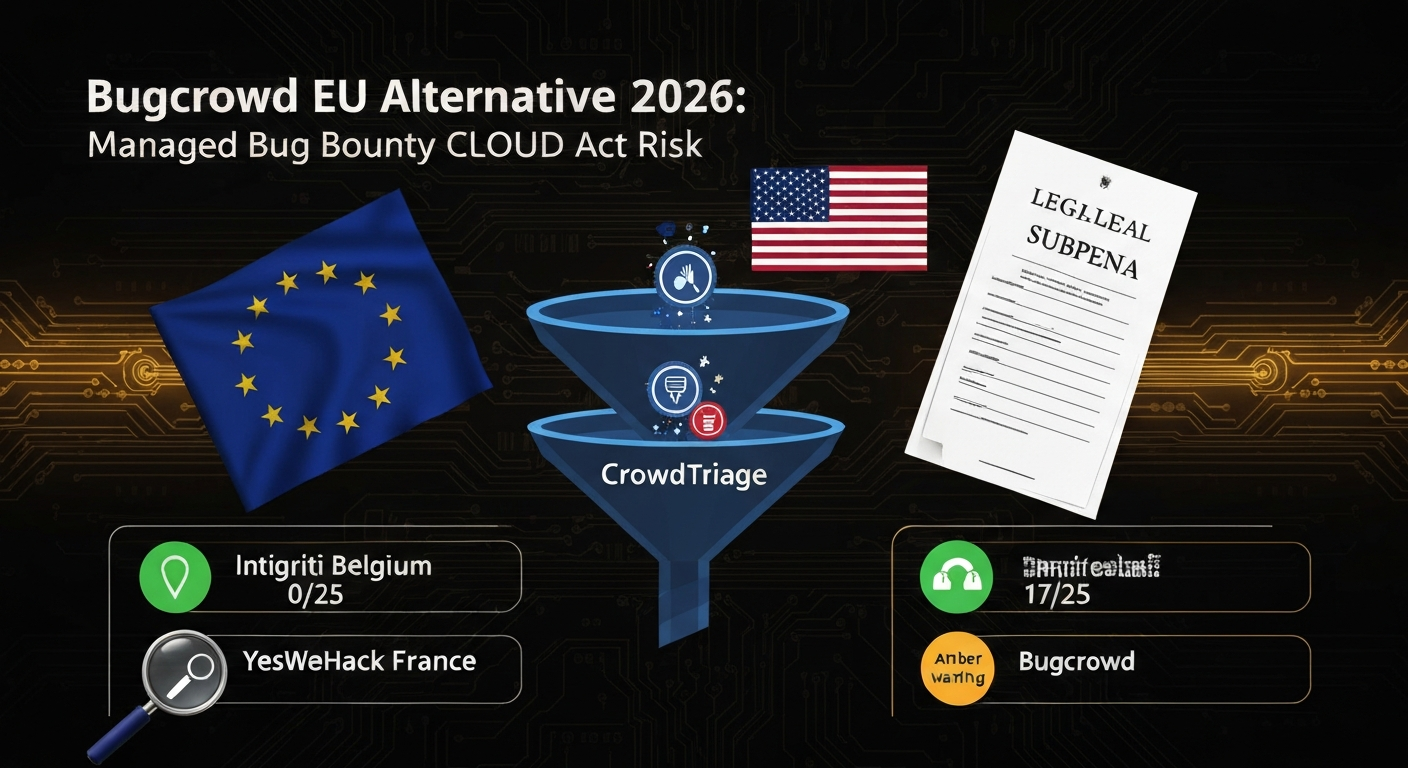
Bugcrowd is one of the world's largest managed bug bounty platforms, hosting vulnerability disclosure programs (VDP) and bug bounty programmes for hundreds of enterprise clients — including many European organisations subject to GDPR, NIS2, and DORA. Bugcrowd Inc. is incorporated in Delaware. Its growth has been fuelled by Insight Partners, a New York-based private equity and growth equity firm managing over $80 billion in assets.
This creates a specific legal risk that European security teams must understand before selecting a bug bounty platform: every vulnerability report your security programme receives, every PoC exploit submitted by a researcher, every patch window discussion documented inside the platform, and every CrowdTriage™ analyst note about your systems falls under US CLOUD Act jurisdiction the moment it is processed by Bugcrowd's infrastructure.
This post provides a complete CLOUD Act risk analysis of Bugcrowd, introduces the CrowdTriage™ Paradox as a new legal concept, and compares EU-native alternatives that provide equivalent functionality with zero US jurisdictional exposure.
Bugcrowd Inc. — Corporate and Ownership Structure
Bugcrowd was founded in 2011 by Casey Ellis in San Francisco, California. The company is incorporated as Bugcrowd Inc., a Delaware C-Corporation with headquarters in San Francisco, CA. Unlike HackerOne — which has a separate non-US entity structure — Bugcrowd operates primarily through its US Delaware entity for enterprise contracts.
Investor Profile: Insight Partners, Rally Ventures, Paladin Capital
The key investor for CLOUD Act analysis purposes is Insight Partners (New York City, NY). Insight Partners is one of the world's largest growth equity and buyout firms, managing over $80 billion in assets under management. Founded by Jeff Horing and Jerry Murdock, Insight Partners operates under Delaware corporate law and is subject to US jurisdiction, including CLOUD Act obligations for its portfolio companies.
Additional investors include:
- Rally Ventures (San Francisco, CA) — early-stage cybersecurity investor
- Blackbird Ventures (Sydney, Australia) — early-stage backer
- Paladin Capital Group (Washington, DC) — cybersecurity-focused PE with deep US defence and intelligence ties
- Triangle Peak Partners (Menlo Park, CA) — growth equity investor
The Paladin Capital Group involvement deserves particular attention for European legal analysis. Paladin is known for its investments in companies serving the US Intelligence Community (IC) and Department of Defense. While Paladin's stake in Bugcrowd is not majority-controlling, its presence signals the company's alignment with US government security ecosystem interests.
Bugcrowd is a US Delaware C-Corp backed by US PE/VC with documented ties to the US defence and intelligence investment community. This is the foundational jurisdictional fact for CLOUD Act analysis.
What Bugcrowd Processes — and Why It Matters
Before analysing the legal framework, European security teams need to understand what data categories Bugcrowd actually handles on behalf of enterprise clients.
Vulnerability Reports
The core Bugcrowd product processes:
- Proof-of-Concept (PoC) exploit code submitted by security researchers
- Technical vulnerability details including affected endpoints, parameters, and attack chains
- CVSS scores and severity assessments performed by Bugcrowd's triage analysts
- Affected system identifiers — hostnames, IP addresses, service names, API endpoints
- Patch timeline discussions between the enterprise client and submitting researcher
- Disclosure agreements governing when vulnerabilities become public
This data represents the most sensitive operational security information an organisation can possess — a real-time, continuously updated map of exploitable weaknesses in production systems.
CrowdTriage™ — The Human-in-the-Loop Data Flow
Bugcrowd's flagship differentiation from competitors is CrowdTriage™ — a managed triage service where Bugcrowd's US-based human security analysts review every vulnerability submission before it reaches the enterprise client.
The CrowdTriage™ workflow means:
- A researcher discovers a vulnerability in your European organisation's systems
- The researcher submits a detailed report to Bugcrowd's platform (US infrastructure)
- A Bugcrowd security analyst in the United States reads, assesses, and annotates the report
- The analyst determines severity, validates the vulnerability, and prepares a triage summary
- Only then does the report reach your internal security team
This creates what we call the CrowdTriage™ Paradox: you paid for managed triage to reduce your team's workload, but the mechanism delivering that service is a US-based human reading every security weakness in your European infrastructure.
Under CLOUD Act §2703, a US government order targeting Bugcrowd can compel production of this data — including the analyst annotations, triage notes, and any internal communications about your vulnerabilities — without notifying you.
Attack Surface Management Data
Bugcrowd's Attack Surface Management (ASM) product continuously crawls and catalogues your external attack surface. This means Bugcrowd maintains an ongoing, automated inventory of your organisation's internet-facing systems — domains, IP ranges, services, and technology fingerprints. This data lives in Bugcrowd's US infrastructure.
CLOUD Act Legal Framework Analysis
The Clarifying Lawful Overseas Use of Data Act (18 U.S.C. §2703) applies to US electronic communication service providers and remote computing service providers. Bugcrowd, as a Delaware-incorporated entity with servers and staff in the United States, falls squarely within scope.
Key Legal Provisions
§2703(a) — Content disclosure: Government entities can require Bugcrowd to disclose stored communications content (vulnerability reports, PoC code, triage notes) with a warrant or §2703(d) court order.
§2703(b) — Non-content records: Metadata — who submitted what vulnerability, when, about which systems — is obtainable with a subpoena. This includes researcher identities, submission timestamps, and affected system lists.
§2703(f) — Preservation orders: The government can issue a preservation letter requiring Bugcrowd to preserve all data relating to a specific client or programme without notifying the client. Your European organisation may be entirely unaware that US law enforcement is cataloguing your vulnerability data.
Extraterritorial reach: The US Supreme Court's reasoning in United States v. Microsoft Corp. (2018), though ultimately resolved by the CLOUD Act itself, confirmed that US providers can be compelled to produce data stored outside the United States. Bugcrowd's vulnerability data stored in EU regions (if any) remains subject to US CLOUD Act jurisdiction.
The NIS2 Intersection
NIS2 Article 23 requires operators of essential and important entities to notify the relevant national CSIRT of significant incidents within 24 hours. Consider this scenario:
- A critical vulnerability is submitted to your Bugcrowd programme on a Monday morning
- On Monday afternoon, a US CLOUD Act preservation order is served on Bugcrowd for your organisation's data
- You discover the vulnerability on Tuesday, triggering NIS2 Art.23 24-hour notification obligations
- By this time, US law enforcement already possesses the vulnerability report, the affected system details, and all triage notes
The CLOUD Act timeline runs independently of and potentially ahead of your NIS2 incident response timeline. US agencies could possess your incident data before you have completed your Art.23 notification to EU authorities.
DORA Article 28 — ICT Third-Party Risk
The Digital Operational Resilience Act (DORA) requires financial sector entities to conduct thorough risk assessments of critical ICT third-party providers. Bug bounty platforms that maintain your attack surface inventory and vulnerability disclosures could be designated as critical ICT third-party service providers under DORA Article 31 if their compromise or unavailability would materially impact operational resilience.
DORA Art.30 (Key contractual provisions) requires contractual provisions ensuring the ICT third-party provider cooperates with supervisory authorities, alongside access and audit rights. A US CLOUD Act order served on Bugcrowd could create a conflict between Bugcrowd's US legal obligations and its DORA contractual obligations to EU financial sector clients — and CLOUD Act typically prevails over contractual provisions.
CLOUD Act Risk Score: Bugcrowd — 17/25
We apply the sota.io 5-dimension CLOUD Act scoring framework to Bugcrowd:
Dimension 1 — Corporate & Ownership Structure: 5/5
Bugcrowd Inc. is a Delaware C-Corporation incorporated and headquartered in the United States. Primary investor Insight Partners operates under New York and Delaware law. Paladin Capital Group has direct ties to the US defence and intelligence community. No structurally independent non-US entity handles European customer data outside US jurisdiction. Score: 5/5.
Dimension 2 — Government Relationships & Certifications: 2/5
Bugcrowd has operated some government-facing programmes but lacks the prominent federal certifications held by HackerOne (which ran Hack the Pentagon, maintains VDPs for CISA, DC3, and multiple defence agencies). Bugcrowd does not have published FedRAMP authorisation as of 2026. The presence of Paladin Capital Group as an investor (with IC/DoD alignment) raises the government connection score above minimum. Score: 2/5.
Dimension 3 — Data Sensitivity: 5/5
Bug bounty vulnerability data represents the highest data sensitivity tier in security operations:
- PoC exploit code for production systems
- Complete vulnerability chains including technical reproduction steps
- Affected endpoint details for internet-facing infrastructure
- Patch timing information usable for coordinated exploit timing
- CrowdTriage™ analyst assessments — US-created intelligence about EU security weaknesses
- Attack Surface Management data — continuous external footprint inventory
There is no data category more operationally sensitive than an adversary-discovered list of current exploitable vulnerabilities in your production systems. Score: 5/5.
Dimension 4 — Infrastructure & Data Location: 3/5
Bugcrowd's primary infrastructure is US-hosted (AWS, primarily US regions). The company does not publicly offer EU data residency options or region-locked storage for European enterprise clients. CrowdTriage™ processing occurs on US-hosted systems by US-based analysts. Score: 3/5.
Dimension 5 — Encryption & Sovereign Access Controls: 2/5
Bugcrowd does not offer Customer-Managed Encryption Keys (CMEK) or a Bring-Your-Own-Key (BYOK) programme that would allow European clients to control access to their vulnerability data. Standard platform encryption protects data from external attackers but does not protect against a lawful CLOUD Act production order directed at Bugcrowd. Score: 2/5.
Total Score: 17/25
| Dimension | Weight | Score |
|---|---|---|
| D1: Corporate & Ownership | — | 5/5 |
| D2: Government Relationships | — | 2/5 |
| D3: Data Sensitivity | — | 5/5 |
| D4: Infrastructure Location | — | 3/5 |
| D5: Encryption Controls | — | 2/5 |
| Total | — | 17/25 |
Bugcrowd scores 17/25 — slightly below HackerOne's 18/25 (reflecting HackerOne's more prominent DoD programme history), but higher than many enterprise software tools because of the extreme sensitivity of vulnerability data processed under CrowdTriage™.
The CrowdTriage™ Paradox — A New Legal Concept
Previous CLOUD Act analyses of SaaS platforms focus primarily on stored data — what your organisation uploads to a US platform. Bugcrowd introduces a qualitatively different legal exposure through its managed triage service.
When Bugcrowd's US security analysts perform CrowdTriage™, they are:
- Creating new documents — triage assessments, severity ratings, analyst notes — that are entirely US-created intelligence about EU organisations' vulnerabilities
- Forming expert judgements about the exploitability and priority of weaknesses in your EU systems
- Communicating internally about your security posture through platform messaging and ticketing systems
A CLOUD Act production order can capture not just the original researcher submission but the entire chain of US-created intelligence about your organisation's security weaknesses. This is distinct from a simple data hosting arrangement.
The CrowdTriage™ Paradox can be stated simply: the feature that makes Bugcrowd more convenient for European enterprises — removing the burden of vulnerability triage — is also the mechanism that creates the deepest US intelligence exposure about those enterprises.
Comparison: Self-Managed vs Managed Bug Bounty
| Arrangement | Data at US rest | US human review | US-created intelligence |
|---|---|---|---|
| Self-managed VDP (EU-hosted) | None | None | None |
| Bugcrowd VDP (no triage) | Yes (submissions) | No | Minimal |
| Bugcrowd managed (CrowdTriage™) | Yes (submissions) | Yes | Yes — analyst notes |
| Bugcrowd ASM + Managed | Yes (submissions + footprint) | Yes | Yes + continuous scan data |
The more Bugcrowd services a European organisation purchases, the wider its CLOUD Act exposure becomes.
GDPR Article 28 — Data Processor Implications
When a European organisation operates a Bugcrowd programme, Bugcrowd acts as a data processor under GDPR Article 28. The controller (your organisation) must execute a Data Processing Agreement (DPA) with Bugcrowd. This DPA governs Bugcrowd's use of personal data — including researcher identities and contact information.
However, GDPR Art.28 DPAs contain a structural vulnerability when the processor is a US entity under CLOUD Act: a CLOUD Act production order supersedes the DPA's data protection provisions. Bugcrowd cannot simultaneously comply with a US court order requiring disclosure and honour its DPA obligation to process data only on documented controller instructions.
The European Court of Justice's Schrems II judgment (C-311/18) reinforced that US surveillance law creates a structural incompatibility with GDPR data protection standards. While the EU-US Data Privacy Framework (DPF) partially addressed this for routine data transfers, it does not immunise Bugcrowd vulnerability data from targeted CLOUD Act requests — particularly for data relating to specific organisations or incidents.
EU-Native Alternatives: Intigriti and YesWeHack
Two European-headquartered bug bounty platforms provide equivalent managed bug bounty, VDP, and pentest coordination capabilities with zero US CLOUD Act exposure:
Intigriti — CLOUD Act Score: 0/25
Intigriti NV is headquartered in Antwerp, Belgium (EU). Founded in 2016 by Stijn Jans, Intigriti has grown into Europe's largest native bug bounty platform, serving major European enterprises and public sector organisations.
Key differentiators for CLOUD Act analysis:
- Belgian B.V. corporate structure — no Delaware incorporation
- EU-based infrastructure — GDPR-native data residency
- European investor base — no US PE/VC majority control
- Human triage service performed by EU-based security analysts
- SOC 2 and ISO 27001 certified
Intigriti's managed triage operates within EU jurisdiction. The equivalent of Bugcrowd's CrowdTriage™ paradox does not apply: triage notes created by Intigriti's Belgian analysts are not subject to US CLOUD Act orders.
YesWeHack — CLOUD Act Score: 0/25
YesWeHack SAS is headquartered in Paris, France (EU). Founded in 2015 by Guillaume Vassault-Houlière and Manuel Kasper, YesWeHack operates Europe's second-largest bug bounty platform with a particular strength in French public sector and defence-adjacent organisations.
Key differentiators:
- French SAS corporate structure — no US entity
- EU data residency for all vulnerability data
- French National Cybersecurity Agency (ANSSI) qualified partner
- Supports NIS2 coordinated vulnerability disclosure (CVD) workflows natively
- GDPR-native platform design
YesWeHack's ANSSI qualification is particularly relevant for NIS2 operators: national cybersecurity authority endorsement provides additional assurance that the platform's vulnerability handling meets EU regulatory standards.
Open-Source and Self-Hosted VDP Options
For organisations requiring maximum control, open-source VDP infrastructure eliminates third-party platform exposure entirely:
| Tool | Jurisdiction | Notes |
|---|---|---|
| Disclose.io VDP templates | N/A (open standard) | Policy framework for self-managed VDP |
| OpenBugBounty | EU-hosted (Prague, CZ) | Non-commercial CVD coordination |
| HackerOne's VDP.policy | US (as template only) | Use policy structure, host on EU infrastructure |
| Yogosha | Paris, France | EU-native, smaller platform |
| Cobalt.io | San Francisco (covered separately in this series) | Not EU-native |
Procurement Decision Framework: Three Scenarios
Scenario A — Regulatory-unrestricted organisations: If your organisation processes no GDPR Art.9 special category data, holds no NIS2 essential/important entity designation, and operates outside DORA scope — Bugcrowd's CLOUD Act exposure may represent an acceptable risk for the operational convenience of CrowdTriage™.
Scenario B — NIS2 operators and GDPR-sensitive organisations: The combination of Bugcrowd's 17/25 CLOUD Act score and the CrowdTriage™ Paradox creates material regulatory risk. NIS2 Art.21(2)(d) requires supply chain security risk assessment. A DPA/DSFA should explicitly model the CLOUD Act scenario. EU-native alternatives (Intigriti, YesWeHack) should be preferred unless Bugcrowd's specific researcher network or programme management features are irreplaceable.
Scenario C — DORA-regulated financial entities: Under DORA Art.28, bug bounty platforms maintaining your attack surface inventory are plausibly critical ICT third parties. Bugcrowd's US CLOUD Act exposure represents a DORA third-party ICT risk that should be reflected in your third-party risk register. Intigriti and YesWeHack provide structurally compliant alternatives.
The Insight Partners Factor — PE Backing and Contractual Leverage
When Insight Partners invested in Bugcrowd, they brought standard PE governance rights — board representation, information rights, and potentially step-in rights under certain circumstances. As a US Delaware entity, Insight Partners is subject to US law including CLOUD Act obligations and potential US government leverage.
This is structurally different from a VC backing scenario. PE firms at Insight Partners' scale operate within the US regulatory and legal ecosystem in ways that create documented obligations toward US government authorities. For European legal analysis, the PE ownership chain matters — not just the operating entity.
The HackerOne case (covered in Post #1 of this series) involved Francisco Partners — a San Francisco buyout firm. Bugcrowd's Insight Partners involvement creates a parallel PE-backed CLOUD Act concentration risk with different corporate governance dynamics.
Series Context: EU Bug Bounty & Pentest Management
This post is part of the sota.io EU Bug Bounty & Pentest Management Series, analysing CLOUD Act risk across managed vulnerability platforms:
- Post #1: HackerOne EU Alternative 2026 — Delaware + Francisco Partners PE — 18/25 — Vulnerability Sovereignty Paradox introduced
- Post #2 (this post): Bugcrowd EU Alternative 2026 — Delaware + Insight Partners PE — 17/25 — CrowdTriage™ Paradox
- Post #3: Synack EU Alternative 2026 — NSA/DARPA founding team — expected score TBD
- Post #4: Cobalt.io EU Alternative 2026 — Pentest-as-a-Service (PtaaS) model
- Post #5: EU Bug Bounty Comparison Finale — Intigriti vs YesWeHack vs US platforms
Summary and Recommendations
Bugcrowd Inc. receives a CLOUD Act risk score of 17/25 — representing high exposure for European organisations' vulnerability data.
The critical factor is not just Bugcrowd's Delaware incorporation or US infrastructure: it is the CrowdTriage™ human-in-the-loop model that creates US-jurisdiction intelligence about EU organisations' security weaknesses beyond what other SaaS platforms generate. Every triage note, severity assessment, and analyst annotation is a new US-created document describing your European infrastructure's attack surface.
For European organisations subject to GDPR, NIS2, or DORA:
- Conduct a DPIA/DSFA that explicitly models the CLOUD Act scenario — a US DOJ preservation order served on Bugcrowd during an active incident
- Evaluate Intigriti (Belgium, 0/25) and YesWeHack (France, 0/25) as structurally compliant alternatives
- Review existing DPAs with Bugcrowd to confirm whether CLOUD Act override scenarios are disclosed
- Model the CrowdTriage™ data flow in your third-party data processing inventory — triage service creates US-originated intelligence, not just data hosting
- Consider self-managed VDP using open-source tooling for highest-sensitivity vulnerability programmes (critical infrastructure, financial services core systems)
Vulnerability data is uniquely sensitive: unlike most enterprise software, it directly describes the exploitable weaknesses in your production systems. The jurisdiction governing that data should match the jurisdiction of the organisations it protects.
Next in this series: Synack EU Alternative 2026 — founded by former NSA/DARPA personnel, operating the "Synack Red Team" with US government clearance requirements.
Related reading: HackerOne EU Alternative 2026 — EU AST Comparison Finale 2026 — EU Zero Trust Networking Comparison Finale 2026
EU-Native Hosting
Ready to move to EU-sovereign infrastructure?
sota.io is a German-hosted PaaS — no CLOUD Act exposure, no US jurisdiction, full GDPR compliance by design. Deploy your first app in minutes.