HackerOne EU Alternative 2026: Bug Bounty CLOUD Act Risk for European Organisations
Post #1248 in the sota.io EU Security Series — EU Bug Bounty & Pentest Management #1/5
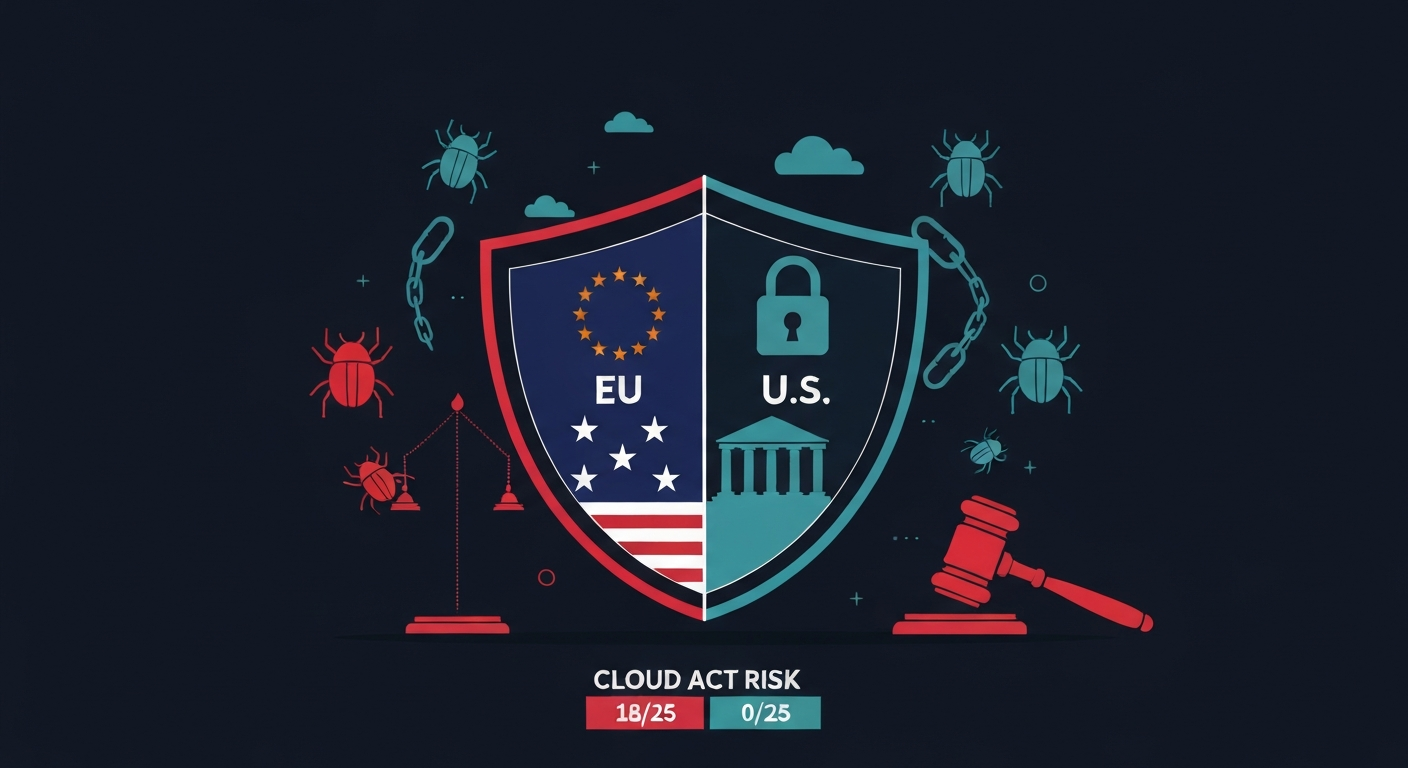
HackerOne is the dominant bug bounty and vulnerability disclosure platform used by hundreds of European enterprises, banks, and government agencies. But here is what the GDPR compliance team rarely considers: every vulnerability report submitted to your HackerOne program — every CVE finding, every pentest scope, every disclosed weakness in your EU systems — is stored under the jurisdiction of a Delaware corporation majority-owned by US private equity.
Under the US CLOUD Act (18 U.S.C. § 2713), the US Department of Justice can compel HackerOne to produce that data with no requirement to notify the affected European company. The result is what we call the Vulnerability Sovereignty Paradox: European organisations invest heavily in finding their own vulnerabilities, then hand a comprehensive map of those vulnerabilities to a US-jurisdiction platform where intelligence agencies can request access.
HackerOne Corporate Structure
HackerOne Inc. is incorporated in Delaware (C-Corporation). The company is headquartered at 548 Market Street, San Francisco, California.
Francisco Partners (San Francisco private equity) holds a significant majority stake following their 2022 investment round. Francisco Partners manages over $45 billion in assets and has a portfolio that includes multiple technology and cybersecurity companies with US federal government relationships.
Francisco Partners is a US person under the CLOUD Act. This means that CLOUD Act obligations extend through Francisco Partners' ownership position to every platform it controls, including HackerOne.
Previous investors include Benchmark Capital, New Enterprise Associates (NEA), Draper Associates, and Valor Equity Partners — all US-headquartered venture capital firms. No EU-based investor holds a controlling or influential stake.
What Data HackerOne Holds About Your Systems
The data sensitivity of bug bounty and VDP platforms is uniquely high. When your European organisation runs a HackerOne program, the platform accumulates:
Vulnerability reports: Detailed technical descriptions of security weaknesses in your production systems, including attack vectors, proof-of-concept code, and reproduction steps.
Pentest scope and findings: If you use HackerOne Pentest (managed pentest service), the full scope definition — which systems are in scope, their IP ranges, API endpoints, authentication mechanisms — is held in HackerOne infrastructure.
Triage data: HackerOne Response (their triage service) processes incoming vulnerability reports on your behalf. This means third-party contractors under HackerOne's employment review and classify vulnerabilities in your EU systems.
Hacker identities and payment data: The identities of researchers who disclosed vulnerabilities to you, and the amounts paid per finding, are stored in HackerOne's US-jurisdiction infrastructure.
CVSS scores and severity ratings: Your internal severity assessment of each vulnerability — which findings are critical, which are high, which are accepted risk — creates a priority map of your attack surface.
For a European bank, hospital network, or critical infrastructure operator, this data constitutes a comprehensive offensive intelligence package. Under CLOUD Act §2713, the US DOJ could compel HackerOne to produce all of it.
CLOUD Act Risk Score: 18/25
We apply the same five-dimension framework used throughout this series to assess CLOUD Act exposure.
D1 — Corporate Jurisdiction (5/5)
HackerOne Inc. is a Delaware C-Corporation. Francisco Partners, the majority owner, is a San Francisco-based limited partnership. Both are unambiguously "US persons" under 18 U.S.C. § 2523(6). There is no parent company in a GDPR-adequate third country that might shield data from US government access requests. Score: 5/5.
D2 — Government Relationships (3/5)
HackerOne has deep, documented relationships with US government agencies:
- Hack the Pentagon (2016): HackerOne ran the first US federal bug bounty program for the US Department of Defense. This established HackerOne as a trusted DoD vendor.
- DC3 Partnership: HackerOne partners with the DoD Cyber Crime Center (DC3) for vulnerability coordination.
- US Federal VDP Programs: Multiple US federal agencies — including the Department of Homeland Security, Department of State, and Department of Defense — run active Vulnerability Disclosure Programs on HackerOne.
- CISA Coordination: HackerOne has worked with CISA (Cybersecurity and Infrastructure Security Agency) on coordinated vulnerability disclosure.
While HackerOne does not hold a FedRAMP Authorization (which would indicate the highest level of US government cloud integration), the depth of active federal agency partnerships creates material CLOUD Act exposure beyond a standard commercial SaaS relationship. Score: 3/5.
D3 — Data Sensitivity (5/5)
This is the dimension where bug bounty platforms differ fundamentally from all other security SaaS categories.
When Tenable holds your vulnerability scan data, it holds which CVEs exist in your environment. When HackerOne holds your bug bounty data, it holds how to exploit them — with working proof-of-concept code, reproduction steps, and attacker-perspective analysis provided by professional security researchers.
A CLOUD Act production order against HackerOne for an EU critical infrastructure operator's program data would yield:
- A prioritised list of that organisation's exploitable vulnerabilities
- Technical exploitation details sufficient for offensive operations
- The organisation's own internal severity assessment and risk acceptance decisions
- The identities of external researchers who know about those vulnerabilities
No other security tool category creates this exact combination. CLOUD Act access to a comprehensive bug bounty program history is functionally equivalent to having conducted a red team exercise against the target organisation. Score: 5/5.
D4 — Data Location (3/5)
HackerOne infrastructure runs primarily on AWS in US-East regions. The company offers limited data residency options for enterprise customers, with some EU-region hosting available under certain contract tiers. However, "EU data centre" in AWS eu-west-1 or eu-central-1 does not confer sovereignty — AWS is a US company, and AWS infrastructure in Ireland or Frankfurt falls under CLOUD Act jurisdiction.
HackerOne does not offer a dedicated EU-sovereign deployment option equivalent to, for example, a German-sovereign cloud with no CLOUD Act exposure. Score: 3/5.
D5 — Encryption and Sovereign Controls (2/5)
HackerOne does not offer customer-managed encryption keys (CMEK) that would prevent platform-level access to report content. The platform uses standard transport and at-rest encryption managed by HackerOne. There is no option for EU-sovereign key management, no hardware security module (HSM) integration under EU control, and no technical mechanism that would prevent HackerOne from producing plaintext vulnerability report data in response to a CLOUD Act production order. Score: 2/5.
Total CLOUD Act Risk Score: 18/25
| Dimension | Score | Rationale |
|---|---|---|
| D1 Corporate Jurisdiction | 5/5 | Delaware C-Corp + Francisco Partners PE (US person) |
| D2 Government Relationships | 3/5 | DoD VDP, Hack the Pentagon, DC3 partnership, CISA coordination |
| D3 Data Sensitivity | 5/5 | Exploitation details + attack surface map under US jurisdiction |
| D4 Data Location | 3/5 | AWS US-primary, EU region available but not sovereign |
| D5 Encryption/Sovereign Controls | 2/5 | No CMEK, no EU-sovereign key management option |
| Total | 18/25 |
The Vulnerability Sovereignty Paradox
The core problem is not that HackerOne is a bad platform — it is widely considered the market leader for good reasons. The problem is structural.
European organisations subject to NIS2, DORA, or GDPR have a legal obligation to manage the security of their systems. Running a bug bounty program is a responsible, proactive security measure. But the dominant platforms for running those programs are US-jurisdiction entities where the most sensitive output of your security programme — the map of your own vulnerabilities — is compellable by US government order.
The paradox: the more seriously you take security, the more vulnerability intelligence you accumulate in a US-jurisdiction platform.
For NIS2 Article 21(2)(d) (supply chain security) this creates a concrete compliance question: Does using a US-jurisdiction VDP platform constitute an acceptable supply chain security risk when the platform holds a comprehensive vulnerability database for your critical infrastructure?
For GDPR Article 32 (security of processing), the question is whether routing vulnerability information about EU data processing systems through a US-jurisdiction platform meets the "appropriate technical and organisational measures" standard when that platform is subject to compelled disclosure.
For DORA Article 28 (ICT third-party risk management), financial institutions must assess whether their "critical ICT third-party providers" create unacceptable concentration risk — and a US-jurisdiction repository of their own exploitable vulnerabilities is precisely the kind of risk DORA was designed to surface.
EU-Native Alternatives: 0/25 CLOUD Act Score
Two EU-headquartered bug bounty and vulnerability disclosure platforms exist and are production-ready for enterprise use:
Intigriti — Belgium (0/25)
Intigriti (Intigriti NV, Antwerp, Belgium) is the largest European-headquartered bug bounty platform. Founded in 2016, the company is incorporated under Belgian law and operates exclusively within the EU legal framework.
- Jurisdiction: Belgian law, GDPR-native, EU data residency
- Data location: EU-only data centres (no US data processing)
- Hacker community: 70,000+ security researchers, strong European representation
- Enterprise customers: European banks, telecoms, and government agencies including multiple EU member state governments
- Certifications: ISO 27001, GDPR Article 28 DPA available
- Products: Bug Bounty, Vulnerability Disclosure Program, Pentest matching, HackerExperience (education)
- CLOUD Act score: 0/25 — Belgian NV, no US corporate parent, no US PE ownership, EU data centres
Key differentiators vs. HackerOne: Intigriti has comparable researcher community depth for European targets, stronger EU regulatory expertise, and native GDPR compliance built into the platform rather than bolted on.
YesWeHack — France (0/25)
YesWeHack (YesWeHack SAS, Paris, France) is the second major EU-native bug bounty platform. Founded in 2013, the company operates under French law and GDPR.
- Jurisdiction: French law (SAS structure), EU data residency
- Data location: EU-only, French data centres
- Hacker community: 45,000+ security researchers with strong EU coverage
- Government customers: Multiple French government agencies, European Defence Fund coordination
- Products: Bug Bounty, VDP, Pentest management, Dojo (training)
- CLOUD Act score: 0/25 — French SAS, no US corporate parent, EU infrastructure
Key differentiators: Strong French government relationships, native support for ANSSI-aligned security processes, defence-sector expertise.
Self-Hosted VDP with EU-Native Tools (0/25)
For organisations that require complete control over vulnerability disclosure infrastructure:
- Disclose.io: Open-source VDP framework (policy templates, not a SaaS platform)
- Bugzilla / Jira (self-hosted): Vulnerability tracking with EU-hosted infrastructure
- OpenBugBounty: Community-managed coordinated disclosure (for web vulnerabilities specifically)
Self-hosted is significantly higher operational overhead but offers complete data sovereignty.
NIS2 and DORA Compliance Implications
NIS2 Article 23 requires essential and important entities to notify their national CSIRT of significant incidents within 24 hours. If vulnerability information is stored in a US-jurisdiction platform, a US government CLOUD Act request during an active incident investigation could create a scenario where US agencies have access to incident data before the EU organisation has completed its NIS2 notification obligations.
NIS2 Article 7 establishes national CSIRTs and coordinated vulnerability disclosure frameworks within the EU. The NIS2 intent is that vulnerability information about EU critical infrastructure flows through EU-jurisdiction coordination channels. Running VDPs through US-jurisdiction platforms creates a structural misalignment with this policy intent.
DORA Article 28 requires financial entities to identify and manage ICT third-party risk, including "concentration risk" from reliance on a single ICT provider or providers under a single jurisdiction. For EU financial institutions using HackerOne as their primary VDP/bug bounty platform, the CLOUD Act exposure of that platform is a material risk to be assessed and documented in the third-party risk register.
GDPR Article 32 requires "appropriate technical and organisational measures to ensure a level of security appropriate to the risk." For a data controller processing data about EU citizens, the argument that routing vulnerability information about your EU data processing systems through a US-jurisdiction platform is "appropriate" becomes increasingly difficult to sustain as regulators focus on CLOUD Act risk.
Decision Framework: When to Switch
| Organisation Type | Assessment | Recommendation |
|---|---|---|
| EU Critical Infrastructure (NIS2 Essential Entity) | CLOUD Act risk for vulnerability data is material NIS2 supply chain risk | Migrate to Intigriti or YesWeHack |
| EU Financial Institution (DORA scope) | VDP platform is ICT third-party under DORA Art.28 risk framework | Document risk + migrate within DORA third-party roadmap |
| EU Public Sector / Government | Vulnerability data for government systems should remain under EU jurisdiction | Migrate immediately — Intigriti has government programme experience |
| EU Mid-Market (GDPR only, not NIS2/DORA) | Material GDPR Art.32 risk for vulnerability-related personal data | Evaluate migration; Intigriti/YesWeHack offer comparable capabilities |
| EU Startup / SME | Limited compliance burden, HackerOne's larger researcher community may justify risk | Document risk assessment; revisit at first NIS2 audit |
Migration Considerations
Migrating a live bug bounty program from HackerOne to Intigriti or YesWeHack involves:
Hacker community continuity: Both Intigriti and YesWeHack have overlapping researcher communities with HackerOne. EU-based researchers often participate in all three platforms. Expect some transition period as researchers discover and join your new program.
Historical report data: Export all historical vulnerability reports before migration. HackerOne supports data exports under GDPR Article 20 (data portability) for reports associated with your organisation.
Triage continuity: If you use HackerOne Response (managed triage), both Intigriti and YesWeHack offer managed triage services with EU-based triage analysts.
Integration migration: HackerOne integrations with Jira, ServiceNow, Slack, and PagerDuty exist on both EU platforms with comparable functionality.
Timeline: Expect 4–8 weeks for a full program migration including data export, new program setup, researcher notification, and integration reconfiguration.
Conclusion
HackerOne's 18/25 CLOUD Act risk score reflects both its unambiguous US corporate structure and the exceptional sensitivity of the data it holds. Vulnerability reports, pentest findings, and VDP disclosures for European organisations are some of the most operationally sensitive data in existence — and storing them in a US-jurisdiction platform creates legal exposure that EU regulators are only beginning to examine systematically.
The EU-native alternatives — Intigriti in Belgium and YesWeHack in France — are production-ready enterprise platforms with comparable features and growing researcher communities. Both offer 0/25 CLOUD Act scores through EU incorporation, EU data centres, and no US corporate parentage.
For European organisations subject to NIS2, DORA, or operating critical infrastructure, the vulnerability sovereignty question deserves explicit board-level attention. The next post in this series examines Bugcrowd EU Alternative 2026, where the private equity ownership structure creates additional CLOUD Act considerations.
Next in the EU Bug Bounty & Pentest Series: Bugcrowd EU Alternative 2026 — PE Ownership and CLOUD Act in Managed Bug Bounty. See all sota.io EU Security posts.
EU-Native Hosting
Ready to move to EU-sovereign infrastructure?
sota.io is a German-hosted PaaS — no CLOUD Act exposure, no US jurisdiction, full GDPR compliance by design. Deploy your first app in minutes.