Bigeye EU Alternative 2026 — Data Quality Monitoring CLOUD Act & VC Dissolution Risk
Post #1295 in the sota.io EU Cyber Compliance Series
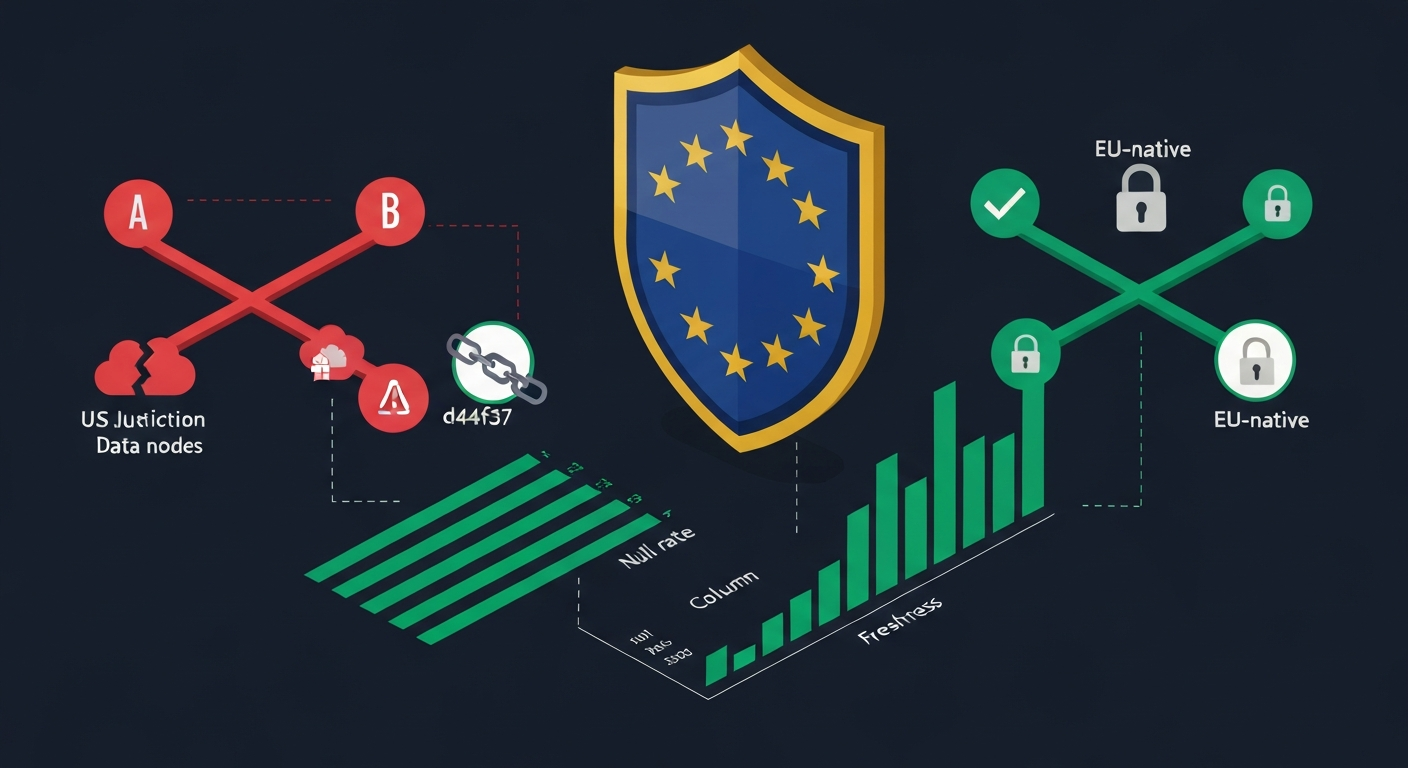
Bigeye positioned itself as the data quality monitoring platform built for data engineers. Its automated data freshness checks, volume anomaly detection, and field-level quality metrics were designed to catch data issues before they reached analysts and decision-makers. For EU enterprises with GDPR Art.5(1)(d) accuracy obligations and DORA data integrity requirements, the pitch was persuasive.
The problem: Bigeye was a Delaware C-Corp headquartered in San Francisco, backed by Sequoia Capital and Tiger Global — US entities that bring automatic CLOUD Act jurisdiction. Its platform ingested column-level statistics, pipeline metadata, and schema information from customer data warehouses under US legal jurisdiction. In 2023, Bigeye ceased independent operations, transferring its technology and customer relationships to a new corporate owner.
This transfer introduces a risk pattern that EU data teams rarely account for: the CLOUD Act follows data through acquisition. When a VC-backed US startup changes hands, there is no contractual mechanism that protects EU customer data from the jurisdiction of the acquirer.
This post quantifies Bigeye's CLOUD Act exposure, names three risk patterns specific to data quality monitoring platforms, and identifies sovereignty-safe EU alternatives that eliminate acquisition risk entirely.
Bigeye — Corporate Structure
Legal entity: Bigeye Data, Inc.
Incorporation: Delaware, USA
Headquarters: San Francisco, California
Founded: 2019 by Kyle Kirwan and Egor Gryaznov
Status: Ceased independent operations (2023); technology and team absorbed by acquirer
Investor jurisdiction:
- Sequoia Capital — Menlo Park, California (US VC, flagship fund)
- Tiger Global Management — New York, New York (US hedge fund / growth equity)
- Additional early-stage investors — US-domiciled
Both lead investors are US entities. Under 18 U.S.C. § 2703 (the CLOUD Act), a US court order can compel Bigeye — and any successor entity — to produce customer data, metadata, and communications held anywhere in the world, regardless of where that data is stored.
The 2023 acquisition introduces a second layer: the successor entity has its own corporate structure, investor base, and CLOUD Act exposure. EU customers who never consented to a data transfer to a new corporate entity find their quality monitoring metadata — and any associated personal data — in a new legal relationship they did not choose.
CLOUD Act Scoring: Bigeye Data (17/25)
| Dimension | Score | Evidence |
|---|---|---|
| D1: Corporate Domicile | 5/5 | Delaware C-Corp, US headquarters |
| D2: Data Center Location | 3/5 | AWS US infrastructure; EU deployment optional, not default |
| D3: Investor/Board Control | 4/5 | Sequoia + Tiger Global — both US entities |
| D4: Personnel Jurisdiction | 3/5 | Engineering and legal team based in San Francisco |
| D5: Contractual Sovereignty | 2/5 | Standard SaaS DPA; no CLOUD Act contractual limitations |
| TOTAL | 17/25 | High CLOUD Act exposure |
For comparison: EU-native Soda.io (Brussels, Belgium) scores 0/25 — no US corporate parent, no US investors, no contractual exposure.
Three Named Risk Patterns
Pattern 1: The Acquisition Risk Transfer Pattern
Standard GDPR data processing agreements (DPAs) require your data processor to notify you of sub-processor changes. When a vendor is acquired, the acquirer typically becomes a new processor — and your DPA may require you to acknowledge that change.
Here is the structural problem: no DPA clause can override the CLOUD Act. When Bigeye transferred operations to a new entity, its customer data — including all monitoring configurations, schema metadata, and historical anomaly records — transferred under that entity's jurisdiction. The new entity has its own corporate structure, its own US legal exposure, and its own CLOUD Act obligations.
EU GDPR Art.28(2) requires that a processor only engages a sub-processor with prior specific or general written authorisation from the controller. An acquisition can be structured as a business transfer that bypasses the sub-processor notification requirement. Even when notification occurs, the practical reality is: EU customers cannot refuse the data transfer to the acquirer without terminating the service.
For EU data teams evaluating any VC-backed US data quality tool, acquisition risk is not theoretical. The typical VC-backed startup has a 5-7 year horizon to exit via acquisition or IPO. An IPO expands CLOUD Act exposure (public company, broader legal discovery obligations); an acquisition transfers it to a new entity. Neither outcome benefits EU customers.
The only structural protection: choose a vendor with no exit incentive. EU-native companies with EU investors have no US CLOUD Act exposure regardless of whether they're acquired by another EU entity.
Pattern 2: The Column Statistics Fingerprint
Data quality platforms like Bigeye operate by collecting column-level statistics from your data warehouse: null rates, uniqueness rates, distribution histograms, value frequency counts, freshness timestamps. This statistical profiling is the core of automated quality monitoring.
The privacy risk is non-obvious: column statistics can constitute personal data under GDPR Art.4(1).
Consider a customer table with columns customer_email, phone_number, and date_of_birth. Bigeye would collect:
- Null rate for
customer_email(e.g., 0.3%) - Uniqueness rate for
customer_email(e.g., 99.7%) - Freshness of
created_atcolumn (e.g., last record 14 minutes ago) - Row count trends (e.g., 12,450 new customers this week)
Individually, these statistics are anonymous. But combined with schema structure — particularly for healthcare, financial services, or HR datasets — the statistics become a metadata fingerprint that:
- Reveals the existence of sensitive personal data categories (GDPR Art.9)
- Shows the volume of data subjects being processed
- Exposes processing patterns that regulators and litigants could use to infer processing purposes
Under GDPR Art.35(3)(b), high-risk processing that involves "large-scale processing of special categories of data" requires a Data Protection Impact Assessment (DPIA). Your DPIA documents what sensitive data you hold. The column statistics in Bigeye describe that data in numeric terms. Both describe the same underlying reality — but only the DPIA stays in EU jurisdiction.
A CLOUD Act request targeting Bigeye for column statistics across customer and healthcare tables would not access raw PII — but it would produce a detailed quantitative profile of your EU personal data processing operations.
Pattern 3: The VC Dissolution Jurisdiction Gap
The standard scenario for cloud service agreements assumes continuity: the vendor continues operating, processes your data under your DPA, and you can terminate and request data deletion at any time.
Startup dissolution or distressed acquisition breaks this assumption. When a VC-backed US startup runs out of funding before an exit:
-
Data persistence after termination: Shutdown procedures may not include guaranteed secure deletion of customer data. In a distressed dissolution, engineering resources are minimal and contractual obligations may not be fulfilled.
-
Bankruptcy transfer: Under US Chapter 7 or Chapter 11 proceedings, customer data is a corporate asset. A bankruptcy trustee can authorise the sale of customer data to a third party. Your DPA with the original vendor does not automatically bind the trustee or the acquiring entity in bankruptcy.
-
CLOUD Act exposure during wind-down: A company in wind-down status is not immune from CLOUD Act requests. Law enforcement can serve orders during the dissolution period. The company's obligation to comply does not expire with its business operations.
GDPR Art.28(3)(g) requires your DPA to specify that the processor "deletes or returns all the personal data to the controller after the end of the provision of services." In a US bankruptcy scenario, this contractual clause is superseded by US bankruptcy law.
The practical risk: if you processed EU personal data through Bigeye during its active period, the metadata about that processing — anomaly records, schema history, quality check results — may persist in systems beyond your contractual reach.
EU-Native Alternatives
Soda Core — Brussels, Belgium (0/25 CLOUD Act)
Soda was founded in Brussels and maintains its operational headquarters there. It has raised European investment, maintains no US corporate parent, and has no CLOUD Act exposure.
Architecture:
- Soda Core (Apache 2.0 open-source): Python library that runs data quality checks entirely inside your infrastructure
- Soda Cloud (optional): EU-hosted SaaS observability layer for alerting, dashboarding, and incident management
- Integrates with Snowflake, BigQuery, PostgreSQL, Databricks, dbt, Apache Spark, Pandas
The key sovereign design: Column statistics never leave your infrastructure when you run Soda Core as a library. Check results can be sent to Soda Cloud (EU-hosted) or to your own data warehouse — the data flow is entirely within your control.
# soda/checks/orders.yml — runs entirely inside your infrastructure
checks for orders:
  - row_count > 0:
      name: Orders table is populated
  - missing_count(customer_email) = 0:
      name: All orders have customer email
  - duplicate_count(order_id) = 0:
      name: No duplicate orders
  - freshness(updated_at) < 4h:
      name: Orders refreshed within 4 hours
  - values in (status) must exist in [pending, processing, shipped, delivered, cancelled]:
      name: Valid order status values only
GDPR Art.28 DPA advantage: Soda.io as a Brussels-based entity means your DPA is with an EU-established processor. GDPR Chapter V restrictions on international data transfers do not apply. No SCCs required. No transfer impact assessment needed.
DORA fit: For financial entities, Soda.io's EU domicile means the platform can support DORA Art.28 ICT third-party risk management requirements without the CLOUD Act conflict that US alternatives create.
Great Expectations OSS (0/25 — Fully Self-Hosted)
License: Apache 2.0
Governance: Open-source, no controlling US entity when self-hosted
CLOUD Act exposure: 0/25
Great Expectations runs as a Python library inside your infrastructure with no external dependencies. It generates "Expectation Suites" (machine-readable data quality contracts) and produces HTML Data Docs reports that remain in your environment.
import great_expectations as gx

context = gx.get_context()

# Define expectations — all executed locally
validator = context.sources.pandas_default.read_dataframe(df)

validator.expect_column_values_to_not_be_null("customer_id")
validator.expect_column_to_exist("customer_email")
validator.expect_column_values_to_match_regex(
    "customer_email",
    r"^[a-zA-Z0-9._%+-]+@[a-zA-Z0-9.-]+\.[a-zA-Z]{2,}$"
)
validator.expect_column_unique_value_count_to_be_between(
    "country_code", min_value=1, max_value=50
)

results = validator.validate()
# Results stored in your infrastructure — zero external calls
No API keys. No cloud dependency. No CLOUD Act exposure. No acquisition risk.
dbt Tests (0/25 — If You Already Use dbt)
If your data transformation stack uses dbt, its built-in test framework provides data quality checks without adding any external dependency:
# models/schema.yml
models:
  - name: orders
    columns:
      - name: order_id
        tests:
          - not_null
          - unique
      - name: customer_email
        tests:
          - not_null
      - name: status
        tests:
          - accepted_values:
              values: ['pending', 'processing', 'shipped', 'delivered', 'cancelled']
dbt tests run in your data warehouse. Results are stored in your environment. Zero CLOUD Act exposure. No additional vendor relationship required.
Atlan (Post-Acquisition of Bigeye — Conditional)
Atlan, which absorbed Bigeye's technology and team in 2023, is incorporated in Singapore with engineering operations in India and a sales presence in the United States. Its CLOUD Act exposure depends on US entity structure and investor jurisdiction — a separate analysis is required. The key point: inheriting Bigeye's capabilities through Atlan does not eliminate CLOUD Act risk; it transfers it to a new, more complex corporate structure.
Migration: Bigeye → Soda Core
For teams that implemented Bigeye monitors and need to migrate to a sovereign alternative:
Step 1: Export Bigeye monitor inventory
If Bigeye is still accessible via your account, export your existing monitors before access lapses. For teams where access has already terminated, reconstruct from your data models and business requirements.
Step 2: Map Bigeye concepts to Soda Core equivalents
# Bigeye freshness monitor → Soda freshness check
checks for ${table_name}:
  - freshness(${timestamp_column}) < ${threshold_hours}h

# Bigeye volume monitor → Soda row_count check
  - row_count between ${min_volume} and ${max_volume}:
      name: Volume within expected range

# Bigeye null rate monitor → Soda missing_count check
  - missing_count(${column_name}) < ${null_threshold}:
      name: Null rate acceptable

# Bigeye uniqueness monitor → Soda duplicate_count check
  - duplicate_count(${column_name}) = 0:
      name: No duplicates in ${column_name}
Step 3: Update your GDPR documentation
Remove Bigeye from your GDPR Art.30 Record of Processing Activities (RoPA). Add Soda.io (Brussels) as the new processing entity — or note that Soda Core processes no data outside your infrastructure.
If you maintained a Data Transfer Impact Assessment (DTIA) for Bigeye as a US processor, that assessment is no longer required for Soda Core.
Step 4: Update vendor risk register
For DORA-regulated entities: update your ICT third-party provider register. Remove Bigeye and any successor entity. Document Soda.io as the replacement, noting EU domicile and 0/25 CLOUD Act score.
For NIS2 compliance under Art.21(2)(g): the supply chain risk assessment should reflect the transition from US-exposed to EU-native tooling.
EU Data Quality Regulatory Framework
GDPR Art.5(1)(d) — Accuracy: personal data must be accurate and kept up to date. Data quality monitoring is the technical implementation of this obligation. The irony: implementing GDPR Art.5(1)(d) compliance through a CLOUD Act-exposed US platform creates a GDPR Art.46 violation — international data transfer without adequate safeguards.
GDPR Art.35(3)(b) — DPIA for large-scale special category data: if your quality monitoring covers tables containing health, financial, or biometric data, a DPIA is required. The DPIA must assess risks including third-party CLOUD Act exposure.
DORA Annex I, Section 3 — Data quality management: ICT risk management for financial entities must include data quality controls. DORA Art.28 requires that ICT third-party providers meet information security standards under EU regulatory oversight — a US CLOUD Act-exposed platform creates direct conflict.
NIS2 Art.21(2)(g) — Supply chain security: data quality infrastructure is critical supply chain. The dissolution of Bigeye and data transfer to an acquirer illustrates exactly the supply chain risk that NIS2 Art.21 was designed to address.
EU Data Quality Monitoring Comparison
| Tool | Jurisdiction | CLOUD Act | Self-Hosted | Acquisition Risk |
|---|---|---|---|---|
| Soda Core (OSS) | Brussels, BE 🇧🇪 | 0/25 ✅ | Yes (primary) | None |
| Soda Cloud | Brussels, BE 🇧🇪 | 0/25 ✅ | Optional | Low (EU-native) |
| Great Expectations | Self-hosted | 0/25 ✅ | Yes | None |
| dbt Tests | Self-hosted | 0/25 ✅ | Yes (dbt warehouse) | None |
| Elementary Data | Self-hosted | 0/25 ✅ | Yes (dbt-native) | None |
| Bigeye (Acquired) | Delaware, USA 🇺🇸 | 17/25 ❌ | No | High (acquired 2023) |
| Monte Carlo | Delaware, USA 🇺🇸 | 18/25 ❌ | No | Medium (unicorn) |
| Acceldata | Delaware, USA 🇺🇸 | 17/25 ❌ | No | Medium |
Decision Framework: Bigeye Replacement Selection
Are you migrating from Bigeye to an EU-native alternative?
│
├── Do you already use dbt?
│   ├── Yes → dbt Tests (zero new dependency)
│   │         + Elementary Data (dbt-native observability)
│   └── No → Soda Core (Python library) or Great Expectations
│
├── Do you need a managed SaaS dashboard (alerting, incidents)?
│   ├── Yes → Soda Cloud (Brussels, 0/25)
│   └── No → Soda Core OSS or Great Expectations (fully self-hosted)
│
├── Are you a DORA-regulated financial entity?
│   └── Yes → Soda.io (Brussels) preferred — EU supervisory alignment
│
└── Do you have special category data (GDPR Art.9)?
    └── Yes → Self-hosted only (Soda Core, GE, dbt Tests)
                Column statistics never leave your infrastructure
Verdict
Bigeye's 17/25 CLOUD Act score represents the standard structural exposure of any Delaware C-Corp data platform backed by US venture capital. The three risk patterns — Acquisition Risk Transfer, Column Statistics Fingerprint, and VC Dissolution Jurisdiction Gap — are not unique to Bigeye. They are inherent to the business model of US VC-backed data startups.
The Acquisition Risk Transfer Pattern is the most consequential for EU data teams evaluating vendors today: the CLOUD Act follows data through acquisition. A data quality platform that today has acceptable terms can acquire a new CLOUD Act exposure profile tomorrow through a corporate transaction that EU customers cannot block.
Soda Core (Brussels, 0/25) eliminates all three risks structurally. It is EU-native, no-acquisition-risk, and fully open-source when run as a library. For teams with existing dbt infrastructure, dbt Tests and Elementary Data achieve zero-dependency sovereignty with no migration overhead.
The lesson from Bigeye is not simply that a startup failed. It is that US VC-backed data infrastructure carries a lifecycle risk that EU enterprises cannot contractually manage. Choosing EU-native tooling removes the risk rather than managing it.
Part 3 of 5 in the sota.io EU Data Observability Tools Series.
See Part 1: Monte Carlo EU Alternative 2026 | See Part 2: Acceldata EU Alternative 2026
EU-Native Hosting
Ready to move to EU-sovereign infrastructure?
sota.io is a German-hosted PaaS — no CLOUD Act exposure, no US jurisdiction, full GDPR compliance by design. Deploy your first app in minutes.