Ansible EU Alternative 2026: Red Hat IBM Acquisition, CLOUD Act 20/25, and Sovereign Configuration Management
Post #2 in the sota.io EU IaC Tools Series
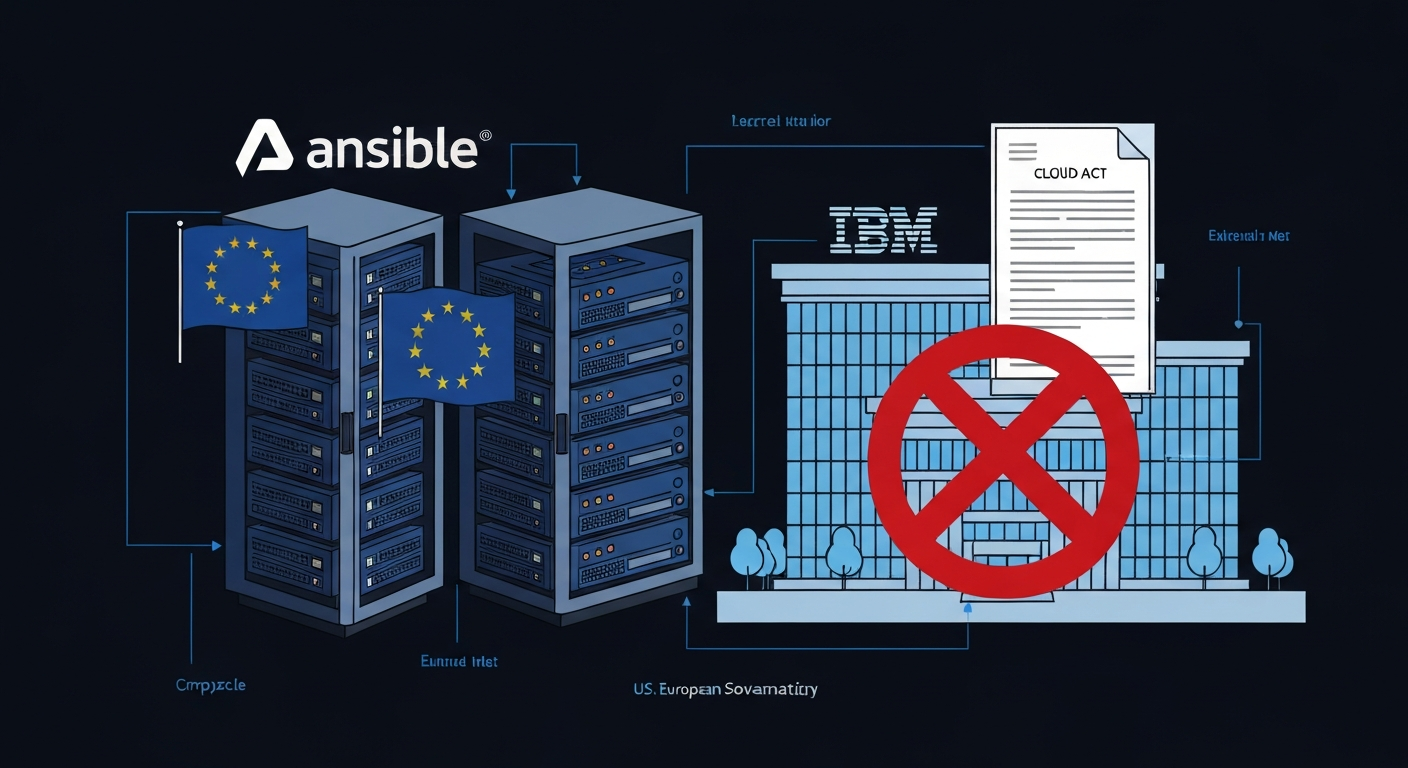
Ansible is the world's most widely deployed configuration management and automation platform — used by hundreds of thousands of organizations to manage server configurations, deploy applications, and orchestrate complex IT workflows. For EU engineering teams, the company story matters as much as the product story: Ansible is owned by Red Hat, which is owned by IBM. IBM is a US Delaware corporation listed on the NYSE, with full CLOUD Act obligations. That ownership chain reaches directly into every Ansible Automation Platform log, inventory record, and playbook execution stored in Red Hat's cloud services.
The IBM acquisition of Red Hat in 2019 for $34 billion was one of the largest software acquisitions in history. It gave IBM control of the entire Red Hat portfolio — including Ansible, OpenShift, RHEL, and the Ansible Automation Platform. For EU customers using any Red Hat cloud-backed service, that acquisition fundamentally changed the data governance question: your configuration data is no longer held by an independent open-source company but by a US public corporation with $60 billion in annual revenue, extensive US government contracts, and full exposure to CLOUD Act compulsion orders.
The practical consequence for EU Ansible users: if you run Ansible Automation Platform in its hosted or cloud-connected configuration, your infrastructure automation data — which can include hostnames, IP addresses, credentials references, playbook outputs, and full execution histories — is governed by a company that must comply with valid US government orders regardless of where your servers sit.
Red Hat and IBM: The Ownership Chain That Changes Everything
To understand the CLOUD Act risk, you need to understand the Red Hat corporate structure post-acquisition.
Red Hat Inc.:
- Incorporated in Delaware (since 1993)
- Headquartered in Raleigh, North Carolina
- Wholly-owned subsidiary of IBM Corporation since July 9, 2019
- ~20,000 employees worldwide; US engineering teams have full access to cloud infrastructure
- Continues to operate as a distinct brand but reports financially to IBM
IBM Corporation:
- Incorporated in New York (NYSE: IBM)
- Headquartered in Armonk, New York
- Market cap: ~$200 billion (2025)
- ~280,000 employees globally
- US largest institutional shareholders: Vanguard Group (~9%), BlackRock (~7%), State Street (~4%) — all US asset managers
- Extensive US federal government contracts: DoD, NSA, DHS, CIA (IBM's federal division processes classified workloads)
- Published National Security Letter (NSL) transparency report — IBM receives and complies with law enforcement requests
The CLOUD Act chain: IBM Corporation → Red Hat Inc. → Ansible Tower / Automation Platform. A US law enforcement order served on IBM or Red Hat carries legal force over all data held by their subsidiaries and services. The EU data residency of your managed nodes is irrelevant — what matters is who holds the control plane.
Ansible CLOUD Act Risk Score: 20/25
We use a 25-point rubric across five dimensions to measure CLOUD Act exposure. Ansible/Red Hat/IBM scores 20/25 — the highest in the EU IaC Tools Series.
| Dimension | Score | Rationale |
|---|---|---|
| US Corporate Jurisdiction | 5/5 | Red Hat is a Delaware C-Corp, 100% owned by IBM Corporation (NYSE). Zero EU holding entity between your data and US law |
| US Data Infrastructure | 4/5 | Ansible Automation Platform SaaS on IBM Cloud US; Ansible Galaxy on US servers; Red Hat Insights analytics in US |
| US Personnel Data Access | 4/5 | Red Hat's US engineering teams have full access to AAP cloud infrastructure; IBM global workforce with US management chain |
| US Investor & Board Control | 5/5 | IBM is 100% parent — shareholders are Vanguard, BlackRock, State Street (all US institutional). No independent EU board representation at Red Hat |
| Historical Government Cooperation | 2/5 | IBM publishes transparency reports confirming law enforcement request compliance; IBM Federal has active DoD/NSA contracts |
Score: 20/25 — CLOUD Act Maximum Risk. This is the highest score in the EU IaC Tools Series — higher than Pulumi (17/25) and matching Terraform/HashiCorp (IBM-acquired in 2024, 20/25). The IBM parent company with its federal government contracting history and US institutional investor base creates a uniquely high exposure profile.
The important nuance: open-source Ansible (the command-line tool and playbook runner) has zero CLOUD Act exposure when self-hosted on EU infrastructure. The risk is specific to Ansible Automation Platform's cloud services, Ansible Galaxy, and Red Hat Insights integration — the managed-service layer built on top of the open-source core.
Five GDPR Compliance Problems with Ansible Automation Platform Cloud
Problem 1: Ansible Automation Platform SaaS — Execution Data in IBM Cloud US
Red Hat offers Ansible Automation Platform (AAP) as a managed SaaS hosted on IBM Cloud. In this configuration, the AAP controller (formerly Ansible Tower) runs in IBM's infrastructure, not yours. Every playbook execution record — which hosts were targeted, what tasks ran, what the output was, when it ran, and which credentials were used — is stored in IBM Cloud data centers in the United States.
AAP cloud collects: playbook job history, host facts, inventory records, execution environment details, and stdout/stderr output. For production infrastructure, this output routinely contains sensitive information: file permissions, service configurations, network topology details, and user account states. Under CLOUD Act §2713, IBM must produce this execution history to US law enforcement with a valid court order — and may be prohibited from notifying Red Hat EU customers that their data was accessed.
GDPR implication: Execution logs are operational data derived from your EU-regulated systems. Storing them in IBM Cloud US without adequate safeguards violates Article 46 transfer requirements. Standard Contractual Clauses do not override CLOUD Act compulsion — Schrems II confirmed that contractual safeguards cannot neutralize a US law enforcement order.
Problem 2: Ansible Galaxy — Your Content Supply Chain in the US
Ansible Galaxy (galaxy.ansible.com) is Red Hat's community hub for sharing Ansible roles and collections. When your automation pipelines fetch collections from Galaxy during playbook execution, you are pulling content from Red Hat's US-hosted servers. Galaxy stores: collection download counts, namespace metadata, user account information, API token usage, and collection content analytics.
For EU teams using ansible-galaxy install or ansible-galaxy collection install in CI/CD pipelines, every collection fetch creates a network request to Red Hat's US servers. This is typically done with authenticated tokens, meaning Red Hat can correlate your collection downloads with your organization's automation activity patterns.
GDPR implication: Even if you self-host Ansible, using Ansible Galaxy with authenticated tokens creates a data flow to Red Hat/IBM US infrastructure. The collection download telemetry can reveal which automation patterns your organization uses — potentially sensitive competitive and operational intelligence subject to CLOUD Act compulsion.
Problem 3: Red Hat Insights — Automation Analytics Sent to the US
Red Hat Insights is an analytics service bundled with Red Hat subscriptions. When Insights is enabled (the default for new AAP installations), it sends automation analytics data to Red Hat's US infrastructure. This includes: playbook execution summaries, host counts, task success/failure rates, job template usage patterns, and cluster health metrics.
Insights Analytics is marketed as a "productivity" and "optimization" feature. It provides dashboards showing which automation is running across your organization. The cost: that aggregated picture of your infrastructure automation activity lives in IBM's US systems and is subject to CLOUD Act access.
GDPR implication: Insights data is operational metadata about your EU infrastructure. Organizations that disabled Insights before discovering this data flow may have already transferred months of automation analytics to Red Hat US. The opt-out mechanism exists but is not prominently documented during AAP installation.
Problem 4: Red Hat Customer Portal and Subscription Management
Red Hat subscription management requires periodic check-ins with the Red Hat Customer Portal (access.redhat.com), hosted in the United States. Registered RHEL and AAP systems submit subscription status data, system facts (hostname, CPU count, memory, OS version, installed packages), and entitlement checks to Red Hat's US servers.
For EU organizations running AAP on-premises with active subscriptions, this creates a steady-state data flow: your production server hostnames and hardware configurations are periodically transmitted to Red Hat/IBM US infrastructure as part of subscription compliance verification.
GDPR implication: System facts including hostnames are organizational data. For regulated industries (finance, healthcare, critical infrastructure), the hostname alone can reveal information about system purpose and data classification. Transmitting this to IBM US infrastructure requires a valid transfer mechanism — and remains vulnerable to CLOUD Act compulsion.
Problem 5: Ansible Lightspeed — AI Code Generation via IBM watsonx US
Red Hat Ansible Lightspeed (now generally available as part of AAP) provides AI-powered Ansible playbook generation. You describe what you want to automate in natural language, and Lightspeed generates the corresponding Ansible task or playbook. Lightspeed runs on IBM's watsonx.ai platform — hosted in IBM Cloud US data centers.
When Ansible Lightspeed is used, your natural-language prompts (which often describe infrastructure you want to configure) are sent to IBM watsonx US for inference. IBM's watsonx model for Ansible was trained on Ansible Galaxy content and is served from IBM's US AI infrastructure.
GDPR implication: Prompts describing your infrastructure automation intent are sent to IBM US AI infrastructure. For EU organizations in regulated sectors, describing which servers you want to configure, which services you're deploying, or which security policies you're enforcing via natural language prompts to IBM AI creates an uncontrolled cross-border data transfer.
EU-Sovereign Alternatives to Ansible Automation Platform
The central insight: community Ansible is EU-sovereign by default. AWX (the open-source upstream of Ansible Tower) and self-hosted playbook runners create zero CLOUD Act exposure when deployed on EU infrastructure. You are replacing the IBM-controlled managed-service layer, not the automation capability.
Option 1: AWX on EU Infrastructure (0/25 CLOUD Act)
What it is: AWX is the upstream open-source project from which Ansible Automation Platform is built. Red Hat open-sources the controller, UI, and API under the Apache 2.0 license — then adds subscription services and support for the enterprise AAP product.
How to self-host AWX:
# AWX Operator (Kubernetes)
kubectl apply -f https://raw.githubusercontent.com/ansible/awx-operator/devel/deploy/awx-operator.yaml

# Or Docker Compose (development/small deployments)
git clone https://github.com/ansible/awx.git
cd awx && make docker-compose
AWX provides: job scheduling, inventory management, credential vaulting, playbook execution, notification hooks, RBAC, and a full REST API — everything AAP offers minus Red Hat support and Insights analytics. Deployed on Hetzner Cloud, OVHcloud, or IONOS, AWX creates zero data flows to IBM US.
Cost comparison: AWX on a €30/month Hetzner VPS (4 vCPU / 8 GB RAM) replaces an Ansible Automation Platform subscription that costs $13,000–$50,000/year depending on managed node count. The self-hosting cost is under €400/year.
Option 2: Semaphore UI — Simpler Ansible Automation (0/25 CLOUD Act)
What it is: Semaphore (formerly Ansible Semaphore) is a lightweight open-source web UI for running Ansible playbooks. Written in Go, it provides: project management, task scheduling, inventory management, team access control, and execution history — without the complexity of AWX.
When to choose Semaphore over AWX: Smaller teams (under 50 people) that want a simpler operational model. AWX requires Kubernetes or Docker and has significant resource overhead. Semaphore runs as a single binary with a PostgreSQL backend.
# Semaphore via Docker
docker run -d \
  --name semaphore \
  -p 3000:3000 \
  -e SEMAPHORE_DB_DIALECT=postgres \
  -e SEMAPHORE_DB_HOST=your-pg-host \
  -e SEMAPHORE_DB_NAME=semaphore \
  -e SEMAPHORE_DB_USER=semaphore \
  -e SEMAPHORE_DB_PASS=yourpassword \
  semaphoreui/semaphore:latest
Semaphore is maintained by an independent open-source community with no IBM affiliation. Deployed on EU infrastructure, it provides zero CLOUD Act exposure.
Option 3: Gitea Actions + Ansible Runner (0/25 CLOUD Act)
What it is: For teams already using Gitea for self-hosted Git, the combination of Gitea Actions (CI/CD) and ansible-runner provides playbook automation without any external UI dependency. Ansible Runner is Red Hat's open-source library for programmatically running Ansible — it's the execution engine that AWX uses internally.
# .gitea/workflows/deploy.yml
name: Deploy Infrastructure
on:
  push:
    branches: [main]
jobs:
  ansible:
    runs-on: self-hosted
    steps:
      - uses: actions/checkout@v4
      - name: Run Ansible Playbook
        run: |
          ansible-runner run . \
            --playbook site.yml \
            --inventory inventory/prod \
            --artifact-dir artifacts/$(date +%Y%m%d)
This approach requires no additional UI tool — Gitea's built-in CI runner executes Ansible directly. Execution artifacts (logs, output) are stored in your self-hosted Gitea instance, never leaving EU infrastructure.
Option 4: Sovereign Ansible Galaxy Mirror (0/25 CLOUD Act)
For organizations that cannot avoid Ansible Galaxy dependencies: A private Automation Hub (Red Hat's enterprise equivalent of Ansible Galaxy) or an Artifact Manager like Pulp can mirror Galaxy content on EU infrastructure.
Red Hat open-sources Pulp (https://pulpproject.org/) — the same backend that powers Automation Hub. A Pulp instance on EU infrastructure can mirror Galaxy collections, serve them internally, and eliminate the need for galaxy.ansible.com network calls in CI/CD pipelines.
# Configure Ansible to use private Galaxy mirror
# /etc/ansible/ansible.cfg or ansible.cfg in project root
[galaxy]
server_list = my_org_hub

[galaxy_server.my_org_hub]
url=https://your-pulp-instance.eu/pulp/api/v3/
auth_url=https://your-pulp-instance.eu/pulp/api/v3/users/
token=your_pulp_token
This eliminates authenticated connections to Red Hat US while preserving the Galaxy collection ecosystem.
Migration Timeline: From AAP Cloud to AWX Self-Hosted
For organizations migrating from Ansible Automation Platform cloud to self-hosted AWX, a structured 4-week approach minimizes disruption.
Week 1 — Inventory and Assessment:
- Export AAP inventory (Hosts, Groups, Variables) via AAP API:
curl -u admin:pass https://your-aap.redhat.com/api/v2/inventories/?format=json - Document all Job Templates, Schedules, and Notification integrations
- Identify any Lightspeed (AI) usage — these prompts need to move to local LLM (Ollama on EU infrastructure)
- Disable Red Hat Insights:
insights-client --unregisteron all managed hosts
Week 2 — AWX Installation and Configuration:
- Deploy AWX on Hetzner Cloud (CX31: 2 vCPU, 8 GB RAM, €8.90/month is sufficient for under 500 managed nodes)
- Install AWX Operator on K3s (lightweight Kubernetes):
curl -sfL https://get.k3s.io | sh - - Configure AWX: Organizations, Teams, Credentials (use HashiCorp Vault EU or IONOS Secrets Manager)
- Import inventories from Week 1 export
Week 3 — Playbook Migration and Testing:
- Copy playbook repositories to self-hosted Gitea
- Configure AWX SCM integration pointing to internal Gitea
- Set up private Pulp Galaxy mirror if using external collections
- Run all critical playbooks in check mode (
--check) against staging inventories - Validate execution output matches AAP baseline
Week 4 — Cutover and Cleanup:
- Switch production schedules from AAP to AWX
- Monitor execution success rates for 72 hours
- Disable Red Hat subscription management check-in: configure
rhsmto disconnect or use offline certificates - Cancel AAP cloud subscription
- Document new architecture in internal runbooks
Estimated migration effort: 2–4 engineering weeks for a team managing under 1,000 nodes. The primary complexity is credential migration (ensure Vault integration replaces AAP's credential storage) and Insights disable/opt-out across managed hosts.
Cost Analysis: AAP Cloud vs. EU Self-Hosted
| Solution | Annual Cost | CLOUD Act Score | EU Data Residency |
|---|---|---|---|
| AAP Starter (up to 100 nodes) | ~$13,000/year | 20/25 (Maximum) | No (IBM Cloud US) |
| AAP Enterprise (500 nodes) | ~$50,000/year | 20/25 (Maximum) | No (IBM Cloud US) |
| AWX on Hetzner CX31 | ~€107/year | 0/25 | Yes (Hetzner DE/FI) |
| AWX on OVHcloud VPS | ~€144/year | 0/25 | Yes (OVH FR/DE) |
| Semaphore + Hetzner | ~€107/year | 0/25 | Yes (Hetzner DE) |
The cost differential is substantial. For mid-sized EU infrastructure teams, the migration from AAP cloud to self-hosted AWX typically pays back in under 3 months from subscription savings alone — before accounting for the GDPR compliance value.
Decision Matrix: Which Ansible Solution for Which EU Team
| Scenario | Recommended Solution | Rationale |
|---|---|---|
| Team of 3–15, managing under 200 nodes | Semaphore + Community Ansible | Lowest operational overhead, full EU sovereignty, no Kubernetes required |
| Team of 15–100, existing Kubernetes cluster | AWX on self-hosted K8s | Full AAP feature parity, existing ops skills apply |
| Team using GitHub Actions already | Migrate to Gitea Actions + ansible-runner | Consolidate CI/CD and automation, eliminate two US data flows |
| Enterprise, SOC 2 / ISO 27001 required | AWX + HashiCorp Vault (self-hosted) + Pulp | Full audit trail, credential segregation, no US dependencies |
| Currently using Lightspeed AI generation | AWX + Ollama (self-hosted LLM) | Replace IBM watsonx US with local inference, same UX |
The Open-Source Core: What Stays the Same
The migration from AAP to AWX-based automation preserves the entire Ansible ecosystem that makes the tool valuable:
- All existing playbooks: Community Ansible is 100% compatible. No rewriting.
- All Ansible modules: The module ecosystem (10,000+ modules on Galaxy) works identically with self-hosted runners
- Ansible Collections: Mirrored via Pulp, all existing
ansible.builtin,community.general,ansible.posixcollections work unchanged - YAML playbook format: Zero syntax changes required
- Inventory formats: INI, YAML, dynamic inventory scripts — all supported in AWX identically to AAP
- Vault-encrypted variables: Ansible Vault works identically; migrate secrets to HashiCorp Vault EU for zero-trust credential management
The only capabilities that change: Red Hat commercial support (replace with community support or third-party EU consultants), Insights analytics (replace with Prometheus + Grafana on self-hosted infrastructure), and Lightspeed AI (replace with Ollama running Mistral or Code Llama on EU infrastructure).
Ansible vs. Other EU IaC Tools: Where It Fits
In the EU IaC Tools Series, Ansible occupies a distinct niche from Terraform/Pulumi. The comparison matters for EU teams choosing between tools:
| Tool | Primary Use Case | CLOUD Act Score | Self-Hosted Option | EU Alternative |
|---|---|---|---|---|
| Ansible (Red Hat/IBM) | Configuration management, app deployment | 20/25 | AWX/Semaphore (0/25) | AWX on Hetzner |
| Pulumi (Pulumi Corp.) | Cloud resource provisioning (infrastructure) | 17/25 | CE + MinIO backend (0/25) | Self-hosted Pulumi CE |
| Terraform (HashiCorp/IBM) | Cloud resource provisioning | 20/25 | OpenTofu + EU S3 (0/25) | OpenTofu on Hetzner |
| Puppet (Perforce) | Configuration management | 16/25 | Puppet Community (0/25) | Self-hosted Puppet |
Ansible and Puppet serve overlapping purposes (configuration management, drift correction) but have different architectural philosophies: Ansible is agentless (SSH-based), while Puppet uses a persistent agent model. For EU teams currently split between Terraform (provisioning) and Ansible (configuration), the EU-sovereign path is: OpenTofu + AWX, both self-hosted on Hetzner or OVHcloud.
Summary: What EU Teams Should Do Now
-
Audit Insights: Run
insights-client --statuson your RHEL/AAP systems. If Insights is active, you have ongoing data flows to Red Hat US. Disable immediately if not contractually required. -
Assess AAP Cloud usage: If you use Red Hat's hosted AAP controller (not self-hosted), your execution data is in IBM Cloud US. Classify this under your GDPR transfer impact assessment.
-
Inventory Galaxy dependencies: Run
ansible-galaxy listto see what collections are installed. Determine which can be mirrored internally and which are developed by EU-based contributors (many RHEL collections are). -
Evaluate AWX migration: AWX is production-ready and deployed at enterprises worldwide. The migration risk is manageable — the technical capability is identical to AAP. The business risk of a CLOUD Act order against IBM/Red Hat is harder to quantify but real.
-
For new projects: Start with AWX on EU infrastructure from day one. The operational overhead of self-hosting AWX (primarily: Kubernetes deployment and ongoing upgrades) is significantly lower than managing a GDPR impact assessment for IBM US data exposure.
The IBM acquisition of Red Hat changed Ansible's data governance story fundamentally. The open-source tool itself remains EU-sovereign when self-hosted. The managed service layer — AAP cloud, Galaxy, Insights, Lightspeed — carries the full weight of IBM's US CLOUD Act obligations. For EU teams building GDPR-compliant infrastructure automation, the choice is clear: self-hosted AWX on EU infrastructure, not IBM's managed automation platform.
This post is part 2 of the sota.io EU IaC Tools Series. Next: Puppet (Perforce) — Configuration Management Under US Private Equity CLOUD Act Exposure.
See Also
- Pulumi EU Alternative 2026: Seattle-Based IaC, CLOUD Act 17/25 — Pulumi Cloud state files contain a complete blueprint of your EU infrastructure; every resource is compellable under CLOUD Act §2713 from Pulumi's Delaware-registered parent.
- Puppet EU Alternative 2026: Perforce Acquisition, CLOUD Act 16/25 — Puppet's US private-equity ownership mirrors the Red Hat/IBM story; Forge telemetry and CD4PE pipeline data carry the same CLOUD Act obligations.
- Chef EU Alternative 2026: Progress Software, CLOUD Act 18/25 — Chef and Ansible share the same IBM-adjacent acquisition pattern; Progress Software's NASDAQ-listed Delaware corp brings Automate telemetry under full US jurisdiction.
EU-Native Hosting
Ready to move to EU-sovereign infrastructure?
sota.io is a German-hosted PaaS — no CLOUD Act exposure, no US jurisdiction, full GDPR compliance by design. Deploy your first app in minutes.