Wasabi Hot Cloud Storage EU Alternative 2026: Why Massachusetts Law Follows Your EU Bucket
Post #3 in the sota.io EU Object Storage Series
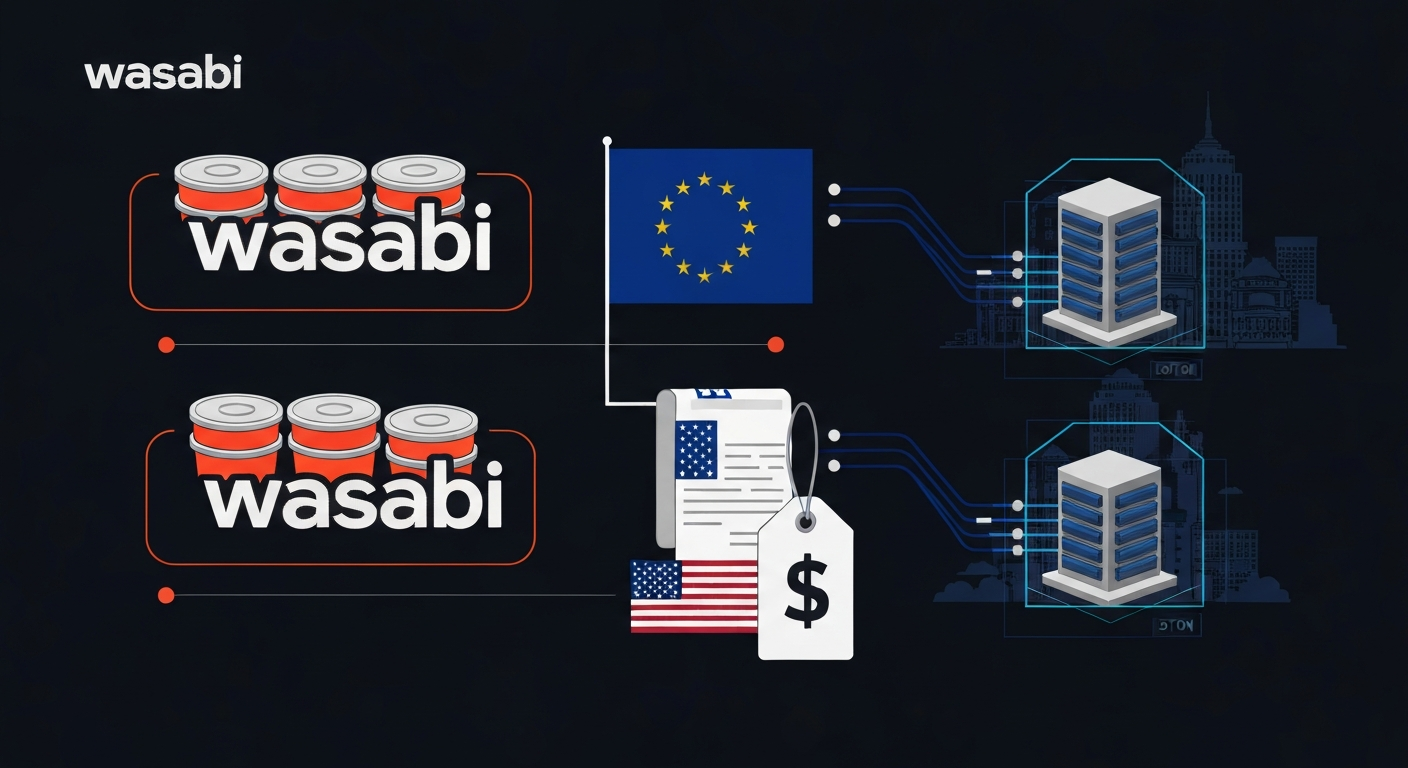
Wasabi Technologies markets "Hot Cloud Storage" aggressively to cost-conscious teams: $6.99 per TB per month, no egress fees, no API request charges, AWS S3-compatible. EU teams running on AWS S3 often move to Wasabi expecting both cost savings and a cleaner GDPR story — Wasabi has EU regions in Frankfurt, Paris, and London.
The GDPR story doesn't hold up. Wasabi Technologies, Inc. is a privately held Massachusetts corporation headquartered in Boston. It has no EU legal entity. Under the CLOUD Act (18 U.S.C. §2713), any US company can be compelled to disclose data held anywhere in the world — including in Frankfurt or Paris. Your EU bucket is under Massachusetts law whether you chose Frankfurt for latency reasons or data residency reasons.
This post is the third in our EU Object Storage Series. We covered Cloudflare R2 (16/25) and Backblaze B2 (13/25). Wasabi scores 14/25 on our CLOUD Act risk matrix.
What Is Wasabi Hot Cloud Storage?
Wasabi Technologies was founded in 2015 by David Friend and Jeff Flowers — the same team that built Carbonite, the consumer backup pioneer. Armed with that background in mass-market cloud storage economics, they designed Wasabi around a single thesis: object storage should be commodity-priced with no surprise bills.
The product is deliberately simple:
- One tier: "Hot" storage only — no cold, archive, or intelligent tiering
- One price: $6.99/TB/month (as of 2026)
- Zero egress fees: Download all you want
- Zero API request fees: GET, PUT, LIST are free
- S3-compatible: Drop-in replacement for AWS S3 with no SDK changes
Wasabi's EU presence spans three regions:
- eu-central-1 — Frankfurt, Germany
- eu-west-1 — London, United Kingdom (post-Brexit, UK GDPR territory)
- eu-west-2 — Paris, France
This geographic footprint is broad enough that most EU teams can find a region with acceptable latency. And Wasabi's pricing is genuinely compelling: compared to AWS S3's tiered pricing ($23/TB standard) or even the cheaper Backblaze B2 ($6/TB + egress), Wasabi's all-in $6.99 with zero egress is often the cheapest option for read-heavy workloads.
That's the pitch. Now the problem.
The CLOUD Act Problem: Massachusetts Law Is Not EU Law
Wasabi Technologies, Inc. — The Entity That Matters
Every Wasabi bucket agreement, every data processing relationship, every compelled disclosure risk flows through a single legal entity: Wasabi Technologies, Inc., incorporated under Massachusetts law, headquartered at 2 Copley Place, Suite 520, Boston, MA 02116.
Wasabi has no:
- EU subsidiary (no GmbH, SAS, ApS, or BV)
- EU Data Controller registration in any member state
- Binding Corporate Rules (BCR) filed with an EU supervisory authority
- Published EU Standard Contractual Clauses (SCCs) with a Transfer Impact Assessment (TIA) covering CLOUD Act risks
Without an EU legal entity, the entire GDPR compliance chain depends on Wasabi's contractual commitments as a US-based data processor. Those commitments cannot override US law.
CLOUD Act §2713 — The Worldwide Reach Clause
The CLOUD Act (Clarifying Lawful Overseas Use of Data Act, 2018) amended the Stored Communications Act to make explicit what courts had started to rule implicitly: US service providers must comply with lawful US legal process regardless of where the data is stored.
18 U.S.C. §2713:
"A provider of electronic communication service or remote computing service shall comply with the obligations of this chapter to preserve, backup, or disclose the contents of a wire or electronic communication and any record or other information pertaining to a customer or subscriber within such provider's control, regardless of whether such communication, record, or other information is located within or outside of the United States."
A US federal court order directed at Wasabi Technologies, Inc. in Boston reaches the Frankfurt eu-central-1 bucket. The EU region is a latency and cost choice, not a legal barrier.
The FBI/DOJ Process Against Private Companies
Wasabi is a private company — no NYSE ticker, no quarterly earnings calls, no government transparency reports. That opacity is a double-edged sword for GDPR compliance:
Less visible government contract exposure: Unlike AWS (extensive JEDI/DOD/IC contracts) or Microsoft (Azure Government), Wasabi has not publicized federal agency contracts. Lower government contract exposure means fewer routine government access scenarios.
No transparency reporting: AWS, Google Cloud, and Microsoft publish annual transparency reports showing how many government requests they receive and how many they push back on. Wasabi publishes nothing comparable. For a GDPR Art.28 processor assessment, the absence of transparency data is a risk factor — you cannot evaluate how Wasabi responds to law enforcement requests.
National Security Letters: NSLs (18 U.S.C. §2709) can be served on any US electronic communication provider with a gag order preventing disclosure to the affected customer. Wasabi, as a US "remote computing service," is squarely within NSL jurisdiction. No transparency report = no baseline for how often this happens.
CLOUD Act Risk Score: 14/25
We score providers on 25 risk factors across five categories (jurisdiction, government access, data handling, transparency, and architectural exposure).
| Category | Score | Key Factors |
|---|---|---|
| US Jurisdiction | 4/5 | Massachusetts private corp, no EU subsidiary |
| Government Access | 3/5 | No transparency reports, NSL-eligible, no federal contracts known |
| Data Handling | 3/5 | Control plane US, billing US, account data US |
| Transparency | 2/5 | No law enforcement transparency report, no BCR, no public TIA |
| Architectural Exposure | 2/5 | Storage-only product limits data accumulation compared to CDN/Zero-Trust providers |
Total: 14/25
For comparison:
- Cloudflare R2: 16/25 (CDN + Zero Trust + security products = more data accumulation surface)
- Backblaze B2: 13/25 (public company with some transparency; NASDAQ reporting obligations)
- Hetzner Object Storage: 0/25 (German GmbH, no US parent, no CLOUD Act)
- Scaleway Object Storage: 0/25 (French SAS under Iliad, no US parent)
Wasabi's 14/25 reflects genuine relative advantages (no federal contracts, storage-only attack surface) while marking the fundamental problem: full CLOUD Act exposure with zero transparency reporting.
Five GDPR Exposure Points for EU Teams Using Wasabi
1. Control Plane Lives in the United States
When you create a Wasabi bucket, configure IAM policies, generate API keys, or manage lifecycle rules, you interact with Wasabi's control plane APIs. These management APIs are operated from Wasabi's US infrastructure. Account authentication, access key generation, and bucket policy enforcement all run through US-jurisdictioned systems.
GDPR Art.28 implication: The processor relationship includes not just data storage but control plane operations. A US court can compel Wasabi to grant access to your bucket by targeting the control plane — without touching the Frankfurt data center directly.
Practical risk: If you store EU personal data (user-uploaded files, medical records, financial documents) and a US agency requests access, Wasabi complies through control plane access, not physical Frankfurt server access. EU data residency laws don't apply to control plane operations.
2. No EU Legal Entity Means No GDPR Art.3(2) Protection
GDPR Art.3(2) extends the regulation to controllers/processors established outside the EU when they offer goods or services to EU data subjects or monitor their behavior. But GDPR's territorial scope doesn't override the CLOUD Act — it applies in addition to US law, creating a conflict.
When GDPR and CLOUD Act conflict, US courts have consistently held that US law takes precedence for US companies. The EU court system has no enforcement mechanism over Wasabi Technologies, Inc. in Boston. Your GDPR DPA (Data Processing Agreement) with Wasabi is a contractual promise, not a legal shield against US government requests.
Schrems II (C-311/18) implication: The EU Court of Justice ruling in 2020 invalidated Privacy Shield and raised the bar for transatlantic data transfers. Standard Contractual Clauses remain valid, but only when supplementary measures adequately protect against third-country government access. With no published TIA addressing CLOUD Act risk, Wasabi cannot demonstrate those supplementary measures exist.
3. Account Data and Billing Under US Jurisdiction
Your Wasabi account metadata — email address, company name, payment information, usage statistics, API access logs — is stored and processed by Wasabi Technologies, Inc. in Massachusetts. This data is subject to US law regardless of which storage region you use.
Who cares about this data?
- Customs and Border Protection (CBP) has accessed cloud account metadata in travel investigations
- DOJ investigations routinely subpoena account records from cloud providers
- Financial regulators (FinCEN, OFAC) access billing data in sanctions enforcement
For EU companies processing personal data on behalf of EU data subjects, the data controller's account metadata at Wasabi is itself a personal data category requiring GDPR protection.
4. Compliance Monitoring Requires Data Egress to the US
Wasabi's analytics, usage reporting, and compliance logging infrastructure operates in the US. When you query bucket metrics, audit access logs, or configure event notifications, that operational data flows to Wasabi's US-based monitoring systems.
Under GDPR Art.32 (security of processing), controllers must implement appropriate technical measures including logging and monitoring. The monitoring infrastructure for those security measures runs under US jurisdiction — a nested compliance problem: your GDPR security monitoring is itself subject to CLOUD Act disclosure.
5. The "Free Egress" Trap: Longer Retention Risk
Wasabi's zero-egress-fee model is explicitly designed to encourage long-term retention. "There's no penalty for storing data long-term and accessing it frequently," says Wasabi's marketing. From a business model perspective, that's true — you're not punished for reads.
From a GDPR Art.5(1)(e) perspective (storage limitation principle), zero egress costs reduce the financial incentive to implement proper retention policies. Organizations that store data indefinitely on Wasabi "because it's cheap" accumulate GDPR liability. The CLOUD Act disclosure risk compounds over time — every year you retain EU personal data in Wasabi, you maintain a standing CLOUD Act exposure window.
Wasabi's EU Regions: What They Give You (and Don't)
Wasabi operates three EU-accessible regions:
| Region | Location | Notes |
|---|---|---|
| eu-central-1 | Frankfurt, Germany | Most popular for DACH-region teams |
| eu-west-1 | London, UK | UK GDPR territory (post-Brexit) — not EU GDPR |
| eu-west-2 | Paris, France | French CNIL jurisdiction |
What EU regions give you:
- Data residency (bytes stored in EU data centers)
- Lower latency for EU users
- No data transfer charges within the region
- GDPR Art.44 compliance for data-at-rest location
What EU regions don't give you:
- Exemption from CLOUD Act compelled disclosure
- EU legal entity for GDPR Art.28 processor contracts
- Protection from US national security process
- Transparency reporting on government requests
The Frankfurt bucket is physically in Germany. Legally, it's in Massachusetts.
EU-Native Object Storage Alternatives (0/25)
If you need object storage with genuine EU data sovereignty — no US parent, no CLOUD Act exposure — these providers score 0/25:
Hetzner Object Storage
Legal entity: Hetzner Online GmbH, Industriestraße 25, 91710 Gunzenhausen, Germany
Ownership: 100% German private company (Klaus Hetzner family), no US investor, no US parent
CLOUD Act exposure: None
Price: €0.0115/GB/month (~$12.65/TB) — roughly 2× Wasabi
S3 compatibility: Full AWS S3 API compatibility
Regions: FSN1 (Falkenstein, DE), NBG1 (Nuremberg, DE), HEL1 (Helsinki, FI)
Migration command:
# rclone migration from Wasabi eu-central-1 to Hetzner FSN1
rclone copy wasabi:your-bucket hetzner:your-bucket \
  --transfers=32 \
  --checkers=16 \
  --progress \
  --s3-chunk-size=128M
rclone.conf for Hetzner:
[hetzner]
type = s3
provider = Other
access_key_id = YOUR_HETZNER_ACCESS_KEY
secret_access_key = YOUR_HETZNER_SECRET_KEY
endpoint = fsn1.your-objectstorage.com
region = eu-central-1
Scaleway Object Storage
Legal entity: Scaleway SAS, 8 rue de la Ville l'Evêque, 75008 Paris, France (subsidiary of Iliad SA)
Ownership: Iliad SA (Xavier Niel), French telecom group, no US parent
CLOUD Act exposure: None
Price: €0.015/GB/month (~$16.50/TB)
S3 compatibility: Full AWS S3 API compatibility
Regions: fr-par (Paris), nl-ams (Amsterdam), pl-waw (Warsaw)
boto3 configuration:
import boto3

s3 = boto3.client(
    's3',
    endpoint_url='https://s3.fr-par.scw.cloud',
    aws_access_key_id='YOUR_SCALEWAY_ACCESS_KEY',
    aws_secret_access_key='YOUR_SCALEWAY_SECRET_KEY',
    region_name='fr-par'
)

# Standard S3 operations work unchanged
s3.upload_file('local_file.pdf', 'your-bucket', 'remote_key.pdf')
OVHcloud Object Storage
Legal entity: OVH SAS, 2 rue Kellermann, 59100 Roubaix, France
Ownership: OVH Groupe SA (French), Auchan Retail and family-controlled
CLOUD Act exposure: 1/25 (minor US operational exposure, no US parent)$9.35/TB) — cheapest EU-native option
Price: €0.0085/GB/month (
S3 compatibility: Full AWS S3 API compatibility
Regions: GRA (Gravelines, FR), SBG (Strasbourg, FR), UK (London, UK GDPR)
MinIO (Self-Hosted)
Legal entity: Your infrastructure
CLOUD Act exposure: Depends on VPS/bare-metal provider (0/25 on Hetzner or Scaleway)
Price: VPS cost only — effectively 0/25 at €0.005-0.008/GB on Hetzner
S3 compatibility: 100% — MinIO was designed as the S3-compatible EU-native answer
MinIO on Hetzner CCX13 (2 vCPU, 8GB RAM, €0.015/h):
# Deploy MinIO on Hetzner Cloud
docker run -d \
  -p 9000:9000 \
  -p 9001:9001 \
  -v /mnt/data:/data \
  --name minio \
  -e MINIO_ROOT_USER=minioadmin \
  -e MINIO_ROOT_PASSWORD=YOUR_STRONG_PASSWORD \
  quay.io/minio/minio server /data --console-address ":9001"
This gives you complete control: data stored on Hetzner German servers, no upstream US company in the data chain.
Storj DCS (Decentralized Cloud Storage)
Legal entity: Storj Labs, Inc. — US Delaware
CLOUD Act exposure: ~3/25 (US company, but data is end-to-end encrypted and sharded across nodes; Storj cannot access plaintext)
Price: $4/TB/month, $7/TB egress
Note: Not zero CLOUD Act exposure, but cryptographic architecture significantly limits what Storj can disclose. Requires careful SCA analysis.
Cost Analysis: Wasabi vs EU-Native Alternatives
Real-world costs for a typical SaaS application storing 10TB of user data with 3TB/month read egress:
| Provider | Storage (10TB) | Egress (3TB) | API Requests | Total/Month | CLOUD Act |
|---|---|---|---|---|---|
| Wasabi eu-central-1 | $69.90 | $0 | $0 | $69.90 | 14/25 |
| AWS S3 eu-central-1 | $230 | $81 | ~$5 | $316 | 21/25 |
| Backblaze B2 | $60 | $0 | $0 | $60 | 13/25 |
| OVHcloud GRA | €85 | €0* | €0 | ~$93 | ~1/25 |
| Hetzner FSN1 | €115 | €0† | €0 | ~$126 | 0/25 |
| Scaleway fr-par | €150 | included | €0 | ~$165 | 0/25 |
| MinIO on Hetzner CCX13 | €11 (VPS) | €0 | €0 | ~$12 | 0/25 |
*OVHcloud includes 10TB egress in storage price
†Hetzner includes 1TB egress per TB stored
The cost premium for EU sovereignty: Approximately 35-140% over Wasabi, depending on provider. Against the potential cost of a GDPR Art.83 fine (up to €20M or 4% of global annual turnover), the premium is modest risk insurance.
MinIO on Hetzner inverts the equation entirely — it's cheaper than Wasabi at scale while delivering better sovereignty guarantees.
Migration Guide: Wasabi to Hetzner Object Storage
A typical migration takes 2-4 weeks for production workloads. Here's the technical path:
Phase 1: Parallel Write (Week 1-2)
Configure your application to dual-write new objects to both Wasabi and Hetzner. Use a middleware wrapper that doesn't change your S3 interface:
import boto3
from botocore.config import Config

def create_dual_write_client(primary_endpoint, fallback_endpoint):
    """Write to both endpoints, read from primary."""

    primary = boto3.client('s3',
        endpoint_url=primary_endpoint,
        aws_access_key_id=PRIMARY_KEY,
        aws_secret_access_key=PRIMARY_SECRET,
        config=Config(retries={'max_attempts': 3})
    )

    fallback = boto3.client('s3',
        endpoint_url=fallback_endpoint,
        aws_access_key_id=FALLBACK_KEY,
        aws_secret_access_key=FALLBACK_SECRET,
        config=Config(retries={'max_attempts': 3})
    )

    return primary, fallback

def dual_put_object(bucket, key, body, primary, fallback):
    """Write to both, return primary result."""
    primary.put_object(Bucket=bucket, Key=key, Body=body)
    try:
        fallback.put_object(Bucket=bucket, Key=key, Body=body)
    except Exception as e:
        # Log but don't fail — migration catch-up handles this
        print(f"Fallback write failed for {key}: {e}")
Phase 2: Backfill Existing Objects (Week 2-3)
Use rclone for the bulk migration of existing data:
# Estimate size first
rclone size wasabi:your-bucket

# Run migration with progress reporting
rclone copy wasabi:your-bucket hetzner:your-bucket \
  --transfers=16 \
  --checkers=8 \
  --progress \
  --stats 30s \
  --log-file migration.log \
  --log-level INFO

# Verify object counts match
WASABI_COUNT=$(rclone ls wasabi:your-bucket | wc -l)
HETZNER_COUNT=$(rclone ls hetzner:your-bucket | wc -l)
echo "Wasabi: $WASABI_COUNT objects, Hetzner: $HETZNER_COUNT objects"
Phase 3: Read Cutover (Week 3)
Update your application configuration to read from Hetzner, continue writing to both:
# Environment variable swap — no code changes needed if using env-based config
export S3_ENDPOINT=https://fsn1.your-objectstorage.com
export S3_ACCESS_KEY=hetzner_access_key
export S3_SECRET_KEY=hetzner_secret_key
Phase 4: Wasabi Decommission (Week 4)
After 1 week of read-only validation on Hetzner, disable Wasabi writes. Run a final diff:
# Final verification — find any objects in Wasabi not yet in Hetzner
rclone check wasabi:your-bucket hetzner:your-bucket \
  --one-way \
  --log-file final-check.log

# Review and copy any missing objects
grep "ERROR" final-check.log | \
  awk '{print $NF}' | \
  xargs -I{} rclone copyto wasabi:your-bucket/{} hetzner:your-bucket/{}
GDPR Art.28 Checklist for Wasabi Customers
If you currently use Wasabi for EU personal data, evaluate these requirements:
Data Processing Agreement:
- Wasabi DPA signed and stored (required for GDPR Art.28)
- DPA covers your specific data categories (user uploads, PII, health data?)
- DPA addresses CLOUD Act conflict explicitly — or notes it doesn't
Transfer Mechanism:
- Standard Contractual Clauses (SCCs) in place with Wasabi
- Transfer Impact Assessment (TIA) completed for the Wasabi relationship
- TIA specifically addresses: what happens when Wasabi receives a US court order?
- Supplementary technical measures documented (encryption key control?)
Data Mapping:
- EU personal data categories stored in Wasabi identified
- Data retention periods defined and enforced (lifecycle policies configured?)
- Deletion procedures tested (does Wasabi's delete actually zero the data?)
Most Wasabi customers fail 4+ of these 9 items, making them technically non-compliant with GDPR Art.28.
Who Should (and Shouldn't) Use Wasabi
Acceptable Use Cases
- Non-personal data: Software artifacts, compiled binaries, game assets, public media files — no GDPR implications, Wasabi's pricing is unbeatable
- Backup with client-side encryption: If you encrypt data with keys Wasabi never sees (using Restic, Duplicati with encryption, or Rclone crypt), CLOUD Act disclosure is limited to encrypted blobs
- Development/staging environments: Non-production data where personal data rules don't apply
- US-market SaaS: If your users are primarily US-based and not EU data subjects, GDPR doesn't apply
High-Risk Use Cases (Replace with EU-Native)
- User-uploaded files: Profile photos, documents, invoices containing EU personal data
- Application databases on object storage: Backup dumps with full table data
- Healthcare/legal/financial data: Regulated data categories with stricter transfer requirements
- Enterprise B2B SaaS serving EU customers: Art.28 liability chains flow through your storage provider
The Bottom Line
Wasabi Hot Cloud Storage is an excellent product that genuinely disrupted the S3 pricing market. For non-personal data or encrypted backups, it remains compelling.
For EU personal data, the CLOUD Act problem is not theoretical — it's a documented legal mechanism that applies to every Wasabi bucket in Frankfurt, Paris, and London. The solution is not to trust that Wasabi won't receive a court order. The solution is to store EU personal data with providers where court orders don't reach: Hetzner (Germany, 0/25), Scaleway (France, 0/25), OVHcloud (France, ~1/25).
The cost premium is real but modest. For workloads at 10TB scale, you pay €40-100/month more for genuine sovereignty. For GDPR Art.83 fine exposure at €20M or 4% global revenue, that's not a hard trade-off.
Next in this series: Google Cloud Storage EU Alternative 2026 (CLOUD Act 20/25) — Google LLC Delaware with PRISM participation and the highest CLOUD Act exposure in the object storage category.
Quick Reference: EU Object Storage CLOUD Act Scores
| Provider | CLOUD Act Score | Legal Entity | Recommendation |
|---|---|---|---|
| AWS S3 | 21/25 | Amazon.com Inc. (WA) | ❌ Replace for EU personal data |
| Cloudflare R2 | 16/25 | Cloudflare Inc. (CA/DE) | ❌ Replace for EU personal data |
| Wasabi | 14/25 | Wasabi Technologies Inc. (MA) | ❌ Replace for EU personal data |
| Backblaze B2 | 13/25 | Backblaze Inc. (CA) | ❌ Replace for EU personal data |
| Storj DCS | 3/25 | Storj Labs Inc. (DE) | ⚠️ Encryption mitigates, evaluate carefully |
| OVHcloud | ~1/25 | OVH SAS (FR) | ✅ EU-compliant option |
| Hetzner | 0/25 | Hetzner Online GmbH (DE) | ✅ Recommended EU-native option |
| Scaleway | 0/25 | Scaleway SAS (FR) | ✅ Recommended EU-native option |
| MinIO (self-hosted) | 0/25 | Your infrastructure | ✅ Best sovereignty, requires ops |
sota.io is an EU-native PaaS platform (Hetzner Germany, 0/25 CLOUD Act exposure). We publish this EU compliance research to help EU DevOps teams make informed infrastructure decisions. Try sota.io for free.
EU-Native Hosting
Ready to move to EU-sovereign infrastructure?
sota.io is a German-hosted PaaS — no CLOUD Act exposure, no US jurisdiction, full GDPR compliance by design. Deploy your first app in minutes.