After the Vercel Breach: Why EU-Native PaaS Means a Different Risk Profile
Breaking down the April 2026 Vercel supply-chain attack — and what it means for EU development teams under GDPR
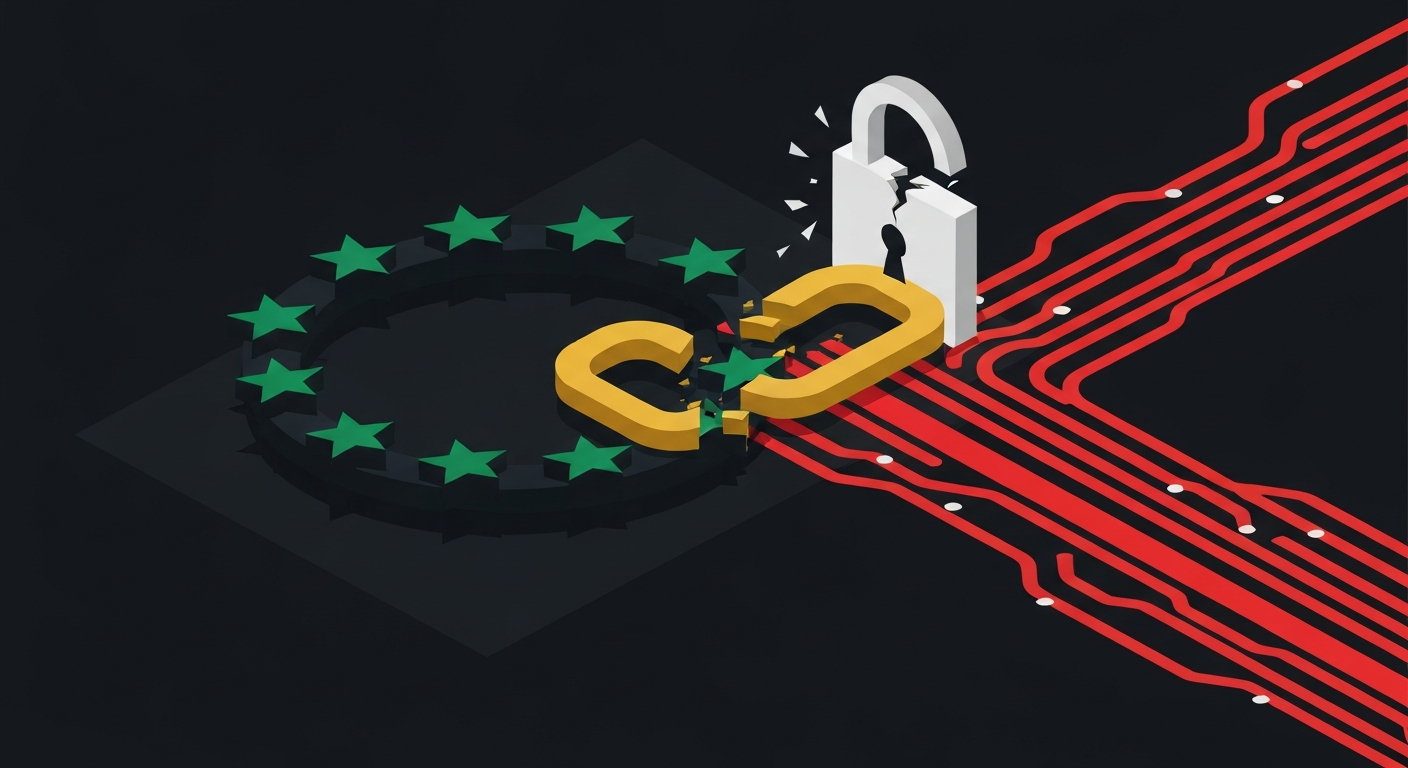
In April 2026, Vercel suffered a significant security incident: a supply-chain attack via a compromised OAuth integration with Context.ai allowed attackers to exfiltrate customer account data and environment variables from thousands of projects. The breach demonstrated how deeply interconnected third-party OAuth flows create systemic risk — and surfaced a harder question for EU teams: what happens to your GDPR obligations when your PaaS provider is breached?
This post unpacks the incident, your legal exposure under GDPR Article 33, the CLOUD Act dimension, and why EU-native managed PaaS platforms carry a materially different risk profile.
What Happened: The Vercel / Context.ai Supply-Chain Attack
The attack vector was a malicious OAuth application in Vercel's integration marketplace. Context.ai, an AI code-review tool, had its OAuth token compromised. Because Vercel's integration architecture granted marketplace apps broad read access to project environment variables (including secrets, API keys, and database credentials), the attacker was able to enumerate and exfiltrate:
- Environment variables from affected projects (containing database URLs, payment processor keys, API credentials)
- Deployment logs exposing internal service endpoints
- Vercel account metadata (team names, domains, project structures)
Vercel notified affected customers approximately 96 hours after the breach was confirmed — exceeding the 72-hour GDPR Art.33 window.
Hacker News Thread 47832842 ("Ask HN: What Vercel alternatives do you recommend?") became one of the top threads of April 2026, with hundreds of comments from teams actively migrating away from Vercel following the breach.
Your GDPR Obligations When Your PaaS Is Breached
GDPR Article 33: The 72-Hour Clock
Under GDPR Article 33, if a personal data breach occurs at a data processor (your PaaS provider), the processor must notify the controller (you) without undue delay — enabling you to notify your supervisory authority within 72 hours of becoming aware.
The Vercel breach exposed a common gap: if your environment variables contained database credentials that gave access to personal data, the breach at Vercel becomes your breach for GDPR purposes. You are the data controller. Vercel is your data processor (per your DPA with them).
The notification chain under GDPR:
- Vercel detects breach → must notify you promptly
- You assess if personal data was accessible → if yes, 72-hour clock starts
- You notify your supervisory authority (BfDI, CNIL, ICO, etc.) within 72 hours
- If high risk to individuals: direct notification to affected users (Art.34)
When Vercel notified at hour 96, EU controllers were already in technical violation of their Art.33 obligation if they hadn't independently detected the breach and notified their DPA.
GDPR Article 28: DPA Requirements and Processor Accountability
Your Data Processing Agreement with Vercel must include:
- Obligation to notify you of breaches promptly (Art.28(3)(f))
- Audit rights and security assurances (Art.28(3)(h))
- Sub-processor controls (Context.ai was effectively a sub-processor)
The Context.ai OAuth integration represents a sub-processor in GDPR terms. Did Vercel's DPA require prior authorisation for new sub-processors? Did Vercel notify customers before granting Context.ai environment-variable access? These are the questions EU DPAs will ask.
The CLOUD Act Layer: Jurisdictional Risk Beyond the Breach
Vercel, Inc. is a Delaware C-Corp headquartered in San Francisco, CA. This means your data — including environment variables, deployment artifacts, and project code — is subject to the Clarifying Lawful Overseas Use of Data (CLOUD) Act (2018).
Under the CLOUD Act, US law enforcement can compel Vercel to produce your data regardless of where Vercel's servers are located. The April 2026 breach makes this concrete: your data was already exfiltrated by criminal actors. But the CLOUD Act adds a second, lawful exfiltration path that operates in parallel.
GDPR Schrems II implications:
- Post-Schrems II (ECJ, 2020), Standard Contractual Clauses (SCCs) require a Transfer Impact Assessment (TIA)
- Your TIA for Vercel must account for CLOUD Act exposure — US surveillance law as a "problematic legislation" factor
- The breach demonstrates that theoretical access risks are real operational risks
The Environment Variable Problem: A Structural Vulnerability
The Vercel breach was not primarily a cryptographic failure — it was an architectural one. Granting OAuth marketplace integrations read access to environment variables creates a single point of failure that bypasses all your application-level security controls.
Environment variables in PaaS platforms commonly contain:
- Database connection strings (PostgreSQL, MySQL, Redis)
- Payment processor API keys (Stripe, Adyen, Braintree)
- Third-party API credentials (SendGrid, Twilio, AWS SDK keys)
- Internal service tokens and JWTs
Once an attacker has your environment variables, they have the keys to your entire backend — not just your Vercel deployment.
EU GDPR Art.32 Technical Measures Requirements:
GDPR Art.32 requires "appropriate technical and organisational measures" including encryption of credentials at rest and access controls. When your PaaS provider grants broad OAuth access to plaintext environment variables without your explicit consent, your Art.32 compliance depends entirely on their marketplace security governance.
How EU-Native Managed PaaS Changes the Risk Profile
Moving to an EU-jurisdiction PaaS provider doesn't make breaches impossible — but it fundamentally changes three risk dimensions:
1. Jurisdictional Risk: No CLOUD Act Exposure
EU-native PaaS providers incorporated under EU law (German GmbH, French SAS, Dutch BV) are not subject to the US CLOUD Act. EU law enforcement access goes through EU judicial procedures with higher procedural protections and your supervisory authority has jurisdiction.
Comparison:
| Dimension | Vercel (Delaware C-Corp) | EU-Native PaaS |
|---|---|---|
| CLOUD Act exposure | Yes | No |
| Primary data jurisdiction | US | EU |
| Supervisory authority | US FTC + state | EU DPA (BfDI, CNIL, etc.) |
| SCC/TIA requirement | Yes | No (same jurisdiction) |
| Law enforcement access | US DOJ MLAT or CLOUD Act | EU judicial procedure |
2. Breach Notification Alignment: GDPR Art.33 by Design
EU-incorporated providers operate under GDPR directly as data processors — not via SCCs that need to approximate GDPR protections. This means their breach notification obligations are natively aligned with your Art.33 requirements. They cannot notify at hour 96 and claim compliance with their US-law obligations — GDPR Art.28(3)(f) is their primary law.
3. Sub-Processor Governance: Stricter by Default
The Context.ai integration that caused the Vercel breach would require explicit prior authorisation under a GDPR-native DPA. EU-based providers conducting sub-processor assessments under GDPR Art.28(2) must:
- Document each sub-processor
- Assess sub-processor security (Art.28(4))
- Notify you before adding new sub-processors
- Flow GDPR obligations to sub-processors
A marketplace OAuth app with environment-variable read access would require documented approval under this framework — a structural control that was absent in Vercel's architecture.
EU-Native PaaS Alternatives
Following the breach, HN Thread 47832842 catalogued several alternatives. Here are the key options with their GDPR risk profile:
sota.io
- Jurisdiction: EU (European entity, EU data centres)
- CLOUD Act exposure: No
- Env var access model: Encrypted at rest, no marketplace OAuth with plaintext access
- GDPR Art.28 DPA: EU-native, no SCCs required
- Pricing: From €9/mo managed deployments
- Best for: EU development teams needing managed PaaS with full GDPR compliance without TIA overhead
Hetzner Cloud + Coolify
- Jurisdiction: Germany (Hetzner Online GmbH, Gunzenhausen)
- CLOUD Act exposure: No
- Model: Self-hosted PaaS layer (Coolify) on Hetzner infrastructure
- GDPR: Full EU jurisdiction, no US sub-processors
- Best for: Teams wanting maximum control and EU infrastructure with open-source PaaS tooling
- Limitation: Self-managed — you own the operations burden
Fly.io EU Regions
- Jurisdiction: Fly.io, Inc. is a US Delaware C-Corp
- CLOUD Act exposure: Yes (US parent entity regardless of EU region)
- GDPR: SCCs required, TIA needed
- Note: Running in EU regions does not remove CLOUD Act exposure from the US parent entity
Railway
- Jurisdiction: Railway Corp, Delaware C-Corp
- CLOUD Act exposure: Yes
- Note: Same CLOUD Act risk as Vercel despite EU-region availability
Render
- Jurisdiction: Render Inc., Delaware C-Corp
- CLOUD Act exposure: Yes
- Note: US entity, SCCs required for EU deployments
OVHcloud (EU-native)
- Jurisdiction: OVH Groupe SA, France (SBF:OVH)
- CLOUD Act exposure: No
- Model: Infrastructure + managed services
- GDPR: EU jurisdiction, ICO/CNIL-regulated
- Best for: Infrastructure-focused teams needing EU sovereignty at scale
Summary comparison:
| Provider | EU Entity | CLOUD Act | Needs SCCs | Env Var Security |
|---|---|---|---|---|
| sota.io | ✅ Yes | ✅ No | ✅ No | Encrypted, no OAuth marketplace |
| Hetzner + Coolify | ✅ Yes | ✅ No | ✅ No | Self-managed |
| OVHcloud | ✅ Yes | ✅ No | ✅ No | Self-managed |
| Fly.io | ❌ Delaware | ❌ Yes | ❌ Yes | US entity |
| Railway | ❌ Delaware | ❌ Yes | ❌ Yes | US entity |
| Render | ❌ Delaware | ❌ Yes | ❌ Yes | US entity |
| Vercel | ❌ Delaware | ❌ Yes | ❌ Yes | Breached |
What the Vercel Breach Means for Your GDPR Compliance Programme
Immediate Actions (If You Use Vercel)
- Audit your environment variables — identify which contain personal data access paths (database credentials, email service keys, payment processor keys)
- Check your DPA with Vercel — does it include Art.28(3)(f) breach notification obligations? What's the notification timeframe?
- Assess whether personal data was accessible — if breached environment variables could give access to personal data, you may have an Art.33 reporting obligation to your DPA
- Review sub-processor authorisations — did you authorise Context.ai as a sub-processor? If not, was Vercel's DPA violated?
- Update your incident response plan — include third-party PaaS breach scenarios with defined Art.33 timelines
Medium-Term: Transfer Impact Assessment Update
If you continue with Vercel, your TIA under Schrems II SCCs must now account for:
- Demonstrated operational breach risk (not just theoretical)
- US DOJ access patterns for breach investigations (potential CLOUD Act intersection)
- Adequacy of Vercel's marketplace sub-processor governance
Long-Term: Jurisdictional Risk Reduction
The Vercel breach demonstrates that theoretical CLOUD Act and GDPR risk isn't purely theoretical — it intersects with operational breach scenarios. EU-native PaaS removes the jurisdictional risk vector entirely and simplifies your GDPR compliance programme:
- No SCCs to draft and maintain
- No TIA to conduct and document
- No CLOUD Act in your DPA risk register
- Supervisory authority in your own jurisdiction
The Supply-Chain Attack Lesson: OAuth Governance Matters
The Vercel breach was ultimately a supply-chain attack enabled by insufficient OAuth governance. Key lessons for EU development teams regardless of PaaS choice:
- Principle of least privilege for integrations — audit what OAuth apps have access to, especially environment variables
- Sub-processor inventory — maintain an Art.30 record of all PaaS integrations that touch production data
- Regular access reviews — OAuth tokens should be rotated; integrations should be reviewed quarterly
- Incident response for third-party breaches — know your DPA's Art.33 notification timeline and who triggers it in a processor breach scenario
- Environment variable hygiene — use secrets managers (HashiCorp Vault, AWS Secrets Manager, 1Password for teams) instead of PaaS-native environment variable stores for high-sensitivity credentials
GDPR Risk Score: Vercel vs. EU-Native PaaS
Using our 5-dimension GDPR Risk Scoring Framework (0–20 points, lower = less GDPR risk):
Dimension 1: Legal Jurisdiction (0–4 pts)
- Vercel: 4/4 (Delaware C-Corp, US jurisdiction)
- sota.io: 0/4 (EU entity, EU jurisdiction)
Dimension 2: CLOUD Act Exposure (0–4 pts)
- Vercel: 4/4 (subject to CLOUD Act, demonstrated operational breach)
- sota.io: 0/4 (no CLOUD Act exposure)
Dimension 3: Data Residency (0–4 pts)
- Vercel: 3/4 (EU regions available, but US parent entity)
- sota.io: 0/4 (EU data centres, EU entity)
Dimension 4: Sub-Processor Control (0–4 pts)
- Vercel: 4/4 (marketplace OAuth demonstrated insufficient governance — breach event)
- sota.io: 1/4 (limited third-party integrations, EU sub-processors)
Dimension 5: Breach Notification Track Record (0–4 pts)
- Vercel: 4/4 (96-hour notification — exceeded GDPR Art.33 72-hour window)
- sota.io: 0/4 (EU-native notification obligations, no breach incidents)
GDPR Risk Score:
- Vercel: 19/20 🔴 (Very High Risk)
- sota.io: 1/20 ✅ (Very Low Risk)
Conclusion
The Vercel breach of April 2026 is a case study in how supply-chain vulnerabilities at US PaaS providers create compounded GDPR exposure for EU controllers. The breach demonstrated:
- Operational risk is real — not just theoretical CLOUD Act or SCC concerns
- 72-hour Art.33 compliance depends on your processor — Vercel notified at hour 96
- OAuth marketplace governance is a GDPR control — sub-processors need authorisation
- Jurisdictional risk reduction is achievable — EU-native PaaS eliminates the CLOUD Act vector entirely
For EU development teams, the question is not whether US PaaS providers will improve their security. It's whether the jurisdictional and architectural risk profile matches your GDPR obligations — and whether a breach at your infrastructure provider becomes a breach you're legally required to report.
EU-native managed PaaS, with GDPR-aligned breach notification, no CLOUD Act exposure, and EU supervisory authority oversight, represents a structurally different risk profile. One that doesn't require a TIA, doesn't require US-law SCCs, and doesn't put your 72-hour Art.33 clock at the mercy of a Delaware company's incident response team.
Related reading:
- EU Cloud and AI Development Act (CADA) — What Changes for EU PaaS Buyers in 2026
- EU Cyber Resilience Act: Vulnerability Disclosure Requirements for Software Vendors
- GitHub Actions EU Alternative 2026 — CLOUD Act, CI/CD Supply Chain Risk
EU-Native Hosting
Ready to move to EU-sovereign infrastructure?
sota.io is a German-hosted PaaS — no CLOUD Act exposure, no US jurisdiction, full GDPR compliance by design. Deploy your first app in minutes.