Signal EU Alternative 2026: Why Signal's US Jurisdiction Creates Business Compliance Gaps
Post #926 in the sota.io EU Cyber Compliance Series
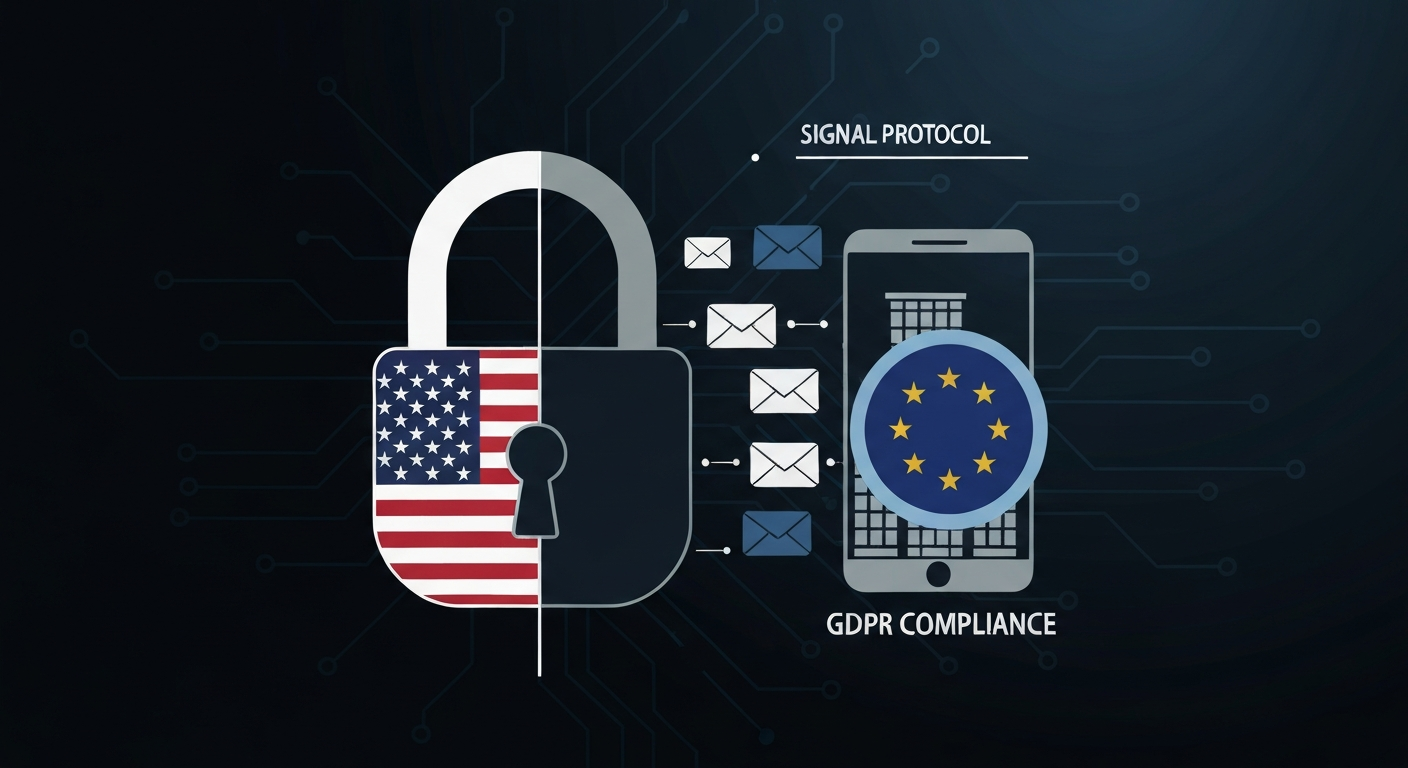
Signal has become the gold standard reference for end-to-end encrypted messaging. Recommended by security researchers, journalists, privacy advocates, and increasingly by EU government agencies as a replacement for SMS and unencrypted messaging, Signal occupies a position no other consumer application holds: a credibly private, open-source, audited messaging tool with a proven track record against government demands for user data.
EU businesses evaluating messaging infrastructure after concerns about WhatsApp, Teams, Slack, or Google Chat frequently land on Signal as an obvious answer. The encryption works. The foundation has resisted production demands. The protocol is open and independently verified. What more is needed?
Quite a lot, as it turns out — particularly for businesses in regulated EU industries, and for any organisation seeking to rely on Signal as enterprise-grade infrastructure rather than as a secure consumer application for individual employees. Signal Foundation is a California-incorporated US non-profit, subject to the US Clarifying Lawful Overseas Use of Data Act (CLOUD Act). Signal's architecture deliberately minimises what data Signal holds — which is genuinely privacy-protective — but the absence of enterprise features creates compliance gaps that EU organisations in finance, healthcare, law, and public administration cannot bridge without alternatives.
This guide explains what Signal actually provides from a GDPR and CLOUD Act perspective, what it does not, and which EU-native alternatives serve the business use case that Signal was not built to fill.
Signal Foundation: California Incorporation and the CLOUD Act
Signal Foundation is a 501(c)(3) non-profit corporation incorporated in California and headquartered in Mountain View, California. Signal Messenger LLC — the entity that operates the Signal messaging service — is a California limited liability company. Both entities are US-incorporated and subject to US law, including the CLOUD Act (18 U.S.C. § 2713).
The CLOUD Act requires US-incorporated electronic communication service providers and remote computing service providers to produce data they possess, custody, or control in response to valid US federal legal process, regardless of where that data is physically stored. Signal Foundation and Signal Messenger LLC fall within this definition.
The critical question for GDPR compliance is not whether Signal is subject to the CLOUD Act — it is — but what data Signal actually possesses and could therefore be compelled to produce.
Signal's answer to this question is architecturally distinctive. Signal is explicitly designed to hold as little user data as possible:
- Message content: End-to-end encrypted using the Signal Protocol. Signal's servers relay encrypted ciphertext but do not hold decryption keys. Signal cannot read message content, and cannot produce message content in response to legal process.
- Message metadata: Signal collects the phone number used to register and the date and time a user last connected to Signal servers. Signal does not collect information about who communicated with whom, when messages were sent, or the content of communications.
- Contact discovery: Signal has developed private contact discovery technology (using Intel SGX and more recently ORAM-based approaches) designed so that Signal's servers do not learn users' contact lists when users check which of their contacts are on Signal.
- Groups: Signal group membership is managed client-side in a distributed fashion. Signal's servers do not hold a list of which users belong to which groups.
Signal has published government data request transparency reports and has provided US law enforcement with only the account registration date and last connection date in response to legal demands — because that is genuinely all they hold.
This architecture means that Signal's CLOUD Act exposure is qualitatively different from WhatsApp's. A US court order compelling Signal to produce message content would receive a response of "we don't have it" — because they genuinely do not. This is not a legal argument; it is an architectural reality that has been verified in practice.
What Signal's Architecture Does Not Protect Against
Signal's privacy-by-design approach provides strong protection against the specific attack vector of law enforcement or intelligence agencies compelling access to message content. It does not address several other GDPR compliance considerations that EU businesses must evaluate.
Phone number requirement and pseudonymisation limits
Signal requires a phone number to register. Phone numbers are personal data under GDPR. For employees using Signal for business communications, those phone numbers — and the fact of their use of Signal — are personal data elements that an employer must account for in its ROPA documentation and data subject access request procedures.
Signal does not permit organisations to provision accounts at the enterprise level, manage accounts through an identity provider, or deactivate accounts when employees leave. There is no administrative control plane. The phone number bound to each account follows the individual employee's phone contract, not the organisation's directory.
Data retention and e-discovery obligations
EU regulated industries face data retention obligations that are architecturally incompatible with Signal's design. Financial services firms under MiFID II are required to retain records of communications relating to client orders and transactions for at least five years. Insurance intermediaries face similar requirements under IDD. Legal professionals in many EU member states face court-imposed discovery obligations requiring production of communications in legal proceedings.
Signal's ephemeral message deletion, disappearing messages feature, and client-side storage model mean there is no server-side archive. If an employee's device is lost, replaced, or wiped, message history is irretrievable. If a regulator requests records of communications relating to a client matter, Signal provides no mechanism to retrieve them. If a court issues an e-discovery order, Signal messages on employee devices may be technically inaccessible.
This is not a criticism of Signal's design — it is precisely what Signal is designed to do. But it makes Signal unsuitable as the primary communication infrastructure for regulated industries where retention obligations are legally mandated.
Audit trails and compliance logging
EU organisations subject to NIS2, DORA, or sector-specific regulatory frameworks are required to maintain audit logs of communications and actions within their systems. Signal provides no audit log capability, no message export, no administrative reporting, and no integration with SIEM tools.
An information security team investigating a security incident cannot retrieve Signal message content from a Signal server. A compliance officer responding to a regulatory inquiry cannot pull Signal communication records. A DPO conducting a data breach investigation cannot determine the scope of information shared via Signal without physical access to the devices of everyone involved in the relevant conversations.
Account management and access control
Enterprise messaging requires the ability to provision and deprovision accounts, enforce device policies, require multi-factor authentication through a corporate identity provider, and remotely wipe messages from devices when employees depart. Signal provides none of these capabilities.
There is no Signal enterprise portal. There is no MDM integration. There is no way for an organisation to enforce a minimum security policy on Signal accounts used for business communications. When an employee leaves, their Signal account — linked to their personal phone number — leaves with them. The organisation has no mechanism to retrieve business communications stored in that departing employee's Signal account.
The EU-Specific Regulatory Conflict: NIS2, DORA, and Sector Requirements
The NIS2 Directive (2022/2555, effective January 2023 for implementation, October 2024 for transposition) requires essential and important entities to implement technical and organisational measures for the security of network and information systems, including incident logging and reporting, business continuity measures, and supply chain security assessments.
Organisations using Signal as part of their communication infrastructure cannot audit Signal's security practices because Signal does not provide B2B agreements, enterprise SLAs, or SOC 2 reports to business customers. Signal is a consumer application. It does not have a business tier, a DPA for enterprise customers, or a formal B2B relationship.
The Digital Operational Resilience Act (DORA, 2022/2554) applies to financial entities in the EU and their ICT third-party providers. DORA requires financial entities to document their ICT dependencies, conduct risk assessments of third-party providers, and ensure contractual protections. Signal Messenger LLC does not enter into DORA-compliant ICT third-party service agreements. A financial entity using Signal for internal communications would face DORA compliance gaps it cannot resolve contractually.
Healthcare organisations processing patient data under GDPR must implement appropriate technical and organisational measures. Signal's lack of an administrative control plane, audit logging, and data retention capability creates gaps that most healthcare data controllers would struggle to document as "appropriate" in a DPIA.
EU-Native Alternatives for Secure Business Messaging
The EU alternatives that close the gap between Signal's genuine security and the business compliance requirements that Signal was not designed to meet operate across three distinct deployment models.
Wire for Enterprise (Switzerland)
Wire Swiss GmbH is incorporated in Zug, Switzerland. Wire operates Wire for Enterprise — an explicitly business-focused messaging platform built on the same Signal Protocol end-to-end encryption that underpins Signal itself. The Wire for Enterprise offering provides the security foundation of the Signal Protocol with the enterprise control plane that Signal lacks:
- Organisation-provisioned accounts linked to corporate identity (no personal phone number required)
- SCIM-based account provisioning and deprovisioning
- SAML/SSO integration with corporate identity providers (Okta, Azure AD, OneLogin)
- Message retention policies with configurable retention periods to meet regulatory requirements
- Audit logging and export for compliance and e-discovery
- MDM integration for device policy enforcement
- Administrative dashboard with user management, security policy enforcement, and reporting
- EU data residency with servers operated in Germany and Switzerland
Wire Swiss GmbH is incorporated in Switzerland, not the United States. Switzerland is not subject to the CLOUD Act. Swiss law requires a formal Mutual Legal Assistance Treaty (MLAT) process for foreign governments seeking data held by Swiss companies, providing a significantly higher procedural threshold than US federal legal process. Switzerland has data protection legislation (nFADP) aligned with GDPR principles.
Wire's end-to-end encryption is independently audited and the protocol — which is the Signal Protocol — is the same open, verified cryptographic standard. Wire for Enterprise adds the administrative layer that regulated businesses require without compromising the underlying encryption architecture.
Element / Matrix Protocol (EU-hosted self-deployment)
Element is the reference client for the Matrix open federated communication protocol. The Matrix Foundation is UK-based, and Element (the company) is New Vector Ltd., incorporated in England. For EU businesses, the relevant deployment model is self-hosted Matrix using Element: organisations deploy their own Matrix homeserver within their own EU infrastructure, under their own administrative control.
Self-hosted Matrix deployment means:
- No third-party service provider relationship — the organisation is the data controller and data processor
- Full administrative control over accounts, retention policies, and access
- Message data remains on the organisation's own servers within EU jurisdiction
- Integration with existing LDAP/Active Directory or SSO infrastructure
- Audit logging and message export capabilities through server administration
- Federation with other Matrix homeservers if cross-organisational communication is required
For organisations that have the technical capacity to self-host (internal IT or DevOps teams, or platform-as-a-service providers with EU infrastructure), self-hosted Matrix on EU servers provides the strongest possible EU data sovereignty position: no dependency on any non-EU third party for message processing or storage.
Element also offers a managed hosting service (Element Cloud) with EU data residency options, providing the self-hosted control model on managed infrastructure for organisations without internal hosting capability.
Threema Work (Switzerland)
Threema GmbH is incorporated in Bettlach, Switzerland. Threema Work is the enterprise-oriented deployment of Threema, a messaging application that does not require a phone number to register (users receive a random Threema ID) and is built on end-to-end encryption with minimal metadata collection.
Threema Work provides:
- Organisation-managed accounts with no phone number requirement — users are provisioned with organisation-controlled Threema IDs
- Threema Management Cockpit for central administration, provisioning, and deprovisioning
- Pre-configuration of devices with organisation settings (server URLs, security policies, contact directories)
- Message data processed on servers in Switzerland
- Threema does not know which users belong to which organisation's Threema Work deployment
Threema GmbH is a Swiss company. Its servers are operated in Switzerland. Like Wire, Threema benefits from Switzerland's MLAT-based legal assistance framework, providing stronger procedural protection against foreign government data demands than US-headquartered providers.
Threema Work is particularly well-suited for organisations that want to minimise the linkage between employee identity and the communication platform — the no-phone-number model means Threema IDs are organisationally issued and revocable, without touching employees' personal phone contracts.
Comparing Signal, Wire for Enterprise, Element, and Threema Work
| Dimension | Signal | Wire for Enterprise | Element (self-hosted) | Threema Work |
|---|---|---|---|---|
| Incorporation | California, USA | Zug, Switzerland | England (self-hosted) | Bettlach, Switzerland |
| CLOUD Act subject | Yes | No (Swiss MLAT) | Not applicable (self-hosted) | No (Swiss MLAT) |
| End-to-end encryption | Signal Protocol | Signal Protocol | Matrix/Olm | Custom E2E |
| Account provisioning | None (personal phone) | SCIM/SAML/SSO | LDAP/SAML/SSO | Management Cockpit |
| Admin control plane | None | Full dashboard | Full (self-hosted) | Full Cockpit |
| Retention compliance | Not possible | Configurable policies | Configurable | Configurable |
| Audit logging | None | Yes | Yes (server logs) | Yes |
| Phone number required | Yes | No | No | No |
| EU data residency | Not guaranteed | Germany/Switzerland | Self-determined | Switzerland |
| Enterprise DPA | None | Yes | Self-processing | Yes |
| Open source | Yes | Partially | Yes (protocol) | No |
GDPR Considerations for EU Businesses Currently Using Signal
EU businesses using Signal for any business communications — even informally — should document the following in their ROPA and DPIA:
Legal basis for processing personal data through Signal
Employee phone numbers and the fact of their Signal communication constitute personal data. The use of Signal for business communications must be documented with a lawful basis under GDPR Article 6. Legitimate interest (Article 6(1)(f)) is the most likely applicable basis, but it requires a balancing test documenting that the business interest in secure messaging outweighs the data subject's rights — and that balance must be reassessed if Signal's architecture or jurisdiction changes.
Transfer Impact Assessment for data transfers to the US
Signal is a US service provider. Even though Signal's architecture minimises the data it holds, the use of Signal involves a transfer of personal data — specifically, phone numbers and connection metadata — to a US entity. This transfer requires coverage under a legal transfer mechanism. Signal does not provide Standard Contractual Clauses or a formal Data Processing Agreement for business users. The absence of a DPA from Signal means this transfer cannot rely on SCCs for legal basis.
Special categories of data
Businesses in healthcare, HR, legal services, or social care may use Signal to communicate information that constitutes special category data under GDPR Article 9 (health data, information about trade union membership, legal case details). The absence of Signal's ability to provide any contractual or technical safeguards for this data is particularly significant for Article 9 compliance.
Incident response gaps
If a device containing Signal business communications is lost, stolen, or compromised, the organisation has no mechanism to retrieve, wipe, or audit those communications through Signal. Incident response procedures must document this gap and establish compensating controls (device-level encryption, MDM for remote wipe, screen lock policies).
Selecting the Right EU Alternative
The appropriate EU alternative depends on the organisation's size, technical capacity, regulatory context, and communication requirements.
Small to medium EU businesses without regulated data obligations should consider Threema Work: straightforward deployment, Swiss jurisdiction, no phone number requirement, and a management cockpit accessible without technical complexity. The pricing is competitive with Slack and Teams at enterprise scale.
Regulated EU businesses (financial services, healthcare, legal) should evaluate Wire for Enterprise first: the SAML/SSO integration, configurable retention policies, and audit logging directly address the specific compliance gaps that Signal leaves open. German server infrastructure and Swiss incorporation provide both EU data residency and non-CLOUD Act jurisdiction.
Technically capable organisations seeking maximum data sovereignty should deploy self-hosted Matrix/Element on EU infrastructure: zero third-party dependency, full administrative control, and federation capability for cross-organisational communication. The operational overhead of self-hosting a Matrix server is comparable to other self-hosted communication infrastructure.
Signal remains an excellent choice for individual journalists, activists, legal professionals, and anyone who needs maximum protection for personal communications against government surveillance. For that use case, Signal's architecture is optimal — the minimal metadata model and end-to-end encryption combination provides protection that enterprise-oriented alternatives do not match for individual-to-individual communication.
But Signal was designed to protect individuals from mass surveillance, not to provide EU businesses with compliant enterprise communication infrastructure. The two use cases have different requirements. The tools that best serve them are different too.
Signal Protocol is used under the open-source license by Wire and other providers. The Signal Foundation's approach to minimising data collection remains the benchmark for privacy-protective architecture. The compliance analysis in this post concerns Signal's suitability as enterprise business infrastructure — not its effectiveness as a privacy tool for individual users.
sota.io is a European cloud platform for developers who need EU data sovereignty without operational overhead. Start deploying on EU infrastructure today.
EU-Native Hosting
Ready to move to EU-sovereign infrastructure?
sota.io is a German-hosted PaaS — no CLOUD Act exposure, no US jurisdiction, full GDPR compliance by design. Deploy your first app in minutes.