Rippling EU Alternative 2026: CLOUD Act Risk, GDPR, and EU Payroll Data Sovereignty
Post #959 in the sota.io EU Compliance Series
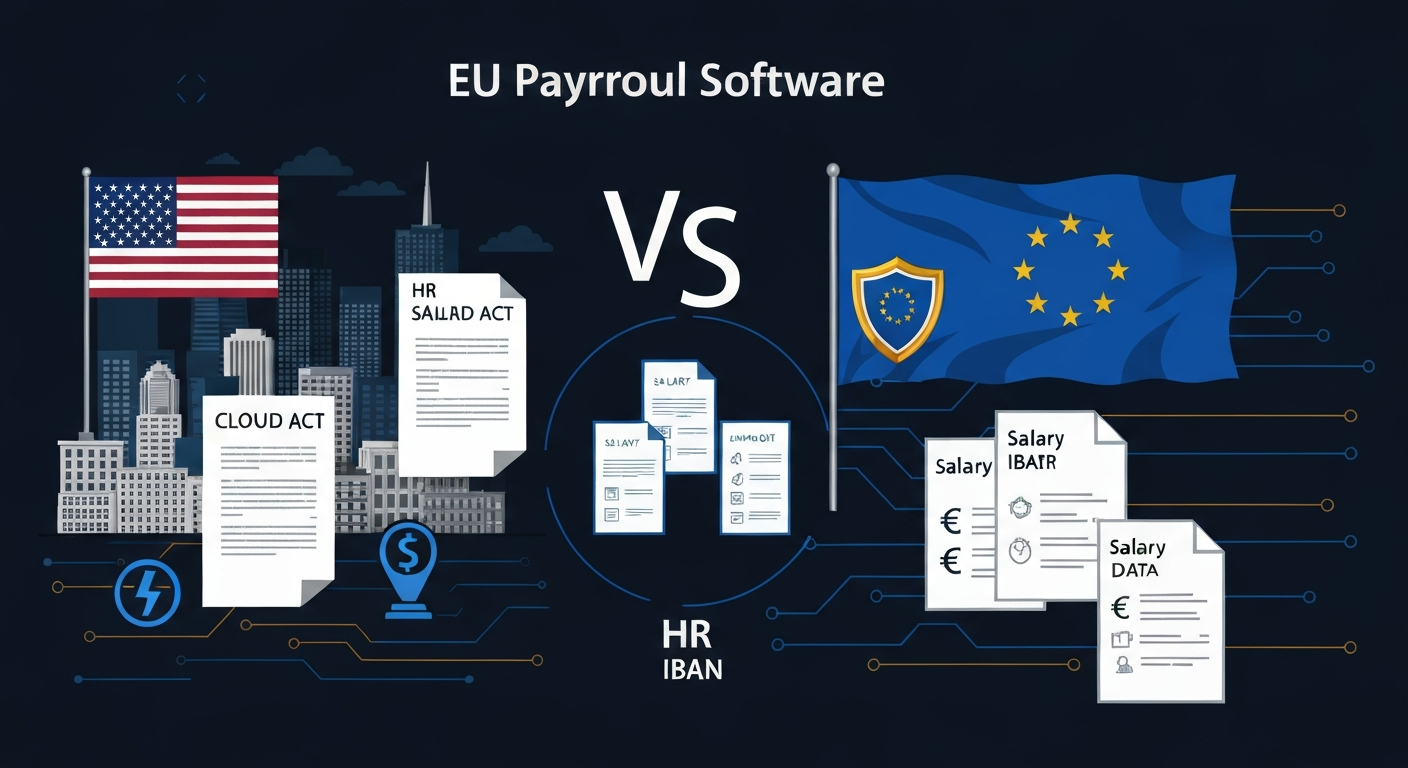
Rippling describes itself as the platform that connects HR, IT, and Finance in a single system. For the growing category of EU startups and mid-market companies choosing Rippling for global payroll, there is a legal question that product demos rarely address: what happens to your employees' salary data when a US federal agency issues a compelled-disclosure order?
The answer matters more than ever. The EU Pay Transparency Directive (2023/970/EU) requires all member states to transpose legislation by 7 June 2026 — four weeks away. Employers processing employee compensation data in systems controlled by US companies face a structural tension between EU transparency rights and US surveillance law that no data processing agreement can resolve.
Who Rippling Is
Rippling was founded in 2016 by Parker Conrad and Prasanna Sankar. It is incorporated in Delaware and headquartered in San Francisco, California. In January 2024, Rippling raised a $200 million extension at a reported valuation of $13.5 billion, with investors including Andreessen Horowitz, Founders Fund, and Coatue.
Rippling has an Irish entity — Rippling Workforce Management International Limited — registered in Dublin, which it uses as the contracting entity for EU customers. Rippling's EU data processing addendum routes transfers through Standard Contractual Clauses (SCCs) under GDPR Chapter V.
For CLOUD Act purposes, this structure is insufficient. The CLOUD Act (18 U.S.C. § 2713) applies to US persons — and a US parent company retains the obligation to produce data held by its controlled foreign subsidiaries when served with a US court order or government demand. The Irish entity does not sever the US parent's statutory obligation.
What CLOUD Act Means for Payroll Data
The CLOUD Act (Clarifying Lawful Overseas Use of Data Act, signed 2018) amended the Stored Communications Act to allow US law enforcement to compel US service providers to produce communications and records stored abroad. It does not require a mutual legal assistance treaty. It does not require prior notice to the data subject or the EU employer.
Payroll data is among the most sensitive categories of personal data a company holds:
- Gross and net salary figures — directly linked to financial discrimination
- Bank account details — IBAN, BIC, direct debit mandates
- National identification numbers — social security equivalents (SSN, BSN, NIN, Steuernummer)
- Benefits elections — health plan choices may reveal health conditions
- Equity grant schedules — material non-public information for listed employers
Under GDPR Article 9, data about trade union membership and health status qualifies as special-category data. Payroll systems that record sick leave, parental leave, or union dues deductions are processing Article 9 data — which requires either explicit consent or a specific legal basis under Article 9(2), plus elevated security obligations.
A CLOUD Act order served on Rippling Inc. in San Francisco could require disclosure of any of this data — for your EU employees — without informing you.
The Schrems II Problem for Rippling
The CJEU Schrems II ruling (C-311/18, 16 July 2020) invalidated the EU–US Privacy Shield and introduced a mandatory transfer impact assessment (TIA) requirement for data transfers using Standard Contractual Clauses.
A TIA requires the data exporter to assess whether the legal framework of the recipient country provides equivalent protection to EU law. For US cloud providers subject to the CLOUD Act, this assessment is structurally difficult: US surveillance law explicitly grants access to data held abroad, which is incompatible with GDPR Article 46 adequacy requirements.
The EU–US Data Privacy Framework (DPF), effective since July 2023, provides an adequacy decision for certified US companies. Rippling is listed on the DPF. However, the DPF certification:
- Does not restrict the US government's rights under the CLOUD Act
- Covers commercial data processing, not national security access
- Is currently subject to challenge proceedings in the CJEU (Schrems III expected)
For special-category payroll data under Article 9, the DPF provides no additional safeguard. The EDPB has consistently held that national security access regimes fall outside the scope of commercial adequacy decisions.
The EU Pay Transparency Directive — Why This Matters Now
Directive 2023/970/EU on pay transparency must be transposed into national law by 7 June 2026. Key provisions:
Right to pay information: Employees may request information on their own pay level and on the average pay level for the same work, broken down by gender. Employers must respond within 60 days.
Pay transparency reporting: Companies with 100 or more employees must report gender pay gap data to national authorities annually (from 2027 onwards), with the first report covering 2026 data.
Prohibition on pay secrecy: Contractual clauses preventing employees from disclosing or requesting information about pay are void.
Enforcement: Member states must designate enforcement bodies and establish effective, proportionate, and dissuasive penalties.
The connection to payroll software jurisdiction: the salary data collected for pay transparency reporting is exactly the data that CLOUD Act orders can compel. An employer using a US-controlled payroll platform creates a scenario where EU regulators enforce pay transparency rights against data that a US agency could simultaneously demand — with no notification to the employer.
Rippling's EU-Specific Payroll Features — and Their Limits
Rippling offers a dedicated EU payroll module covering Germany, France, the Netherlands, Spain, Ireland, and the United Kingdom. The product includes:
- Automated payroll calculations per jurisdiction
- SEPA direct debit integration
- Country-specific tax and social contribution filings
- Integration with Rippling's global HR system
These features are technically sound. The compliance gap is not in the product itself — it is in the corporate structure. All of Rippling's infrastructure is ultimately controlled by Rippling Inc. (Delaware). The EU payroll data flows through a US-controlled system. Rippling's sub-processors include US entities for cloud infrastructure.
Rippling's DPA lists AWS EU-WEST-1 (Dublin) as primary storage. AWS Ireland is an Amazon Web Services EMEA SARL subsidiary. Amazon.com Inc. is a US company subject to the CLOUD Act. The sub-processor chain does not resolve the jurisdictional exposure.
EU-Native Payroll Alternatives
For EU employers who need payroll software without CLOUD Act exposure, several options exist:
DATEV (Nuremberg, Germany) — DATEV eG is a German cooperative association, not a US-controlled entity. It is the market-standard payroll processor for German SMEs. DATEV Lohn und Gehalt has no US parent and no CLOUD Act exposure. Coverage is currently limited to Germany.
Personio Payroll — Personio SE & Co. KG (Munich) offers integrated payroll for Germany and Austria as an add-on to its core HR platform. See our full Personio analysis. No CLOUD Act exposure.
Nmbrs (Amsterdam, Netherlands) — Nmbrs B.V. is a Dutch BV entity acquired by Visma (Norwegian private company). Visma is not listed on a US exchange and has no US parent. Coverage: Netherlands, Spain, Sweden, Denmark. Strong GDPR record.
Kenjo (Berlin, Germany) — German GmbH, Berlin HQ. EU-native HR and payroll platform targeting SMEs. No US parent. BayLDA supervisory jurisdiction.
SD Worx (Antwerp, Belgium) — Belgian SA/NV, established 1945. One of Europe's largest payroll providers. Covers 150+ countries but is EU-incorporated and EU-controlled. No CLOUD Act exposure.
Factorial (Barcelona, Spain) — Factorial HR S.L. is a Spanish SL entity. See our full Factorial analysis. Offers payroll features for Spain, with EU expansion ongoing. No CLOUD Act exposure.
Deployment Infrastructure — The Other Layer
Most EU organisations running Rippling are also deploying web applications and APIs that integrate with their payroll systems: expense management apps, time-tracking tools, developer tooling that calls Rippling's API.
For that infrastructure layer, the same CLOUD Act analysis applies. If your application is deployed on a US-controlled platform — AWS, Vercel, Railway, Render, Fly.io — the code and data are subject to the same jurisdictional exposure as Rippling itself.
EU-native managed PaaS platforms like sota.io provide deployment infrastructure on Hetzner Germany with no US parent company, no CLOUD Act exposure, and GDPR-by-design architecture. For organisations committed to EU data sovereignty across the full stack, the payroll system and the deployment infrastructure need to be evaluated together.
Verdict
Rippling is a technically sophisticated platform with a strong product and EU-specific payroll functionality. For EU employers, the decisive issue is jurisdictional: Rippling Inc. is a Delaware corporation subject to the CLOUD Act, and no contractual or technical measure eliminates that exposure for EU employee data.
| Criterion | Assessment |
|---|---|
| Legal entity | Rippling Inc. — Delaware C-Corp, San Francisco CA |
| CLOUD Act exposure | HIGH — US parent, compelled disclosure applies |
| GDPR Article 9 risk | HIGH — payroll data includes special-category data |
| EU Pay Transparency Directive risk | HIGH — salary data subject to dual US/EU legal regimes |
| EU supervisory authority | None directly — DPC Ireland under GDPR Art.77 but no enforcement against US parent |
| EU-native alternative | DATEV (DE), Personio Payroll (DE/AT), Nmbrs (NL), SD Worx (BE) |
For EU employers who need to comply with the Pay Transparency Directive by June 2026 without exposing salary data to US surveillance law: a structurally EU-native payroll platform is the only architecture that fully addresses the risk.
This analysis is part of the sota.io EU Payroll Software series. Next: ADP EU Alternative 2026 — the world's largest payroll processor, NYSE-listed, Delaware incorporated.
EU-Native Hosting
Ready to move to EU-sovereign infrastructure?
sota.io is a German-hosted PaaS — no CLOUD Act exposure, no US jurisdiction, full GDPR compliance by design. Deploy your first app in minutes.