Pipedrive EU Alternative 2026: Vista Equity's US Ownership, CLOUD Act Exposure, and CRM Tools That Keep Sales Data in Europe
Post #942 in the sota.io EU Cyber Compliance Series | EU-CRM-SERIE Post #3
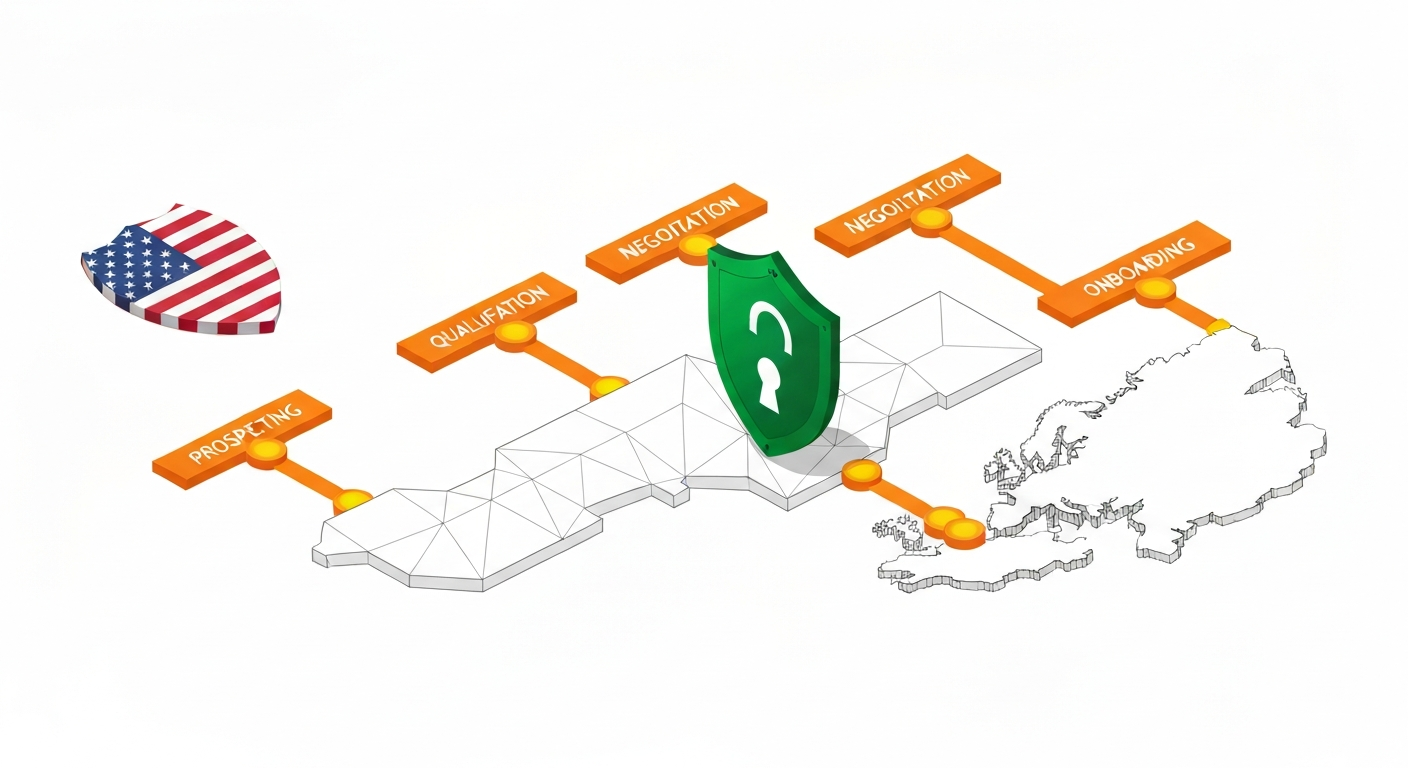
Pipedrive occupies a distinctive position in the European CRM market: founded in Tallinn, Estonia in 2010, its origin story reads like a success narrative for European tech entrepreneurship. Five co-founders — Timo Rein, Urmas Purde, Ragnar Sass, Martin Henk, and Martin Tajur — built a pipeline-focused sales CRM that eventually reached 100,000 customers in 179 countries. For many European businesses, Pipedrive's Estonian origin creates an intuitive assumption of regulatory proximity — surely a tool born in the EU operates under EU legal frameworks?
That assumption has been incorrect since January 2020. In that month, Vista Equity Partners — a US private equity firm based in Austin, Texas — acquired a majority stake in Pipedrive at a valuation of $1.5 billion. Pipedrive, Inc. is incorporated in Delaware. Its controlling shareholder is a US entity. Every piece of customer data processed through Pipedrive's platform is processed by, or under the control of, a US person — and therefore falls within the extraterritorial reach of the US CLOUD Act.
This is the regulatory reality that Pipedrive's Estonian heritage obscures. The country of origin of a software product does not determine the legal jurisdiction of its corporate owner. For GDPR compliance purposes, jurisdictional risk follows corporate structure, not geography or founding team nationality.
Pipedrive, Inc.: Delaware Incorporation, Vista Equity Ownership
Pipedrive operates through Pipedrive, Inc., a Delaware corporation. Delaware incorporation is the standard structure for US-facing tech companies — it carries US personhood under federal law and makes Pipedrive an "electronic communication service" or "remote computing service" provider subject to the Stored Communications Act, as amended by the CLOUD Act.
Vista Equity Partners manages approximately $100 billion in assets and specialises in enterprise software acquisitions. Its portfolio includes dozens of B2B software companies across ERP, CRM, analytics, and HR categories. Vista Equity Partners LLC is a Delaware limited liability company, headquartered in Austin, Texas, with additional offices in San Francisco, New York, and Chicago. It is unambiguously a US entity.
The CLOUD Act, codified at 18 U.S.C. § 2713, requires any US electronic communications provider or remote computing service provider to comply with lawful warrants, subpoenas, or court orders requiring data disclosure "regardless of whether such communication, record, or other information is located within or outside of the United States." The operative criterion is the legal status of the provider — not the physical location of the data, not the nationality of the customers, and not the country where the service was founded.
A US federal court can therefore issue a CLOUD Act production order directed at Pipedrive, Inc. requiring the production of EU customer data stored in European data centres. Pipedrive's legal obligation to comply derives from its US incorporation and its US-domiciled controlling shareholder. EU judicial proceedings are not required, the data subject does not receive notice, and no mutual legal assistance treaty request is necessary.
Why Vista Equity Ownership Matters for GDPR
The Vista acquisition creates two independent CLOUD Act exposure pathways for Pipedrive customers:
Pipedrive, Inc. as direct obligor: As a Delaware corporation providing electronic communication services to EU customers, Pipedrive, Inc. is directly subject to CLOUD Act production orders.
Vista Equity Partners as controlling parent: Vista Equity Partners holds controlling influence over Pipedrive's operations. US authorities seeking Pipedrive customer data could reach that data through Vista's US corporate structure, compelling Vista to exercise its controlling influence over Pipedrive to produce the requested records. This parent-subsidiary exposure is structurally identical to the exposure that affects AWS EU regions through Amazon's US parent, or Salesforce Hyperforce EU through Salesforce's US incorporation.
Neither of these pathways depends on data being stored in the United States. Both operate as a function of corporate structure and US federal jurisdiction over US-domiciled entities.
Pipedrive's EU Data Hosting: What It Provides and What It Doesn't
Pipedrive offers an EU data residency option for customers on Professional and higher plans. Under this configuration, customer data — including contacts, deals, activities, notes, and pipeline stages — is stored in AWS EU-CENTRAL-1 (Frankfurt) or AWS EU-WEST-1 (Ireland) infrastructure.
EU data residency addresses the geographic element of GDPR Article 44 and Chapter V compliance. Data at rest within EU AWS infrastructure is not subject to data transfer restrictions for the act of storage itself. For DPA checklists, vendor assessment questionnaires, and GDPR Article 30 records of processing, EU data residency is a documentable control.
What EU data residency does not change is the corporate structure. Pipedrive, Inc. remains a Delaware corporation. Vista Equity Partners remains its US-domiciled controlling shareholder. A CLOUD Act order does not instruct AWS Frankfurt to release data — it instructs Pipedrive, Inc. to produce data. Pipedrive's obligation to comply with that order arises from US federal law and extends to data held anywhere globally, including AWS EU regions.
This distinction is well-established in EU data protection enforcement. The Swedish Data Protection Authority's 2022 decision against healthcare company Capio found a violation because patient data was transferred to Salesforce in the United States without an adequate Transfer Impact Assessment — despite Salesforce's European hosting claims. The Austrian Data Protection Authority's 2022 ruling against Google Analytics found that the analytics tool's EU data processing did not eliminate the CLOUD Act exposure arising from Google LLC's US incorporation. In both cases, data location in Europe was insufficient to override the jurisdictional risk created by the US corporate structure.
What Data Pipedrive Processes: Sales CRM Data Sensitivity
CRM data occupies a particular position in the personal data spectrum: it is simultaneously among the most commercially sensitive data a business holds and among the most extensively profiled for individual data subjects. Understanding what Pipedrive accumulates helps scope the GDPR exposure.
Contact Records: Full name, email address, phone number, job title, organisation, LinkedIn profile, physical address. For B2B sales teams, this represents the personal data of individual employees at target companies — data subjects with full GDPR rights whose data your company holds as controller and Pipedrive processes as processor.
Deal and Pipeline Data: Every opportunity recorded in Pipedrive captures deal value, expected close date, probability, stage history, and often free-text notes containing negotiation details, competitive intelligence, and internal strategic commentary. Individual employee names linked to deal records are personal data. Deal-specific annotations may reveal commercially sensitive information about third parties.
Activity Logs: Phone calls logged, emails sent through Pipedrive, meetings scheduled through calendar integrations, tasks completed. This generates a timestamped record of individual salesperson behaviour and customer interaction patterns — behavioural personal data under GDPR Article 4(1).
Email Integration Data: Pipedrive's email integration syncs messages between CRM and email providers (Gmail, Microsoft 365). Subject lines, sender and recipient addresses, timestamps, and where configured, full email body content, are ingested into Pipedrive's database. Email content tied to named individuals constitutes sensitive personal data in many contexts.
AI Features: Pipedrive has introduced AI-assisted features including automatic activity summaries, email drafting suggestions, and deal health scoring. These features process existing CRM data to generate inferences about customer relationships and salesperson performance. Where AI model inference occurs — and whether EU data residency commitments extend to AI processing workloads — is not fully disclosed in Pipedrive's documentation.
Marketplace Integrations: Pipedrive's marketplace lists over 400 integrations with third-party applications. When data flows from Pipedrive to an integrated third-party tool, it exits the EU data residency envelope and enters the data governance framework of that third-party provider. Each such integration requires independent assessment of the third party's jurisdictional status and transfer mechanism.
GDPR Obligations When Using Pipedrive
For EU companies using Pipedrive, the following GDPR obligations require attention regardless of whether EU data residency is configured:
Data Processing Agreement: Pipedrive's DPA designates Pipedrive as a data processor and the customer as controller. The DPA incorporates Standard Contractual Clauses (SCCs) as the transfer mechanism for any processing outside the EEA.
Transfer Impact Assessment: The EDPB's post-Schrems II guidelines and supervisory authority practice in Austria, Sweden, and France establish that SCCs require a Transfer Impact Assessment (TIA) evaluating the laws of the data importer's country. For Pipedrive, the TIA must assess US surveillance law including FISA Section 702 and the CLOUD Act. The conclusion of that TIA — given Vista Equity's US domicile and Pipedrive's Delaware incorporation — is that US law enforcement and intelligence access to EU personal data is legally possible without EU judicial oversight.
Article 30 Records of Processing: Pipedrive must appear in your Record of Processing Activities. The record entry should document the transfer mechanism (SCCs), the TIA status, and the categories of personal data involved.
Legitimate Interest Assessment for Sales Tracking: For prospecting activities involving unsolicited contact with individuals not yet in a commercial relationship, the legal basis for processing contact data in Pipedrive requires analysis. GDPR Article 6(1)(f) (legitimate interests) is the most commonly used basis for B2B prospecting, but requires a balancing test that weighs the controller's interests against data subjects' rights.
AI Feature Opt-Out: If Pipedrive AI features process CRM data, review the terms governing AI model training and inference. Pipedrive's AI terms should be reviewed for any provisions permitting data use beyond instruction — for which the standard DPA processor relationship may be insufficient.
EU Alternatives to Pipedrive
The following alternatives are incorporated in EU member states, are not majority-controlled by US entities, and offer comparable CRM functionality for sales teams.
Teamleader (Belgium)
Teamleader was founded in 2012 in Ghent, Belgium and remains headquartered there. It is incorporated under Belgian law and its primary operations remain within the EU. Teamleader Focus provides CRM, project management, invoicing, and time tracking in a single platform, making it particularly well-suited for professional services firms, agencies, and SMBs that need CRM alongside operational workflows.
Teamleader's investor base includes Insight Partners (a US firm that invested in 2019) — this creates indirect US exposure that should be evaluated in any TIA. However, the corporate entity contracting with customers — Teamleader N.V. — is Belgian, and the product was not subject to a Vista-style majority acquisition by a US PE firm. Customers should verify the current ownership structure with Teamleader and document findings in their TIA.
Best for: SMBs that need CRM + projects + invoicing in one EU-native tool. Belgian law jurisdiction, GDPR-native by design.
Brevo CRM (France)
Brevo (formerly Sendinblue) was founded in Paris in 2012 and remains headquartered there. Brevo is a French corporation under French law. Its CRM product is integrated with email marketing, transactional email (SMTP), SMS, and WhatsApp messaging — making it the strongest option for teams that want a combined marketing and sales CRM.
Brevo data centres are located in Paris (OVHcloud and its own infrastructure) and Frankfurt (AWS). For EU data sovereignty, OVHcloud infrastructure is preferable — request explicit confirmation of data centre location when configuring Brevo accounts.
Best for: Teams combining email marketing with CRM, or businesses migrating from HubSpot's Marketing Hub who want an EU-native replacement for both CRM and marketing automation.
CentralStationCRM (Germany)
CentralStationCRM is developed and operated by 42he GmbH, a company based in Cologne, Germany. It targets small teams of 2–25 people with a deliberately simple interface: contacts, deals, tasks, and notes — no automation complexity, no AI features, no marketplace integrations that would create sub-processor chains.
Data is processed exclusively within Germany on German infrastructure. For small German-market businesses with straightforward sales processes and strong data minimisation preferences, CentralStationCRM offers the cleanest GDPR profile in this list.
Best for: Small teams that want maximum simplicity, German law jurisdiction, and the tightest possible data minimisation posture.
Twenty CRM (Open Source, France)
Twenty is an open-source CRM platform, MIT licensed, developed by a French team and available at twenty.com. It is designed as a modern alternative to Salesforce for teams that want full data ownership through self-hosting. The visual data model is highly customisable, the API is GraphQL-based, and self-hosted deployments can run on any EU infrastructure.
For companies with engineering resources, Twenty on self-hosted EU infrastructure offers complete legal sovereignty: no US corporate involvement, no SaaS DPA required, no sub-processor chain. The trade-off is operational responsibility for hosting, backups, and upgrades.
Best for: Engineering-led teams that want full data sovereignty and are willing to manage self-hosted infrastructure. Ideal for companies already running EU-hosted developer infrastructure.
SuiteCRM (UK)
SuiteCRM is the most widely deployed open-source CRM globally, maintained by SalesAgility Ltd in Stirling, Scotland. As a fork of SugarCRM, it covers all standard CRM functionality: contacts, accounts, leads, opportunities, forecasting, workflows, and reporting. The UK's exit from the EU creates a minor complication: the UK is an EU adequacy country (for now), but UK law is not EU law, and SalesAgility as a UK entity operates under UK GDPR rather than EU GDPR.
For companies that want open-source CRM on their own EU servers, SuiteCRM deployed on EU infrastructure eliminates the corporate jurisdiction question entirely — the software vendor's jurisdiction becomes irrelevant when data never leaves your own servers.
Best for: Organisations with complex CRM requirements that need a feature-complete open-source solution with self-hosted deployment on EU infrastructure.
Decision Framework: Should You Migrate from Pipedrive?
The case for staying with Pipedrive is operationally strongest when your organisation is deeply integrated into its pipeline workflow, has trained sales teams on its interface, and uses multiple Pipedrive Marketplace integrations. Operational disruption costs are real. The CLOUD Act risk is real but may be evaluated as acceptable depending on your industry, customer data sensitivity, and regulatory context.
The case for migrating is strongest when:
- Your customers operate in regulated sectors (healthcare, finance, legal, government) and contractually require EU-law-governed data processing
- Your Data Protection Officer or legal counsel has assessed that a TIA for Pipedrive, Inc. under Vista Equity ownership cannot produce a positive conclusion
- You are subject to NIS2, DORA, or sectoral regulations that impose specific supply chain data governance requirements on software processors
- Your customers' enterprise procurement teams are asking for data sovereignty commitments that a US-owned CRM cannot meet
- You are a software company competing on EU data sovereignty as a feature — using a US-owned CRM for customer data is inconsistent with that positioning
For organisations in the middle — not under acute regulatory pressure but wanting to reduce jurisdictional risk on a reasonable timeline — Teamleader and Brevo offer the most practical migration paths with the lowest operational disruption.
Migration Planning: Moving CRM Data from Pipedrive to an EU Alternative
Pipedrive's data export functionality covers the main CRM objects. A typical migration sequence:
1. Export from Pipedrive
Export contacts, organisations, deals, activities, notes, and custom fields via Pipedrive's Settings > Data Export. CSV exports are available for all primary objects. For email history synced through Pipedrive's email integration, the email records stored within Pipedrive can be exported, but historical emails in the linked email provider (Gmail, Outlook) are controlled by that provider's export tools.
2. Data Cleaning
CSV exports frequently contain duplicates, stale contact records, and incomplete address data. Pre-migration data cleaning reduces clutter in the target system and is an opportunity to apply data minimisation — GDPR Article 5(1)(c) requires keeping only data that is adequate, relevant, and limited to what is necessary for specified purposes.
3. Import to Target System
Teamleader, Brevo, and most alternatives accept CSV imports for contacts and deals. Custom field mapping is the most labour-intensive part of the migration. Plan for iteration: first import with a test data set, validate the field mapping, then run the full import.
4. Integration Reconnection
Marketplace integrations (accounting tools, email marketing, customer success platforms) will need to be reconnected or replaced. This is an opportunity to audit each integration against its own jurisdictional risk profile — US-owned integrations connected to a new EU-native CRM still create sub-processor transfer exposure.
5. Historical Data Decision
For historical pipeline and deal data that goes back years, evaluate whether full migration is necessary or whether a read-only export archive suffices. Active pipeline and current customer records are the migration priority; multi-year historical opportunity data can often remain in a Pipedrive export archive rather than being imported into the new system.
Conclusion
Pipedrive's Estonian origin is a founding story, not a jurisdictional guarantee. Since Vista Equity Partners' 2020 acquisition, Pipedrive operates through Pipedrive, Inc. — a Delaware corporation with a US private equity majority shareholder. EU data hosting reduces geographic exposure for Chapter V compliance documentation, but does not alter the CLOUD Act obligation that applies to Pipedrive's US corporate structure.
For EU businesses in unregulated sectors conducting low-sensitivity B2B sales, this may be an acceptable risk after a documented TIA. For businesses in regulated sectors, those subject to NIS2 or DORA supply chain requirements, or those competing on EU data sovereignty, it requires a CRM selection decision that aligns with the legal obligations and commitments those businesses have already made.
EU-native alternatives — Teamleader in Belgium, Brevo in France, CentralStationCRM in Germany, and Twenty as an open-source self-hosted option — cover the functional scope Pipedrive provides for the vast majority of SMB and mid-market sales teams. The migration cost is real but bounded. The jurisdictional risk from a US-majority-owned CRM processing your entire customer relationship history is structural and ongoing.
Running a EU-native SaaS product and deploying it to EU infrastructure? sota.io is a managed EU PaaS — Hetzner Germany, no US parent, no CLOUD Act exposure. Deploy any language in minutes.
EU-Native Hosting
Ready to move to EU-sovereign infrastructure?
sota.io is a German-hosted PaaS — no CLOUD Act exposure, no US jurisdiction, full GDPR compliance by design. Deploy your first app in minutes.