EUCS Meets DORA, NIS2, and EU Public Procurement: What Changes for Regulated Industries in 2026
Post #4 in the sota.io EU Cloud Sovereignty Series
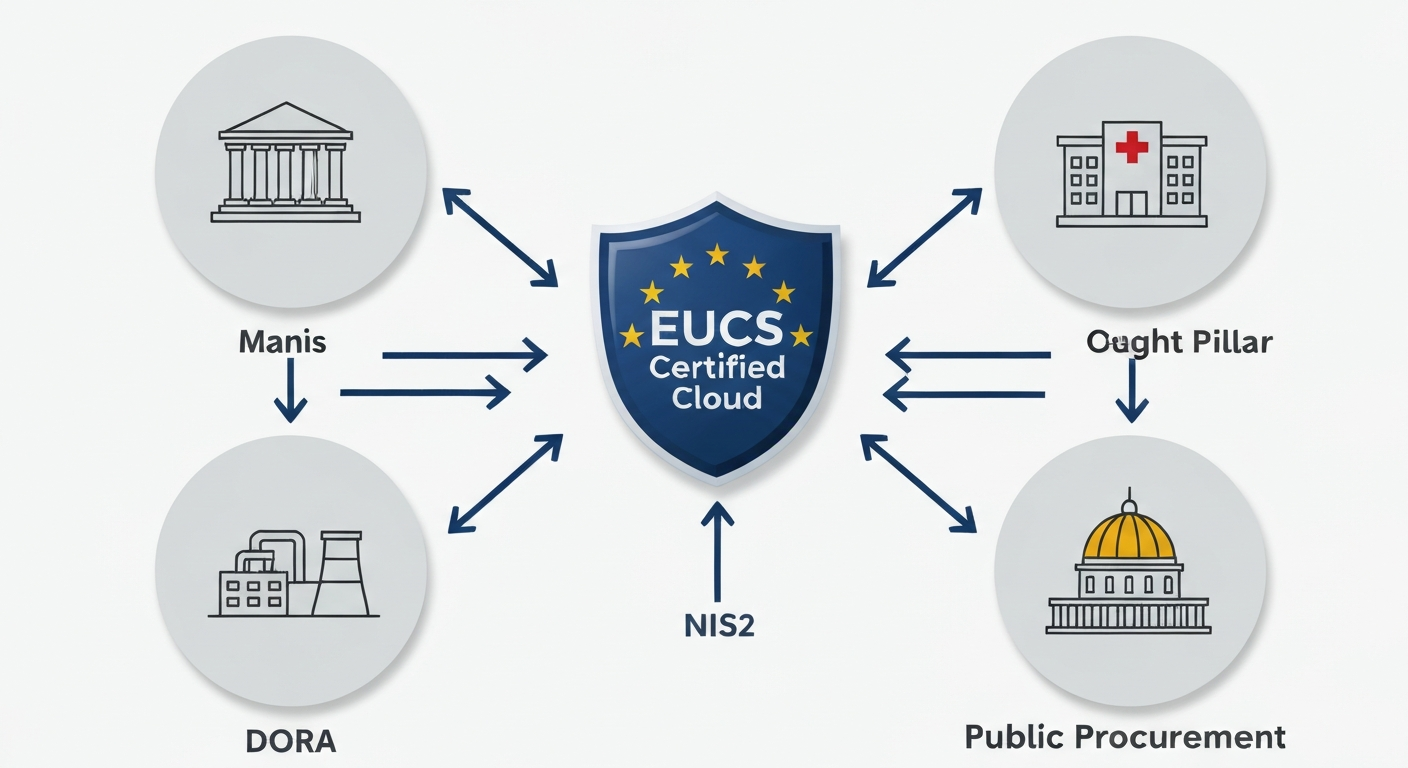
If you work in financial services, critical infrastructure, healthcare, or government IT, EUCS certification by your cloud provider is not a nice-to-have background detail. It is a factor that directly touches your primary regulatory obligations.
DORA requires financial entities to assess ICT third-party risk with documented evidence. NIS2 explicitly names EU cybersecurity certification schemes as an instrument for satisfying supply chain security obligations. EU public procurement frameworks are moving toward requiring EUCS HIGH certification for government cloud contracts in sensitive categories.
None of these frameworks make EUCS certification by your provider a substitute for your own compliance work. But all three interact with EUCS in ways that create concrete compliance shortcuts — and concrete gaps if you assume certification covers more than it does.
This post maps those intersections precisely for each regulated sector.
What the EUCS Certification Levels Mean for Regulated Industries
Before examining the framework interactions, a quick anchor on what EUCS levels mean operationally:
EUCS Basic covers standard commercial cloud deployments. Threat model assumes opportunistic attackers with low capability. Relevant for: non-regulated SaaS workloads, internal tooling, development environments.
EUCS Substantial addresses determined attackers with significant capability. Encryption at rest and in transit is mandatory. Personnel with provider access must have EU nationality checks. Relevant for: regulated entities in financial services, healthcare, medium-sensitivity public sector workloads.
EUCS High assumes state-level adversaries. Strict EU legal entity requirements (provider cannot be subject to non-EU law enforcement). HSM-backed key management. EU-only personnel for privileged access. Relevant for: defense, national security-adjacent workloads, the highest-sensitivity EU institutional cloud contracts.
The critical jurisdiction boundary matters here: under EUCS High, the provider must not be owned or controlled by a non-EU entity and must not be subject to foreign laws that allow access to EU data (a direct reference to the US CLOUD Act and equivalent instruments). This is where AWS Frankfurt, Azure Netherlands, and GCP Belgium fail the EUCS High standard — not because of their data center location, but because of their US parent jurisdiction.
EUCS and DORA: Digital Operational Resilience for Financial Services
DORA (Regulation (EU) 2022/2554) applies to an extensive list of financial entities: credit institutions, payment institutions, electronic money institutions, investment firms, crypto-asset service providers, insurance undertakings, occupational pension funds, credit rating agencies, and others.
For these entities, cloud providers are ICT third-party service providers under DORA's terminology. The regulation creates a layered set of requirements specifically for this relationship.
Art.28: General Principles for ICT Third-Party Risk
DORA Art.28 establishes the foundational framework for managing ICT third-party risk. Financial entities must implement a strategy for ICT third-party risk as part of their overall ICT risk management framework. This strategy must be documented, reviewed at least annually, and reported to management.
EUCS certification by your cloud provider does not replace this requirement. You still need the strategy document. But EUCS certification gives you documented, third-party-verified evidence for a substantial portion of the infrastructure risk assessment that Art.28 requires. Instead of commissioning your own audit of the provider's physical security, hypervisor controls, and incident response procedures, you can reference the EUCS certification — which was produced by an accredited conformity assessment body against a published standard.
The practical value: EUCS certification compresses the due diligence cycle for provider assessments. For financial entities that use multiple cloud providers across multiple jurisdictions, this is not a trivial saving. An audit that previously took three months of back-and-forth with the provider's vendor security team can be anchored to the certification report.
Art.29: ICT Concentration Risk
DORA Art.29 requires financial entities to perform a preliminary assessment of ICT concentration risk at the entity level — both horizontally (across the entity) and vertically (dependency on a single provider).
This article interacts with EUCS in a subtle way. When you select a EUCS-certified provider, you are typically selecting from a shorter list — the providers that have invested in accreditation tend to be larger, more established EU-native or EU-operating providers. This changes your concentration risk calculation.
For some financial entities, this means the EUCS certification requirement for higher-sensitivity workloads may itself create concentration risk if only one or two providers can offer EUCS Substantial or High certification in the relevant service category. DORA Art.29 requires you to document and assess this. The answer is not necessarily to avoid EUCS-certified providers — it may mean diversifying across two or three certified providers, or maintaining a certified primary with a contingency plan for less-sensitive workloads.
Art.30: Key Contractual Provisions
DORA Art.30 specifies mandatory contractual provisions that must appear in agreements between financial entities and ICT third-party service providers. These include: clear service description and data location specifications, incident notification timelines, audit and inspection rights, exit assistance provisions, and sub-contracting conditions.
EUCS certification does not replace or satisfy Art.30 contractual requirements. The contract between you and your provider must contain these provisions regardless of the provider's certification status. However, EUCS-certified providers typically already maintain contractual templates that include these provisions — the certification process itself requires documented service agreements, data location controls, and audit rights as part of the conformity assessment.
In practice, contract negotiation with a EUCS Substantial-certified provider is smoother for DORA Art.30 compliance because the provider has already structured their service agreements around the EUCS audit requirements, which overlap substantially with what DORA Art.30 mandates.
Art.31: Critical ICT Third-Party Service Providers
DORA Art.31 authorizes the ESAs (European Banking Authority, EIOPA, ESMA) to designate certain ICT third-party service providers as "critical" — meaning they become subject to direct EU oversight, including inspections by the Joint Oversight Network.
For providers designated as critical under Art.31, EUCS certification status will likely become a factor in the oversight assessment. The Joint Oversight Network's methodology for assessing critical providers overlaps significantly with EUCS assessment domains: incident response, operational resilience testing, sub-contractor controls, and data protection.
For you as a financial entity, if your cloud provider is designated critical under Art.31, EUCS certification gives you a compliance shortcut in your own reporting to your national competent authority. You can point to the certification as evidence that the provider's infrastructure controls have been independently assessed — which matters when your NCA asks how you verified your critical provider's security posture.
EUCS and NIS2: Supply Chain Security for Essential and Important Entities
NIS2 (Directive (EU) 2022/2555) applies to essential and important entities across sixteen sectors: energy, transport, banking, financial market infrastructure, health, drinking water, wastewater, digital infrastructure, ICT service management, public administration, space, and five additional sectors for important entities.
Art.21: Cybersecurity Risk-Management Measures
NIS2 Art.21 requires essential and important entities to implement appropriate and proportionate technical, operational, and organisational measures to manage cybersecurity risks. Art.21(2) lists ten specific measure categories that this requirement covers.
Art.21(2)(d) is directly relevant to your cloud provider relationship: it requires measures addressing "supply chain security, including security-related aspects concerning the relationships between each entity and its direct suppliers or service providers."
EUCS certification by your cloud provider is the most direct evidence you can produce for the supply chain security assessment that Art.21(2)(d) requires. When your national competent authority asks how you assessed the security of your cloud provider — which is your most significant direct supplier for the purposes of ICT delivery — EUCS certification gives you a documented, accredited answer.
Without EUCS certification (or an equivalent documented third-party assessment), Art.21(2)(d) compliance requires you to either commission your own supplier audit, rely on the provider's self-attestation, or conduct a contractually negotiated right-to-audit exercise. All three are more expensive and more time-consuming than pointing to a EUCS certification report.
Art.24: Use of European Cybersecurity Certification Schemes
This is the article that creates the explicit NIS2 link to EUCS, and it is frequently overlooked.
NIS2 Art.24 authorizes member states to require essential and important entities to use ICT products, ICT services, or ICT processes that are certified under European cybersecurity certification schemes. The article is a permissive provision — "member states may require" — but several member states are already moving to exercise this permission.
Germany (via BSI guidance supplementing the national NIS2 transposition law) and France (via ANSSI) are both developing requirements that tier cloud certification expectations to entity sensitivity. Essential entities in high-sensitivity sectors — financial market infrastructure, energy, healthcare — can expect national requirements to reference EUCS Substantial or High as a baseline for critical cloud workloads.
For software companies selling into regulated European markets, Art.24 means that your infrastructure choice may become a direct compliance input for your customer. If you run on a EUCS Substantial-certified provider and your customer is an essential entity under NIS2, your infrastructure certification simplifies their Art.24 compliance documentation. This is increasingly a procurement selection criterion — not just a background vendor security detail.
EU Public Procurement: The Government Cloud Mandate
The intersection of EUCS and EU public procurement is the most operationally concrete of the three frameworks — and the one moving fastest.
The EU Institutional Requirements
EU institutions, bodies, and agencies are subject to their own procurement frameworks under Regulation (EU, Euratom) 2018/1046 (the Financial Regulation) and subsequent implementing rules. The European Commission has published guidance that directs EU institutions toward EUCS-certified services for cloud procurement in categories involving sensitive or classified-adjacent data.
For cloud services handling sensitive EU institutional data, EUCS High is the target level. For moderate-sensitivity workloads, EUCS Substantial is expected. EUCS Basic is acceptable only for non-sensitive administrative workloads.
This creates a practical market segmentation: cloud providers that cannot achieve EUCS High certification — including all major US hyperscalers operating under their US parent jurisdiction — are excluded from competing for the highest-sensitivity EU institutional contracts, regardless of their European data center presence.
Member State Government Procurement
Member state government procurement rules vary, but several EU members are implementing or piloting EUCS-based requirements in national procurement frameworks:
France: ANSSI's SecNumCloud certification (the French national scheme) is being aligned with EUCS High as France pushes for EU-level recognition of SecNumCloud. French public sector entities in sensitive categories are already required to use SecNumCloud or SecNumCloud-equivalent certified services for sensitive data workloads.
Germany: The BSI's C5 (Cloud Computing Compliance Criteria Catalogue) is recognized as complementary to EUCS, with BSI actively participating in EUCS scheme development. German public sector procurement for sensitive workloads references C5 Substantial or High type attestations, with EUCS Substantial expected to align as the scheme matures.
Other member states: Netherlands, Sweden, and Austria are the most active in developing similar national requirements. Pan-EU government procurement is expected to consolidate around EUCS Substantial as the baseline for sensitive categories as the EUCS scheme reaches full maturity (anticipated 2026-2027).
What This Means for SaaS Companies Selling to Government
If you build SaaS and sell to public sector entities in the EU, your infrastructure choice is increasingly a sales qualification criterion:
- Contracts for non-sensitive administrative functions: EUCS Basic or equivalent is sufficient. Most cloud providers qualify.
- Contracts involving personal data of public sector employees or citizens: EUCS Substantial is increasingly the expected baseline. Providers without this certification face procurement evaluation penalties or disqualification.
- Contracts involving classified or near-classified data: EUCS High is required. Only a small number of EU-native providers qualify. US hyperscalers operating under US parent jurisdiction do not.
For SaaS companies, this means that running on EUCS Substantial or High infrastructure is not just about your own compliance — it directly affects whether your government customers can purchase from you under their own procurement rules.
Regulated Industry Impact Matrix
| Framework | Entity Type | EUCS Interaction | What EUCS Gives You | What You Still Need |
|---|---|---|---|---|
| DORA | Financial entities | ICT third-party risk evidence | Compressed Art.28 due diligence | Art.30 contracts, Art.29 concentration risk docs |
| DORA Art.31 | Critical ICT service providers | Oversight evidence | Infrastructure audit shortcut | Operational resilience testing (TLPT under Art.26) |
| NIS2 Art.21(2)(d) | Essential + important entities | Supply chain evidence | Provider security assessment | Application-layer controls, incident reporting (Art.23) |
| NIS2 Art.24 | Essential entities (DE, FR, others) | National certification requirement | Procurement qualification | Ongoing monitoring, governance (Art.20) |
| Public Procurement | EU institutions | Contract qualification | Sensitive-category access | Data processing agreements, audit rights |
| Public Procurement | Member state public sector | Contract qualification | Procurement scoring advantage | National implementation variations |
What EUCS Certification Covers vs What Remains Your Responsibility
A EUCS-certified provider's certification covers the infrastructure layer. Your application layer, your data governance, and your own operational processes remain entirely your responsibility.
What you inherit from your provider's EUCS certification:
- Physical data center security (access controls, surveillance, environmental protections)
- Hypervisor and virtualisation layer integrity
- Network infrastructure security between provider components
- Provider staff access controls and nationality-based vetting (for Substantial/High levels)
- Provider incident response procedures for infrastructure-level events
- Supply chain management for the provider's own sub-contractors (hardware, network, facilities)
- Legal jurisdiction controls ensuring data remains subject to EU law
What remains your obligation regardless of your provider's certification status:
- Application security: your code, your APIs, your authentication mechanisms
- Data classification: identifying which data requires which protection tier
- Access management: who in your organisation can access your cloud-hosted data
- Encryption key management: if you manage your own keys, key lifecycle is yours
- Incident detection and reporting: NIS2 Art.23 / DORA Art.19 reporting timelines are your obligation
- Business continuity and backup: DORA Art.12 backup obligations require your own documented procedures
- Governance and management liability: NIS2 Art.20 requires management body approval of your security measures
The practical implication: EUCS certification by your provider does not reduce your own compliance workload by more than approximately 30-40% in terms of documented control evidence. The majority of your compliance documentation burden concerns your application layer, which EUCS does not address.
The Sovereignty Layer: Why Provider Nationality Matters Across All Three Frameworks
A recurring theme across DORA, NIS2, and EU public procurement is that provider jurisdiction matters in ways that data center location alone does not satisfy.
DORA Art.28 requires financial entities to assess risks associated with ICT third-party providers — and one of those risks, explicitly acknowledged in the EBA guidelines, is the risk of access by non-EU authorities. A provider operating under US jurisdiction (subject to the CLOUD Act) presents a materially different risk profile than a provider incorporated under EU law with no non-EU parent.
NIS2 Art.21(2)(d) supply chain security assessment must consider legal risks, not just technical controls. The CLOUD Act creates a legal risk that no amount of technical encryption or data center location eliminates — a US court order to the US parent can compel disclosure of EU-stored data without the EU controller's knowledge or consent.
EU public procurement frameworks for sensitive categories are explicit: EUCS High requires providers to be EU-incorporated entities not subject to foreign jurisdiction that allows access to EU institutional data. This is the hard requirement that eliminates US hyperscalers from the highest-sensitivity contracts.
For regulated EU entities across all three frameworks, the cloud provider sovereignty question is not a philosophical preference. It is a documented risk factor that your compliance documentation must address — and that affects your ability to compete for regulated contracts.
Developer Checklist: EUCS × DORA / NIS2 / Public Procurement
Assess your own regulatory scope:
- Are you a DORA-covered financial entity or ICT third-party service provider?
- Are you an NIS2 essential or important entity? (Check your sector against Annex I/II)
- Do you sell to EU government or public sector entities?
- Do you operate under national regulations that have transposed NIS2 with certification requirements (Germany BSI, France ANSSI)?
For DORA entities:
- Document your cloud provider's EUCS certification level in your ICT third-party risk register
- Map EUCS coverage to your DORA Art.28 risk assessment evidence requirements
- Review your ICT third-party contracts against DORA Art.30 mandatory provisions
- Assess ICT concentration risk (Art.29) — document if only EUCS-certified providers meet your security baseline
For NIS2 essential entities:
- Map your cloud provider's EUCS certification level to Art.21(2)(d) supply chain evidence
- Check your national competent authority's guidance on Art.24 certification requirements
- Ensure your provider's certification scope covers the specific services and regions you use (certification scope varies by service and geography)
For public sector / government sales:
- Confirm the EUCS certification level required for your target contract categories
- Verify that your provider's certification covers the data types and sensitivity levels involved
- Check that your provider's legal entity is EU-incorporated with no non-EU parent (for EUCS High contracts)
- Prepare certification documentation for procurement qualification packages
Ongoing:
- Monitor EUCS scheme maturity — current candidate scheme expected to reach final status 2026-2027
- Track national NIS2 transposition variations — Art.24 requirements differ by member state and evolve
- Re-verify certification scope at contract renewal — EUCS certification scope can change with service additions or regional expansions
What Comes Next in This Series
This post covers the regulated-industry regulatory intersections. The fifth and final post in this series will deliver the complete EUCS developer compliance checklist — an integrated view of everything you need to assess, document, and maintain as a SaaS operator choosing a cloud provider in the EUCS era, with a 2026-2027 timeline for scheme maturity milestones.
[Post #5 coming next]: Full EUCS Developer Checklist and 2026-2027 Certification Timeline for SaaS Operators
This series: #1 EUCS Assurance Levels and Provider Qualification · #2 EUCS High Level Technical Controls · #3 EUCS SaaS Tenant Compliance Obligations · #4 EUCS × DORA, NIS2, Public Procurement · [#5 Developer Checklist and 2026-2027 Timeline (coming next)]
EU-Native Hosting
Ready to move to EU-sovereign infrastructure?
sota.io is a German-hosted PaaS — no CLOUD Act exposure, no US jurisdiction, full GDPR compliance by design. Deploy your first app in minutes.