EU Vector Database Comparison Finale 2026 — CLOUD Act Sovereignty Matrix: Pinecone vs Weaviate vs Chroma vs Zilliz vs Milvus
Post #1292 in the sota.io EU Cyber Compliance Series — EU-VECTOR-DB-TOOLS Series Finale
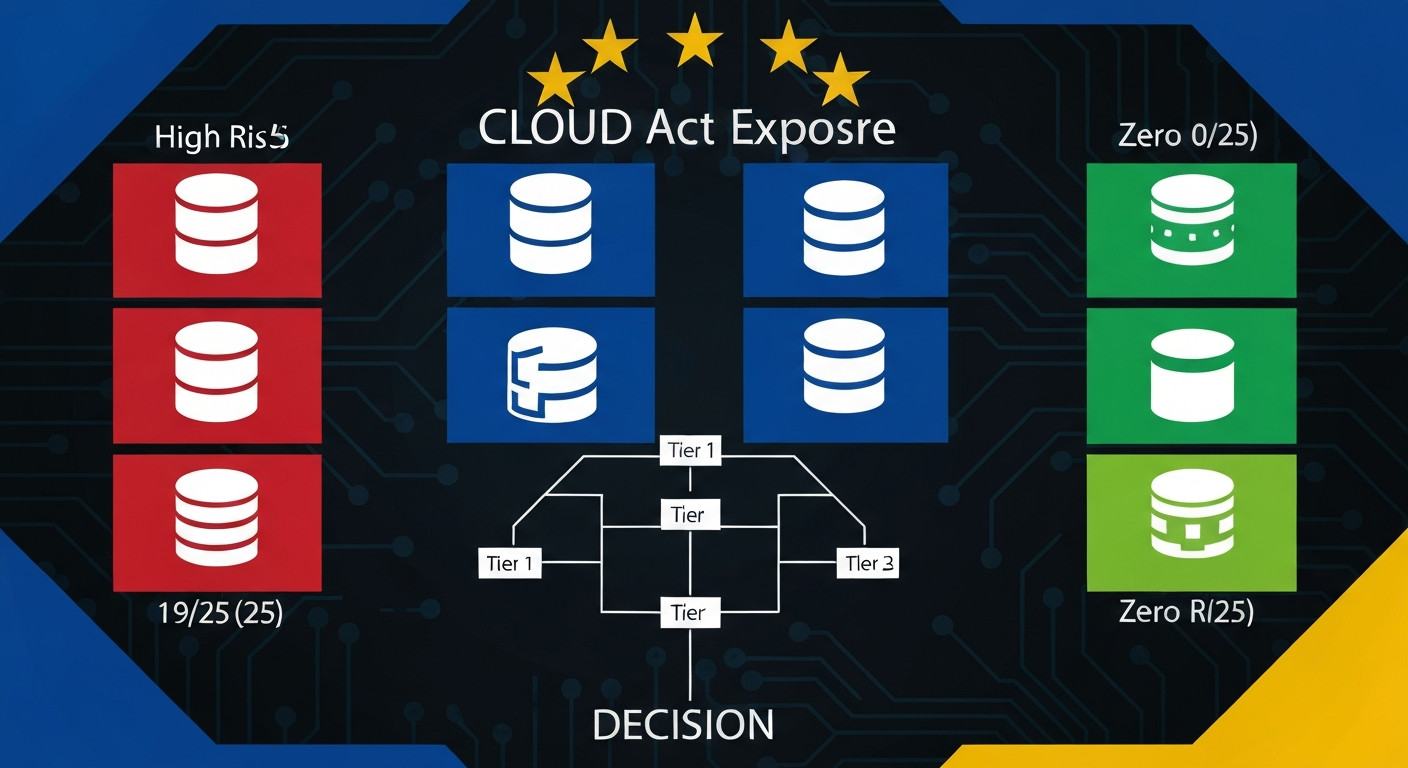
Over the past five posts we have worked through the leading vector database platforms from a single angle that the vendor marketing literature never addresses: CLOUD Act jurisdictional exposure. Each platform was assessed across five dimensions — corporate structure, investor intelligence links, data sensitivity, infrastructure jurisdiction, and EU-native alternatives — producing a score from 0 to 25 where higher means greater US legal-process reachability.
This finale brings the five assessments together. The complete sovereignty matrix reveals a pattern that individual assessments can obscure: the vector database market has sorted itself into structurally distinct risk tiers, and the tier you land in is determined not primarily by where you run the software, but by who owns the company building it.
We also consolidate the four named risk patterns identified across the series — patterns that appear in isolation in individual vendor posts but whose combined significance only becomes visible here — and present the EU RAG Stack Decision Framework for engineering teams choosing vector infrastructure in a GDPR-regulated environment.
The EU Vector Database Landscape: What Gets Stored
Vector databases are not passive storage. They hold processed representations of content — embeddings — generated by large language models that encode semantic meaning. For enterprise RAG systems, those embeddings derive from EU user queries, EU user documents, EU customer interaction histories, and EU employee communications.
GDPR Article 4(1) defines personal data as "any information relating to an identified or identifiable natural person." The Court of Justice of the European Union has established that uniqueness of identification, not the presence of a name or email address, determines whether data constitutes personal data. Research published in Nature demonstrated that 87% of Americans could be re-identified from sparse demographic datasets. The analogous concern for embedding vectors is their potential as indirect identifiers: a vector generated from a specific person's writing style, query vocabulary, or document corpus may be linkable back to that individual.
This matters for CLOUD Act assessment because it determines what a successful legal process request actually yields. A subpoena served on a vector database provider does not just yield storage — it yields semantic representations of EU user activity that may qualify as personal data under GDPR Article 4(1), triggering Article 44 cross-border transfer restrictions and Article 32 security obligations.
Complete CLOUD Act Sovereignty Matrix
The five platforms were assessed across the same five dimensions as each individual post. The table below presents the canonical scores derived from the detailed per-platform analyses.
| Dimension | Pinecone | Weaviate WCS | Chroma Managed | Zilliz Cloud | Milvus (DockerHub) |
|---|---|---|---|---|---|
| D1 — Corporate Structure | 5/5 | 2/5 | 5/5 | 5/5 | 3/5 |
| D2 — Investor Intelligence Links | 3/5 | 3/5 | 3/5 | 3/5 | 0/5 |
| D3 — Data Sensitivity | 5/5 | 3/5 | 5/5 | 4/5 | 0/5 |
| D4 — Infrastructure Jurisdiction | 3/5 | 2/5 | 3/5 | 3/5 | 0/5 |
| D5 — EU Alternatives Scarcity | 3/5 | 2/5 | 2/5 | 3/5 | 3/5 |
| CLOUD Act Score | 19/25 | 12/25 | 18/25 | 18/25 | 6/25 |
Deployment Mode Changes Everything
The single most important variable in this table is deployment mode. Three of the five platforms offer a self-hosted variant, and the sovereignty profile changes dramatically between managed cloud and self-hosted operation.
| Platform | Managed Score | Self-Hosted Score (Optimal) | Score Delta |
|---|---|---|---|
| Pinecone | 19/25 | N/A (cloud-only) | — |
| Weaviate WCS → self-hosted | 12/25 | 2/25 | −10 |
| Chroma Cloud → self-hosted (telemetry off) | 18/25 | 7/25 | −11 |
| Zilliz Cloud → Milvus (registry mirror) | 18/25 | 3/25 | −15 |
| Milvus (DockerHub) → Milvus (registry mirror) | 6/25 | 3/25 | −3 |
Pinecone is the only platform with no self-hosted escape route. It is a cloud-only service: Delaware C-Corp, San Francisco HQ, US infrastructure. There is no configuration change that moves its score.
The Four Named Risk Patterns
Across this series, four distinct risk patterns emerged. Each is named for the mechanism that creates the sovereignty exposure, not for the vendor that exemplifies it.
Pattern 1 — The RAG Pipeline Memory Paradox (exemplified by Pinecone)
Mechanism: A RAG system stores user query embeddings to enable semantic retrieval. The pipeline processes EU user inputs — questions, document excerpts, conversation history — into high-dimensional vectors and persists them in the vector store. When that vector store is a US-incorporated cloud service, EU user interaction history accumulates in US-jurisdiction infrastructure without the data subjects' awareness.
Why it matters: Unlike traditional databases storing explicit personal data fields, vector databases store implicit representations derived from personal content. The RAG system's memory — its accumulated understanding of what users have asked and what documents they have accessed — lives in the vector store. GDPR Article 5(1)(e) requires storage limitation: personal data "kept in a form which permits identification of data subjects for no longer than is necessary." RAG systems rarely implement embedding lifecycle management. The result is growing repositories of EU user interaction semantics in US-jurisdiction services.
Pinecone specific: D1=5/5 (Delaware C-Corp, no EU entity), D3=5/5 (query embeddings are the highest sensitivity data type for a RAG system), D4=3/5 (US-east and EU regions available, but legal compellability follows the Delaware parent). Score: 19/25.
Pattern 2 — The WCS Trap (exemplified by Weaviate)
Mechanism: A vector database is incorporated as a non-US entity — in Weaviate's case, Weaviate B.V. (Amsterdam, Netherlands) — and offers an open-source product. The assumption is that EU incorporation and open-source availability create a CLOUD Act shield. They do not, when the company has accepted substantial investment from US-domiciled venture capital firms with governance rights over the company.
Why it matters: The CLOUD Act reaches service providers that operate or store data in the United States. It also reaches foreign companies when US courts determine that the company has sufficient US nexus through subsidiary activity, investor governance, or US-person officer involvement. Weaviate B.V. has accepted investments from Index Ventures (San Francisco/London), NEA (Baltimore), and Battery Ventures (Boston/Menlo Park). US-based lead investors typically hold board seats and information rights. The open-source availability of the Weaviate code does not affect the compellability of data stored on Weaviate Cloud Services (WCS) infrastructure.
Weaviate specific: D1=2/5 (Dutch BV reduces direct CLOUD Act nexus vs Delaware C-Corp), D2=3/5 (US VC governance presence), D3=3/5 (WCS stores vector data, metadata, tenant configuration). WCS score: 12/25. Self-hosted with EU infrastructure and no WCS telemetry reporting: 2/25.
Pattern 3 — The Local-First Telemetry Trap (exemplified by Chroma)
Mechanism: A vector database presents itself as "local-first" or "self-hosted" — implying that data stays on the operator's infrastructure. The default configuration, however, includes a telemetry reporting mechanism that phones home to the vendor's analytics infrastructure. The vendor's analytics infrastructure is US-jurisdiction. Organisations running a "self-hosted" deployment that have not explicitly disabled telemetry are transmitting operational data — client identifiers, query patterns, collection sizes, error events — to US-jurisdiction cloud services.
Why it matters: Telemetry from enterprise vector database deployments can include information that qualifies as operational personal data. Query volume patterns may correlate with individual user behaviour. Error events may include sanitised query fragments. Collection size trajectories encode document ingestion behaviour. Even "anonymised" telemetry from an enterprise vector store contains organisational operational intelligence accessible to the US government via CLOUD Act subpoena.
Chroma specific: anonymized_telemetry=True is the default configuration value in chromadb/config.py. An organisation deploying Chroma without reviewing configuration defaults has active telemetry to US infrastructure regardless of where the Chroma server runs. Chroma Inc., San Francisco, Delaware C-Corp. Managed score: 18/25. Self-hosted with anonymized_telemetry=False explicitly set: 7/25.
# Required for any EU-compliant Chroma self-hosted deployment:
import chromadb
client = chromadb.PersistentClient(
    path="/opt/chroma-data",
    settings=chromadb.Settings(
        anonymized_telemetry=False  # MUST be explicit — default is True
    )
)
Pattern 4 — The Dual Jurisdiction Paradox (exemplified by Zilliz/Milvus)
Mechanism: A vector database is simultaneously reachable under two distinct national intelligence frameworks from competing geopolitical blocs. Zilliz Inc. (Delaware C-Corp) is subject to the US CLOUD Act. Zilliz's Beijing and Shanghai engineering teams — who contribute to both the commercial platform and the open-source Milvus codebase — are natural persons subject to China's National Intelligence Law (NIL) Article 7: "all organisations and citizens shall support, assist, and cooperate with national intelligence work."
Why it matters: The Dual Jurisdiction Paradox creates a risk profile that no single-jurisdiction assessment captures. A standard GDPR Data Protection Impact Assessment template addresses one legal framework. Zilliz's profile requires a multi-jurisdiction DPIA addressing simultaneously: US CLOUD Act requests reaching Zilliz Inc. (Delaware nexus), and PRC NIL requests reaching Zilliz's PRC-based engineering personnel (who have technical access to platform systems as a condition of their employment).
Milvus container registry note: The standard Helm installation pulls from DockerHub milvusdb/* images maintained by Zilliz. A "self-hosted" Milvus deployment using these images is operationally dependent on Zilliz-controlled container infrastructure. A self-hosted deployment that is genuinely independent from Zilliz requires building from the LF AI Foundation source with a private registry mirror and pinned digests.
Zilliz Cloud score: 18/25. Milvus self-hosted (DockerHub images): 6/25. Milvus self-hosted (LFAI source build, registry mirror): 3/25.
EU-Native Alternatives: The Sovereignty-Safe Stack
Three vector database options exist with EU-native corporate structures and zero US legal-process reachability under standard deployment.
Qdrant GmbH — Berlin, Germany (0/25)
Qdrant GmbH is incorporated under German law. It has no US parent company, no Delaware subsidiary, and no US-domiciled VC governance that would create CLOUD Act nexus. Its Series A round ($28M, 2023) was led by Unusual Ventures — a US firm — but without board control or governance rights that would create CLOUD Act compellability over the GmbH entity.
Qdrant Cloud offers EU region deployments (Frankfurt). The self-hosted Qdrant server has no telemetry enabled by default. The open-source codebase is available at github.com/qdrant/qdrant under Apache 2.0.
For EU enterprises replacing Pinecone in a RAG pipeline, Qdrant provides equivalent functionality: HNSW indexing, dense and sparse vector support, payload filtering, multi-tenancy, and a REST/gRPC API. Migration from Pinecone to Qdrant requires adapting the client library but no architectural changes.
CLOUD Act score: 0/25
Vespa.ai — Trondheim, Norway (2/25)
Vespa.ai AS is incorporated in Norway. Norway is an EEA member with an EU-equivalent data protection framework and a GDPR adequacy-equivalent standard applied through the EEA Agreement. It is not an EU member state, and the absence of EU court jurisdiction creates a marginal D1 score of 2/5 — not from US nexus, but from the slight jurisdictional gap created by Norwegian rather than EU-proper incorporation.
Vespa.ai is fully self-hostable. It has no telemetry by default. It supports dense and sparse vector search alongside traditional text ranking, making it particularly suited for hybrid retrieval systems. The cloud offering (Vespa Cloud) is operated from EU infrastructure.
CLOUD Act score: 2/25 (0/25 for self-hosted with EU infrastructure)
pgvector — PostgreSQL Extension (0/25)
pgvector is an open-source extension for PostgreSQL maintained by the PostgreSQL community. It has no corporate entity, no VC funding, no telemetry, and no cloud dependency. An enterprise running pgvector on self-hosted PostgreSQL in EU infrastructure has complete sovereignty over vector storage.
pgvector supports approximate nearest neighbour search via IVFFlat and HNSW indexes. It integrates natively with existing PostgreSQL tooling — replication, backup, point-in-time recovery, row-level security, audit logging. For enterprises already operating PostgreSQL, pgvector adds vector search capability without introducing a new external dependency.
CLOUD Act score: 0/25
Sovereignty Tier Classification
Combining the five assessments with the EU-native alternatives produces a four-tier sovereignty classification.
| Tier | Score Range | Platforms | Recommended Use |
|---|---|---|---|
| Tier 1 — High Sovereign Risk | 15–25/25 | Pinecone (19), Chroma Managed (18), Zilliz Cloud (18), Weaviate WCS (12*) | Avoid for EU personal data. Acceptable only for non-personal data with explicit DPA consultation and DPIA. |
| Tier 2 — Medium Sovereign Risk | 5–14/25 | Weaviate WCS (12), Milvus (DockerHub, 6) | Use only with contractual DPA guarantees, active data residency enforcement, and legal team sign-off. |
| Tier 3 — Low Sovereign Risk | 1–4/25 | Weaviate self-hosted (2), Chroma self-hosted (7**), Milvus (LFAI source, 3), Vespa.ai (2) | Acceptable for most EU personal data use cases with proper configuration and EU infrastructure. |
| Tier 4 — No Sovereign Risk | 0/25 | Qdrant GmbH (0), pgvector (0), Vespa.ai self-hosted (0) | Recommended for all EU personal data RAG systems. No CLOUD Act exposure. |
*Weaviate WCS sits at the Tier 1/2 boundary due to the Dutch BV structure reducing direct US nexus relative to Delaware C-Corps.
**Chroma self-hosted requires explicit anonymized_telemetry=False to reach Tier 3.
The EU RAG Stack Decision Framework
Engineering teams building RAG systems for EU-regulated environments can use the following decision framework.
Step 1 — Does your embedding corpus contain personal data?
│
├── NO → Any tier is acceptable. Evaluate on performance/cost.
│
└── YES → Continue to Step 2.

Step 2 — What is the regulatory framework?
│
├── GDPR Article 9 (special category data: health, ethnicity, etc.)
│   └── Tier 4 ONLY: Qdrant GmbH, pgvector
│
├── EU AI Act high-risk system (Annex III)
│   └── Tier 3 or 4: Document sovereignty in technical documentation (Art.11)
│
├── NIS2 essential/important entity
│   └── Tier 3 or 4: Document in security policy per Art.21(2)(h)
│
└── Standard GDPR (Art.5, 25, 32)
    └── Tier 3 or 4 preferred. Tier 2 requires documented DPIA.

Step 3 — Self-hosted capacity?
│
├── YES → Qdrant self-hosted (EU infra) or pgvector = Tier 4
│
└── NO (managed cloud required) →
    ├── Qdrant Cloud EU region (Frankfurt) = effective Tier 4
    └── Weaviate self-hosted managed by EU-domiciled MSP = Tier 3
Practical Migration Path from Pinecone
For teams currently using Pinecone (19/25) who need to move to a sovereignty-safe stack:
- Drop-in replacement: Qdrant with the LangChain
QdrantVectorStoreclass. API semantics are nearly identical to Pinecone's index operations. - Embedding model: Retain current model (OpenAI, Cohere, etc.) or move to EU-hosted embedding (Mistral AI, Paris — 0/25 CLOUD Act exposure as France SAS).
- Data migration: Export Pinecone vectors via
index.fetch(), re-ingest to Qdrant. For large indices, script in batches of 10,000 vectors. - DPIA update: Document the change in your GDPR Article 30 Records of Processing Activities as a security measure improving data sovereignty.
# Before: Pinecone (19/25 CLOUD Act exposure)
from pinecone import Pinecone
pc = Pinecone(api_key=os.environ["PINECONE_API_KEY"])
index = pc.Index("eu-rag-prod")

# After: Qdrant (0/25 CLOUD Act exposure)
from qdrant_client import QdrantClient
client = QdrantClient(url="https://your-qdrant-eu.internal", api_key=os.environ["QDRANT_API_KEY"])
Cross-Series Observation: The Escape Hatch Illusion
A pattern runs through multiple series in our EU compliance research, not just vector databases. Vendors that offer both a managed cloud service and an open-source self-hosted option market the self-hosted variant as the "privacy-preserving" choice. The framing is that running the software yourself removes the vendor from the data path.
This is true to a first approximation and false to a second. The cases where self-hosting does not achieve full sovereignty are now well-documented across several series:
- Default telemetry enabled (Chroma, Local-First Telemetry Trap)
- Container images from vendor registry (Milvus, Container Registry Trap)
- Open-source foundation controlled by US entity (HashiCorp Vault → IBM; Weaviate B.V. under US VC governance)
- SDK making calls to vendor-hosted APIs (multiple analytics/observability tools in other series)
The common thread: the managed service is clearly in-scope for CLOUD Act. The self-hosted variant creates the appearance of sovereignty while preserving technical dependencies that re-introduce it. A sovereignty-conscious deployment must audit not just "who runs the software" but "what external connections does the software make by default, and to whose infrastructure."
Series Summary: EU-VECTOR-DB-TOOLS
| Post | Platform | CLOUD Act Score | Key Risk Pattern |
|---|---|---|---|
| #1288 | Pinecone | 19/25 | RAG Pipeline Memory Paradox |
| #1289 | Weaviate | WCS: 12/25 / Self-hosted: 2/25 | WCS Trap (Dutch BV ≠ CLOUD Act shield) |
| #1290 | Chroma | Managed: 18/25 / Self-hosted: 7/25 | Local-First Telemetry Trap |
| #1291 | Zilliz/Milvus | Zilliz Cloud: 18/25 / Milvus: 3–6/25 | Dual Jurisdiction Paradox (CLOUD Act + China NIL) |
| #1292 | Finale | — | All four patterns + EU RAG Stack Framework |
EU-native alternatives (Tier 4, 0/25): Qdrant GmbH (Berlin, DE), pgvector (Apache OSS), Vespa.ai AS (Trondheim, NO — 2/25)
What This Means for EU Developers
Vector databases are infrastructure — they tend to be chosen early in a project and are costly to migrate later. The RAG ecosystem has several excellent EU-native or EU-sovereignty-compatible options: Qdrant, pgvector, and Vespa.ai cover the full spectrum from enterprise managed cloud to embedded open-source extension.
The four risk patterns described in this series are not theoretical. The CLOUD Act has been in force since 2018. US agencies have issued thousands of CLOUD Act production orders. The legal mechanism exists, is actively used, and reaches the exact category of infrastructure — cloud-hosted embedding stores — that modern RAG systems depend on.
Building on Tier 4 infrastructure from the start is a design decision with no performance downside and a substantial compliance upside. Qdrant's benchmark performance is competitive with Pinecone on ANN recall at scale. pgvector's HNSW implementation added in version 0.5.0 closed the performance gap with dedicated vector stores for most production workloads. Vespa.ai has operated at web scale (Yahoo/Verizon document retrieval) for over a decade.
The question is not whether EU-native vector infrastructure is viable. It is whether your team knows it exists and knows how to choose it.
sota.io is an EU-native managed PaaS for developers who need sovereignty-compliant infrastructure. No US parent. No CLOUD Act exposure. Hetzner Germany. Deploy your first app in minutes.
This analysis is based on publicly available corporate registration records, SEC filings, investor announcements, and product documentation. It does not constitute legal advice. Organisations handling personal data in EU-regulated environments should consult qualified legal counsel for their specific circumstances.
EU-Native Hosting
Ready to move to EU-sovereign infrastructure?
sota.io is a German-hosted PaaS — no CLOUD Act exposure, no US jurisdiction, full GDPR compliance by design. Deploy your first app in minutes.