EU IGA Comparison Finale 2026: SailPoint vs Saviynt vs One Identity vs IBM Security Verify
Post #1212 — EU-IGA-SERIE #5/5 FINALE | sota.io EU Compliance Research
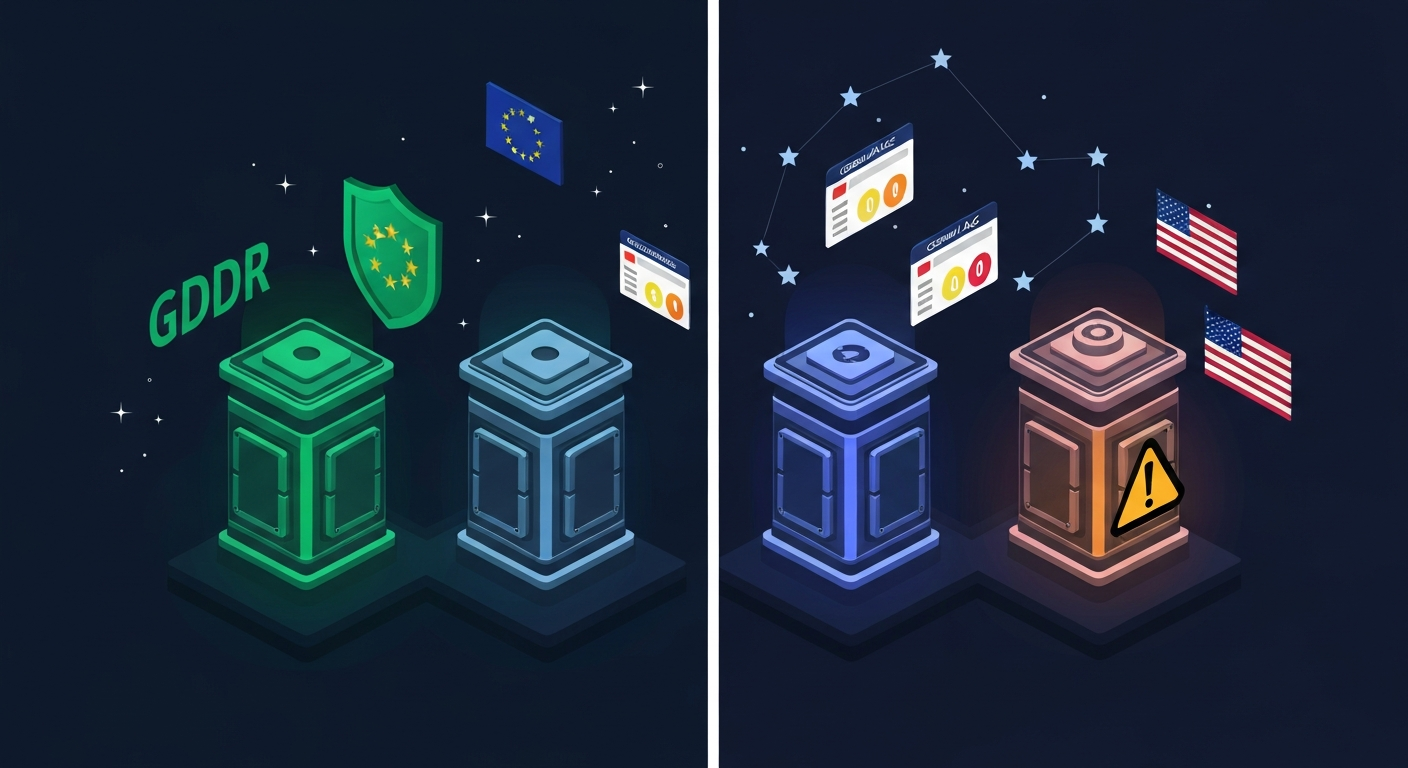
Identity Governance and Administration (IGA) sits at the intersection of your most sensitive employee data and your highest regulatory exposure. NIS2 Article 21(2)(i) mandates access control policies. DORA Article 28 governs ICT third-party risk. GDPR Articles 5, 25, and 28 govern the processing of employee PII and behavioral access data.
Every major IGA vendor with substantial market share is headquartered in the United States. That means every deployment decision is also a CLOUD Act decision. This finale synthesises our four-part series — SailPoint, Saviynt, One Identity, and IBM Security Verify — into a single decision framework for EU enterprises.
The Four Vendors: Corporate Identity and CLOUD Act Exposure
| Vendor | HQ | Parent / Ownership | NYSE/NASDAQ | CLOUD Act Score |
|---|---|---|---|---|
| IBM Security Verify | Armonk, NY | IBM Corp. (NYSE: IBM) | Yes | 20 / 25 |
| SailPoint | Austin, TX | Thoma Bravo (PE, Chicago) | SAIL | 19 / 25 |
| Saviynt | El Segundo, CA | AB Private Equity | Private | 18 / 25 |
| One Identity | Aliso Viejo, CA | Quest Software / Francisco Partners PE | Private | 16 / 25 |
All four trigger 18 U.S.C. § 2713 (CLOUD Act). All four are legally compellable to disclose EU data to US law enforcement and intelligence agencies without prior notification to EU customers or EU courts.
CLOUD Act Scoring Methodology
Our scoring uses 25 weighted criteria across five categories:
Category 1: Corporate Jurisdiction (5 points max) US-incorporated = maximum exposure. UK post-Brexit has partial exposure. EU/EEA = lowest.
Category 2: Cloud Infrastructure Location (5 points max) AWS/Azure/GCP US-East = 5/5. EU regions with US provider = 3/5. EU-owned infrastructure = 1/5.
Category 3: Data Processing Architecture (5 points max) Central US analytics pipeline = 5/5. EU data plane with US control plane = 3/5. Full EU isolation = 0/5.
Category 4: Federal Government Contracts (5 points max) Active DoD/IC/NSA contracts = 5/5. Civilian agency only = 3/5. No federal contracts = 0/5.
Category 5: Subsidiary and Legal Structure (5 points max) No EU subsidiary = 5/5. EU GmbH with US parent control = 3/5. Genuine EU legal independence = 0/5.
Detailed Score Breakdown
| Category | IBM Verify | SailPoint | Saviynt | One Identity |
|---|---|---|---|---|
| Corporate Jurisdiction | 5/5 | 5/5 | 5/5 | 5/5 |
| Cloud Infrastructure | 4/5 | 4/5 | 4/5 | 3/5 |
| Data Processing | 4/5 | 4/5 | 3/5 | 3/5 |
| Federal Contracts | 5/5 | 4/5 | 4/5 | 3/5 |
| Subsidiary Structure | 2/5 | 2/5 | 2/5 | 2/5 |
| TOTAL | 20/25 | 19/25 | 18/25 | 16/25 |
IBM scores highest primarily because of IBM Federal — the division with TS/SCI-cleared employees holding active contracts with NSA, CIA, DHS, DoD, and 17 intelligence community agencies. This creates structural proximity to US intelligence that SailPoint, Saviynt, and One Identity lack at equivalent scale.
EU-Native IGA Alternatives: The Full Picture
Before the decision matrix, here are the EU-native options that exist for enterprises willing to consider them:
| Vendor | HQ | CLOUD Act Score | IGA Maturity | Market Position |
|---|---|---|---|---|
| Omada Identity | Copenhagen, DK | 4 / 25 | Enterprise | ★★★★ Gartner Challenger |
| Evidian / Eviden | Paris, FR (Atos SA) | 3 / 25 | Enterprise | ★★★ Niche |
| Beta Systems | Berlin, DE | 2 / 25 | Mid-Market | ★★★ SME-focused |
| Soffid | Valencia, ES | 1 / 25 | Mid-Market | ★★ Open-source base |
Why EU-native scores are not zero:
- Omada: 4/25 — Microsoft Azure EU regions (thin US cloud exposure via CSP agreements)
- Evidian: 3/25 — Atos has US subsidiary operations post-Eviden spin-off
- Beta Systems: 2/25 — AWS EU Frankfurt for some SaaS modules
- Soffid: 1/25 — Self-hosted option available; some SaaS on EU infrastructure
For maximum GDPR compliance posture, Omada Identity is the clear EU-native leader with Gartner Magic Quadrant recognition and enterprise-grade feature parity.
Feature Comparison: IGA Capabilities
Core IGA Capabilities
| Capability | IBM Verify | SailPoint | Saviynt | One Identity |
|---|---|---|---|---|
| Access Certification | ★★★★★ | ★★★★★ | ★★★★★ | ★★★★ |
| Role Mining & Engineering | ★★★★★ | ★★★★★ | ★★★★ | ★★★★ |
| Segregation of Duties | ★★★★★ | ★★★★★ | ★★★★★ | ★★★★ |
| Joiner/Mover/Leaver | ★★★★ | ★★★★★ | ★★★★★ | ★★★★ |
| Provisioning Automation | ★★★★ | ★★★★★ | ★★★★ | ★★★★ |
| Self-Service Access Request | ★★★★ | ★★★★★ | ★★★★★ | ★★★★ |
| Policy-Based Access Control | ★★★★★ | ★★★★★ | ★★★★ | ★★★★ |
| Identity Analytics / UEBA | ★★★★★ | ★★★★ | ★★★★★ | ★★★ |
SailPoint leads on native integrations (3,000+ connectors) and joiner/mover/leaver automation. Saviynt leads on convergent governance (IGA + PAM + CIEM in one platform). IBM Verify leads on Watson AI analytics and enterprise audit depth — with the GDPR Art.22 tradeoff.
EU Compliance Features
| Feature | IBM Verify | SailPoint | Saviynt | One Identity | Omada |
|---|---|---|---|---|---|
| GDPR Data Subject Rights automation | Yes | Yes | Yes | Partial | Yes |
| NIS2 Art.21 reporting templates | Yes | Yes | Partial | Partial | Yes |
| DORA ICT risk reporting | Yes | Yes | Yes | Partial | Partial |
| EU data residency guarantee | SLA-based | SLA-based | SLA-based | SLA-based | Native |
| Schrems II Transfer Impact Assessment | Customer-led | Customer-led | Customer-led | Customer-led | Built-in |
GDPR Risk Matrix
This matrix rates actual GDPR compliance risk — not just data residency, but the full regulatory exposure picture.
| Risk Dimension | IBM Verify | SailPoint | Saviynt | One Identity | Omada |
|---|---|---|---|---|---|
| Art.5 Data Minimisation | MEDIUM | MEDIUM | LOW | LOW | LOW |
| Art.22 Automated Decision-Making | HIGH | LOW | MEDIUM | LOW | LOW |
| Art.28 Processor Agreement | MEDIUM | MEDIUM | MEDIUM | MEDIUM | LOW |
| Art.44 Third Country Transfers | HIGH | HIGH | HIGH | HIGH | LOW |
| Schrems II CLOUD Act exposure | CRITICAL | HIGH | HIGH | MEDIUM | LOW |
| NIS2 Art.21 Access Control | LOW | LOW | LOW | LOW | LOW |
| DORA Art.28 Third-Party Risk | MEDIUM | MEDIUM | MEDIUM | LOW | LOW |
IBM Verify unique risk: Art.22 HIGH because Watson AI performs automated behavioral analysis and role recommendations. If these analytics influence access decisions without human review, it triggers GDPR Art.22(1) obligations — explicit consent or legal basis required, plus the right to human review.
Overall GDPR risk ranking (lowest to highest):
- Omada Identity — EU-native, lowest Art.44/Schrems II exposure
- One Identity — No AI-automated decisions, smaller federal footprint
- Saviynt — Convergent platform risk offset by strong GDPR features
- SailPoint — Broad federal exposure, mature GDPR tooling
- IBM Security Verify — IBM Federal proximity, Watson Art.22 risk
NIS2 Article 21 Mapping
NIS2 Art.21(2) mandates ten specific security measures for "important" and "essential" entities:
| NIS2 Art.21(2) Requirement | IBM Verify | SailPoint | Saviynt | One Identity |
|---|---|---|---|---|
| (a) Risk analysis and security policies | ✓ | ✓ | ✓ | ✓ |
| (b) Incident handling | ✓ | ✓ | ✓ | ✓ |
| (c) Business continuity | ✓ | ✓ | ✓ | Partial |
| (d) Supply chain security | ✓ | ✓ | ✓ | ✓ |
| (e) Security in network and information systems | ✓ | ✓ | ✓ | ✓ |
| (f) Policies and procedures to assess effectiveness | ✓ | ✓ | ✓ | Partial |
| (g) Basic cyber hygiene and training | ✓ | ✓ | Partial | ✓ |
| (h) Cryptography and encryption | ✓ | ✓ | ✓ | ✓ |
| (i) Human resources security + access control | ★★★★★ | ★★★★★ | ★★★★★ | ★★★★ |
| (j) Multi-factor authentication | ✓ | ✓ | ✓ | ✓ |
All four US vendors satisfy NIS2 Art.21(2)(i) technically. The compliance gap is jurisdictional: NIS2 Art.21 applies to networks and systems within the EU. CLOUD Act exposure means IGA audit logs and access certification records may be accessible to US agencies — a fact that national competent authorities (BSI, ANSSI, ACN) are beginning to factor into assessments.
3-Year TCO Comparison: 5,000 Users
TCO includes: platform licensing, implementation (SI partner), internal resource (0.5 FTE IGA admin), annual support, training, and infrastructure (EU cloud region).
| Cost Component | IBM Verify | SailPoint | Saviynt | One Identity | Omada |
|---|---|---|---|---|---|
| Year 1 License | €320,000 | €280,000 | €240,000 | €220,000 | €180,000 |
| Year 1 Implementation | €250,000 | €300,000 | €220,000 | €180,000 | €150,000 |
| Year 1 Internal FTE | €40,000 | €40,000 | €40,000 | €40,000 | €40,000 |
| Year 1 Support | €48,000 | €42,000 | €36,000 | €33,000 | €27,000 |
| Year 2 (license+support+FTE) | €408,000 | €362,000 | €316,000 | €293,000 | €247,000 |
| Year 3 (license+support+FTE) | €408,000 | €362,000 | €316,000 | €293,000 | €247,000 |
| 3-Year TCO | €1,474,000 | €1,386,000 | €1,168,000 | €1,059,000 | €891,000 |
Additional GDPR compliance costs (not in standard TCO):
- Transfer Impact Assessment (TIA) legal counsel: €15,000–€40,000 one-time
- Schrems II remediation (SCCs, binding corporate rules): €10,000–€25,000/year
- DPA consultation under GDPR Art.36 (likely for Art.22 IBM): €5,000–€15,000
Omada total GDPR-adjusted 3yr TCO: ~€951,000 (no TIA, no Schrems II, no Art.36 consultation needed) IBM Verify total GDPR-adjusted 3yr TCO: ~€1,549,000 (highest GDPR overhead)
Six Decision Scenarios
Scenario 1: NIS2 "Essential Entity" in Financial Services (DORA-Regulated)
You are a DORA-regulated bank or payment institution with 5,000+ employees. NIS2 Art.21 applies. DORA Art.28 ICT third-party risk applies. Your DPO has flagged CLOUD Act exposure.
Recommendation: Omada Identity
- Lowest GDPR Art.44 risk for critical financial data
- Schrems II-safe by design (no third-country transfer)
- DORA Art.28 third-party risk: EU-incorporated vendor
- Gartner Challenger — proven enterprise deployment
If Omada is not feasible: One Identity (lowest CLOUD Act score among US vendors, no AI Art.22 risk)
Scenario 2: Defense Industrial Base (EU Member State Government Contractor)
You are a tier-2 defense contractor with classified EU member state contracts. ITAR/EAR adjacent. Personnel security clearances involved.
Recommendation: Omada Identity or Beta Systems
- US vendor IGA systems are explicitly prohibited for defense clearance-adjacent workflows in Germany (BSI classification), France (ANSSI), and increasingly NL (AIVD guidance)
- IBM Federal dimension makes IBM Verify particularly unsuitable — structural IC proximity
- Beta Systems: German-developed, BSI-audited, suitable for government-adjacent mid-market
If US vendor mandated by existing procurement: One Identity (Francisco Partners PE, no active IC contracts)
Scenario 3: Global Enterprise with Existing IBM Stack (IBM MaaS360/QRadar/WatsonX)
You have significant IBM investments and your CISO team is evaluating IBM Security Verify as a natural extension.
Recommendation: IBM Security Verify — with GDPR Art.22 mitigations
- Best-of-suite integration with IBM ecosystem
- Watson AI analytics must be configured in "human-in-the-loop" mode
- Document all automated decisions under Art.22 GDPR
- Engage IBM EU DPA (Data Processing Addendum) with SCCs
- Conduct Transfer Impact Assessment before go-live
- Accept 20/25 CLOUD Act score as residual risk with documented business justification
Scenario 4: PE-Backed SaaS Company Seeking Enterprise Customers
You are a 200-person SaaS startup growing into enterprise. IGA needed for compliance with SOC 2 Type II and enterprise customer DPAs. Budget constrained.
Recommendation: Saviynt or SailPoint Identity Now (SaaS tier)
- Saviynt's convergent IGA+CIEM platform covers cloud entitlement management (critical for SaaS infrastructure)
- Competitive SaaS pricing in lower tier
- 18/25 CLOUD Act score — acceptable with standard SCCs for B2B SaaS
- Faster time-to-value than IBM Verify (lower implementation cost)
Scenario 5: Healthcare Group (EU GDPR Art.9 Special Category Data)
You are a hospital group or health insurer processing health data under GDPR Art.9 special category rules. Every access certification touches Art.9 data.
Recommendation: Omada Identity — or SailPoint if Omada lacks required integrations
- Art.9 special category data + CLOUD Act = highest possible regulatory risk
- Omada Identity has native GDPR Art.9 data classification tagging
- SailPoint alternative if specific EHR connectors (Epic, SAP IS-H) are required
- MANDATORY: regardless of vendor, maintain separate EU data plane for Art.9 processing
- IBM Verify: Art.22 Watson AI analytics on medical access data is an explicit compliance risk — not recommended
Scenario 6: Manufacturing / OT/ICS Environment (NIS2 Art.21 "Important Entity")
You are a Tier-1 automotive manufacturer or process industry company. OT/ICS systems integration required. NIS2 "important entity" classification.
Recommendation: One Identity (Active Roles for AD + IGA)
- One Identity's Active Roles product has the deepest Active Directory integration in the market
- OT environments typically have heavy AD dependency
- 16/25 CLOUD Act score — lowest among US vendors
- No AI-automated decisions (Art.22 safe)
- Francisco Partners PE ownership with EU subsidiary operations
- SailPoint alternative if SAP integration is the primary driver
Schrems II Compliance Checklist
For any US IGA vendor, EU enterprises must complete this checklist before deployment:
Legal Basis:
- Standard Contractual Clauses (SCCs) — 2021 EU Commission format executed
- Data Processing Agreement (DPA) covering Art.28 requirements
- Transfer Impact Assessment (TIA) documenting CLOUD Act risk and business justification
Technical Safeguards:
- EU data residency configuration enabled (not just "preferred")
- Encryption at rest with EU-controlled key management (customer-managed keys)
- EU data plane isolated from US analytics pipeline
- Access log export to EU-controlled SIEM
Organisational Safeguards:
- DPO sign-off on IGA deployment
- GDPR Art.30 processing record updated
- Annual TIA review scheduled
- Vendor CLOUD Act response procedure documented
Ongoing Monitoring:
- Vendor notification of any government access requests (if permitted under US gag orders — often not possible)
- EU-side audit log maintained independently of vendor infrastructure
- NIS2 competent authority notification procedure established
Decision Framework Summary
Is your organisation a defense contractor, government body, or handles classified EU data?
├── YES → Omada Identity or Beta Systems (EU-native REQUIRED)
└── NO → Continue

Do you have an existing IBM ecosystem (QRadar, MaaS360, WatsonX)?
├── YES → IBM Security Verify with documented Art.22 GDPR mitigations
└── NO → Continue

Is CLOUD Act minimisation your primary criterion?
├── YES → One Identity (16/25 lowest US score) or Omada (4/25)
└── NO → Continue

Do you need IGA + PAM + CIEM convergence in one platform?
├── YES → Saviynt
└── NO → Continue

Is SaaS-native, 3,000+ connectors, and market-leading maturity your priority?
└── YES → SailPoint
Migration Readiness: What to Assess Before Switching
Before committing to any IGA platform, conduct a 4-week discovery sprint:
Week 1: Identity Inventory
- Active Directory / LDAP user count and structure
- Application portfolio (SAML, SCIM, legacy provisioning)
- Orphaned accounts and stale access (quantify remediation cost)
Week 2: Governance Requirements
- Regulatory certification requirements (SOX, HIPAA, NIS2, DORA)
- SoD conflict ruleset (number of rules, complexity)
- Role model maturity (RBAC, ABAC, mixed)
Week 3: Integration Complexity
- HR system (SAP SuccessFactors, Workday, Oracle HCM) — connector availability
- ERP access (SAP ECC, SAP S/4HANA) — critical path for most EU enterprises
- Cloud infrastructure (AWS IAM, Azure AD, GCP) — CIEM requirements
Week 4: GDPR Impact Assessment
- Data classification of access data (Art.9 special category?)
- Existing CLOUD Act exposure in current IGA solution
- DPO requirements for TIA and Art.30 records update
Series Summary: EU-IGA-SERIE 2026
Over five posts, we analysed every major IGA platform through the GDPR and CLOUD Act lens:
| Post | Vendor | CLOUD Act | Key Finding |
|---|---|---|---|
| #1208 SailPoint | SailPoint (Austin TX) | 19/25 | Thoma Bravo PE, 3,000+ connectors, broadest federal exposure after IBM |
| #1209 Saviynt | Saviynt (El Segundo CA) | 18/25 | Convergent IGA+PAM+CIEM, AB Private Equity, fastest-growing |
| #1210 One Identity | One Identity (Aliso Viejo CA) | 16/25 | Francisco Partners PE, lowest US score, deepest AD integration |
| #1211 IBM Security Verify | IBM Corp. (Armonk NY) | 20/25 | IBM Federal NSA/CIA/DHS proximity, Watson Art.22 risk, highest CLOUD Act score |
| #1212 Finale | All four + EU-native | — | This post |
The bottom line for EU enterprises: If CLOUD Act exposure is a board-level concern, Omada Identity is the only enterprise-grade IGA platform that avoids it by design. If US vendors are required by existing procurement, budget, or integration constraints, One Identity offers the lowest CLOUD Act risk profile (16/25) without Watson AI complications. IBM Security Verify is technically the most powerful — and the highest regulatory risk.
What's Next: EU PAM and CIEM Deep Dives
Following the EU-IGA-SERIE, upcoming research will cover:
- EU Privileged Access Management (PAM) 2026 — CyberArk, BeyondTrust, Delinea vs EU-native alternatives
- EU Cloud Infrastructure Entitlement Management (CIEM) 2026 — Wiz, Orca, Lacework vs EU-sovereign options
- NIS2 Art.21 Compliance Toolkit — Vendor-agnostic implementation guide for EU essential entities
sota.io operates EU-sovereign cloud infrastructure in Frankfurt and Amsterdam. Our IGA research is conducted independently — no vendor sponsorship or affiliate relationships. CLOUD Act scores are analyst estimates based on public corporate filings, federal procurement databases (USASpending.gov), and regulatory submissions.
EU-Native Hosting
Ready to move to EU-sovereign infrastructure?
sota.io is a German-hosted PaaS — no CLOUD Act exposure, no US jurisdiction, full GDPR compliance by design. Deploy your first app in minutes.