EU Cybersecurity Reserve: How Pre-Qualified MSSPs Defend the EU — A Developer's Guide 2026
Post #3 in the sota.io EU Cyber Solidarity Act Series
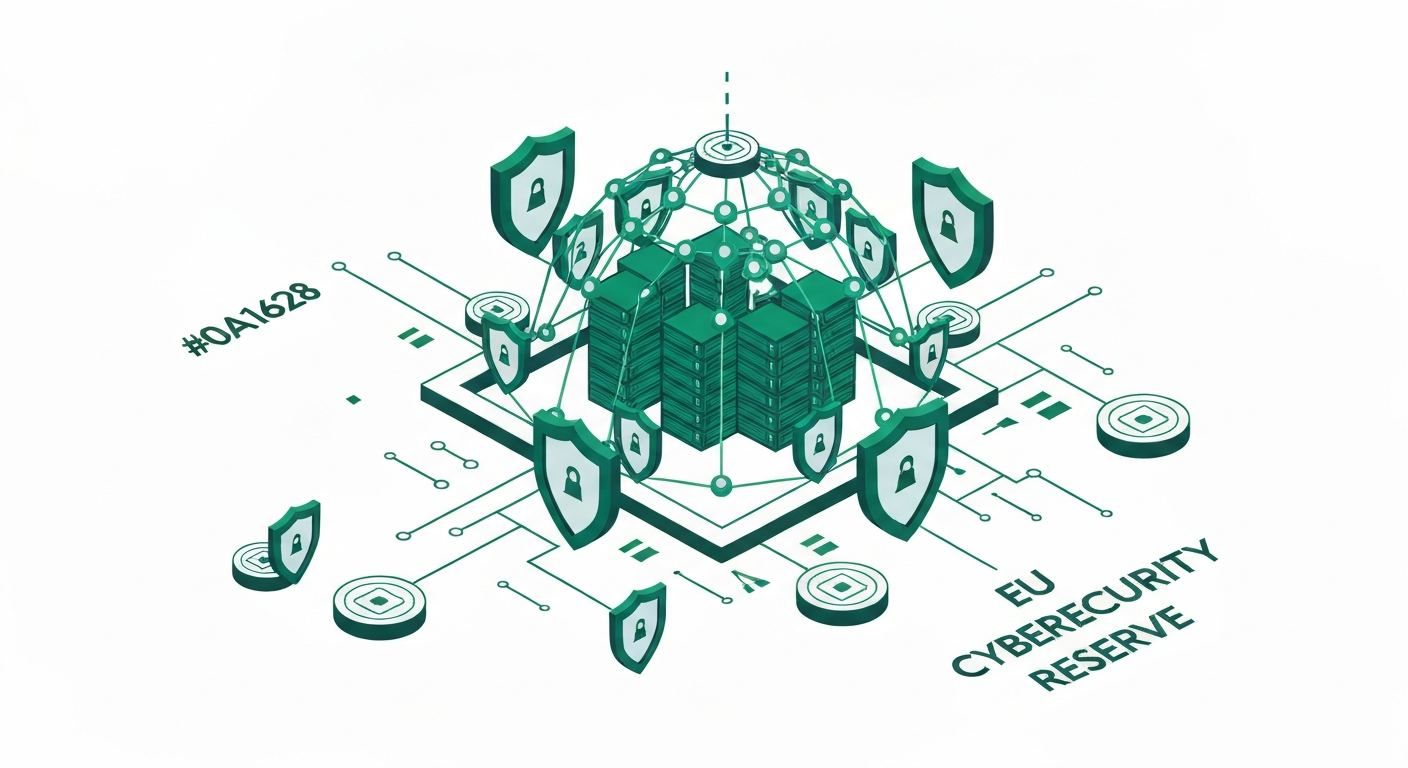
The first two posts in this series covered the EU Cyber Solidarity Act's scope and the European Cyber Shield's threat intelligence infrastructure. This post focuses on the Act's most operationally specific mechanism: the EU Cybersecurity Reserve — a standing pool of pre-qualified managed security service providers that can be rapidly deployed when a significant or large-scale cross-border incident overwhelms national response capacity.
If you run a SaaS platform, understanding this Reserve matters for two reasons: you may eventually interact with a Reserve deployment as an affected entity, and the pre-qualification standards the Reserve uses are increasingly becoming the de facto benchmark for what "competent incident response" looks like under EU law.
What the EU Cybersecurity Reserve Is
The EU Cybersecurity Reserve is a contracted pool of trusted managed security service providers (MSSPs) selected through a competitive procurement process coordinated by ENISA. These are not government agencies — they are private sector incident response firms that have passed a rigorous pre-qualification process, agreed to contractual SLAs, and are available for rapid deployment across EU member states.
The Reserve serves as the EU's "surge capacity" for cybersecurity incidents. When a member state or EU institution faces a significant or large-scale incident that exceeds its national response capacity, it can request Reserve activation. A pre-qualified MSSP from the Reserve is then assigned and deployed — typically within hours, not days.
Why a Standing Reserve?
Incident response at scale has a fundamental logistics problem: the time to contract, vet, and mobilize an external incident response firm during an active crisis is measured in days or weeks. By pre-qualifying MSSPs in advance, the Cyber Solidarity Act eliminates that lead time. The contracts are signed, the technical standards are verified, and the SLAs are defined — before any incident occurs.
The Reserve model draws on established patterns from other emergency response systems. The EU's Civil Protection Mechanism uses a similar logic for natural disasters: pre-positioned assets and pre-contracted service providers are registered and available for immediate deployment.
For the cybersecurity domain, this means the Reserve MSSPs have already demonstrated capability in areas including:
- Advanced threat detection and forensic analysis — reconstructing attack timelines from host, network, and cloud logs
- Incident containment and recovery — isolating affected systems, preserving evidence, restoring operations
- Cross-border coordination — working with multiple national CERTs/CSIRTs simultaneously
- Sector-specific expertise — energy, financial infrastructure, health, transport, and digital infrastructure incidents have distinct characteristics
MSSP Pre-Qualification: The Selection Framework
The pre-qualification process for Reserve membership is ENISA-managed and establishes the baseline standards that all Reserve MSSPs must meet. The process involves technical assessment, legal eligibility checks, and contractual commitments.
Technical Competence Requirements
Reserve MSSPs must demonstrate operational capability across the full incident response lifecycle. The regulation specifies that trusted MSSPs must have:
Detection and analysis capability:
- Skilled personnel with verifiable experience in large-scale incident response
- Tooling for rapid acquisition and analysis of forensic evidence from cloud environments, on-premise infrastructure, and hybrid deployments
- Integration capability with national CERT/CSIRT systems and the European Cyber Shield's SOC network
- Ability to process and contribute to STIX 2.1 / TAXII 2.1 threat intelligence feeds
Containment and recovery capability:
- Demonstrated experience with at least one major incident response engagement in EU critical infrastructure or digital services context
- Processes for evidence preservation compliant with applicable legal frameworks (chain of custody for potential criminal investigations)
- Playbooks for common attack vectors: ransomware, supply chain compromise, credential theft, cloud configuration exploitation
Coordination capability:
- Staff with language skills covering the major EU working languages
- Defined escalation paths to national authorities and ENISA
- Experience coordinating response across multi-vendor cloud environments
Trust and Security Requirements
The "trusted" designation in the regulation is not a marketing term — it reflects specific requirements around information security governance of the MSSP itself. Organizations applying for Reserve membership must demonstrate:
Jurisdictional requirements: Reserve MSSPs must be established within the EU or EEA. This is not just a preference — it is a hard eligibility criterion. An MSSP headquartered outside the EU cannot join the Reserve, even if it operates EU-based subsidiaries. This requirement flows from the same logic that drives NIS2's supply chain security provisions: you cannot trust incident response to a provider whose parent entity is reachable under a foreign government's legal process.
Clearance and screening: Personnel assigned to Reserve deployments may work with classified or sensitive government data. Reserve MSSPs must have personnel screening processes aligned with national security clearance standards of the member state where they operate.
Information security management: Reserve MSSPs are expected to maintain ISO 27001 certification or equivalent, with specific controls around data handling during incident response engagements (which involves processing significant volumes of sensitive operational data from affected organizations).
No conflict of interest: An MSSP with significant commercial relationships with the affected entity is typically excluded from that specific deployment to avoid conflicts of interest.
Contractual Framework
ENISA manages framework contracts with Reserve MSSPs that define:
- Response time SLAs — typically initial engagement within 4-8 hours of activation (exact SLAs depend on incident severity classification)
- Minimum personnel commitment — the number of qualified incident responders available for simultaneous deployments
- Geographic scope — where the MSSP can be deployed and within what timeframe
- Data handling obligations — how incident data is retained, protected, and ultimately deleted
- Reporting requirements — what the MSSP must document and report to ENISA and the requesting authority
The contracts run for defined periods and are subject to renewal, with performance reviews based on actual deployment outcomes.
How the EU Cybersecurity Reserve Gets Deployed
Understanding the deployment process is essential for any organization that might need Reserve assistance — or that operates infrastructure that could be affected by an incident triggering Reserve activation.
Trigger Conditions
The Reserve is activated for incidents classified as significant or large-scale under the EU Cybersecurity Act framework and NIS2 definitions:
Significant incidents are those that cause or have the potential to cause severe disruption to the delivery of critical services, affect a large number of individuals, or have significant impact on member state critical infrastructure. The specific thresholds for "significant" are defined by sector-specific supervisory authorities in coordination with national NCCs.
Large-scale incidents meet an even higher bar: they affect multiple member states, overwhelm national response capacity, or involve cross-border propagation that requires coordinated EU-level response. Large-scale incidents are typically declared by ENISA in consultation with member state authorities.
For SaaS platforms, a large-scale incident affecting your platform would typically involve:
- Attack affecting users across multiple member states
- Ransomware or destructive malware causing service unavailability exceeding defined thresholds
- Data breach affecting large populations of EU residents
- Supply chain compromise affecting downstream customer systems in critical sectors
The Request Process
Deployment requests flow through a defined channel:
- National authority assessment — The national CERT/CSIRT or NCA of the affected member state assesses whether the incident exceeds national response capacity
- Formal request to ENISA — The national authority submits a formal request for Reserve support, including incident classification, affected entities, and specific capability gaps
- ENISA matching — ENISA selects an appropriate Reserve MSSP based on availability, geographic proximity, language capability, and sector expertise. Conflict of interest checks are performed.
- Activation and deployment — The selected MSSP is notified and begins mobilization. Initial remote support begins immediately; on-site deployment follows within the agreed SLA window
- Coordination structure — During the engagement, the MSSP operates under a joint coordination structure involving ENISA, the national NCA, the national CERT/CSIRT, and the affected entity
For affected organizations, this process means that when a Reserve deployment is triggered affecting your environment, you will typically:
- Receive formal notification from your national NCA that Reserve support has been authorized
- Be introduced to a primary contact at the assigned MSSP
- Be expected to provide access to your infrastructure (within scope defined by your NCA)
- Participate in regular coordination calls with the MSSP and national authorities
During a Deployment: What to Expect
Reserve deployments follow a structured methodology, but the practical experience for affected organizations is roughly:
Days 1-2 (Initial Response):
- Remote triage and initial forensic data collection
- Access provisioning for MSSP personnel to relevant systems and logs
- Initial scope definition: what is confirmed as affected vs. potentially affected
- First situation report to national authorities and ENISA
Days 3-7 (Investigation):
- Deep forensic analysis of affected systems
- Threat actor TTPs (tactics, techniques, procedures) identification
- Scope validation and boundary determination
- Development of containment and remediation plan
- Ongoing situation reports with daily cadence
Days 7-30 (Containment and Recovery):
- Systematic containment of identified attack vectors
- Parallel restoration of critical services where possible
- Evidence preservation for potential legal proceedings
- Lessons learned documentation
- Transition to normal operations and follow-up hardening
The exact timeline depends heavily on the incident type. Ransomware with known variants may resolve faster. Supply chain compromises involving embedded persistence mechanisms can extend investigation phases significantly.
Mutual Assistance Procedures
The Cyber Solidarity Act establishes formal mutual assistance procedures that operate alongside and beyond the Cybersecurity Reserve. These procedures allow member states to directly request and provide cybersecurity assistance to each other.
How Mutual Assistance Works
When a member state faces a cybersecurity crisis that exceeds its national capacity, it can request assistance from other member states under the formal mutual assistance framework. This is distinct from Reserve activation — mutual assistance involves a member state lending its own national capabilities (personnel, tools, expertise) to another.
The procedures define:
Request submission: Requests are submitted through ENISA, which coordinates the matching between requesting and offering member states. The request must include the nature of the incident, the specific capabilities needed, and the expected duration of assistance.
Capability matching: ENISA maintains a register of member state capabilities available for mutual assistance, including specialist personnel, forensic tooling, and sector-specific expertise. The matching process considers language compatibility and past cooperation relationships.
Operational arrangements: Personnel deployed under mutual assistance operate under a jointly agreed operational structure. Questions of liability, data handling, and authority are resolved in advance through the framework arrangements.
Cost sharing: The Act establishes cost-sharing principles for mutual assistance, with EU funding under the Digital Europe Programme available to offset some costs for both requesting and assisting member states.
Implications for Cross-Border SaaS Operators
For SaaS companies operating across multiple EU member states, mutual assistance means that a response to an incident affecting your platform may involve personnel and capabilities from multiple national authorities, not just your primary home state authority.
Practically, this means:
- Your incident response plan should contemplate coordination with authorities from multiple member states simultaneously
- Your platform's logging and forensic data should be accessible in formats that multiple national teams can work with (STIX export, standard log formats, documented API endpoints)
- You should understand which member state NCAs have jurisdiction over which of your operations and customer segments
- Your legal and compliance team should understand the cross-border data handling rules that apply when forensic data from operations in Country A is reviewed by personnel from Country B
Technical Preparation for Reserve Interaction
If your SaaS platform serves entities in NIS2-covered critical sectors, there is a realistic probability that a significant incident affecting your infrastructure would trigger Reserve involvement. Preparing for that scenario before it happens dramatically reduces the chaos during an actual event.
Incident Response Readiness Baseline
Log aggregation and retention:
Reserve forensic analysts need access to centralized, query-able logs from your infrastructure. A platform that runs log aggregation on EU-sovereign infrastructure (not S3 in us-east-1) can deliver forensic data to Reserve personnel without triggering CLOUD Act concerns.
# Example: Loki log retention configuration for incident readiness
retention_period: 365d  # 12 months minimum for forensic investigations
storage:
  backend: filesystem  # or S3-compatible EU-based storage
compactor:
  working_directory: /data/loki/boltdb-shipper-compactor
  retention_enabled: true
  retention_delete_delay: 2h
Network flow logging: Reserve analysts will ask for network flow data (NetFlow or equivalent) covering the weeks preceding the incident. If you're not currently retaining flow data, start.
Immutable audit trails: Log data that can be modified after the fact is a forensic liability. Implement write-once storage for security logs.
API-Based Evidence Delivery
Prepare API endpoints that allow authorized forensic analysts to pull structured evidence without requiring custom development during an active incident:
# Incident response evidence API pattern
from fastapi import FastAPI, Depends, HTTPException
from datetime import datetime, timedelta
from typing import Optional

app = FastAPI()

@app.get("/ir/evidence/logs")
async def get_security_logs(
    start_time: datetime,
    end_time: datetime,
    source_type: str,  # "auth", "network", "app", "admin"
    requestor_cert: str = Depends(verify_authority_certificate),
    max_records: int = 10000
):
    """
    Evidence export endpoint for authorized incident response personnel.
    Requires: client certificate from EU NCA or authorized Reserve MSSP.
    Returns: STIX bundle with relevant observations.
    """
    if not is_authorized_ir_requestor(requestor_cert):
        raise HTTPException(status_code=403, detail="Unauthorized")

    logs = await fetch_security_logs(start_time, end_time, source_type, max_records)
    return to_stix_bundle(logs)
This pattern — a pre-built, auth-gated evidence API — is the difference between a 2-hour evidence delivery and a 2-day evidence delivery during an active incident.
Pre-Incident Documentation Pack
Reserve MSSPs will ask for an "environment map" early in any deployment. Prepare this in advance:
# Incident Response Environment Map — [YourPlatform] v1.0
Last updated: [date]
Contact: security@[yourplatform].eu

## Infrastructure Overview
- Primary hosting: [Cloud Provider], Regions: [list]
- CDN: [provider]
- DNS: [provider]

## Critical Services
| Service | Technology | Data Classification | DR Target |
|---------|-----------|---------------------|-----------|
| API Gateway | [tech] | Customer operational data | 4h |
| Auth Service | [tech] | Credentials, tokens | 1h |
| Database | [tech] | PII, operational data | 2h |

## Log Sources
| Source | Format | Retention | Access Method |
|--------|--------|-----------|---------------|
| Application logs | JSON/Loki | 12 months | API /ir/evidence/logs |
| Auth logs | JSON/Loki | 24 months | API /ir/evidence/logs |
| Network flow | NetFlow v9 | 6 months | SFTP |

## Emergency Contacts
- Security team lead: [contact]
- Primary NCA contact: [NCA name + contact]
- Outside counsel (EU data law): [firm + contact]
This document should be updated at every major infrastructure change and stored in your incident response runbook.
EU Data Sovereignty and the Reserve
One aspect of the Cybersecurity Reserve that matters specifically for SaaS infrastructure decisions: the jurisdictional requirements that govern Reserve MSSP selection also affect how Reserve-assisted incidents interact with data sovereignty frameworks.
When a Reserve MSSP is deployed to assist with an incident affecting your platform, they will necessarily access operational data from your environment — logs, configuration data, potentially user data depending on scope. That access is governed by:
- The Reserve MSSP's own data handling obligations (established in their ENISA contract)
- Your national NCA's legal authority over the investigation
- GDPR Article 6 and the relevant legal basis for processing data in the context of incident response
- NIS2 obligations around information sharing with authorities
Critically: a Reserve MSSP established in the EU, accessing your data that is stored on EU-sovereign infrastructure, creates a clean legal chain. The access has a clear legal basis, the data stays within EU jurisdiction, and the chain of custody is unambiguous for any subsequent legal proceedings.
If your logs are stored on infrastructure subject to foreign government access (US CLOUD Act, UK IPA, etc.), an incident investigation becomes significantly more complicated. Authorities in the member state requesting Reserve assistance may face obstacles accessing evidence that sits in a US-parent cloud provider's jurisdiction — regardless of whether the data physically sits on EU servers.
This is a concrete, practical reason — not just a compliance checkbox — to run your security-relevant data infrastructure on EU-sovereign providers.
The Operator Perspective: Before the Crisis Hits
SaaS operators who interact with the EU Cyber Solidarity Act framework are doing so at two levels: as potential recipients of Reserve assistance during a crisis, and as infrastructure providers whose architecture choices affect how that assistance can be delivered.
The practical preparation checklist:
Pre-Incident Checklist
- Know your NCA — identify which national cybersecurity authority has primary jurisdiction over your operations (typically the NCA of the member state where you are established)
- NIS2 registration — if you're a DNS service provider, TLD registry, cloud provider, data center operator, CDN, or managed service provider, you may be directly subject to NIS2 registration obligations that connect you to the Reserve framework
- Incident reporting thresholds defined — document internally what constitutes a "significant incident" for your platform and who makes the declaration
- Log centralization on EU-sovereign infrastructure — security-relevant logs should not be stored on non-EU-sovereign infrastructure if you serve NIS2-covered customers
- IR runbook current — your incident response runbook should name the Reserve process as a potential escalation path and designate a point of contact for NCA coordination
- MSSP relationship — even if you don't use a Reserve MSSP day-to-day, identifying and pre-qualifying a preferred MSSP that meets Reserve standards gives you faster access to Reserve-quality incident response capabilities
- Evidence preservation policy — define log retention periods, immutability controls, and chain-of-custody procedures before you need them
Platform Architecture Factors
For platform teams making infrastructure decisions, the Reserve framework reinforces several architectural choices:
Centralized security logging over distributed log silos — cross-border incidents require rapid correlation across your entire infrastructure, which is only possible with centralized logging.
EU-sovereign infrastructure for security-sensitive data — see the data sovereignty section above.
API-accessible forensic data — building evidence export capabilities before a crisis saves critical hours during one.
Documented blast radius — maintaining current documentation of which systems can affect which customer segments (your "blast radius map") is something Reserve analysts will ask for in the first hour of a deployment.
What's Next in This Series
Post #3 has covered the EU Cybersecurity Reserve — the tactical response capability of the Cyber Solidarity Act. The next post in this series will cover cross-border incident handling procedures under the Act: how NCCs coordinate across member states, how the European Cybersecurity Incident Review Mechanism works post-incident, and the reporting obligations that arise when a significant incident affects operations across multiple EU jurisdictions.
The final post (#5) will deliver a complete developer checklist for Cyber Solidarity Act compliance — a practical summary of everything a SaaS company needs to do across the full scope of the regulation.
Building on EU-sovereign infrastructure (Hetzner Germany, no US parent, no CLOUD Act exposure) is the structural foundation that makes all of these compliance postures straightforward rather than legally complex. sota.io is the EU-native managed PaaS built for exactly this context.
EU-Native Hosting
Ready to move to EU-sovereign infrastructure?
sota.io is a German-hosted PaaS — no CLOUD Act exposure, no US jurisdiction, full GDPR compliance by design. Deploy your first app in minutes.