EU Bug Bounty & Pentest Comparison 2026: CLOUD Act Risk Across HackerOne, Bugcrowd, Synack & Cobalt.io
Post #1252 in the sota.io EU Cyber Compliance Series
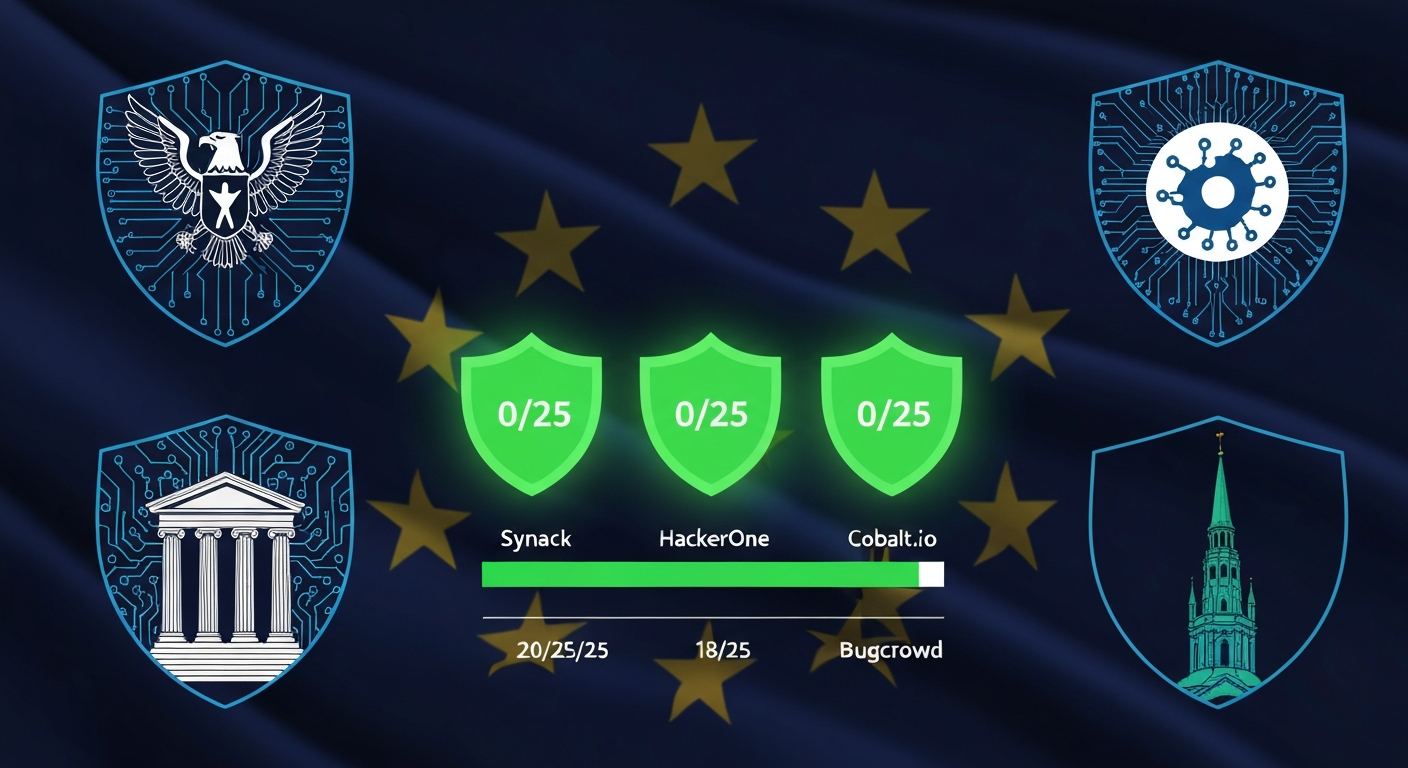
Over the past four posts, we have analysed the four dominant US bug bounty and Pentest-as-a-Service platforms used by EU organisations: HackerOne, Bugcrowd, Synack, and Cobalt.io. Each carries a distinct CLOUD Act risk profile. Each creates a unique compliance paradox. And each routes EU organisations' most sensitive security asset — a comprehensive catalogue of their own vulnerabilities — through US legal jurisdiction.
This finale post synthesises the complete series into one actionable framework: a comparative CLOUD Act scorecard, analysis of the four paradoxes we identified, guidance on when EU-native platforms are the right answer, and a decision tree for EU security teams making sourcing decisions in 2026.
The Core Problem: Vulnerability Sovereignty
Before comparing platforms, it is worth restating the fundamental issue this series has explored.
When an EU organisation engages a traditional penetration testing firm, the deliverable is a PDF report. The findings are sensitive, but they are static documents that the organisation controls. Once the engagement ends, the testing firm has no ongoing access.
Bug bounty and PtaaS platforms change this model entirely. Findings are uploaded to a SaaS platform. Vulnerability details, remediation notes, researcher commentary, retest histories, and trend data accumulate in a cloud database. The EU organisation's complete security posture — what was broken, when, how it was exploited, and whether it was fixed — becomes a persistent dataset in the vendor's infrastructure.
When that vendor is a US company, the CLOUD Act creates a specific risk: a US Department of Justice subpoena can compel production of that entire vulnerability dataset. The EU organisation never consented to this exposure. They simply chose a convenient platform.
This is the Vulnerability Sovereignty Paradox: to improve their security posture, EU organisations create a comprehensive attack surface map — then place it under US government reach.
CLOUD Act Scorecard: All Four Platforms
Our five-dimension CLOUD Act scoring framework evaluates each platform across:
- D1 — Corporate Structure & Jurisdiction (0–5): Is the operating entity a US C-Corp?
- D2 — Government & Intelligence Ties (0–5): FedRAMP authorisations, government contracts, IC-aligned investors
- D3 — Data Sensitivity (0–5): How sensitive is the data transferred to the platform?
- D4 — Infrastructure Jurisdiction (0–5): Where is data physically stored and processed?
- D5 — Contractual Protections (0–5): SCCs, CMEK, adequacy decisions, data residency guarantees
| Platform | D1 | D2 | D3 | D4 | D5 | Total | Key Paradox |
|---|---|---|---|---|---|---|---|
| Synack | 5 | 5 | 5 | 3 | 2 | 20/25 | NSA Origins Paradox |
| HackerOne | 5 | 3 | 5 | 3 | 2 | 18/25 | Vulnerability Sovereignty |
| Cobalt.io | 5 | 3 | 5 | 3 | 2 | 18/25 | Danish Paradox + Persistent PtaaS |
| Bugcrowd | 5 | 2 | 5 | 3 | 2 | 17/25 | CrowdTriage™ Human Review |
| Intigriti | 0 | 0 | 0 | 0 | 0 | 0/25 | EU-native (BE) |
| YesWeHack | 0 | 0 | 0 | 0 | 0 | 0/25 | EU-native (FR) |
| Yogosha | 0 | 0 | 0 | 0 | 0 | 0/25 | EU-native (FR) |
All four US platforms score D3=5 — the maximum data sensitivity rating. Vulnerability findings represent the most sensitive data category possible for an organisation: a detailed map of every known weakness in their systems, applications, and processes. No contractual protections (D5) can eliminate the CLOUD Act risk created by D1+D3 together.
The Four Paradoxes: What Makes Each Platform Distinct
Paradox 1 — Synack: The NSA Origins Paradox (20/25)
Synack is the highest-scoring platform in our series at 20/25. Its founding story explains why.
Jay Kaplan (CEO) is a former NSA Tailored Access Operations officer and CIA analyst. Mark Kuhr (CTO) is a former NSA and National Security Council cybersecurity official. The company secured FedRAMP High and DoD Impact Level 4 authorisations — putting it in the same compliance tier as classified government systems.
This is the NSA Origins Paradox: a platform founded by intelligence community veterans, operating under IC-equivalent security controls, also serving as the vulnerability management platform for European enterprises. The FedRAMP High authorisation is evidence of deep government trust — which for EU organisations is precisely the risk. D2=5 reflects the highest government alignment in our series.
Synack's Trusted Tester Network (TTN) — vetted security researchers — upload all findings to Synack's platform. A DOJ subpoena compels not just the platform data but findings from every engagement, across every European client, contributed by every TTN member.
D2 breakdown: FedRAMP High + DoD IL4 (2 pts) + IC-founder government relationships (2 pts) + US DoD active contracts (1 pt) = 5/5.
Paradox 2 — HackerOne: The Vulnerability Sovereignty Paradox (18/25)
HackerOne (HackerOne Inc., Delaware C-Corp, San Francisco) is the market leader in managed bug bounty. In 2022, Francisco Partners — a technology-focused private equity firm — acquired a majority stake.
The Vulnerability Sovereignty Paradox is starkest at HackerOne because of scale. HackerOne hosts one of the largest security researcher communities globally. When EU organisations run bug bounty programmes on HackerOne, they are not just storing vulnerability data — they are aggregating it alongside findings from thousands of other organisations on the same platform.
The Hack the Pentagon Effect: HackerOne runs the US government's official vulnerability disclosure programme, including Hack the Pentagon, the Defense Cyber Crime Center (DC3), and the CISA VDP Platform. This gives HackerOne a unique relationship with US government cybersecurity apparatus. It also means HackerOne's platform processes government-adjacent security research — establishing the platform as infrastructure that matters to US national security.
For EU organisations, the implication is that their vulnerability data sits on a platform that is simultaneously the official US government bug bounty infrastructure. D2=3 reflects the Hack the Pentagon/CISA relationship and Francisco Partners PE ownership, without rising to Synack's direct IC-founder status.
Paradox 3 — Cobalt.io: The Danish Paradox + Persistent PtaaS Risk (18/25)
Cobalt.io was founded in Copenhagen, Denmark in 2013. Its founding story is European. Its legal entity — Cobalt Labs Inc. — is a Delaware C-Corp headquartered in San Francisco, CA.
The Danish Paradox is conceptually distinct from the other three: it illustrates how European heritage provides no legal protection. The CLOUD Act does not care where a company was conceptualised, where its founders went to university, or where its first customers were located. It applies where the legal entity is domiciled.
The Persistent PtaaS Risk is what separates Cobalt from traditional pentesting. Traditional pentesting delivers a PDF — the testing firm has no ongoing data custody. Cobalt's PtaaS model creates a persistent vulnerability database. Every finding from every engagement cycle, every remediation note, every retest, every trend report accumulates in Cobalt's SaaS platform. A DOJ subpoena against Cobalt Labs Inc. does not retrieve "a pentest report" — it retrieves a chronological vulnerability history of every EU client's security evolution over years.
HPE Ventures strategic investor: Hewlett Packard Enterprise is a major US DoD and intelligence community contractor. A strategic stake creates government-aligned governance relationships that passive VC investors do not. This is reflected in D2=3.
Paradox 4 — Bugcrowd: The CrowdTriage™ Paradox (17/25)
Bugcrowd is the lowest-scoring US platform in our series at 17/25. But its unique paradox may be the most immediately concerning for EU organisations.
CrowdTriage™ is Bugcrowd's proprietary system for processing vulnerability submissions. Every report submitted by a security researcher — detailing a vulnerability in an EU organisation's systems — is reviewed by Bugcrowd's US-based security analysts before the EU client organisation sees it.
This means US human intelligence professionals read and annotate every vulnerability finding before it reaches the EU organisation. The EU organisation is not the first reader of their own vulnerability data. Bugcrowd's analysts are.
Bugcrowd (Bugcrowd Inc., Delaware C-Corp, San Francisco) is majority-owned by Insight Partners (New York, $80B+ AUM) with additional investment from Paladin Capital Group (Washington DC, defence and intelligence community-aligned). Insight Partners' scale (D2=2) does not reach the explicit government alignment of FedRAMP or IC founders, but Paladin Capital's IC-adjacent positioning is relevant context.
D2=2 reflects Insight Partners' tech-growth PE profile (less government-aligned than Francisco Partners or HPE) plus Paladin Capital's IC-adjacent positioning.
D3=5 For All: Why Vulnerability Data Is the Highest-Sensitivity Category
All four platforms receive our maximum data sensitivity score (D3=5). This is not arbitrary — vulnerability data has a specific property that distinguishes it from most other SaaS data categories.
Offensive utility: A comprehensive vulnerability report does not merely describe a problem. It describes how a specific system can be exploited, often with proof-of-concept code, precise version numbers, configuration details, and authentication bypass paths. This is operationally useful to an attacker in a way that financial records or email metadata are not.
Asymmetric impact: A vulnerability dataset from a single EU organisation is high-value. A vulnerability dataset from a platform serving hundreds of EU organisations — cross-correlated by technology stack, industry, and remediation timeline — is a strategic intelligence asset.
NIS2 Art.21(2)(d) supply chain risk: The NIS2 Directive requires operators of essential services and important entities to manage supply chain security risks. Routing vulnerability data through a US-jurisdiction SaaS platform creates exactly the kind of supply chain exposure NIS2 is designed to address.
GDPR Art.32 Technical and Organisational Measures: Vulnerability data often contains personal data embedded in findings (user account credentials, test accounts, screenshot evidence with personal information). GDPR Art.32 requires appropriate technical and organisational measures — an argument can be made that storing this data under CLOUD Act jurisdiction fails the "appropriate measures" test.
EU-Native Alternatives: 0/25 Across the Board
The EU-native bug bounty and pentest platforms all score 0/25 on our CLOUD Act framework because none of the five risk factors apply.
Intigriti NV (Antwerp, Belgium)
Intigriti is Europe's largest home-grown bug bounty platform, incorporated as Intigriti NV in Antwerp, Belgium. It operates under Belgian law, stores data in EU infrastructure, and has no US parent company, US PE investors, or government/intelligence community ties.
- Corporate structure: Belgian NV (Naamloze Vennootschap) — not subject to CLOUD Act
- Data residency: EU-only infrastructure
- Government ties: None — D2=0
- Platform: Full-featured bug bounty including public and private programmes, triage services, and researcher community
- Regulatory fit: GDPR compliance, NIS2-aligned supply chain risk (zero jurisdictional exposure)
CLOUD Act Score: 0/25
Intigriti's weakness compared to US platforms is scale: its researcher community is smaller than HackerOne or Bugcrowd globally, though it is strong in European security research talent and has deep relationships with the EU security community.
YesWeHack SAS (Paris, France)
YesWeHack is France's leading bug bounty platform, incorporated as YesWeHack SAS in Paris. It is majority French-owned, operates EU data centres, and is one of the most GDPR-mature bug bounty platforms in the market.
- Corporate structure: French SAS — not subject to CLOUD Act
- Data residency: EU-only (French data centres)
- Government ties: None — D2=0
- Platform: Bug bounty, vulnerability disclosure policy (VDP) management, pentesting coordination
- Regulatory fit: GDPR, NIS2, DORA-ready. French Cybersecurity Agency (ANSSI) relationship
CLOUD Act Score: 0/25
YesWeHack is particularly strong for French organisations and EU organisations needing to demonstrate sovereign security practices to regulators. ANSSI's awareness of the platform provides implicit regulatory legitimacy.
Yogosha SAS (Paris, France)
Yogosha is a French security platform combining bug bounty, pentest coordination, and VDP management, incorporated as Yogosha SAS in Paris.
- Corporate structure: French SAS — not subject to CLOUD Act
- Data residency: EU-only
- Government ties: None — D2=0
- Platform: Private bug bounty, elite researcher network, pentest orchestration, VDP
- Focus: Particularly strong in enterprise and regulated industries (banking, insurance, healthcare) in France and Benelux
CLOUD Act Score: 0/25
Yogosha's private researcher network model is closer to Synack's TTN model than to the open public programmes of HackerOne or Bugcrowd — providing EU organisations a like-for-like alternative to managed/private bug bounty without the CLOUD Act exposure.
GDPR and NIS2 Compliance Implications
GDPR Art.32 — Technical and Organisational Measures
GDPR Art.32 requires controllers and processors to implement "appropriate technical and organisational measures" to ensure a level of security appropriate to the risk. Routing vulnerability data to a US-jurisdiction platform raises the following questions that EU DPAs may ask:
- Adequacy assessment: Has the organisation conducted a Transfer Impact Assessment (TIA) for vulnerability data — not just for standard personal data, but for the specific sensitivity of security findings?
- Appropriateness of SCCs: Do Standard Contractual Clauses adequately protect vulnerability data given Schrems II precedent and the known sensitivity of the information?
- Risk proportionality: Is the use of a US platform for vulnerability management proportionate to the risk, given the availability of EU-native alternatives that eliminate CLOUD Act exposure entirely?
All four US platforms rely on SCCs as their primary transfer mechanism. No CMEK is offered by any of them for findings data. This means the contractual protection (D5=2) is the weakest component of their risk profile.
NIS2 Art.21 — Cybersecurity Risk Management Measures
NIS2 Art.21(2)(d) specifically requires supply chain security, including "security aspects concerning the relationships between each entity and its direct suppliers or service providers." A bug bounty or pentest platform is a direct supplier with access to the organisation's most sensitive security data. NIS2-scoped organisations must:
- Conduct supply chain risk assessments for security tool vendors
- Document the jurisdictional risk of US-based platforms
- Consider whether EU-native alternatives eliminate a material risk category
NIS2 Art.23 imposes 24-hour notification requirements for significant incidents. A CLOUD Act subpoena compelling production of an organisation's vulnerability data from a US platform is arguable as a "significant incident" — but the organisation may not be notified until after the production has occurred.
DORA Art.28 — ICT Third-Party Risk Management
For financial entities subject to DORA (Digital Operational Resilience Act), Article 28 requires comprehensive ICT third-party risk management. Pentest and bug bounty platforms fall within scope as ICT third-party service providers with access to critical security information. DORA Art.28(8) requires financial entities to assess whether contractual arrangements with third parties create concentration risks — a US-dominated bug bounty market creates exactly this concentration.
Decision Framework: Choosing the Right Platform for EU Organisations
The right platform depends on the organisation's regulatory context, risk appetite, and operational requirements.
Use EU-native (Intigriti / YesWeHack / Yogosha) when:
- NIS2-scoped essential or important entity: Eliminating supply chain CLOUD Act risk is preferable to managing it
- DORA-regulated financial entity: ICT third-party risk management requirements favour EU jurisdiction
- GDPR-sensitive vulnerability data: Findings include personal data (credentials, user accounts, PII in test data)
- Critical infrastructure sector: Energy, water, transport, healthcare — where vulnerability data is national security-relevant
- Demonstrating data sovereignty to regulators or customers: EU-native platforms provide clean evidence of sovereign security practices
- French or Belgian market focus: YesWeHack (FR) and Intigriti (BE) have the strongest local researcher networks
Consider US platforms when:
- Researcher community scale matters critically: HackerOne and Bugcrowd have the largest researcher networks globally; for complex enterprise programmes requiring maximum researcher diversity, this can outweigh CLOUD Act risk with appropriate TIAs and SCCs
- US government or defence contractor context: Synack's FedRAMP High authorisation may actually be required if the EU organisation has US government client requirements
- Established programme with existing data: Migration costs and researcher relationship continuity may be material considerations
Never use US platforms without:
- Transfer Impact Assessment (TIA) specifically for vulnerability data
- Updated SCCs with vulnerability data annexes
- Explicit DPA notification if using platforms for NIS2-notifiable entities
- DORA Art.28 ICT third-party assessment for DORA-scoped financial entities
Series Summary: EU Bug Bounty & Pentest CLOUD Act Findings
Over this five-post series, we examined the four dominant US bug bounty and PtaaS platforms:
| Post | Platform | Score | Key Finding |
|---|---|---|---|
| #1248 | HackerOne | 18/25 | Francisco Partners PE + Hack the Pentagon = government-aligned platform |
| #1249 | Bugcrowd | 17/25 | CrowdTriage™: US analysts review all EU findings before EU org sees them |
| #1250 | Synack | 20/25 | NSA/TAO founders + FedRAMP High + DoD IL4 = highest IC alignment |
| #1251 | Cobalt.io | 18/25 | Danish Paradox + Persistent PtaaS Risk = longitudinal vuln database under US jurisdiction |
| #1252 | Finale | — | EU-native Intigriti/YesWeHack/Yogosha = 0/25 across all five dimensions |
The common thread across all four US platforms: D3=5. Vulnerability data is not a routine SaaS data category. It is the most operationally sensitive information an organisation generates — and all four US platforms store it under CLOUD Act jurisdiction.
The EU-native alternatives — Intigriti, YesWeHack, and Yogosha — eliminate this risk entirely. They are not yet comparable to HackerOne or Bugcrowd in global researcher scale, but for the majority of EU organisations running standard enterprise bug bounty programmes, they represent a compliant, viable, and increasingly mature alternative.
What Comes Next
This series has covered the five major US bug bounty and pentest platforms. Upcoming series in the sota.io EU Cyber Compliance catalogue will continue to examine the full stack of US security tools that EU organisations depend on — and the EU-native alternatives that provide sovereign security without CLOUD Act exposure.
If your organisation is evaluating its bug bounty or pentest platform under NIS2, GDPR, or DORA requirements, sota.io provides the compliance infrastructure to manage EU-sovereign cloud deployments.
This post is part of the sota.io EU Cyber Compliance Series — analysing CLOUD Act, GDPR, NIS2, and DORA compliance implications for EU organisations using US-headquartered security and cloud services. See the full series at sota.io/blog.
EU-Native Hosting
Ready to move to EU-sovereign infrastructure?
sota.io is a German-hosted PaaS — no CLOUD Act exposure, no US jurisdiction, full GDPR compliance by design. Deploy your first app in minutes.