EU AI Act GPAI Compliance for SaaS Operators: Navigating the Three-Tier Obligation Stack
Post #2 in the EU AI Act GPAI Compliance 2026 Series
The first post in this series mapped the Chapter V landscape from Art.51 to Art.56. The central finding: GPAI obligations under Chapter V run primarily toward model providers — Anthropic, OpenAI, Google — not toward downstream developers. If you are building a SaaS product on top of GPAI APIs, the Art.53-55 obligations are, in their primary form, your vendor's problem.
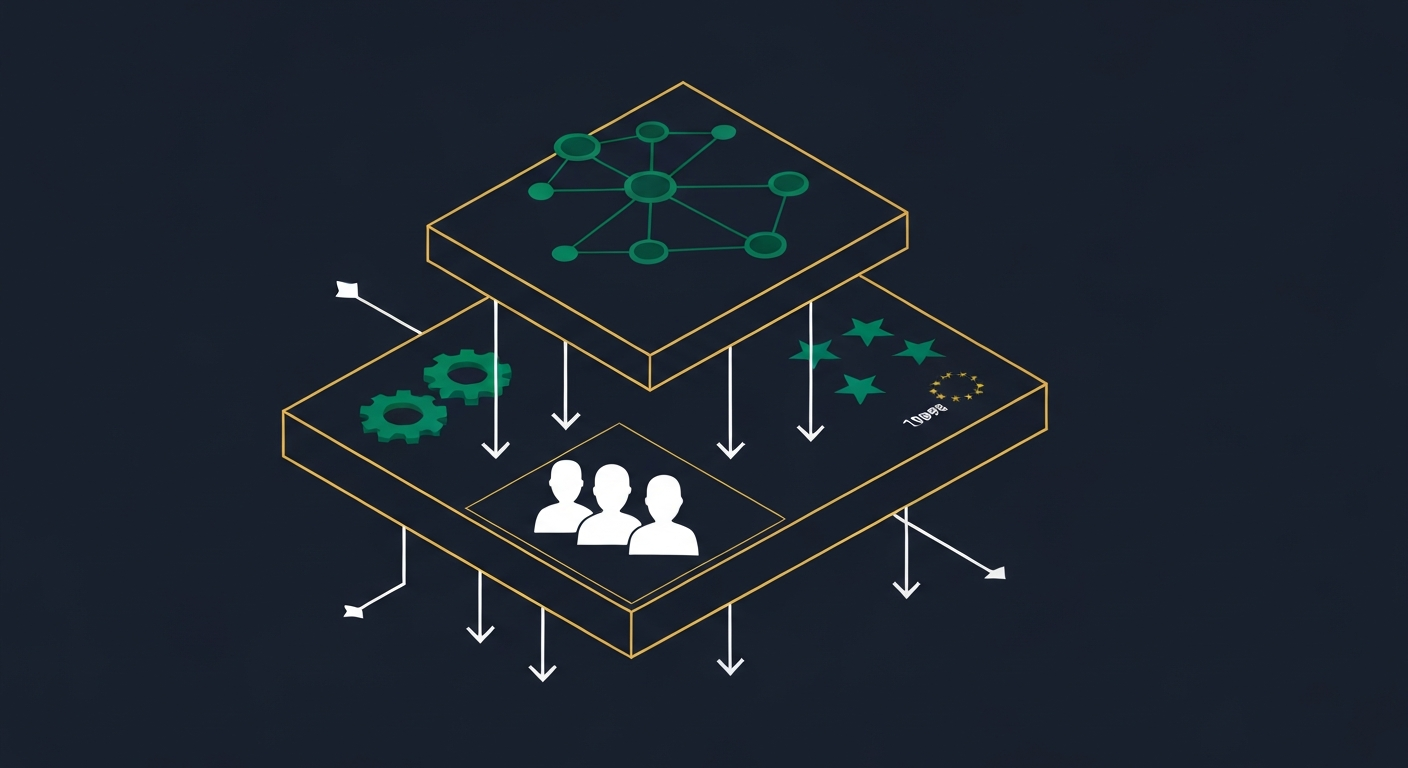
But that framing misses a critical operational reality. Most GPAI-powered SaaS products do not sit passively in the supply chain. They sit at the apex of their own obligation stack, with compliance duties flowing both upward (rights against their GPAI provider) and downward (duties toward their own users). The Chapter V framework creates enforceable rights at every tier — and SaaS operators who treat themselves as passive recipients of provider compliance will reach August 2026 with significant gaps.
This post maps the three tiers, identifies which obligations fall at each layer, and provides a concrete implementation checklist for SaaS operators before the August 2026 enforcement window.
The Three-Tier Stack
A typical GPAI-powered SaaS product involves three distinct actors with distinct legal positions:
Tier 1 — GPAI Model Provider Develops and operates the foundation model. Primary obligations: Art.53 technical documentation, training data transparency, copyright compliance policy; Art.54 EU authorised representative designation; Art.55 adversarial testing, incident reporting to EU AI Office, and cybersecurity measures (if systemic risk under Art.51).
Tier 2 — You (SaaS Operator / Downstream Developer) Build a product that calls GPAI APIs and delivers AI capabilities to users. This tier is the compliance actor most EU AI Act guidance treats as passive. This guide corrects that assumption.
Tier 3 — Your Users Individuals or businesses who interact with AI capabilities through your product, without direct contact with the GPAI model provider.
Understanding which obligations land at which tier is the foundational compliance question for any GPAI-integrated SaaS operator.
Tier 1 → Tier 2: Rights You Can Enforce Against Your Provider
Chapter V creates several enforceable rights that run from the GPAI model provider (Tier 1) to downstream operators (Tier 2). These are not contractual courtesies — they are obligations the regulation imposes on providers, and you have standing to demand compliance.
Art.53: Technical Documentation Access
Providers must make technical documentation available to downstream providers to the extent necessary for compliance with their own EU AI Act obligations. If your SaaS product is or may become a high-risk AI system under Annex III (employment decisions, credit scoring, law enforcement support, education assessment, and other categories), you have a legally grounded right to receive from your GPAI provider the documentation necessary to complete your Annex IV technical file.
What to demand: Architecture overview, training compute summary, capability benchmarks relevant to your use case, known limitations, and any evaluation reports covering the safety parameters relevant to your deployment.
Contractual operationalisation: Your GPAI API agreement should include an explicit clause: "Provider shall, on Operator's written request, provide technical documentation sufficient for Operator to comply with its obligations under EU AI Act Annex IV. Documentation shall be provided within 30 days of written request and updated within 30 days of any material change."
Art.53: Copyright Compliance Policy and Training Data Summary
Your GPAI provider must maintain a copyright compliance policy addressing text and data mining under the DSM Directive, and must make publicly available a meaningful summary of training data content.
As a Tier 2 operator, you need this information for three distinct purposes:
IP representations to users: Your product's Terms of Service likely makes representations about the IP status of AI-generated outputs. Those representations depend on the training data compliance status of your provider. A provider found to have used non-compliant training data creates downstream liability exposure for you unless you have contractual indemnification.
Sector-specific risk assessment: If your deployment context involves a domain where training data quality matters (medical, legal, financial), the training data summary lets you assess whether the model was trained on data types appropriate to your use case.
GDPR interaction: If the training data summary reveals processing of personal data categories relevant to your users, this may affect your GDPR risk assessment and data protection impact assessment obligations.
Art.51 Classification Change Notification
If your GPAI provider's systemic risk classification changes under Art.51 — either because a new model version crosses the compute threshold, or because the EU AI Office designates a model — this changes which Art.55 obligations apply to the provider, which in turn affects your own incident response planning.
Add to your DPA or API agreement: "Provider shall notify Operator within 30 days of any change in the classification status of any GPAI model made available to Operator under this agreement, including any notification submitted to the EU AI Office under Art.52 and any change in Art.51 designation status."
Art.54: EU Authorised Representative Verification
Before integrating any non-EU GPAI API, verify that the provider has a designated EU authorised representative. Major US GPAI providers have completed this step — OpenAI, Anthropic, and Google each have EU legal entities or designated representatives. Smaller or newer providers may not.
This is a five-minute check (look for an EU entity in the provider's legal notices or API terms) that documents your due diligence. If a provider cannot demonstrate an EU authorised representative where required, document the risk assessment in your compliance file.
Tier 2 Obligations: What the Regulation Requires of You
Your own obligations as a SaaS operator using GPAI APIs derive primarily from Chapter IV (Art.50 transparency), the provisions that apply to deployers of high-risk AI systems (Chapter III, Art.26), and the downstream obligations that flow from being part of the GPAI supply chain.
Art.50: Transparency to Your Users
Article 50 imposes direct obligations on operators deploying AI systems that interact with or generate content for users. These obligations fall on you — not on your GPAI model provider.
AI interaction disclosure: If your product includes any AI system that interacts directly with users (chatbots, AI assistants, automated support flows), you must ensure users are informed they are interacting with an AI system before or at the start of the interaction. The disclosure must be made unless it is already obvious from context.
AI-generated content marking: If your product generates synthetic text, images, audio, or video content that users might mistake for human-generated content, you must ensure this content carries a machine-readable marker identifying it as AI-generated. Where technically feasible, this means embedding metadata (such as C2PA content credentials) in generated outputs. Where embedding is not feasible (e.g., returned text strings), a visible UI disclosure is the practical alternative.
Derogation scope: Art.50 includes a derogation for AI systems used for purposes of scientific research and for authorised law enforcement activities. There is no general SaaS derogation. Consumer-facing SaaS products cannot rely on exceptions designed for research or law enforcement.
Implementation checklist for Art.50:
- Chatbot and AI assistant interfaces: visible "You are interacting with an AI system" disclosure at session start
- Generated documents or reports: machine-readable AI-generation metadata where technically feasible; visible label otherwise
- Generated images: "AI-generated" label visible to end users where deployed in contexts that could mislead
- B2B API users: contractual pass-through obligation requiring your B2B customers to apply appropriate disclosures when deploying your AI outputs to their own end users
High-Risk AI System Obligations (If Applicable)
The most common compliance misunderstanding among GPAI-integrated SaaS operators: using a third-party GPAI API does not transfer high-risk AI system obligations to the model provider. If your SaaS product is classified as a high-risk AI system under Annex III, you are the provider of that system. The GPAI model is your subcontractor's input.
This means you carry the full Art.16 provider obligation set:
- Annex IV technical file documenting your AI system's design, intended purpose, risk assessment, and testing results
- Art.9 risk management system
- Art.12 record-keeping for inputs and outputs where technically feasible
- Art.13 transparency documentation for deployers and users
- Art.17 quality management system
Your Art.53 rights against the GPAI model provider exist precisely because you need their technical documentation to complete your own Annex IV technical file. The right is designed to make your compliance possible. Use it.
Incident Response for Dual-Reporting Scenarios
If your high-risk AI system is built on a systemic risk GPAI model (Art.55-classified), a serious incident involving your product may trigger two parallel reporting obligations:
Your Art.73 obligation: You must report the serious incident to your national competent authority within the timeframes set in Art.73 — 2 days for incidents involving a risk to life or health of persons, 15 days for other serious incidents.
Your GPAI provider's Art.55 obligation: The provider must report to the EU AI Office any serious incident related to their GPAI model. If the incident originated in or was enabled by the model's capabilities, the provider's obligation is parallel to yours.
Your incident response procedure should explicitly cover this dual-reporting scenario:
- Incident detection and initial assessment (does it involve the GPAI model layer?)
- Art.73 threshold determination (does it meet the "serious incident" definition for your high-risk AI system?)
- Notification to your GPAI provider (triggering their Art.55 obligation)
- Coordination on disclosure timing and content alignment between your NCA report and the provider's AI Office report
Tier 2 → Tier 3: What You Owe Your Users
The final tier is your obligation to your own users. This is where many SaaS operators have the most significant gaps, because the Art.50 obligations are often understood in theory but not fully implemented in practice.
User-Facing Terms and AI Disclosure
Your Terms of Service and Privacy Policy must disclose that your product uses AI capabilities. The disclosure should cover:
- That AI processing is used and the general nature of that processing
- Whether AI-generated content is presented to the user and in what forms
- The IP status of AI-generated outputs (derived from your Art.53 analysis of your provider's copyright policy)
- How users can request human review of AI-generated decisions, where applicable under Art.50
For B2B products, your customer agreements may need to pass through Art.53-derived documentation rights — enabling your business customers to comply with their own EU AI Act obligations when building on your product.
Data Processing Transparency for GPAI API Inputs
When your SaaS sends user-provided content to a GPAI API, you are typically acting as a data controller processing personal data with a data processor (your GPAI provider). Your privacy policy must:
- Identify that user inputs may be processed by third-party AI model infrastructure
- Describe the categories of data processed (where determinable)
- State whether inputs are used by the provider for model training (check your API agreement)
Your Data Processing Agreement with the GPAI provider must cover the processing of personal data in user inputs. This is separate from, and in addition to, the Art.53 technical documentation access clause.
The Contractual Chain in Practice
The three-tier obligation stack requires a corresponding contractual chain. For most SaaS operators, the gaps are in the middle layer — the API agreement with the GPAI provider. The structure should be:
GPAI Provider Agreement:
- Data Processing Agreement covering model input processing
- Art.53 technical documentation access clause (30-day response commitment)
- Art.51 classification change notification clause
- Art.55 incident coordination clause for systemic risk models
- Copyright compliance warranty and indemnification for training data
Your User Terms:
- Privacy Policy: AI processing disclosure, third-party model infrastructure
- Terms of Service: AI-generated content IP status and limitations
- AI interaction disclosures meeting Art.50 requirements
- B2B pass-through: downstream Art.53 rights and AI disclosure obligations
None of these require bespoke legal drafting from scratch. Most major GPAI providers have DPA templates that cover the core data processing requirements. The effort is in the audit: reviewing your existing agreements against this structure and identifying gaps before enforcement activity begins.
EU Hosting and Compliance Documentation
One frequently overlooked dimension of the three-tier compliance stack: your compliance documentation itself — API agreements, Art.53 documentation requests and responses, incident reports, Art.50 disclosure audit logs — is sensitive and often confidential. If you store this documentation on US-headquartered cloud infrastructure, it is subject to CLOUD Act compulsion by US authorities.
EU-native hosting for your compliance documentation stack is not a Chapter V formal requirement. It is a practical risk mitigation: EU-resident compliance infrastructure is not reachable by non-EU legal process. For SaaS operators whose Annex IV technical files describe proprietary AI system architecture and capability assessments, the sovereignty dimension of where that documentation lives is a genuine business decision.
Immediate Action Checklist
Within the next 30 days:
- Inventory all GPAI API integrations in your product and identify each model's Art.51 classification status
- Review your GPAI provider agreements for Art.53 documentation access clause — if absent, request an amendment
- Add Art.51 classification change notification clause to provider agreements
- Audit your product's user-facing interfaces for Art.50 chatbot and AI-content disclosure compliance
Before August 2026:
- Determine whether your product meets any Annex III high-risk AI system category
- If high-risk: obtain Art.53 technical documentation from your GPAI provider sufficient for your Annex IV technical file
- Implement or verify incident response procedure covering dual Art.73 + Art.55 reporting scenarios
- Verify EU authorised representative status for all non-EU GPAI providers (Art.54)
- Check your GPAI provider's Art.56 Code of Practice participation status
- Update user-facing terms with AI processing disclosure and IP status representation
- Store GPAI compliance documentation in EU-resident infrastructure
The three-tier model establishes that SaaS operators are not passive downstream actors in the GPAI compliance chain. They sit at the apex of their own obligation stack, with enforceable rights against providers and enforceable duties toward users. Treating either side of that stack as someone else's responsibility is the compliance gap most likely to surface in the first wave of EU AI Office enforcement activity.
EU-Native Hosting
Ready to move to EU-sovereign infrastructure?
sota.io is a German-hosted PaaS — no CLOUD Act exposure, no US jurisdiction, full GDPR compliance by design. Deploy your first app in minutes.