EU AI Act Emotion Recognition Prohibition 2026: Workplace Monitoring & HR Platform Compliance
Post #3 in the sota.io EU AI Act Prohibited Practices 2026 Series
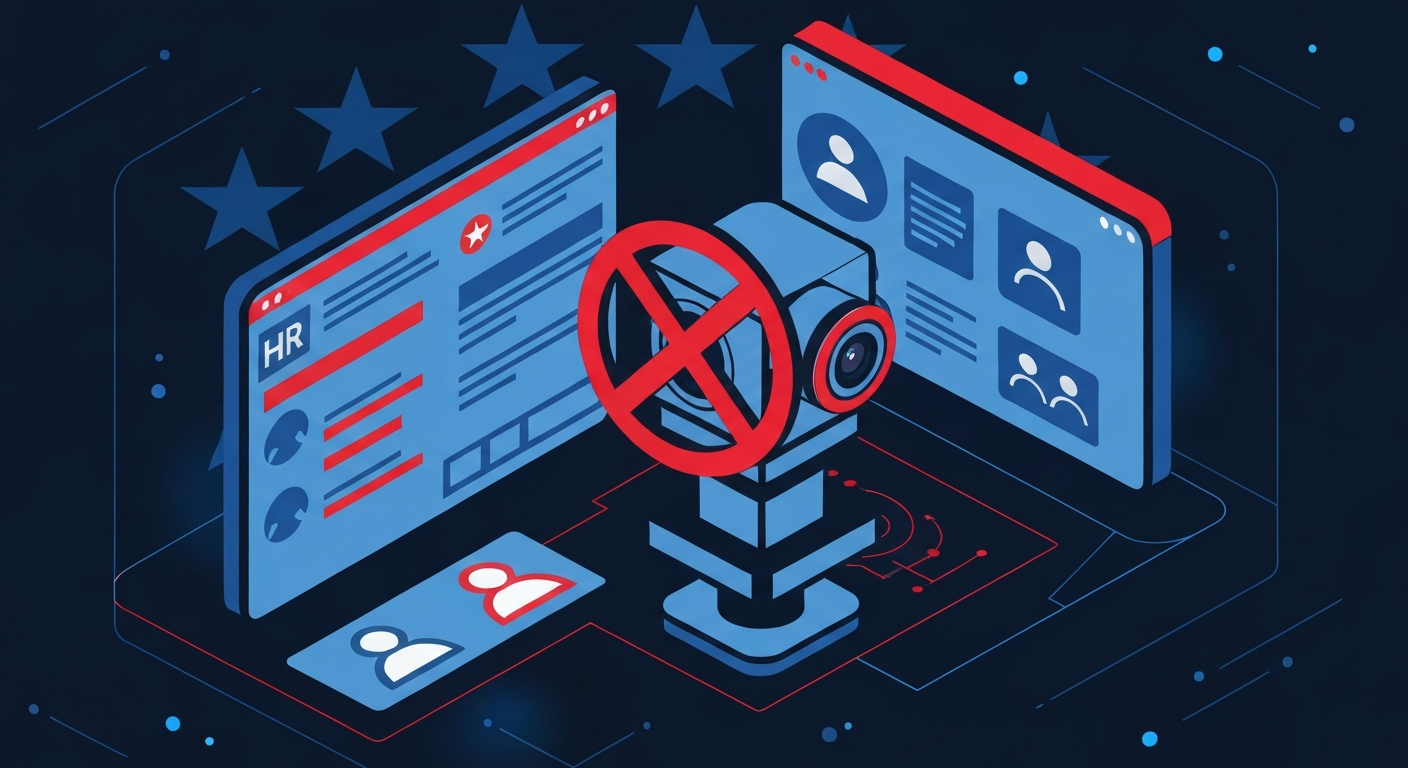
With 67 days until August 2, 2026, EU AI Act Article 5(1)(f) prohibition on emotion recognition AI in workplaces moves from guidance to enforcement. HR platforms, employee monitoring tools, and interview screening systems that infer emotional states face fines up to €35 million or 7% of global annual turnover — the highest penalty tier in the EU AI Act.
This guide explains exactly what emotion recognition AI is prohibited under EU law, what technical patterns trigger the ban, and how to audit your SaaS product before the August deadline.
What Is Prohibited: EU AI Act Art.5(1)(f)
Article 5(1)(f) prohibits the placing on the market, putting into service, or use of AI systems that:
"...infer the emotions of natural persons in the area of the workplace and educational institutions, except where such use is for medical or safety reasons."
The prohibition covers any AI system that — based on biometric or behavioral data — infers, classifies, or predicts emotional or psychological states of individuals in workplace contexts. This includes:
- Facial expression analysis inferring happiness, frustration, engagement, or boredom
- Voice tone / prosody analysis detecting stress, anger, enthusiasm, or deception
- Body language inference from video feeds to determine emotional engagement
- Typing pattern analysis that infers mood, stress level, or mental state per employee
- Eye-tracking sentiment derived from gaze patterns in workplace monitoring tools
- Combined biometric profiles that generate per-employee "emotional scores" or "engagement indices"
The Omnibus Extension (April 2026)
The EU AI Act Omnibus (final text April 2026) expanded the scope of Art.5(1)(f) in two critical ways:
-
Implicit emotion inference is prohibited — not just systems explicitly marketed as "emotion detection." If your productivity monitoring tool generates a "stress index" from keyboard dynamics or voice calls, it's within scope even if you don't call it emotion AI.
-
Aggregate data prohibition — The Omnibus clarified that profiling employees over time to infer emotional patterns (even without real-time emotion labeling) violates the prohibition if the inference relates to emotional or psychological state.
Which HR and Workplace SaaS Products Are Affected
Category 1: Interview Screening Platforms (HIGH RISK)
AI-powered video interview tools that analyze candidate facial expressions, voice tone, or behavioral signals to score candidates on traits like "enthusiasm," "confidence," or "cultural fit" are directly prohibited when such signals are derived from emotion inference.
Affected features:
- Facial expression scoring during video interviews
- Voice stress or confidence analysis in phone screening
- "Engagement score" derived from eye contact or facial movement
- Automated sentiment classification of interview responses
Not prohibited: Automated transcription, keyword extraction, structured question scoring without biometric inference.
Category 2: Employee Monitoring and Productivity Platforms (HIGH RISK)
Workplace surveillance tools that use AI to infer employee emotional state from behavioral patterns are prohibited. This includes:
- Keystroke dynamics → mood/stress inference per employee
- Screenshot analysis → "distraction" or "frustration" classification
- Video feed monitoring → facial expression analysis during meetings
- Email/chat sentiment analysis linked to individual employee profiles
Not prohibited: Anonymous aggregate productivity metrics, time-tracking without biometric inference, activity logs without emotional interpretation.
Category 3: Call Center and Customer Service AI (MEDIUM RISK)
Tools that analyze agent voice during customer calls to infer agent stress, frustration, or burnout are in scope. The prohibition applies to employee-facing inference (the agent's emotional state), not customer sentiment analysis.
Prohibited: Agent stress scoring, burnout prediction from voice patterns, "agent mood" dashboards per employee Allowed: Customer sentiment analysis for quality improvement (no employee emotional state inference)
Category 4: HR Analytics and Engagement Platforms (MEDIUM RISK)
Survey platforms that combine self-reported data with behavioral inference to "validate" emotional state are in scope. AI models that infer whether an employee is "actually disengaged" based on biometric signals, even in combination with survey data, violate Art.5(1)(f).
Prohibited: Behavioral validation of self-reported mood, "real engagement" scoring that contradicts survey responses via biometric inference Allowed: Self-reported wellness surveys, anonymous aggregate pulse surveys, opt-in wellness tracking without biometric emotion inference
Category 5: Meeting Analytics and Communication Tools (LOW-MEDIUM RISK)
AI meeting assistants that score individual participant engagement or emotional reaction during video calls are in scope.
Prohibited: Per-person "engagement score," "reaction analysis," or emotional state summary per meeting participant Allowed: Meeting transcription, topic extraction, action item detection without per-person emotional inference
Technical Compliance Checklist: What to Audit and Remove
Before August 2, 2026, audit every AI pipeline in your product stack:
Step 1: Identify Emotion Inference Pipelines
# Search for emotion/sentiment models in your codebase
grep -r "emotion\|sentiment\|stress\|engagement_score\|mood\|affect" \
  --include="*.py" --include="*.ts" --include="*.js" \
  -l ./src ./api ./ml
Look for:
- ML models trained on facial expressions (FER datasets, AffectNet, RAF-DB)
- Voice analysis models (openSMILE, SpeechBrain emotion classifiers)
- Text sentiment models linked to individual employee IDs
- Any feature named
emotion_*,mood_*,stress_*,sentiment_employee_*
Step 2: Trace Data to Individual Identity
Prohibited inference requires both: (1) emotional state inference AND (2) linkage to an identifiable individual in a workplace context.
# Example — PROHIBITED pattern
def analyze_employee_meeting(employee_id: str, video_frame) -> dict:
    emotion = facial_emotion_model.predict(video_frame)  # PROHIBITED
    return {
        "employee_id": employee_id,  # Individual linkage
        "emotion": emotion,          # Emotional state inference
        "timestamp": datetime.utcnow()
    }

# Example — ALLOWED pattern (anonymous aggregate)
def analyze_meeting_aggregate(video_frames: list) -> dict:
    # No individual tracking, no per-person inference
    return {
        "meeting_id": meeting_id,
        "avg_participation_time": compute_talk_time(video_frames),
        # No emotion labels, no per-person biometric inference
    }
Step 3: Check Third-Party SDKs
Many emotion recognition APIs are embedded in larger SDKs. Audit:
| SDK / Service | Emotion Features to Disable |
|---|---|
| Microsoft Azure Face API | emotion attribute in Detect API — must be removed for EU workplace use |
| Amazon Rekognition | DetectFaces with Emotions attribute — prohibited in workplace contexts |
| Google Cloud Vision | Emotion likelihood fields (joyLikelihood, sorrowLikelihood, etc.) |
| AWS Contact Lens | Agent sentiment scoring — prohibited for agent (not customer) sentiment |
| Affectiva / iMotions | Core product — fully prohibited in EU workplace deployments |
| OpenCV + FER | Any implementation inferring per-employee emotion state |
Step 4: Audit Database and Analytics
-- Find emotion-related columns in employee data tables
SELECT table_name, column_name, data_type
FROM information_schema.columns
WHERE column_name ILIKE '%emotion%'
   OR column_name ILIKE '%sentiment%'
   OR column_name ILIKE '%mood%'
   OR column_name ILIKE '%stress%'
   OR column_name ILIKE '%engagement_score%'
   AND table_schema = 'employees' OR table_schema = 'hr';
Any column linking emotional inference to employee identifiers must be removed or de-linked before August 2.
Step 5: Disable or Anonymize — Decision Matrix
| Feature | Action Required | Deadline |
|---|---|---|
| Per-employee facial emotion scoring | REMOVE — no anonymous fallback | August 2, 2026 |
| Interview candidate emotion scoring | REMOVE from hiring pipeline | August 2, 2026 |
| Agent stress/mood dashboards | REMOVE — disable emotion model | August 2, 2026 |
| Meeting participant emotion analysis | REMOVE per-person scoring | August 2, 2026 |
| Anonymous aggregate engagement | ALLOWED — keep if no individual linkage | — |
| Customer sentiment (no employee link) | ALLOWED — customer data out of scope | — |
| Self-reported wellness surveys | ALLOWED — explicit consent, no inference | — |
| Medical safety monitoring | NARROW EXCEPTION — requires medical context | — |
The Two Narrow Exceptions
Art.5(1)(f) creates only two exceptions — both are extremely narrow:
Exception 1: Medical Reasons
Emotion recognition AI used for genuine medical purposes — such as detecting pain signals in patients unable to communicate — is exempt when:
- Used by medical professionals
- In a medical care context
- Not a workplace productivity or surveillance application
This exception does not apply to "wellness" or "mental health" monitoring in ordinary workplaces, even if marketed as supporting employee health.
Exception 2: Safety Reasons
AI systems inferring emotional state for occupational safety purposes — such as detecting extreme fatigue or distress in safety-critical roles (airline pilots, nuclear plant operators, heavy machinery operators) — may be exempt when:
- The inference directly prevents an imminent safety risk
- No other safety mechanism is available
- Compliant with sector-specific regulations (aviation, nuclear)
This exception is not available for general employee wellness monitoring, burnout prediction, or productivity optimization framed as "safety."
Enforcement: Timeline and Penalties
| Date | Event |
|---|---|
| February 2, 2025 | GPAI provisions and governance rules apply |
| August 2, 2025 | AI literacy and GP AI model obligations |
| August 2, 2026 | Art.5 prohibited practices fully enforceable — including Art.5(1)(f) |
| 2027+ | High-risk AI system requirements (Annex III) |
Penalties for Art.5 violations:
- Up to €35,000,000 or 7% of global annual turnover (whichever is higher)
- The highest penalty tier in the EU AI Act
- Applies to providers, deployers, and importers
- Each member state designates a national market surveillance authority
The first enforcement actions under Art.5 are expected in Q4 2026, when national authorities begin auditing HR tech providers following August 2 enforcement.
EU-Native Alternatives: Compliant Employee Engagement
Replace prohibited emotion AI with privacy-respecting, EU-native alternatives:
Self-Reported Wellness Platforms
| Product | Country | Cloud Act Score | Approach |
|---|---|---|---|
| Leapsome | 🇩🇪 Germany | 0/25 — EU-only infra | Anonymous pulse surveys, no biometric inference |
| Factorial HR | 🇪🇸 Spain | 0/25 — EU-hosted | Employee engagement via structured surveys |
| Kenjo | 🇩🇪 Germany | 0/25 — GDPR-native | Wellness tracking with explicit employee consent |
| Personio | 🇩🇪 Germany | 0/25 — EU datacenter | HR management without emotion inference |
Compliant Meeting Analytics
| Product | Approach | Compliance |
|---|---|---|
| Vowel (EU hosting) | Transcription only, no emotion scoring | Compliant |
| Sembly AI (EU option) | Action items, topics — no per-person emotion | Compliant |
| Internal transcript tooling | Custom implementation, no biometric model | Compliant |
What Anonymous Aggregate Metrics Look Like
Compliant workplace analytics focus on patterns without individual emotional inference:
{
  "team_id": "eng-backend",
  "week": "2026-W22",
  "avg_focus_blocks_per_person": 3.2,
  "meeting_load_hours": 12.4,
  "async_response_time_p50_minutes": 22,
  "pulse_survey_response_rate": 0.84,
  // No emotion labels, no per-person biometric inference
}
Architecture Patterns: Before and After
BEFORE (Prohibited after August 2, 2026)
Video Call → Frame Extraction → FaceAPI emotion model
           → Employee ID lookup → emotion_log table
           → Manager dashboard: "Sarah: frustrated 40% of meetings"
AFTER (Compliant)
Video Call → Transcript only → Topic extraction
           → Anonymous aggregate: "Meeting had high talk-turn ratio"
           → Team-level pulse survey → Self-reported satisfaction
           → No biometric inference, no per-employee emotional data
Frequently Asked Questions
Q: Does this apply to candidates, not just employees? A: Yes. The prohibition covers inference in "workplace" contexts, which courts will interpret to include the recruitment process. Candidate interview screening is within scope.
Q: What if employees provide explicit consent? A: Consent does not override Art.5 prohibited practice prohibitions. Unlike GDPR, where consent is a valid legal basis, the EU AI Act prohibition is absolute in scope — consent cannot make prohibited AI systems legal.
Q: Our emotion recognition feature is "optional" — does that matter? A: No. Placing an optional prohibited AI feature on the market or making it available as a deployer in the EU is itself prohibited, regardless of whether individual users activate it.
Q: We're outside the EU but serve EU-based companies — does this apply? A: Yes. The EU AI Act applies to any AI system placed on the EU market or affecting persons located in the EU, regardless of where the provider is established (Art.2(1)).
Q: What about historical data? If we collected emotion inferences before August 2, must we delete them? A: The prohibition applies to use, not just collection. Continuing to use, process, or serve prohibited emotion inference data after August 2 violates Art.5, even if the data was collected before.
Your August 2, 2026 Compliance Checklist
- Audited all AI pipelines for emotion/sentiment inference linked to employee IDs
- Disabled or removed facial expression scoring from interview tools
- Removed voice stress/mood analysis from call center agent dashboards
- Checked all third-party SDKs for embedded emotion detection (Azure Face, Rekognition, etc.)
- Cleaned emotion-linked columns from employee/HR databases
- Replaced per-employee emotional inference with anonymous aggregate analytics
- Replaced prohibited features with self-reported, consent-based wellness tools
- Documented the medical/safety exception if claiming it (narrow — seek legal counsel)
- Updated privacy notices and DPAs to reflect removal of biometric processing
- Registered HR AI systems subject to Annex III high-risk classification (if applicable)
Next in the Series
- Post #4: EU AI Act Social Scoring & Manipulation Bans: Dark Pattern Compliance 2026
- Post #5: EU AI Act Prohibited Practices Finale: Complete Assessment Framework 2026
Running sota.io on EU-sovereign infrastructure? Every component in this compliance guide runs on European cloud providers with no US data exposure. See how sota.io keeps your EU SaaS stack compliant. 67 days until August 2, 2026 — audit your emotion AI before enforcement begins.
EU-Native Hosting
Ready to move to EU-sovereign infrastructure?
sota.io is a German-hosted PaaS — no CLOUD Act exposure, no US jurisdiction, full GDPR compliance by design. Deploy your first app in minutes.