EU AI Act Art.9 Risk Management System: What High-Risk AI SaaS Providers Must Build by August 2, 2026
Post #1 in the sota.io EU AI Act Risk Management System 2026 Series
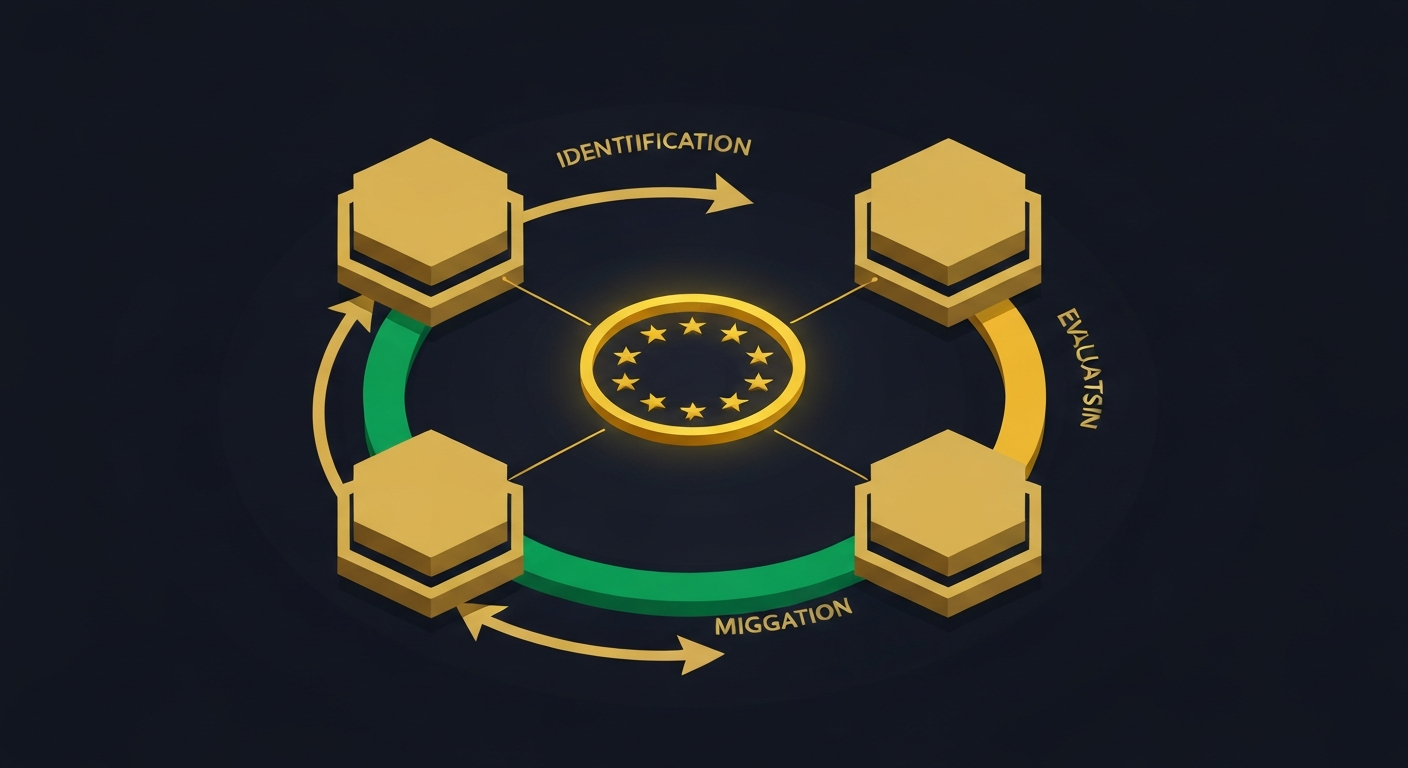
The EU AI Act's August 2, 2026 deadline for high-risk AI systems is fewer than ten weeks away. Among the most demanding operational requirements is Article 9: the mandatory Risk Management System (RMS). Unlike a one-time audit or a checkbox compliance exercise, Art.9 requires a continuously running, documented process embedded into your entire AI development lifecycle — from initial design through eventual decommissioning.
If you are a SaaS provider building or deploying a high-risk AI system in the EU, you cannot pass conformity assessment, issue a Declaration of Conformity, or legally place your product on the EU market without a functioning, documented RMS. This guide explains what Art.9 actually requires, what documentation you must produce, and what a Minimum Viable RMS looks like for a typical SaaS team.
Why Art.9 Is the Core of High-Risk AI Compliance
The EU AI Act's compliance architecture for high-risk systems is built around a simple premise: providers must actively manage risk, not merely declare that risk does not exist. Art.9 operationalises this premise by requiring a systematic, iterative process that:
- Identifies all known and reasonably foreseeable risks the AI system may pose to health, safety, or fundamental rights
- Analyzes those risks in terms of likelihood and severity
- Evaluates whether identified risks fall within acceptable bounds
- Mitigates risks through technical measures, operational constraints, or user information
- Tests that mitigations work before deployment
- Documents the entire process as evidence for conformity assessment
Without a documented RMS, your Annex IV technical documentation is incomplete, your conformity assessment cannot conclude positively, and your Declaration of Conformity has no evidentiary foundation. The RMS is not one item on a compliance checklist — it is the compliance framework that all other Art.9 to Art.14 requirements hang from.
Who Must Build an Art.9 Risk Management System
The RMS obligation applies to providers of high-risk AI systems, defined in Annex III of the EU AI Act. The eight high-risk categories that SaaS providers most commonly encounter include:
Biometric and biometric-based systems — facial recognition for access control, emotion recognition in HR software, or identity verification in financial onboarding (subject to specific Art.5 prohibitions).
Critical infrastructure management — AI systems that manage or make decisions affecting electricity grids, water treatment, transport networks, or digital infrastructure classified under NIS2.
Education and vocational training — AI used to evaluate students, assess performance, allocate places in educational institutions, or monitor exam integrity.
Employment and human resources management — AI systems used in recruitment screening, CV shortlisting, interview analysis, performance evaluation, or workforce allocation.
Access to essential private services — creditworthiness assessment, insurance risk scoring, or life insurance pricing using AI.
Law enforcement — AI used by police for predictive policing, crime analytics, or evaluation of evidence reliability (strictly regulated and partially prohibited).
Migration, asylum, and border control — AI used in visa assessment, asylum claim evaluation, or border crossing risk profiling.
Administration of justice — AI used to assist courts or arbitration bodies in researching facts, applying law, or drafting decisions.
Important scoping note: General-purpose AI systems (GPAI models like GPT-4 or Claude) deployed by SaaS providers are assessed under separate GPAI obligations (Art.51–53). However, if you integrate a GPAI model into a high-risk application — for example, using an LLM to power a CV screening tool — your product is a high-risk AI system and Art.9 applies to the complete system, not just the underlying model.
The Four Core Requirements of Art.9
1. Identify Known and Reasonably Foreseeable Risks
The first stage of the RMS is systematic risk identification. Art.9 requires you to identify risks to health, safety, and fundamental rights across the entire intended use, reasonably foreseeable misuse, and foreseeable interactions with other systems.
Effective risk identification for a SaaS AI system typically covers:
- Technical risks: model failure modes (hallucination, distributional shift, adversarial inputs), infrastructure failure (latency spikes, data loss), integration failures with third-party services
- Discrimination risks: disparate impact on protected groups across race, gender, age, disability status, and other characteristics listed in EU fundamental rights instruments
- Autonomy and human oversight risks: situations where users or deployers may over-rely on AI outputs without exercising independent judgment
- Data rights risks: use of personal data in ways that conflict with GDPR rights (access, erasure, objection to automated decisions)
- Cascade risks: downstream consequences when deployers integrate your AI output into their own decision-making processes
- Misuse risks: how a bad actor or negligent deployer could weaponise your AI against the very users it is supposed to serve
A practical starting point is a structured workshop with product, engineering, legal, and domain experts, using a risk taxonomy like ISO 31000 or NIST AI RMF as a prompt list. The output should be a risk register — a living document where each identified risk is recorded with a unique identifier, a plain-language description, the potential harm, and the category of persons who might be harmed.
2. Analyze Each Risk
Risk analysis transforms the identification stage from a list of concerns into structured evidence. For each identified risk, you must assess:
- Likelihood: Under what circumstances would this risk materialise? How probable is that circumstance? (Qualitative scales of 1–5 or quantitative probability estimates are both acceptable.)
- Severity: If the harm materialises, how severe is it? Does it cause reversible inconvenience, significant economic harm, or irreversible injury to fundamental rights?
- Affected population: Who bears the harm? Concentrated harm to a vulnerable group (e.g., disabled users, ethnic minorities, asylum seekers) typically demands more aggressive mitigation than diffuse low-severity harm across a general population.
- Detectability: Would harmed persons know they were harmed? Low detectability amplifies the net harm even if individual incidents appear minor.
The combination of likelihood and severity produces a risk score that allows you to prioritise mitigation work. Most teams use a simple matrix: a 5×5 grid where scores above a defined threshold require mandatory mitigation before deployment.
3. Evaluate and Accept or Reject Residual Risk
After analysis, Art.9 requires you to evaluate whether each identified risk is acceptable. The evaluation must consider:
- Whether the risk falls below the threshold that would prevent market placement (risks to fundamental rights typically carry a much lower threshold than minor usability risks)
- Whether technically feasible mitigation measures exist that have not yet been applied
- Whether the risk is offset by a clear safety, health, or rights benefit delivered by the system
Risks that exceed your acceptance threshold and for which no technically feasible mitigation exists present a strategic decision: narrow the intended use case, add mandatory human oversight, or do not deploy the feature. Art.9 does not permit you to accept high-severity, high-likelihood risks simply because mitigation is expensive.
Risks that fall below your acceptance threshold — or that have been reduced to below threshold through mitigation — become residual risks. These must be documented, communicated to deployers in your instructions for use, and re-evaluated whenever the system changes.
4. Adopt Risk Management Measures
For each unacceptable risk, Art.9 requires you to adopt appropriate mitigation measures. The regulation specifies a preferred hierarchy:
- Eliminate the risk through design — change the AI architecture, training objective, or system scope so the risk cannot arise (e.g., remove a feature that reliably produces discriminatory outputs rather than trying to patch it)
- Reduce the risk through technical safeguards — add output filters, confidence thresholds, human-in-the-loop requirements, or audit logging that intercept harmful outcomes
- Reduce the risk through operational safeguards — restrict the use context, require deployer training, mandate specific deployment conditions
- Communicate residual risks — document what risks remain and provide clear instructions to deployers about how to manage them in their specific deployment context
Each adopted measure must be logged in your risk register with the specific risk it addresses, the technical or operational change made, and the re-evaluated risk score after the measure is applied.
The Iterative Lifecycle Requirement
Art.9 is explicit that the RMS must be a continuous iterative process throughout the entire AI system lifecycle — not a one-time pre-deployment exercise. In practice, this means:
During development: The RMS is updated as design decisions are made. If you add a new data source, a new use case, or a significant model change, you re-run risk identification and analysis for the changed components.
Before deployment: A final RMS review confirms that all identified high-priority risks have been mitigated to acceptable levels, testing results support the residual risk conclusions, and documentation is complete.
During operation: The RMS is triggered whenever:
- A serious incident occurs or is reported (see Art.73 for incident reporting obligations)
- A deployer reports unexpected AI behaviour
- You discover that the real-world population using the system differs significantly from the population reflected in your training data
- You release a significant model update, retrain on new data, or change the use context
- New research reveals a previously unknown failure mode for your system type
At end of life: The RMS records the system's full risk history, which feeds into any successor system's initial risk identification.
The iterative requirement is often overlooked by teams that treat the RMS as a compliance artefact to be produced once and filed away. Regulators and notified bodies are specifically trained to look for evidence of ongoing maintenance — dated updates, incident responses, and post-deployment review records.
Documentation Requirements
Art.9 compliance lives or dies on documentation. Your Annex IV technical documentation must contain sufficient evidence that the RMS is real, operational, and proportionate to the risks your system poses. Minimum required documentation includes:
Risk register — Each identified risk with: unique ID, description of the harm, category of affected persons, likelihood assessment with rationale, severity assessment with rationale, composite risk score, mitigation measures applied, residual risk score, and acceptance decision.
Risk analysis methodology — A brief description of your identification process (workshop, expert review, red-teaming, automated analysis), your scoring scales, and your acceptance thresholds.
Testing protocol and results — Documented test cases that specifically target the risks in your register, pass/fail criteria, and the actual test outcomes.
Residual risk statement — A summary of risks that remain after mitigation, with the specific information that deployers must include in their own risk management and user communication.
RMS maintenance log — Dated records of every RMS review, what triggered it, what changed, and who approved the update.
RMS owner assignment — A named individual (not a team or role) who is responsible for maintaining the RMS and has the authority to halt deployment if unacceptable risks are identified.
Testing Requirements Under Art.9
Art.9 requires testing "throughout the entire development process" — a standard that goes well beyond a pre-launch QA pass. Compliant testing for a high-risk AI system typically includes:
Functional performance testing — Verifying that the system performs its intended function at the stated level of accuracy, reliability, and robustness. Performance metrics and their acceptable ranges must be defined before testing begins, not after.
Bias and discrimination testing — Testing system outputs across demographic subgroups to detect disparate impact. For employment screening tools, this typically means testing across gender, age, and ethnicity proxies in your test data. For credit assessment, it means testing across postcode, name, and other correlated variables.
Adversarial testing — Deliberately constructing inputs designed to cause the system to fail — edge cases, boundary conditions, adversarial examples, and prompt injection for LLM-powered systems.
Human oversight testing — Verifying that your mandatory human-in-the-loop controls actually work: that override mechanisms are accessible, that confidence thresholds are set appropriately, and that the system provides sufficient information for a human reviewer to make a meaningful independent judgment.
Integration testing — Testing the AI system in its intended deployment context, including realistic data distributions, expected user interfaces, and downstream integrations.
Test results must be retained as part of your Annex IV documentation. There is no mandated minimum number of test cases, but the test suite must be demonstrably proportionate to the identified risks and use context.
The Relationship Between Art.9 and Other AI Act Articles
The RMS does not operate in isolation. It feeds into and is fed by every other technical requirement in Chapter 2:
Art.10 (Data and Data Governance) — Biased, unrepresentative, or poor-quality training data creates Art.9 risks. Your data governance analysis should be the primary input to your risk identification stage.
Art.11 and Annex IV (Technical Documentation) — The RMS evidence must appear in your technical documentation. Without the RMS, the documentation is incomplete.
Art.12 (Record-Keeping) — Automatic logging requirements for high-risk AI systems are partly motivated by Art.9's need for post-deployment risk monitoring. Logs must capture enough information to identify the circumstances of adverse outcomes.
Art.13 (Transparency) — The information you must provide to deployers in your instructions for use is largely derived from your residual risk statement under Art.9.
Art.14 (Human Oversight) — The specific human oversight measures you implement are driven by your Art.9 risk evaluation. Where risks are high and automated mitigation is insufficient, Art.14 oversight becomes mandatory.
Art.17 (Quality Management System) — The QMS required of EU-based providers must incorporate the RMS as a core component. Non-EU providers who designate an authorised representative are not required to have a full QMS but must still have a functioning RMS.
Art.43 (Conformity Assessment) — The conformity assessor — whether a notified body or your own internal control process — will review your RMS documentation as a central part of the assessment.
Minimum Viable RMS for SaaS Providers
For most SaaS providers deploying a single high-risk AI feature (an LLM-powered employment screening tool, a credit scoring model, or a biometric authentication flow), the minimum compliant RMS is achievable with dedicated effort from a small team over 4–6 weeks. It consists of:
Tier 1 — Documentation (non-negotiable):
- Risk register with at minimum 10–20 identified risks for any non-trivial AI system, categorised by harm type and affected population
- Likelihood × Severity matrix with defined thresholds (e.g., score ≥ 15 on a 25-point scale requires mandatory mitigation before deployment)
- Mitigation log documenting what technical or operational measures were taken for each above-threshold risk
- Residual risk statement covering all accepted risks and the information deployers must communicate to users
Tier 2 — Processes (non-negotiable):
- Named RMS owner with defined authority to halt deployment
- Scheduled quarterly review during active development
- Defined triggers for unscheduled reviews (incident, system change, new risk research)
- Integration with your incident management system so that production incidents automatically trigger an RMS review
Tier 3 — Testing (non-negotiable pre-deployment):
- Functional performance test suite targeting your top-priority risks
- Bias testing across at least the protected characteristics most relevant to your use case
- Documented adversarial test cases for your highest-severity identified risks
- Written acceptance criteria that test results must meet before deployment proceeds
Tier 4 — Infrastructure (recommended, may be required by deployers):
- Automatic logging of AI outputs sufficient to reconstruct the circumstances of any adverse outcome
- User-facing confidence indicators or uncertainty quantification where relevant to the risk profile
- Human override mechanism with audit trail
Common Mistakes SaaS Providers Make
Treating the RMS as a one-off deliverable. The most frequent failure mode is creating a risk register before launch and never updating it. Regulators and deployers conducting due diligence will ask for dated maintenance records. A static document with no update history signals non-compliance.
Generic risk descriptions. "The AI might produce biased outputs" is not a properly identified risk. Identify the specific harm (an employment screening tool rejects qualified candidates from a specific ethnic group at a 30% higher rate), the specific mechanism (the training data over-represents a dominant demographic), and the specific population bearing the harm (candidates from minority ethnic backgrounds).
Missing the full lifecycle scope. The RMS must cover risks arising at design time, at training time, at deployment time, and at end of life. A risk register that only covers post-deployment operational risks is incomplete.
Failing to communicate residual risks to deployers. Art.13 requires your instructions for use to include specific information about residual risks that deployers must manage. If your RMS identifies residual risks but your documentation is silent on them, you are non-compliant on both Art.9 and Art.13 simultaneously.
Confusing risk management with security. Cybersecurity risks (data breach, API abuse, prompt injection) are a subset of Art.9 risks, but Art.9 specifically targets harms to health, safety, and fundamental rights. A CISO's security assessment does not substitute for an Art.9 RMS.
August 2, 2026: What Your RMS Must Look Like
For any high-risk AI system you place on the EU market or put into service in the EU on or before August 2, 2026:
☑ Risk register complete, reviewed, and signed off by the named RMS owner
☑ All risks above your acceptance threshold mitigated to acceptable levels, or deployment scope narrowed
☑ Testing completed against documented criteria for all high-priority risks
☑ Residual risk statement finalised
☑ Deployer communication (instructions for use) incorporates residual risk information
☑ RMS evidence included in your Annex IV technical documentation
☑ RMS maintenance process established with defined triggers and review cadence
For high-risk AI systems placed on the market after August 2, 2026: the RMS must be established before the first placement or putting into service. There is no grace period for new systems launched after the deadline.
What's Next in This Series
This 5-part series covers Art.9 in depth:
- Part 1 (this post): Overview — what the RMS is, who needs it, and what must be in place by August 2
- Part 2: Risk identification methodology for AI systems — structured techniques, taxonomies, and common failure modes to check
- Part 3: Quantitative risk analysis — building your likelihood × severity matrix and setting defensible acceptance thresholds
- Part 4: Art.9 testing requirements — what tests you must run, how to document them, and how testing integrates with your CI/CD pipeline
- Part 5: Complete Art.9 RMS template and final compliance checklist for August 2026
Running high-risk AI on EU infrastructure reduces your CLOUD Act exposure risk and strengthens your Art.9 residual risk position. sota.io — EU-native managed PaaS on Hetzner Germany, 100% GDPR-compliant, no US parent company.
EU-Native Hosting
Ready to move to EU-sovereign infrastructure?
sota.io is a German-hosted PaaS — no CLOUD Act exposure, no US jurisdiction, full GDPR compliance by design. Deploy your first app in minutes.