EU AI Act Art.50 Transparency & Watermarking: Developer Guide 2026
Post #1326 in the sota.io EU AI Act Omnibus 2026 Series
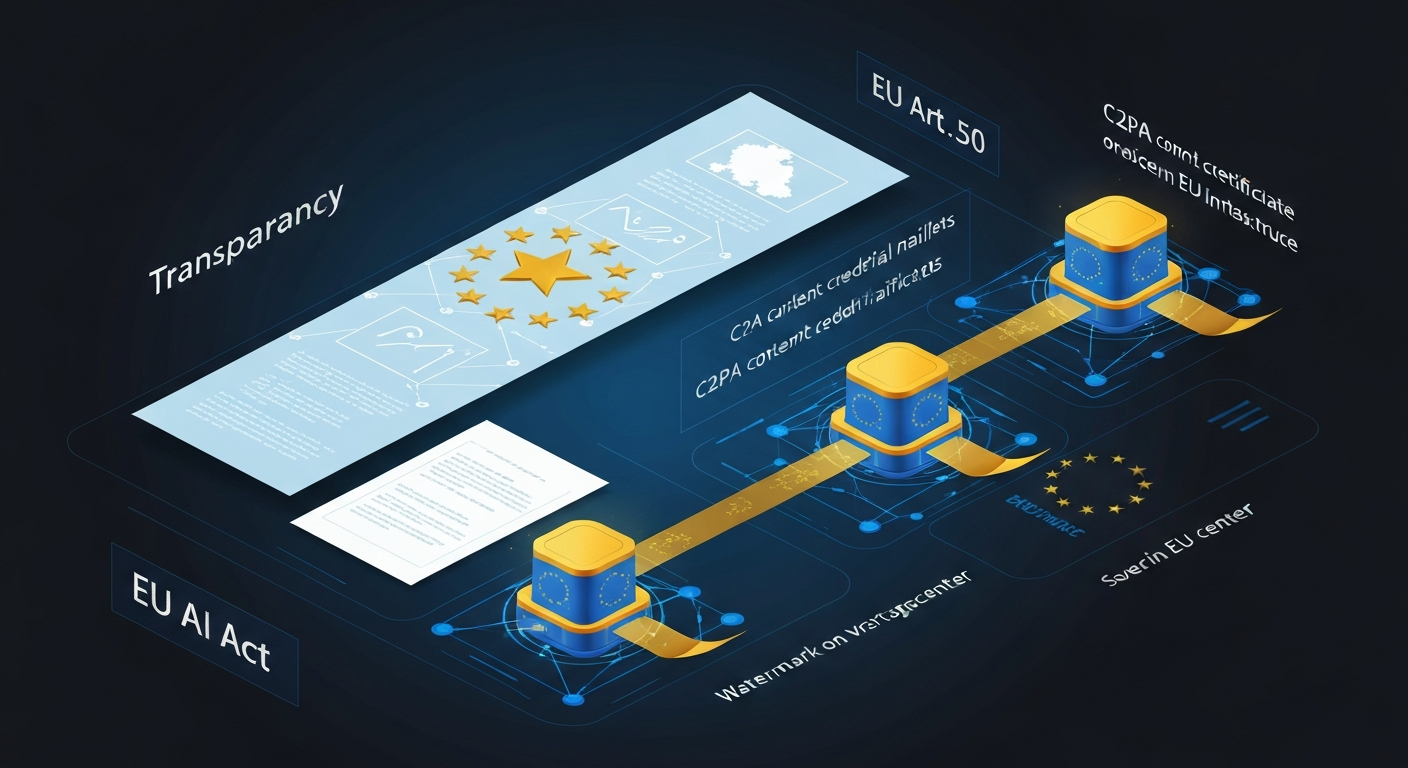
The EU AI Act's Article 50 transparency obligations go live on 2 August 2026 — the same deadline as the General-Purpose AI (GPAI) provisions. If your application uses AI to interact with users, classifies emotions, generates synthetic content, or is built on a GPAI model, you need to act now. This guide covers what Art.50 actually requires, how the C2PA watermarking standard maps to those requirements, and how to implement both in an EU-sovereign way that doesn't route content through US verification servers.
What Article 50 Actually Says
The EU AI Act Omnibus 2026 tightened and clarified Art.50 compared to the 2024 text. There are four distinct obligations:
Art.50(1) — AI System Disclosure
AI systems intended to interact directly with natural persons must disclose their AI nature unless the interaction is obvious from context. This applies to chatbots, virtual assistants, voice bots, and any automated agent engaging with users.
What counts as "obvious": A clearly labeled "Chat with our AI" button followed by a chatbot conversation is borderline — the system prompt makes it obvious, but regulators in Germany (BayLDA) and France (CNIL) have both indicated UI labeling alone is not sufficient without active notification.
Developer action: Add a mandatory opening disclosure in every session initiation. Log that the disclosure was shown. The Omnibus language requires this to happen "at the latest at the beginning of the interaction."
Art.50(2) — Emotion Recognition and Biometric Categorization
Systems that infer emotions or categorize people by biometric attributes must inform affected persons prior to exposure. This covers:
- Sentiment analysis on customer service calls
- Attention-detection in online proctoring
- Employee emotion monitoring (largely prohibited under Art.5 but disclosure still required where permitted)
- Age estimation systems used for content gating
Key trap: "Biometric categorization" under Art.50(2) includes age, gender, and ethnicity inference even when not used for high-risk decisions. If your system passes an image through a classification model that returns any biometric attribute, you trigger this obligation.
Art.50(3) — Deep Fake Labeling
AI-generated or AI-manipulated images, video, and audio that depict real-sounding events must carry a machine-readable marker indicating artificial origin. The Omnibus extended this from the original "deep fake" framing to any realistic synthetic content — marketing images, AI-voiced narration, synthetic product photos.
Exemptions: Art.50(3)(a) covers content for "authorized law enforcement purposes" and Art.50(3)(b) covers "artistic, satirical, or fictional content where such content is clearly recognizable as not depicting reality" — but you have to actively establish the exemption, not assume it applies.
Art.50(4) — GPAI Machine-Readable Watermarking
This is the obligation that created the most implementation work. Providers of GPAI models must ensure generated content carries a machine-readable watermark or other marker that identifies it as AI-generated. The Omnibus added "or other marker" to allow alternatives to traditional watermarking — including metadata schemas like C2PA.
The obligation binds the GPAI provider (OpenAI, Anthropic, Mistral, etc.) directly, but downstream API consumers also carry obligations: if you use a GPAI API to generate content that you then distribute, you must either confirm the provider's markers are intact or apply your own markers.
The C2PA Standard: Technical Foundation for Art.50 Compliance
The Coalition for Content Provenance and Authenticity (C2PA) specification, now at v2.1, provides the only widely-adopted technical framework that maps directly to Art.50(4)'s machine-readable marker requirement. All major GPAI providers — OpenAI, Adobe (Firefly), Google (Imagen), Microsoft (Designer) — now implement C2PA for their generated content.
What a C2PA Manifest Contains
A C2PA manifest is a cryptographically signed JSON structure embedded in the content file (image, video, audio, PDF) that records:
{
  "claim": {
    "dc:title": "AI-Generated Product Photo",
    "created": "2026-05-27T08:14:22Z",
    "claim_generator": "sota.io/v2.1 c2pa-rs/0.36.0"
  },
  "assertions": [
    {
      "label": "c2pa.ai_generative_training",
      "data": {
        "trained_on": "eu_sovereign_dataset",
        "model_uri": "https://models.sota.io/v1/img-gen-v3"
      }
    },
    {
      "label": "c2pa.ai_label",
      "data": {
        "name": "AI Generated",
        "source": "https://sota.io/ai-disclosure"
      }
    }
  ],
  "signature": "<ed25519-signature>"
}
The manifest is embedded as a binary chunk in JPEG/PNG/AVIF, a sidecar for video (MP4/WebM), or an XMP block in PDF. Verification requires only the public key — it does not require calling back to a US-hosted verification server.
EU-Sovereign C2PA Implementation
The reference implementation from C2PA.org currently relies on Microsoft Azure for its public Trust Registry. For EU-sovereign deployments, you need to:
- Self-host your certificate authority — use your own ed25519 signing key rather than relying on Adobe's or Microsoft's trust anchor
- Use
c2pa-rs— the Rust library (Apache 2.0, maintained by the C2PA working group) with no cloud dependencies - Register with EUCS-aligned verifiers — BSI has signaled that Germany will accept self-signed C2PA certs from EUCS-certified providers for regulatory compliance, pending formal guidance
# Install c2pa-rs CLI
cargo install c2pa-tool

# Sign an AI-generated image with your EU certificate
c2pa sign \
  --cert eu-ca.crt \
  --key eu-signing.key \
  --claim-generator "MyApp/1.0 c2pa-rs/0.36" \
  --label c2pa.ai_label \
  --data '{"name":"AI Generated","source":"https://myapp.eu/ai-disclosure"}' \
  input.jpg output-signed.jpg
Implementation Guide: Art.50 Compliance Stack
Step 1: Inventory Your AI Touchpoints
Map every place your application touches AI-generated or AI-processed content:
| Touchpoint | Art.50 Obligation | Priority |
|---|---|---|
| Chatbot / virtual assistant | Art.50(1) — disclosure | Critical |
| Customer service sentiment analysis | Art.50(2) — inform before processing | Critical |
| AI-generated product images | Art.50(3)+(4) — watermark + label | Critical |
| AI-written email drafts | Art.50(4) if GPAI-sourced | High |
| GPAI API responses embedded in UI | Art.50(4) — check provider marks | High |
| AI-voiced support audio | Art.50(3) — machine-readable marker | High |
| Proctoring / attention detection | Art.50(2) — prior disclosure | Medium |
Step 2: Chatbot Disclosure Implementation
For Art.50(1) compliance, every session must start with a disclosure event that is logged:
// types/ai-session.ts
interface AISessionDisclosure {
  sessionId: string;
  userId: string;
  disclosedAt: Date;
  disclosureText: string;
  disclosureVersion: string;
}

// middleware/ai-disclosure.ts
export async function enforceAIDisclosure(
  req: Request,
  sessionStore: SessionStore
): Promise<void> {
  const session = await sessionStore.get(req.sessionId);

  if (!session.aiDisclosureMade) {
    await sessionStore.update(req.sessionId, {
      aiDisclosureMade: true,
      aiDisclosureAt: new Date(),
      aiDisclosureVersion: "art50-v1.0"
    });
    // Emit disclosure event for audit log
    await auditLog.record({
      type: "ai_disclosure",
      sessionId: req.sessionId,
      timestamp: new Date(),
      regulation: "eu-ai-act-art50(1)"
    });
  }
}
Step 3: C2PA Watermarking Pipeline for Generated Images
# watermark_pipeline.py
import c2pa
from pathlib import Path

class EUAIActWatermarker:
    """
    Art.50(3)+(4) compliant watermarking for AI-generated content.
    Uses self-hosted EU signing certificate — no US trust anchor dependency.
    """

    def __init__(self, cert_path: str, key_path: str, app_uri: str):
        self.signer = c2pa.Signer(
            cert=Path(cert_path).read_bytes(),
            key=Path(key_path).read_bytes(),
            alg="ed25519",
            reserve_size=50000
        )
        self.app_uri = app_uri

    def sign_generated_image(
        self,
        image_bytes: bytes,
        mime_type: str,
        model_id: str,
        generation_timestamp: str
    ) -> bytes:
        manifest = {
            "claim_generator": f"sota.io/v1 c2pa-rs/0.36",
            "title": "AI Generated Content",
            "assertions": [
                {
                    "label": "c2pa.ai_label",
                    "data": {
                        "name": "AI Generated",
                        "source": self.app_uri
                    }
                },
                {
                    "label": "c2pa.ai_generative_training",
                    "data": {
                        "model_id": model_id,
                        "generated_at": generation_timestamp
                    }
                }
            ]
        }

        builder = c2pa.Builder(manifest)
        result_bytes = builder.sign(
            signer=self.signer,
            format=mime_type,
            source=image_bytes
        )
        return result_bytes


# Usage in image generation endpoint
watermarker = EUAIActWatermarker(
    cert_path="/etc/sota/eu-c2pa.crt",
    key_path="/etc/sota/eu-c2pa.key",
    app_uri="https://myapp.eu/ai-disclosure"
)

generated_bytes = gpai_client.generate_image(prompt)
signed_bytes = watermarker.sign_generated_image(
    image_bytes=generated_bytes,
    mime_type="image/jpeg",
    model_id="img-gen-eu-v3",
    generation_timestamp="2026-05-27T08:14:22Z"
)
Step 4: Verifying GPAI Provider Watermarks
When consuming GPAI APIs (OpenAI, Mistral, Anthropic), verify that upstream watermarks are intact before serving content:
import c2pa

def verify_upstream_watermarks(content: bytes, mime_type: str) -> dict:
    """
    Verify C2PA manifests on content received from GPAI providers.
    Returns verification result including chain of custody.
    """
    try:
        reader = c2pa.Reader(mime_type, content)
        manifests = reader.manifests()

        return {
            "has_watermark": len(manifests) > 0,
            "ai_labeled": any(
                a["label"] == "c2pa.ai_label"
                for m in manifests
                for a in m.get("assertions", [])
            ),
            "provenance_chain": [m.get("claim_generator") for m in manifests],
            "compliant": True  # Art.50(4) — provider has marked it
        }
    except c2pa.Error as e:
        return {
            "has_watermark": False,
            "compliant": False,
            "error": str(e)
        }
Omnibus 2026 Changes to Art.50
The 2026 Omnibus amendments affect Art.50 in three important ways:
1. GPAI Scope Expansion
The Omnibus explicitly extended Art.50(4) to apply to GPAI model operators — companies building products on top of GPAI models — not just the underlying model providers. If you expose a GPAI model's outputs to end users (even indirectly), you have a watermarking obligation.
2. "Other Marker" Flexibility
The original text required "watermarks." The Omnibus added "or other marker" to accommodate metadata schemas (C2PA), steganographic approaches, and future technical standards. This is practically important: for text content (chat responses, AI-written documents), traditional image watermarking doesn't apply, but you can use metadata headers or document properties as markers.
Recommendation for text content:
// Add AI-content header to all GPAI-sourced text responses
response.headers.set('X-AI-Generated', 'true');
response.headers.set('X-AI-Act-Art50', 'eu-ai-act-2024-art50(4)');
response.headers.set('X-AI-Model', 'eu-sovereign-llm-v3');
3. Open-Weights GPAI Derogation
Under Art.53(4) of the Omnibus, providers of open-weights GPAI models (Llama, Mistral 7B, etc.) have reduced obligations — they are not required to watermark outputs from self-hosted deployments. However, if you build a commercial product on an open-weights model and expose it to users, you — as the deployer — still carry Art.50(4) obligations.
EU-Sovereign Architecture for Art.50 Compliance
The sovereignty concern with Art.50 is subtle but real: if your watermark verification calls out to Adobe's Content Credentials service or Microsoft's C2PA Trust Registry, you're making GDPR-relevant API calls to US infrastructure every time you verify a content credential.
Self-Hosted Verification Architecture
User Request (Content + C2PA Manifest)
         │
    ┌────▼─────────────────────────────────┐
    │     EU Verification Service          │
    │   (hosted on EUCS-certified infra)   │
    │                                      │
    │  1. Parse C2PA manifest              │
    │  2. Check signature against          │
    │     local CA cert bundle             │
    │  3. Return: verified / unverified    │
    │     + provenance metadata            │
    └──────────────────────────────────────┘
           │
    No calls to:
    ✗ contentcredentials.org (Adobe/US)
    ✗ Azure Content Safety (Microsoft/US)
    ✗ AWS Rekognition (US)
EUCS-aligned hosting options for the verification service:
- Hetzner Cloud (DE) — self-hosted c2pa-rs verification container, EUCS under review
- OVHcloud SecNumCloud (FR) — SOC2 + ANSSI certification, GDPR-compliant
- Scaleway (FR) — ISO 27001, EU GDPR DPA, BSI C5 attestation
The verification service itself is stateless — it only needs the C2PA public key bundle and the content bytes. A Hetzner CX21 instance handles ~2,000 verifications/second at <2ms latency.
Developer Compliance Checklist
Use this checklist before your 02.08.2026 Art.50 compliance deadline:
Art.50(1) — AI Disclosure:
- Every chatbot/assistant session starts with explicit AI disclosure
- Disclosure event is logged with timestamp, session ID, user ID
- Disclosure appears "at the beginning of the interaction" (not buried in settings)
- Log retention covers your data subject request window (min. 2 years)
Art.50(2) — Emotion/Biometric Processing:
- Inventory all models that output biometric attributes (even indirectly)
- Pre-processing disclosure shown before first inference on personal data
- Consent or legitimate interest documented for each processing purpose
Art.50(3)+(4) — Watermarking:
- All AI-generated images have C2PA manifests embedded
- All AI-generated audio has metadata markers
- GPAI text responses carry
X-AI-Generatedheader or equivalent marker - EU-sovereign signing key used (not US-CA signed)
- Verification service runs on EUCS-aligned infrastructure
- Upstream GPAI provider marks verified before re-serving content
- Open-weights derogation documented if applicable
Architecture:
- No watermark verification calls to US-hosted trust registries
- Signing keys stored in EU-resident HSM or key management service
- Audit trail of all watermarked content retained for regulatory inspection
sota.io Integration
sota.io's EU-sovereign deployment platform handles the infrastructure side of Art.50 compliance automatically:
- Build-time C2PA signing — generated content is signed during the deployment pipeline using your EU-resident signing key
- EU-only verification service — hosted on Hetzner Frankfurt, no cross-Atlantic verification calls
- Audit logging — every watermarking event logged to your EU-resident Postgres instance
- Header injection — AI-generated content headers automatically applied to API responses
For teams building on GPAI APIs, sota.io's deployment environment handles Art.50(4) compliance at the infrastructure level — your application code doesn't need to implement watermarking manually.
Conclusion
EU AI Act Article 50 creates concrete, enforceable obligations by 2 August 2026. The C2PA standard provides the technical foundation for Art.50(3)+(4) compliance, but your implementation needs to be EU-sovereign — no dependency on US-hosted trust registries or verification services. The Omnibus 2026 extension to GPAI operators means this is not just the problem of foundation model providers: if you serve GPAI-generated content to users, you carry the obligation.
Next in the EU AI Act Omnibus 2026 series: Post #1327 will cover the complete Omnibus compliance stack — combining high-risk AI testing (Art.9/15), GPAI governance (Art.52-55), and transparency requirements (Art.50) into a single deployment-ready framework for SaaS providers.
EU AI Act Art.50 transparency requirements take effect 2 August 2026. The C2PA standard and EU-sovereign deployment architecture described in this guide are production-ready today. References: EU AI Act (2024/1689), C2PA Specification v2.1, EU AI Act Omnibus 2026 amendment text.
EU-Native Hosting
Ready to move to EU-sovereign infrastructure?
sota.io is a German-hosted PaaS — no CLOUD Act exposure, no US jurisdiction, full GDPR compliance by design. Deploy your first app in minutes.