EU AI Act Art.50 Transparency: What Developers Must Disclose About AI-Generated Content by August 2026
Post #1442 in the sota.io EU AI Act Art.50 Transparency Ops 2026 Series
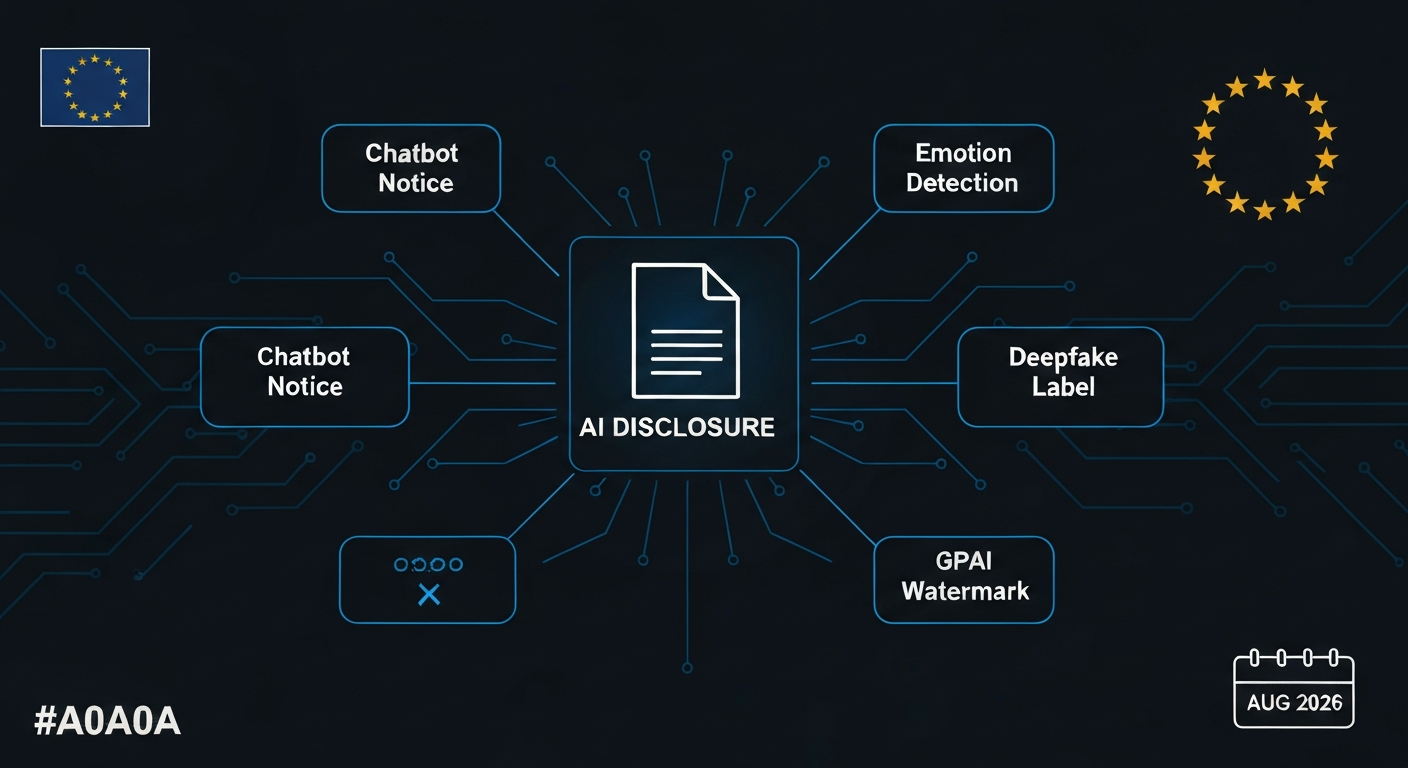
62 days to August 2, 2026. EU AI Act Article 50 — "Transparency obligations for providers and deployers of certain AI systems" — applies in full from that date. If your product interacts with users via AI, generates synthetic content, or deploys emotion-recognition capabilities, you have four distinct disclosure obligations to implement. This operational guide tells you exactly what to disclose, to whom, when, and what documentation you need to show regulators you did it.
The Four Disclosure Obligations Under Art.50
EU AI Act Art.50 creates four separate obligations. Each has a different trigger, scope, and implementation requirement. Many teams conflate them — a common compliance mistake that leaves gaps.
Obligation 1 — AI Interaction Disclosure (Art.50(1))
Who triggers it: Providers of AI systems designed to interact directly with natural persons.
What must be disclosed: That the person is interacting with an AI system. The disclosure must happen "at the latest at the beginning of the interaction."
Scope determination questions:
- Does your system send text, audio, or visual responses to users in a conversational format?
- Is the system designed to simulate human interaction (not just execute commands)?
- Is the AI nature of the system "obvious from context" — or merely implied?
The "obvious from context" exception is narrow. A UI labeled "AI Assistant" in small print does not automatically qualify. Regulators in Germany (BayLDA) and France (CNIL) have both indicated that active, session-level disclosure — not passive branding — is required.
Disclosure format: No prescribed format. A pre-interaction banner, an opening system message ("You are chatting with an AI assistant"), or a persistent UI indicator all qualify. The key is: active, not passive.
What NOT to do:
- Bury the disclosure in terms of service
- Assume logo/product branding counts as disclosure
- Display disclosure only on first session, not subsequent ones (obligation is per-interaction)
Obligation 2 — Emotion Recognition and Biometric Categorization Disclosure (Art.50(2))
Who triggers it: Deployers of AI systems that recognize emotions or categorize individuals by biometric attributes (age, gender, ethnicity).
What must be disclosed: That the system uses these capabilities, prior to exposure.
Scope determination questions:
- Does your system analyze facial expressions, tone of voice, or physiological signals to infer emotional state?
- Does your image/video processing return any biometric classification (even as a side output)?
- Do you use customer call sentiment analysis, proctoring tools, or attention-detection SDKs?
The "biometric categorization" scope is broader than most teams expect. Age estimation for content gating, gender inference for personalization, and ethnicity detection for any purpose all trigger Art.50(2) — even if the result is never stored or acted upon in a high-risk way.
Disclosure format: Must happen before the person is exposed to the system. In practice: a consent/notice flow before accessing a proctored exam, before a customer service call that uses sentiment analysis, or before entering a space with emotion-detection cameras.
What NOT to do:
- Apply this only to systems explicitly sold as "emotion recognition" products
- Treat Art.50(2) as satisfied by general privacy notice coverage
- Deploy sentiment analysis in B2B SaaS without informing end-users (you are the deployer; your B2B customer is also a deployer)
Obligation 3 — Synthetic Content Deep Fake Disclosure (Art.50(3))
Who triggers it: Deployers of AI systems that generate or manipulate image, audio, or video content resembling real persons, real events, or real places — and that a person viewing it could reasonably take as authentic.
What must be disclosed: That the content is artificially generated or manipulated. The disclosure must be machine-readable AND human-readable.
Scope determination questions:
- Does your system produce synthetic images, audio narration, or video featuring human likenesses?
- Could a viewer reasonably believe the content depicts a real event or real person?
- Are you generating marketing images, product photos, news-style content, or voice-overs?
Exemptions (you must actively establish, not assume):
- Art.50(3)(a): Authorized law enforcement purposes
- Art.50(3)(b): Artistic, satirical, or fictional content clearly recognizable as not depicting reality
For commercial content — AI-generated product photos, synthetic spokesperson videos, AI-voiced advertisements — no exemption applies.
Disclosure format: Machine-readable marker (e.g., C2PA metadata) plus human-visible label ("This image was generated by AI"). The machine-readable requirement means the marker must survive typical content processing pipelines.
What NOT to do:
- Label images only in captions on your own platform while distributing unlabeled copies elsewhere
- Assume your content qualifies for the artistic exemption without a documented exemption analysis
- Apply only human-readable labels without implementing machine-readable markers
Obligation 4 — GPAI Machine-Readable Watermarking (Art.50(4))
Who triggers it: Providers of GPAI models generating text, image, audio, video, or other synthetic content.
What must be disclosed: Not a traditional "disclosure" — instead, a machine-readable watermark or equivalent technical marker must be embedded in all generated outputs.
Scope determination questions:
- Do you provide a GPAI model (not just deploy one)?
- Do your model outputs constitute text, images, audio, video, or other synthetic content?
- Are you using a GPAI API and distributing the outputs? (Downstream obligations apply)
Critical distinction: If you use a GPAI API (OpenAI, Anthropic, Mistral, etc.) and distribute the outputs, you are NOT the GPAI provider for watermarking purposes — that obligation rests with the model provider. BUT: you must not strip or circumvent their watermarks. If you process or transform the output (e.g., compositing, editing, post-processing), you may break existing markers and acquire an obligation to re-apply equivalent markers.
Disclosure format: Machine-readable marker in a standard format. The EU AI Act does not mandate a specific standard, but C2PA (Coalition for Content Provenance and Authenticity) v2.1 is the de facto standard adopted by all major GPAI providers.
Disclosure Scope Decision Tree
Use this tree to determine which obligations apply to your system:
Does your system interact with users conversationally?
├── YES → Art.50(1) applies: AI interaction disclosure required
└── NO  → Proceed

Does your system analyze emotions or biometric attributes?
├── YES → Art.50(2) applies: Pre-exposure disclosure required
└── NO  → Proceed

Does your system generate or manipulate realistic synthetic media?
├── YES → Art.50(3) applies: Machine-readable + human-visible label required
└── NO  → Proceed

Do you provide a GPAI model or use one and distribute outputs without stripping markers?
├── YES → Art.50(4) applies or passes through: Verify watermark chain
└── NO  → No Art.50 obligation (verify annually as capabilities expand)
Most SaaS products will trigger at least one obligation. Many will trigger two or three simultaneously.
Record-Keeping Requirements for Art.50 Compliance
Disclosure without evidence is worth nothing in a regulatory audit. Article 50 compliance requires documentation across three layers:
Layer 1 — System Classification Evidence
Document, per system/feature:
- Which Art.50 obligation(s) apply and why
- The scope determination questions answered above with your system's answers
- Any exemptions claimed and the legal basis for each claim
Format: A compliance register entry per system, updated when system capabilities change. A YAML or JSON structure works well for machine-readable audits.
system_id: chatbot-v3
art50_obligations:
  - article: "50(1)"
    trigger: "conversational AI interaction"
    exemption: null
    disclosure_mechanism: "session-opening system message"
    last_reviewed: "2026-06-01"
    reviewer: "compliance@example.com"
Layer 2 — Disclosure Event Logs
For Art.50(1) and Art.50(2): log that the disclosure was shown.
Minimum log fields:
- Session/interaction ID
- Timestamp of disclosure event
- User identifier (pseudonymized per GDPR Art.25)
- Disclosure mechanism used (e.g., "opening_banner_v2")
- User acknowledgment (if required)
Retention: align with your GDPR data retention schedule — typically 1-3 years for compliance evidence.
Layer 3 — Content Provenance Records
For Art.50(3) and Art.50(4): maintain a record that content was generated with markers applied.
Minimum fields:
- Content ID / hash
- Generation timestamp
- GPAI model used (provider + version)
- Marker type applied (C2PA manifest version, metadata schema)
- Distribution channels
For content where markers might be stripped in processing pipelines, log the last-confirmed-marked state and the processing steps applied after.
Common Gaps Found in Current Implementations
Gap 1: API-level disclosure without session-level disclosure
Teams often implement Art.50(1) by adding a disclosure to their API documentation or website. This does not satisfy the obligation. Disclosure must reach the end user at the time of interaction.
Gap 2: B2B "pass-through" assumption
If you build a SaaS platform that your B2B customers use to interact with their end-users via AI, you are the provider of the AI system — you have Art.50(1) obligations directly, not delegated to your customer. Your customer also has obligations as a deployer, but that does not discharge yours.
Gap 3: Emotion recognition in imported SDKs
Third-party analytics SDKs, user experience monitoring tools, and A/B testing platforms increasingly include emotion and attention detection. If you embed such an SDK, you are the deployer for Art.50(2) purposes. Review your third-party SDK inventory against Art.50(2) scope questions.
Gap 4: Content labels that survive only on your platform
Publishing an AI-generated image with a visible "AI" badge on your own platform satisfies the human-readable requirement for visitors to your platform. It does not satisfy it for content shared or embedded elsewhere. Machine-readable C2PA markers travel with the file — visible badges do not.
Gap 5: No log retention for disclosure events
Most teams implement the disclosure mechanism (the banner, the message) but do not log that the disclosure was shown. Without logs, you cannot demonstrate compliance in an audit.
Interaction with GDPR Art.13/14
Art.50 disclosures are not a substitute for GDPR transparency obligations — they are additional. If your AI system processes personal data, you still need full GDPR Art.13 (data collected from the subject) or Art.14 (data collected from third parties) privacy notices covering the lawful basis, retention, and data subject rights.
The Art.50 disclosure adds:
- The AI nature of the system
- The specific capabilities (emotion recognition, synthetic content generation)
- The existence of machine-readable content markers
Practical approach: include Art.50 disclosure language within your GDPR-compliant privacy notice AND deliver it separately as a session-level disclosure. The two obligations are designed to stack, not substitute.
August 2, 2026 Readiness Checklist
- Inventory all AI-enabled features and classify against Art.50(1)–(4) scope questions
- Document scope determination for each feature (keep as compliance register)
- Implement session-level Art.50(1) disclosure for all conversational AI interfaces
- Implement pre-exposure Art.50(2) disclosure for emotion recognition / biometric categorization systems
- Implement machine-readable + human-visible labels for all synthetic content (Art.50(3))
- Verify GPAI provider watermarks are not stripped in your content pipelines (Art.50(4))
- Enable disclosure event logging (session ID + timestamp + mechanism)
- Establish content provenance records for synthetic media
- Review third-party SDK inventory for emotion/biometric capabilities
- Update privacy notice to include Art.50-specific disclosures
- Train product and engineering teams on the four distinct obligations
- Schedule quarterly review of AI feature inventory as new capabilities are added
EU-Sovereign Implementation Considerations
If you are deploying this compliance stack on EU infrastructure, the disclosure logging and content provenance records should not be routed through US-based analytics or logging platforms. Disclosure logs containing user identifiers and session data are personal data — routing them through CLOUD-Act-exposed systems creates a secondary compliance obligation under GDPR Art.44-49 (international transfers).
sota.io provides EU-native managed hosting on Hetzner Germany — no CLOUD Act exposure, no US parent company — for the disclosure logging and content provenance services your Art.50 compliance infrastructure requires.
Next in This Series
- Post #1443: EU AI Act Art.50 Watermarking: Technical Implementation Guide for GPAI Model Providers & Deployers
- Post #1444: EU AI Act Art.50 GPAI Content Labelling: Machine-Readable Metadata Standards & August 2026 Compliance Checklist
- Post #1445: EU AI Act Art.50 Chatbot Disclosure: Informing Users They Interact With AI — SaaS Developer Implementation
- Post #1446: EU AI Act Art.50 Compliance Finale: Complete August 2026 Transparency Ops Checklist for SaaS & AI Providers
EU-Native Hosting
Ready to move to EU-sovereign infrastructure?
sota.io is a German-hosted PaaS — no CLOUD Act exposure, no US jurisdiction, full GDPR compliance by design. Deploy your first app in minutes.