EU AI Act Art.26 Deployer Obligations: Fundamental Rights Compliance for HR, Credit, and Healthcare AI (2026)
Post #1643 in the sota.io EU AI Act Compliance Series — ART25-26-DEPLOYER-PACK-2026 #2/5
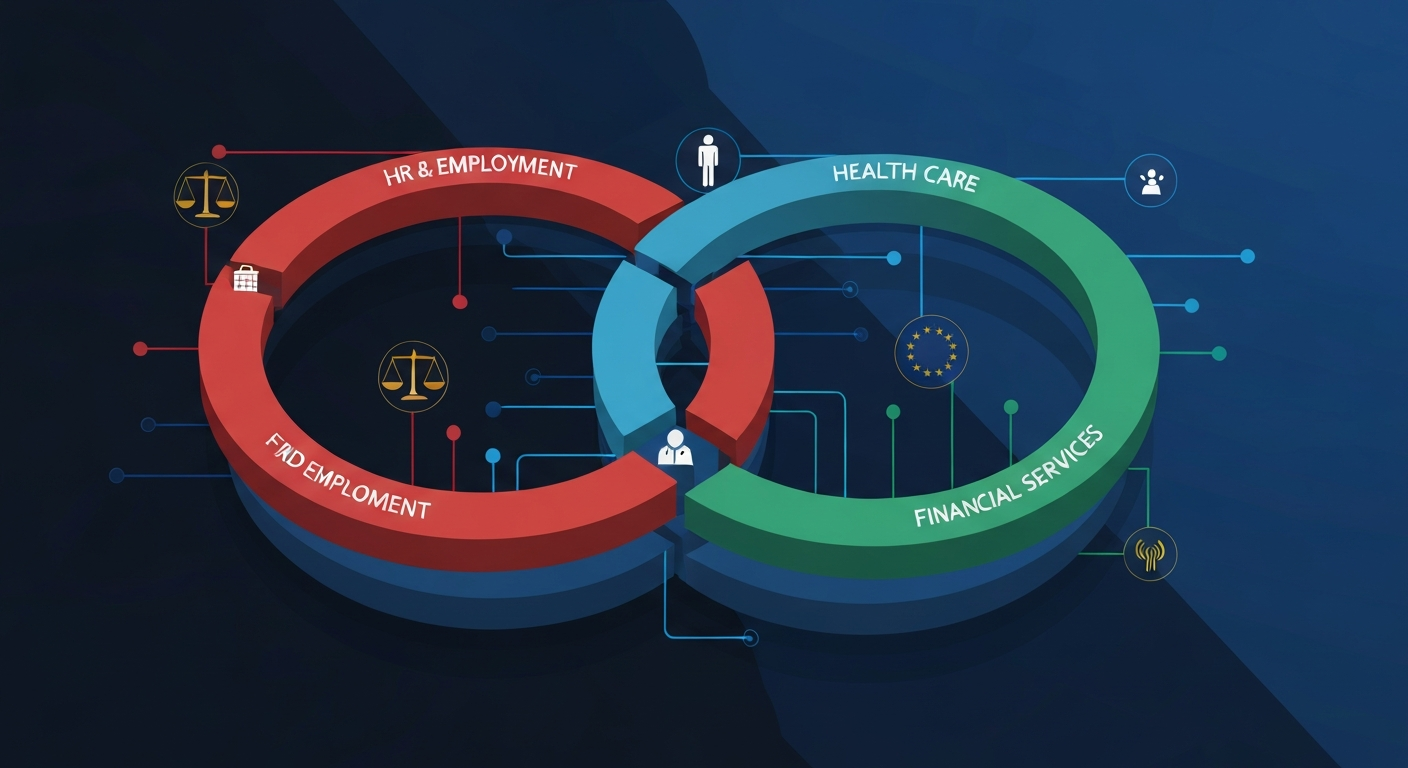
Not all Art.26 deployers face the same compliance weight. A developer integrating a document-reading AI into an internal workflow carries very different obligations from a bank using an AI credit-scoring model to decide loan applications, or an HR platform using AI to shortlist job candidates. The EU AI Act is explicit about this: the higher the impact on individuals' fundamental rights, the heavier the deployer's obligations.
This post focuses on the deployers who face the most demanding Art.26 regime: organizations deploying high-risk AI in employment, credit, access to essential services, and healthcare contexts. These are the Annex III categories where AI decisions directly affect someone's livelihood, financial access, and health — and where the intersection with GDPR Art.22 and the Art.27 Fundamental Rights Impact Assessment (FRIA) obligation creates the densest compliance layer.
Why Fundamental Rights Drive the Highest-Risk Deployer Obligations
The EU AI Act's Annex III defines the eight categories of high-risk AI systems. Not all are equal. The categories that attract the strictest deployer oversight — and where regulators will focus enforcement first — are those where AI output directly shapes decisions that affect individual fundamental rights protected under the EU Charter.
Three Annex III categories stand out for deployers:
Annex III, Category 4 — Employment, Workers Management, and Access to Self-Employment. This covers AI systems used to shortlist candidates, rank applicants, make or influence hiring decisions, manage worker performance, allocate work tasks, and determine promotion eligibility. An AI CV-screening system or an algorithmic work-allocation tool for platform workers sits squarely in this category.
Annex III, Category 5(b) — Creditworthiness Evaluation. AI systems that evaluate an individual's creditworthiness or produce a credit score fall here. This includes traditional credit-scoring models but also newer alternative data approaches — rent payment AI, social signals for microlending, income inference from transaction history.
Annex III, Category 5(a) — Access to Essential Public Services and Benefits. AI systems used by public authorities or private entities acting in a public-service capacity to evaluate eligibility for essential services — welfare benefits, housing assistance, health service prioritization — belong to this category. Healthcare AI that influences patient pathway decisions or resource allocation may sit here when deployed by public health bodies or insurers.
For deployers in all three categories, Art.26 obligations are not theoretical. They include documented human oversight, log retention, role-conversion awareness, and — critically — the Art.27 FRIA requirement for qualifying deployers.
Art.27: The Fundamental Rights Impact Assessment Obligation
Art.27 of the EU AI Act introduces the Fundamental Rights Impact Assessment (FRIA) — a mandatory pre-deployment evaluation for certain deployers of high-risk AI systems. The FRIA obligation does not apply to every deployer; it applies when the deployer falls into one of two categories:
- Bodies governed by public law — national, regional, or local government entities, public universities, public hospitals, social insurance bodies.
- Private operators deploying AI systems that interact with the general public — banks, insurers, private healthcare providers, recruitment platforms, and lending marketplaces where the AI system makes or influences decisions affecting members of the public at scale.
If your organization falls into either category and you deploy a high-risk AI system in Annex III categories 1–8, you must conduct a FRIA before putting the system into service.
What the FRIA Must Cover
The FRIA is not a box-ticking exercise. Art.27 requires a structured assessment of:
- Which fundamental rights could be affected by the AI system's operation — including the right to non-discrimination (Art.21 EU Charter), data protection (Art.8), dignity (Art.1), fair trial and due process (Art.47), and access to social security and employment (Art.34–35).
- The nature and severity of the risk — including how often the system's output influences final decisions, whether decisions are automated or involve human review, and the reversibility of adverse outcomes.
- Mitigation measures — how human oversight, contestation mechanisms, bias testing, and audit trails reduce fundamental rights impact.
- Whether a GDPR Data Protection Impact Assessment (DPIA) under Art.35 GDPR was conducted — if yes, the FRIA should be coordinated with the DPIA. If both are required, many deployers run them as a combined assessment.
The completed FRIA must be filed with the relevant national supervisory authority before deployment. For healthcare and social services deployers, the relevant authority may be different from the general AI market surveillance authority (NCA) — check your member state's implementing legislation.
The GDPR Art.22 Intersection: When Automated Decisions Require Human Review
For deployers in HR, credit, and healthcare, Art.26 of the EU AI Act does not operate in isolation. GDPR Art.22 creates a parallel obligation that significantly shapes how AI systems must be structured in practice.
GDPR Art.22 rule: Individuals have the right not to be subject to a decision based solely on automated processing that produces legal effects concerning them or similarly significant effects. Decisions about loan approval, job shortlisting, insurance pricing, and patient pathway allocation all qualify.
The practical consequence: if your AI system makes or heavily influences a decision with significant effects on an individual, you need a mechanism for human review on request — and you must inform the individual that such a mechanism exists.
What "Solely Automated" Means in Practice
This is where many deployers create accidental violations. A human who rubber-stamps every AI recommendation without genuinely exercising judgment does not satisfy GDPR Art.22. The European Data Protection Board has been explicit: the human review must be meaningful — the reviewer must have the authority, information, and time to actually override the AI.
For deployers this means:
- HR deployers: A recruiter who sees only the AI-generated shortlist — not the rejected applicants — cannot meaningfully review the AI's decision. The human must have access to the full candidate pool and the AI's reasoning before the shortlist is finalized.
- Credit deployers: A loan officer who sees only "approved" or "declined" without the model's input features cannot meaningfully override. Credit deployers must build explanation interfaces that surface which factors drove the decision.
- Healthcare deployers: A clinician who receives an AI triage score but cannot see the underlying patient data the model used cannot provide meaningful oversight. Healthcare AI deployers must ensure the AI's reasoning is legible to the human reviewer.
The Art.26 + GDPR Art.22 Combined Obligation
Deployers in these sectors are effectively operating under a two-layer obligation:
- Art.26 (EU AI Act): Use the system within its intended purpose, maintain human oversight, retain logs, conduct FRIA if qualifying.
- GDPR Art.22: Ensure no purely automated decision with significant individual effects without a human review mechanism; provide explanation on request.
The 2 August 2026 deadline for high-risk AI system compliance means deployers must have both layers operational before that date.
Sector-Specific Compliance Guide
HR and Recruitment Deployers (Annex III, Category 4)
HR AI systems are among the most scrutinized in the EU. The use of AI in hiring has attracted enforcement action from data protection authorities in several member states before the EU AI Act even applies — making this a high-visibility compliance area.
What counts as an HR high-risk AI system: CV screening tools that rank or shortlist candidates. Interview analysis AI (video, audio, or text). Personality assessment models. Performance prediction systems. Work-allocation algorithms for platform workers. Promotion recommendation models.
Key Art.26 obligations for HR deployers:
Intended purpose compliance. A CV screening model validated for software engineering applicants cannot be deployed for marketing roles without provider re-validation. The Annex III, Category 4 system's instructions for use will specify the job function scope. Deploying outside that scope triggers Art.26(2) role conversion — the deployer becomes a provider and must meet the full Art.16 provider obligations.
Human oversight of individual decisions. For each candidate shortlisting or rejection decision, a qualified human must review the AI recommendation. This is not optional. Annex III, Category 4 systems are explicitly high-risk because the outputs affect access to employment — a fundamental right under Art.15 and 35 of the EU Charter. The reviewer must have authority to override and must document when overrides occur.
Worker notification. Art.26 includes a specific obligation that deployers notify workers' representatives before deploying AI systems that monitor or manage employees. If you deploy performance management AI, task-allocation algorithms, or absence monitoring tools, you must engage works councils or equivalent representative bodies before deployment — not after.
Log retention. Logs of AI-driven HR decisions must be retained for audit purposes. The retention period must be sufficient to allow post-hoc review if a candidate or employee challenges the decision.
FRIA. Recruitment platforms and large employers operating at scale will generally qualify as private operators under Art.27. Conduct the FRIA before deployment and coordinate it with the GDPR Art.22 compliance review.
Practical checklist for HR deployers:
- Confirm the AI system's Annex III, Category 4 status with the provider
- Read the instructions for use and document the scope limitations
- Map all current use cases against the intended purpose — identify any scope gaps
- Design a human review workflow: who reviews, what they see, how overrides are recorded
- Brief relevant works council or worker representatives before deployment
- Confirm log retention configuration — minimum period, access controls
- Assess FRIA obligation — run assessment if public body or large-scale private operator
- Align with GDPR Art.22 — build candidate explanation and contestation mechanism
Credit Scoring and Fintech Deployers (Annex III, Category 5(b))
Credit-scoring AI was one of the categories where regulators pushed hardest for inclusion in the EU AI Act's high-risk list, and the resulting obligations reflect that political priority.
What counts as a Category 5(b) system: Any AI that produces a creditworthiness evaluation or credit score for individual loan applicants. This includes traditional bureau-score models, alternative data credit models (rent payment history, transaction behavior, utility payment inference), and buy-now-pay-later (BNPL) eligibility models.
Key Art.26 obligations for credit deployers:
Intended purpose and population scope. Credit models are validated on specific populations and data types. A model validated on applicants in France and Germany may produce systematically biased outcomes when deployed for applicants in Romania or Bulgaria, even within the EU. The instructions for use will specify the geographic and demographic scope. Deploying outside that scope is out-of-scope use under Art.26.
Explainability for GDPR Art.22. Credit decisions are among the clearest cases where GDPR Art.22 applies. Loan applicants have the right to a meaningful explanation of automated credit decisions and to request human review. "The model gave you a low score" is not a sufficient explanation. Credit deployers must build systems that surface the principal factors contributing to a score — and must train loan officers to explain those factors to applicants in plain language.
Non-discrimination monitoring. Annex III, Category 5(b) systems carry heightened discrimination risk. A credit model that encodes historical lending patterns — which often reflect structural discrimination — can systematically disadvantage protected groups even with facially neutral input features. Art.26 requires deployers to use systems in accordance with their instructions, which for reputable providers will include bias testing requirements and prohibited input feature lists. Deployers must monitor for disparate impact and report anomalies.
FRIA for qualifying credit deployers. Banks and insurers operating at scale toward the general public are qualifying private operators under Art.27. Most EU credit institutions regulated under CRD/CRR already conduct model risk assessments; the FRIA requirement adds a specific fundamental rights lens — including non-discrimination analysis — that may not be covered by standard model validation frameworks.
Practical checklist for credit deployers:
- Map every credit AI system to Annex III, Category 5(b) status
- Review provider instructions for use: population scope, prohibited input features
- Audit current use cases for geographic or demographic out-of-scope deployment
- Build applicant explanation interface: principal factors, plain language summaries
- Implement human review request mechanism (GDPR Art.22 compliance)
- Establish regular disparate impact monitoring — protected group analysis
- Coordinate FRIA with existing model risk and DPIA frameworks
- Document the FRIA and file with national supervisory authority before 2 August 2026
Healthcare and Social Services Deployers (Annex III, Category 5(a))
Healthcare AI sits at the intersection of the EU AI Act, GDPR as applied to health data (Art.9 GDPR — special category data), and for medical device software, the Medical Device Regulation (MDR) and In Vitro Diagnostic Regulation (IVDR). Deployers in this space face the most complex compliance stack.
What counts as a Category 5(a) system: AI used by public health authorities, hospitals, insurers, and social service agencies to prioritize access to care, evaluate eligibility for benefits or services, or allocate healthcare resources. This includes: patient triage AI, hospital bed allocation algorithms, social benefit eligibility scoring, and insurance risk assessment models used to determine policy terms.
Note: AI systems that constitute medical device software (SaMD) are additionally regulated under the MDR/IVDR route. EU AI Act compliance does not replace MDR/IVDR compliance — both apply for qualifying medical AI.
Key Art.26 obligations for healthcare and social services deployers:
FRIA is almost always mandatory. Public hospitals, national health services, social insurance authorities, and private insurers offering health or social services to the general public are either public bodies or qualifying private operators under Art.27. For these organizations, the FRIA is not optional — it must be completed before deployment and filed with the relevant authority.
Health data under GDPR Art.9. Health data is special category data. Any AI system processing health information must be authorized under GDPR Art.9(2) — most commonly Art.9(2)(h) (health management) or Art.9(2)(j) (public interest). The DPIA under GDPR Art.35 is mandatory for health data AI. The FRIA and DPIA should be run as a coordinated dual assessment.
Human oversight for patient pathway decisions. AI triage scores, bed allocation recommendations, and treatment pathway suggestions must not operate as final autonomous decisions. A clinician with the relevant medical authority must review AI recommendations before they affect patient care. The AI system's instructions for use will specify the required human oversight level — deployers who remove that oversight to improve throughput are triggering the Art.26(2) role conversion rule.
Algorithmic audit trails. For healthcare AI, log retention is not only an EU AI Act obligation but a patient safety and medico-legal requirement. Logs must capture which AI version produced which recommendation for which patient, at what time, with what input features — enabling post-hoc review if a patient challenges a care decision or an adverse event occurs.
Practical checklist for healthcare deployers:
- Identify all AI systems that qualify under Annex III, Category 5(a) or as medical device software (MDR/IVDR)
- Map applicable legal bases under GDPR Art.9 for health data processing
- Conduct DPIA under GDPR Art.35 — coordinate with FRIA
- Complete FRIA under Art.27 — mandatory for public bodies and qualifying private operators
- Design clinician oversight workflow: no AI recommendation reaches patients without reviewed approval
- Implement log retention: AI system version, input features, timestamp, reviewer identity, override events
- File completed FRIA with national supervisory authority before 2 August 2026
- Verify MDR/IVDR compliance separately if system qualifies as medical device software
The Role Conversion Risk for Sector Deployers
Art.26(2) — the role conversion rule — carries particular weight in HR, credit, and healthcare contexts because these are high-stakes domains where deployers are most tempted to adapt AI systems beyond their validated scope.
Common role-conversion triggers in these sectors:
HR: Using a CV screening model for a different job function than specified. Applying a performance AI trained on office workers to remote workers without revalidation. Expanding a hiring AI's scope to include employee retention decisions.
Credit: Applying a credit model validated for consumer loans to SME lending. Using an alternative-data scoring model in markets outside its validated geographic scope. Feeding input features not specified in the model's instructions (e.g., social media data when the model was validated on financial transaction data only).
Healthcare: Removing specified human oversight steps to speed up triage. Using a patient prioritization model developed for acute care to allocate elective care resources. Applying a benefits eligibility model across service categories not covered by its validated training data.
Each of these scenarios triggers Art.26(2): the deployer becomes a provider and must retrospectively meet the full Art.16 compliance burden — risk management system, technical documentation, conformity assessment, and CE marking. The 2 August 2026 deadline means deployers have no runway to complete that retroactively once high-risk AI obligations kick in.
Infrastructure Considerations for Compliant Deployment
Art.26 obligations — particularly log retention and FRIA filing — have infrastructure implications that are easy to underestimate.
Log storage jurisdiction. Logs generated by high-risk AI systems in HR, credit, and healthcare contexts contain personal data — applicant records, financial profiles, patient identifiers. Storing those logs on infrastructure subject to a foreign government's extraterritorial reach (e.g., the US CLOUD Act) creates a GDPR Art.48 transfer risk even if the storage provider claims EU data centers. For deployers under the EU AI Act's heaviest obligations, log storage on EU-sovereign infrastructure eliminates this jurisdictional exposure.
FRIA documentation security. The FRIA assessment will contain sensitive analysis of your AI system's fundamental rights risks — information you do not want accessible to competitors or foreign governments. Like all sensitive compliance documentation, FRIA records should be stored on infrastructure where data sovereignty is guaranteed.
Audit trail integrity. For Art.27 FRIA-qualifying deployers, the log trail must be available not just for internal review but for submission to national supervisory authorities. Log integrity — immutability, access controls, retention guarantees — must be built into the deployment architecture from day one, not retrofitted after the first audit request.
Timeline: What Sector Deployers Must Complete Before 2 August 2026
The 2 August 2026 deadline applies to most Annex III high-risk AI system obligations. For HR, credit, and healthcare deployers, the pre-deadline checklist is:
Immediate (now through June 2026):
- Inventory all high-risk AI systems by Annex III category
- Review provider instructions for use and document scope limitations
- Identify all current use cases — map against intended purpose
By 1 July 2026:
- Complete FRIA (if qualifying deployer) and initiate DPIA coordination
- Design and test human oversight workflows for each system
- Implement log retention architecture with correct data governance
By 2 August 2026 (deadline):
- File completed FRIA with national supervisory authority
- Activate all Art.26 monitoring and oversight mechanisms
- Ensure GDPR Art.22 explanation and contestation mechanisms are operational
- Document role conversion risk controls
The next post in this series covers Art.26 obligations for AI literacy requirements — what Art.26 requires deployers to ensure their teams understand before operating high-risk AI systems, and how to build a compliant training programme before the August deadline.
Summary
Art.26 deployer obligations are not uniform across all use cases. Deployers in employment, credit, and essential services face the most intensive compliance layer: the Art.27 FRIA obligation, GDPR Art.22 human review requirements, special category data governance under GDPR Art.9, and role conversion risk from adapting AI systems beyond their validated scope.
The 2 August 2026 deadline is not the end of the compliance journey — it is when enforcement begins. Deployers who have not completed FRIA assessments, built human oversight workflows, and aligned log retention infrastructure by that date face enforcement exposure from national AI competent authorities with the power to suspend AI system use pending compliance.
The infrastructure dimension is underappreciated: log storage jurisdiction, FRIA documentation security, and audit trail integrity require EU-sovereign hosting that removes extraterritorial reach risks. That decision point is structural — it shapes every other Art.26 compliance measure that sits on top of it.
Part of the ART25-26-DEPLOYER-PACK-2026 series. Next: Art.26 AI Literacy — what deployers must ensure their teams understand before operating high-risk AI. Previous: Art.26 Use-Case Restrictions and the Intended Purpose Doctrine.
EU-Native Hosting
Ready to move to EU-sovereign infrastructure?
sota.io is a German-hosted PaaS — no CLOUD Act exposure, no US jurisdiction, full GDPR compliance by design. Deploy your first app in minutes.