EU AI Act Art.14 Human Oversight: UX and API Design Patterns (2026)
Post #2 in the EU AI Act Art.14 Human Oversight 2026 Series
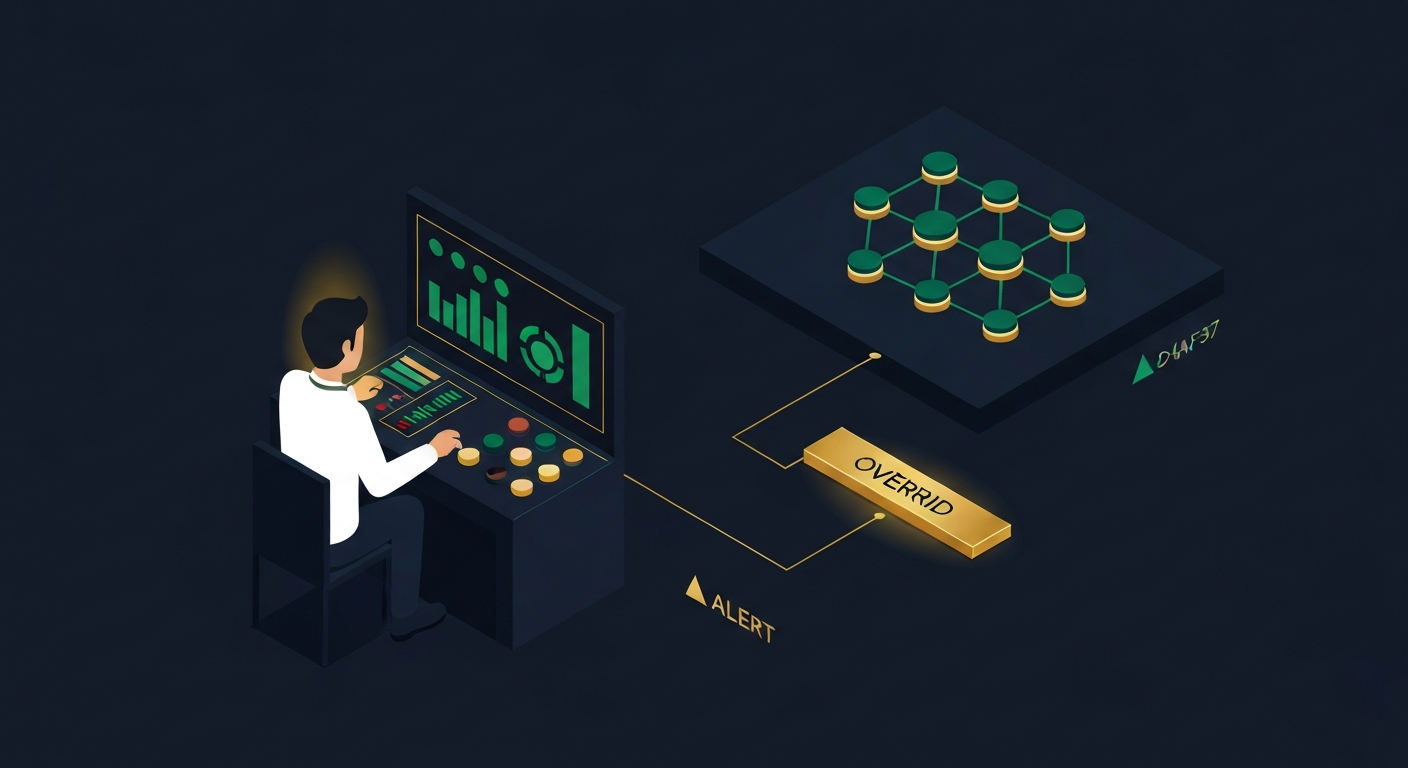
The previous post established the four technical obligations of Art.14(3) — comprehension of capabilities, detection of malfunctions, override/interrupt capability, and automation bias mitigation. Understanding those obligations matters less than implementing them in a way that survives regulatory audit. This post translates the legal obligations into concrete UX components, API contracts, and state machine design that product teams can actually ship.
The core engineering challenge with Art.14 is that "oversight" is not a single feature — it is a system capability that touches multiple layers of the stack. The frontend must surface confidence, uncertainty, and anomalies in real time. The API must provide override endpoints that are authenticated, audited, and idempotent. The backend must maintain an oversight state machine that tracks whether the required overseer has acknowledged, acted, or deferred on every high-stakes decision. Without explicit state management, oversight degrades to a log file the overseer never reads.
Oversight State Machine: The Foundation
Every high-risk AI decision that requires human oversight should pass through an explicit state machine. This is not an industry best-practice recommendation — it is implied by Art.14(3)(c)'s requirement that the system enable the overseer to disregard, override, or interrupt, and by Art.14(3)(b)'s requirement that the system enable detection of unexpected results. Detection is only meaningful if the system has a state that reflects whether detection has occurred and been acted upon.
A minimal compliant state machine has five states:
PENDING_OVERSIGHT — The AI system has produced an output that is flagged for human review. The output may not have been acted upon yet. The overseer has been notified. This state should have a configurable timeout. Art.14 does not specify maximum response time, but your Art.9 RMS must document the maximum acceptable delay between AI output and human review for each use case, and the state machine must enforce it.
OVERSIGHT_IN_PROGRESS — A designated overseer has acknowledged the pending item and is actively reviewing it. The system may present the review interface. If the review does not complete within the timeout defined in your RMS, the system transitions to ESCALATED.
OVERSEEN_APPROVED — The overseer has reviewed the AI output and approved it for use. This state should capture: the overseer identity, timestamp, confidence score they were shown, any notes entered, and whether any anomaly flags were present at review time. All of this becomes your Art.12 log entry.
OVERSEEN_OVERRIDDEN — The overseer has disregarded or replaced the AI output. The same audit fields apply plus the corrected value or decision. Art.14(3)(c) requires this capability; your audit trail must prove it was used in the expected proportion of cases. If override rates are statistically zero over a period, that may indicate automation bias — which itself requires evidence under Art.14(3)(d) that the overseer is genuinely exercising judgment.
ESCALATED — The oversight timeout has expired or the overseer flagged the item as requiring higher-level review. The system should not allow autonomous action in this state. The escalation path should be defined in your Art.9 RMS and documented in your Annex IV package.
This state machine should be persisted — not held in memory. Oversight state is part of your Art.12 logging requirement. The transition log (from state X to state Y at timestamp T by overseer Z) is audit evidence.
API Contract: Oversight Endpoints
Oversight functionality requires a small, well-defined set of API endpoints. These should be separate from the AI inference endpoints both for clarity and because they carry different authentication requirements.
POST /oversight/items/{decision_id}/acknowledge
Called when a designated overseer opens the review interface for a specific decision. Transitions state from PENDING_OVERSIGHT to OVERSIGHT_IN_PROGRESS. Should be idempotent — calling it twice does not create two in-progress reviews.
Request body: { "reviewer_id": "string", "session_token": "string" }
Response: { "item_id": "string", "state": "OVERSIGHT_IN_PROGRESS", "ai_output": {...}, "confidence": 0.87, "anomaly_flags": [], "review_deadline_utc": "2026-06-10T14:30:00Z" }
The ai_output field should include whatever is needed to make the Art.14(3)(a) comprehension requirement satisfiable — confidence scores, uncertainty estimates, key factors, known distribution shifts. This is not optional supplementary information. It is the tooling the regulation requires you to provide.
POST /oversight/items/{decision_id}/approve
Called when the overseer approves the AI output. Transitions state from OVERSIGHT_IN_PROGRESS to OVERSEEN_APPROVED.
Request body: { "reviewer_id": "string", "confidence_acknowledged": true, "notes": "string|null" }
The confidence_acknowledged: true field is important. It creates an explicit record that the overseer was shown the confidence score and acknowledged it before approving. Without this, a reviewer who always clicks approve without reading anything looks identical in the log to a reviewer who is genuinely engaging. The field forces explicit interaction with the uncertainty information.
POST /oversight/items/{decision_id}/override
Called when the overseer replaces the AI output. Transitions state from OVERSIGHT_IN_PROGRESS to OVERSEEN_OVERRIDDEN.
Request body: { "reviewer_id": "string", "override_value": {...}, "override_reason": "string", "confidence_acknowledged": true }
The override_reason field should be required, not optional. The reason is audit evidence and provides signal for model improvement. An overseer who can override without providing a reason will override without providing a reason, and your Art.12 logs will contain unexplained deviations from AI recommendations with no signal about whether those deviations were well-reasoned.
POST /oversight/items/{decision_id}/escalate
Called when the overseer flags the item as requiring senior review or when the system triggers automatic escalation on timeout.
Request body: { "escalated_by": "string", "escalation_reason": "timeout|reviewer_request|anomaly_flag", "notes": "string|null" }
GET /oversight/queue
Returns the list of items in PENDING_OVERSIGHT and OVERSIGHT_IN_PROGRESS states for the calling reviewer's scope. This is the primary driver of the oversight dashboard.
Response: { "pending": [...], "in_progress": [...], "escalated": [...], "total_count": 12, "oldest_pending_age_minutes": 23 }
The oldest_pending_age_minutes field is a compliance signal. If this number is large relative to your RMS-defined maximum review delay, the oversight system is falling behind. Surface this prominently in the oversight dashboard.
Frontend: Oversight Dashboard Design
The oversight dashboard is the primary implementation of Art.14(3)(a)'s tooling requirement. Its design determines whether the regulation is met in practice. A technically correct state machine behind a bad UI does not satisfy "effectively overseen by natural persons."
Information architecture
The dashboard must answer three questions simultaneously for each item:
What did the AI decide, and why? The output, the key factors that drove it, the confidence score, and — where the model supports it — the counterfactual (what would have changed the decision). Present this in the overseer's domain language, not in ML vocabulary. A credit analyst needs to know which financial ratios drove the credit decision, not the attention weights of the model. A medical device reviewer needs to know the differential that was considered and the model's uncertainty about each branch, not the sigmoid output of the final layer.
What is unusual about this item? Anomaly flags should be visually prominent — not buried in a sidebar. If the item triggered a distribution-shift alert, the overseer needs to see that before they see the recommendation. The goal is to direct attention toward the decisions where oversight is most needed, not to present all decisions identically.
What is the time pressure? The review deadline should be visible and countdown-styled when it is approaching. An oversight system where reviewers do not know how much time they have will experience timeout escalations not because of deliberate decisions, but because of time-management failures.
Confidence display conventions
Display confidence as a percentage with a visual indicator that distinguishes high, medium, and low confidence ranges. These ranges should match the thresholds defined in your Art.9 RMS. Do not display raw probabilities — a reviewer who sees "0.73" learns less than one who sees "Medium confidence (73%) — model accuracy in this category: 78% historical."
Add a "this score means" explanation inline. Art.14(3)(a) requires that the overseer be able to "fully understand the AI system's capabilities and limitations." A confidence score without a calibration reference does not provide that understanding. The explanation should be contextual — not a generic tooltip about what confidence means, but a specific statement about what this confidence score means for this type of decision.
When confidence is below a threshold defined in your RMS, the UI should prevent one-click approval. Require the overseer to take an additional confirmation step. This is a UI-enforced automation bias mitigation, which satisfies part of the Art.14(3)(d) requirement.
Anomaly flag presentation
Anomaly flags should use a distinct visual pattern — not just a colored dot in a corner. A yellow triangle with the word "ANOMALY" is not effective at drawing attention in a review queue of fifty items. Consider:
- Surfacing anomalous items at the top of the queue regardless of age
- Using a modal or in-panel alert that requires explicit dismissal before the normal review flow can proceed
- Logging the time between anomaly flag display and overseer interaction as a separate metric — if overseers dismiss anomaly alerts in under one second consistently, the alerts are not being read
Override flow UX
The override flow requires special attention. Art.14(3)(c) requires that override capability exist. Art.14(3)(d) requires that automation bias mitigation exist. These two requirements create a tension: if the override flow is too easy, it may be used reflexively without genuine deliberation; if it is too hard, overseers may approve AI outputs rather than override them just to avoid friction.
A balanced design:
- Make override a primary action — not a hidden option in a dropdown. It should be as easy to access as approve.
- Require a reason — a free-text field with suggested categories (factual error, missing context, policy exception, risk tolerance) makes documentation easy without being a blocker.
- Do not add confirmation steps to the override path that are not also present on the approval path. Asymmetric friction biases toward approval.
- Show the override count for the reviewing overseer in context. An overseer who has never overridden an AI decision in six months should see that data, because it is a signal they should consider when evaluating their own review behavior.
Alert Architecture for Art.14(3)(b)
Art.14(3)(b) requires that the system enable detection of malfunctions and unexpected situations. This is an alerting requirement. The oversight dashboard handles individual decisions; the alert architecture handles system-level anomalies.
Alert types
Drift alert — The distribution of AI outputs has shifted from the baseline established in your Art.9 RMS. Define this statistically: if the proportion of high-confidence outputs drops below X% over a rolling Y-hour window, trigger an alert. Route this to the oversight coordinator, not to individual reviewers.
Override rate alert — The rate at which overseers are overriding AI decisions has changed significantly. A sudden spike suggests the model has encountered a new situation it handles poorly. A sustained drop toward zero suggests automation bias. Both require investigation. Define the thresholds in your RMS.
Oversight queue depth alert — The number of items in PENDING_OVERSIGHT has exceeded a threshold relative to normal review capacity. This is not a model problem but an operational one — there are not enough reviewers to maintain the review SLA. Route to operations and compliance, not to reviewers who cannot process items faster.
Unexpected interaction alert — If your AI system's outputs feed downstream automated systems, instrument those integration points. An alert should fire when the AI output causes a downstream system to behave unexpectedly — a sudden increase in automated rejections, a pricing anomaly, an access-control decision that conflicts with policy. This is the "unexpected interactions with other systems" obligation from Art.14(3)(b).
Alert routing
Alerts should follow a tiered routing pattern. Individual review anomalies (single high-uncertainty item, single timeout escalation) route to the assigned reviewer and their supervisor. System-level alerts (drift, sustained override rate change) route to the ML operations team and the compliance function. Critical alerts (model malfunction suspected, queue entirely blocked) route to the engineering team and the designated responsible person under Art.22.
Document the routing in your Art.9 RMS. An alert system that exists but routes to an unmanned inbox does not satisfy the regulation.
Logging for Art.12 Compliance
Every oversight action should produce a structured log entry. The log schema should capture:
{
  "decision_id": "uuid",
  "ai_system_id": "string",
  "decision_timestamp_utc": "2026-06-10T12:00:00Z",
  "oversight_state": "OVERSEEN_APPROVED",
  "overseer_id": "string",
  "overseer_role": "string",
  "review_start_utc": "2026-06-10T12:02:00Z",
  "review_end_utc": "2026-06-10T12:04:30Z",
  "ai_output": { ... },
  "ai_confidence": 0.87,
  "anomaly_flags": [],
  "confidence_acknowledged": true,
  "action_taken": "approved",
  "override_value": null,
  "override_reason": null,
  "notes": null,
  "alert_flags_at_review": []
}
The review_start_utc and review_end_utc timestamps matter. Review duration is evidence that the overseer spent meaningful time on the decision. A median review time of three seconds across a thousand high-stakes decisions is itself an indicator of automation bias and may be flagged by a conformity assessment auditor reviewing your Art.12 logs.
Deployer vs. Provider Obligations
Art.14(4) assigns additional obligations to deployers — the entities that put high-risk AI systems into use. Deployers must designate natural persons with the authority to perform oversight, assign oversight to persons with the necessary competence, and ensure that those persons have the tools the provider built.
For provider teams this creates a documentation obligation: your API documentation and integration guides must explain the oversight interfaces in enough detail that deployers can configure them correctly. An oversight API that is not documented is functionally unavailable to the deployer. Document:
- Which endpoints implement oversight capability
- What permissions and roles are required to access the override endpoints
- What the review deadline defaults are and how they can be configured for different deployment contexts
- What the expected review SLAs are given the model's risk profile
- How to configure alert routing and escalation paths
This documentation should appear in your Annex IV technical documentation package. The next post in this series covers kill-switch and interrupt protocols. Post #4 covers monitoring oversight health when oversight may be failing.
Implementation Checklist
- Oversight state machine implemented and persisted (PENDING → IN_PROGRESS → APPROVED/OVERRIDDEN/ESCALATED)
- Five API endpoints implemented: acknowledge, approve, override, escalate, queue
-
confidence_acknowledged: truerequired on approve and override calls -
override_reasonrequired (not optional) on override calls - Oversight dashboard surfaces: AI output, confidence with calibration, anomaly flags, review deadline
- Override is a primary action in the UI — not buried in a dropdown
- Asymmetric friction removed: override requires no more steps than approve
- Four alert types implemented: drift, override rate, queue depth, unexpected interaction
- Alert routing documented and tested (routes reach live inboxes)
- Art.12 log schema captures decision_id, overseer_id, timestamps, confidence_acknowledged, action, override fields
- Deployer integration documentation covers oversight endpoints, permissions, and SLA configuration
Deployment and the CLOUD Act Gap
All of the above — state machine, API endpoints, logs, alert routing — generates data. That data is oversight audit evidence under Art.12. Where that evidence is stored matters under Art.74, which gives national competent authorities the right to inspect the technical infrastructure.
If your oversight logs are stored on a US-headquartered cloud provider, those logs are reachable under the US CLOUD Act regardless of which country the servers physically sit in. A US-based cloud provider served with a CLOUD Act order is required to produce data held anywhere in the world. This does not mean CLOUD Act orders are common, but it does mean that your Art.12 oversight evidence — which documents every human review of every AI decision — is potentially accessible to US law enforcement on request, without notification to the data subject or to you.
For high-risk AI systems processing health data, employment decisions, or creditworthiness assessments — the categories enumerated in Annex III — this creates a dual-jurisdiction risk worth documenting in your Data Protection Impact Assessment and your Art.9 RMS.
EU-native infrastructure (Hetzner Germany, no US parent entity, no CLOUD Act exposure) eliminates this risk. Whether to address it is an architectural decision that belongs in your technical documentation package before the August 2026 deadline. The oversight logs you generate under Art.14 are exactly the kind of sensitive operational evidence that the CLOUD Act gap matters for.
The next post covers kill-switch design and interrupt protocols — the Art.14(3)(c) stop-button requirement at the infrastructure level.
EU-Native Hosting
Ready to move to EU-sovereign infrastructure?
sota.io is a German-hosted PaaS — no CLOUD Act exposure, no US jurisdiction, full GDPR compliance by design. Deploy your first app in minutes.