EU AI Act Compliance for Multi-Agent Orchestration: Responsibility Chains, Art.14 Oversight & Data Flows in 2026
Post #2 in the sota.io EU AI Act Agentic AI Compliance Series
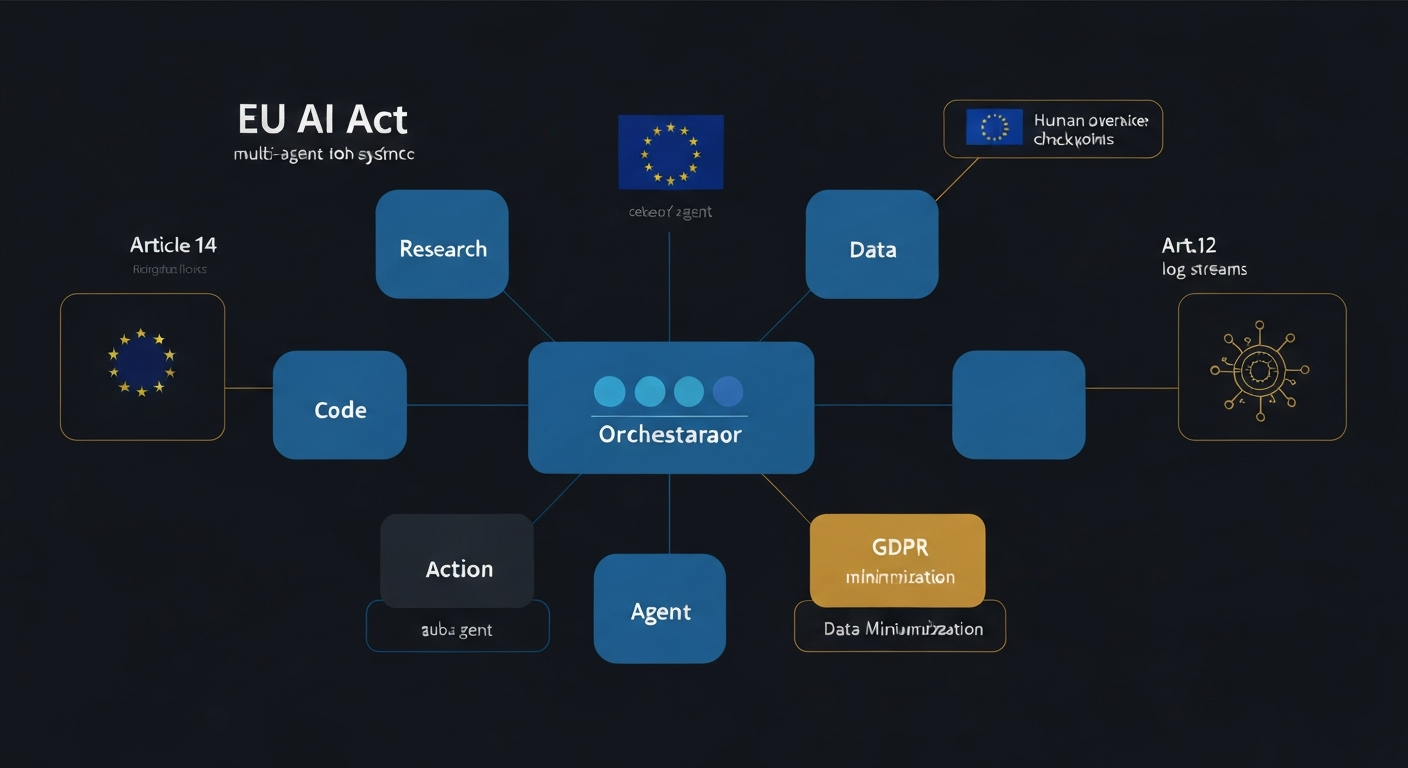
Multi-agent systems are the natural evolution beyond single-model inference. Instead of one AI model answering a question, an orchestrator model decomposes a task, delegates subtasks to specialized sub-agents, coordinates their outputs, and produces a final result. By mid-2026, this pattern — variously called agentic workflows, multi-agent orchestration, or agent pipelines — is the dominant architecture for production AI automation in legal, finance, software development, and research contexts.
The EU AI Act and GDPR do not have dedicated "multi-agent" provisions. What they have is a risk-based framework that applies to AI systems based on their output and impact, not their internal architecture. This means the same compliance obligations that apply to a single-model system also apply to a multi-agent pipeline — but the way those obligations distribute across the agent chain requires careful analysis.
This is Post #2 in our five-part series on EU compliance for agentic AI architectures. Post #1 covered MCP Server compliance and tool-calling governance. This post covers multi-agent orchestration: how the EU AI Act maps onto orchestrators and sub-agents, how responsibility chains work, and how to implement Art.14 human oversight in fully automated agent pipelines.
The Orchestrator-Sub-Agent Architecture
A typical multi-agent system has three layers:
The orchestrator: A planning model that receives a high-level goal, decomposes it into subtasks, routes those tasks to sub-agents, synthesizes their outputs, and returns a final result. The orchestrator may use a planner/executor pattern (sequential), a supervisor pattern (reactive), or a swarm pattern (parallel with consensus).
Specialist sub-agents: Models or tools that execute specific functions — web search, code execution, database queries, document analysis, API calls. Sub-agents typically have narrower context windows and more constrained action spaces than orchestrators.
The tool layer: External systems that sub-agents call to act on the world — file systems, databases, REST APIs, browser automation, code interpreters. This layer is where EU AI Act actions — decisions with real-world consequences — actually occur.
From an EU AI Act perspective, the relevant question is not how many models are involved but what the combined system does to natural persons.
Who Is the Provider? Responsibility in Multi-Agent Systems
Under EU AI Act Art.3(3), a provider is an entity that develops an AI system and places it on the market or puts it into service under its own name. Under Art.3(4), a deployer is an entity that uses an AI system under its authority for a professional purpose.
In a multi-agent system built from components, responsibility allocation follows these principles:
The system integrator is the provider of the combined system. If you build an orchestrator that coordinates a research sub-agent, a code sub-agent, and a data retrieval sub-agent — even if all three sub-agents use third-party LLMs — you are the provider of the integrated multi-agent system. The fact that you did not train the underlying models is not a defense. Art.25 makes this explicit: entities that substantially modify an AI system before placing it on the market assume the obligations of the original provider for those modifications.
Sub-agent vendors are providers of their components. If you purchase a specialized sub-agent from a vendor (e.g., a document classification agent, a financial analysis agent), that vendor is the provider of that component. They must provide the technical documentation required under Art.11 for their component, including instructions for integration.
The enterprise deploying the system is the deployer. Under Art.26, deployers must implement human oversight measures (Art.14), ensure the system is used within its intended purpose, and monitor performance. In a multi-agent deployment, this means the deployer — not the system integrator — bears primary responsibility for ensuring appropriate human oversight is operationally in place.
The compliance question for multi-agent system builders is therefore: have you clearly documented which party is the provider of which component, and have you allocated Art.26 deployer obligations to the correct party in your contracts?
Art.14: Human Oversight in Automated Agent Chains
Article 14 of the EU AI Act requires that high-risk AI systems be designed and developed in such a way that they can be effectively overseen by natural persons. This obligation applies to the combined system, not just individual components.
The human oversight challenge in multi-agent systems is that automation depth is qualitatively different from single-model inference. When an orchestrator delegates to five sub-agents that each call multiple tools, a single user request can trigger dozens of actions before any human sees a result.
The Art.14 framework requires:
Oversight capability (Art.14(1)): The system must allow natural persons to understand what it is doing and intervene. For a multi-agent pipeline, this means each agent action must be observable: not just the final output, but the intermediate decisions, the sub-agent calls, and the tool executions.
Stop/pause/override (Art.14(4)(b)): A human must be able to halt or override the system at any point. In a multi-agent pipeline, this requires interrupt mechanisms at the orchestrator level and at each sub-agent boundary. A "stop all agents" control is not enough if the agent chain has already taken irreversible actions (sent emails, committed database writes, called external APIs).
Override without breaking pipeline integrity (Art.14(4)(c)): The system must not create pressure for humans to approve decisions they do not understand. If your orchestrator presents intermediate results as a fait accompli — where reversal is technically possible but practically disruptive — this creates an Art.14 compliance risk even if an override button exists.
Calibrated trust (Art.14(4)(d)): Humans must be aware of the risk of automation bias. For multi-agent systems, this means your UX must not present agent outputs with false confidence. An orchestrator that returns "research complete, all findings verified" when it has only run automated sub-agents creates the automation bias that Art.14(4)(d) is designed to prevent.
Practical implementation pattern for Art.14 in multi-agent systems:
Define human decision gates at each point in the pipeline where an irreversible action is about to occur. Reversible actions (read a document, search the web) can proceed automatically. Irreversible or high-impact actions (send an email, write a database record, execute a financial transaction, publish content externally) require an explicit human approval step before execution.
This pattern — sometimes called "approval gates" or "human-in-the-loop checkpoints" — requires your orchestrator to classify tool actions into reversible/irreversible categories and pause before the irreversible ones for human confirmation.
Art.9 Risk Management for Orchestrators
Article 9 requires providers of high-risk AI systems to establish, implement, document, and maintain a risk management system for the lifecycle of the AI system. For multi-agent orchestrators, this has specific implications:
Cascading failure analysis. In a single-model system, the failure modes are relatively bounded. In a multi-agent system, a failure in one sub-agent can cascade: an incorrect intermediate result propagates to subsequent sub-agents that take actions based on that incorrect premise. Your Art.9 risk assessment must analyze these cascade paths — specifically, which sub-agent failures produce the highest-impact downstream errors.
Unknown action space. Sub-agents that call external APIs have action spaces that evolve as those APIs change. If your research sub-agent calls web search APIs, the set of results it can return changes with every search. Art.9 requires continuous risk monitoring, not a one-time assessment. For multi-agent systems, this means instrumenting sub-agent outputs for anomaly detection.
Adversarial prompt injection. A specific risk to document in your Art.9 register: prompt injection via tool outputs. If your research sub-agent returns web search results that contain adversarial instructions targeting the orchestrator model, those instructions can hijack the agent's behavior. This is not a theoretical risk — documented attacks against production agent systems have used this vector. Art.9 requires you to identify, assess, and mitigate foreseeable misuse. Prompt injection via external tool outputs is a foreseeable misuse you must address.
Mitigation for prompt injection: Treat tool outputs as untrusted data. Do not concatenate raw tool outputs directly into the orchestrator's system prompt. Pass tool outputs through a validation layer that strips instruction-format content (markdown commands, XML tags with action-format structures) before the orchestrator sees them.
Art.12: Audit Trails for Agent-to-Agent Communications
Article 12 requires providers of high-risk AI systems to ensure that the system automatically generates logs for the period of use. The requirements are:
- Recording of each use of the system
- Level of detail sufficient to identify the cause of a problem
- Coverage of events relevant to detecting risks
For multi-agent systems, Art.12 means you must log not just the final input/output pair but the full agent execution trace: orchestrator decisions, sub-agent calls with their inputs and outputs, tool calls, and any human intervention points.
What to log per agent action:
| Field | Type | Retention |
|---|---|---|
session_id | UUID, links all actions in one run | Duration of system use + minimum required retention period |
agent_id | Which model/agent performed the action | Same |
action_type | orchestrator_plan / subagent_call / tool_call / human_approval | Same |
input_tokens_hash | SHA-256 of input context (not full content if personal data present) | Same |
output_summary | Structured summary, not raw output (for personal data minimization) | Same |
tool_name + tool_args_hash | Tool called + hash of arguments | Same |
decision_timestamp | ISO 8601 UTC | Same |
human_intervention | Boolean + username if true | Same |
GDPR intersection: Art.12 audit logs will often contain personal data — names in documents processed, identifiers in database queries, user information in task inputs. This creates a GDPR Art.5(1)(e) storage limitation tension: your compliance obligation to retain audit logs for the AI Act may conflict with GDPR minimization principles. Resolution: store hashes and structured summaries rather than raw inputs when the raw input contains personal data. Maintain a separate, access-controlled system for the full log that is available only for incident investigation.
GDPR Data Flows Across Agent Boundaries
When an orchestrator sends data to a sub-agent — particularly if that sub-agent is an external API or a service operated by a different legal entity — GDPR data transfer obligations apply.
Sub-processors. If your sub-agents are operated by third parties and process personal data on your behalf, they are sub-processors under GDPR Art.28. You need written agreements with them covering: processing instructions, confidentiality, sub-processor restrictions, data subject rights assistance, and security measures. Many LLM API vendors have standard data processing agreements; verify that these agreements extend to your specific use case (batch processing, fine-tuning exclusions, log retention policies).
Purpose limitation for sub-agent calls (Art.5(1)(b)). If a user provides personal data to accomplish task A, and your orchestrator routes that data to a sub-agent for task B (because it is computationally efficient to batch the calls), you may be violating the purpose for which the data was collected. Sub-agent calls must stay within the purpose scope of the original task.
Data minimization for orchestrator context (Art.5(1)(c)). Orchestrators typically maintain a context window that accumulates across sub-agent calls. This context can grow to include personal data from early in the session that is no longer needed for subsequent sub-agent calls. Implement context pruning: before each sub-agent call, strip the context of personal data fields that are not required for that specific sub-agent's task.
Cross-border transfers. If your orchestrator is deployed in the EU but calls sub-agents operated by US entities, personal data in those calls is an international transfer under GDPR Chapter V. Standard Contractual Clauses (SCCs) or adequacy decisions apply. If the sub-agent provider operates on US CLOUD Act-covered infrastructure, your SCC assessment must account for the law enforcement disclosure risk — a risk that does not exist if your sub-agents are operated on EU-native infrastructure.
Practical Compliance Architecture for Multi-Agent Systems
Combining the above requirements, a compliant multi-agent system architecture includes:
1. Responsibility registry. A document mapping each component (orchestrator model, each sub-agent, each tool) to a provider entity, with contracts specifying Art.11 technical documentation handoff and Art.26 deployer obligations.
2. Action classification layer. Before tool execution, classify each action as reversible or irreversible. Route irreversible actions through a human approval gate before execution.
3. Sub-agent call interceptor. A middleware layer that, before each sub-agent call: (a) checks that the input data is within the GDPR purpose scope, (b) strips personal data not required for the sub-agent's task, (c) logs the call with structured metadata, and (d) validates the sub-agent's output before passing it to the orchestrator.
4. Prompt injection sanitizer. A validation function applied to tool outputs that removes instruction-format content before those outputs enter the orchestrator context.
5. Audit log aggregator. A centralized, tamper-evident log store that receives structured log events from all agents. Separate access controls for compliance audit vs. operational debugging. Retention period per your Art.12 obligations.
6. Human oversight console. A real-time view of orchestrator state, pending sub-agent calls, queued irreversible actions, and audit history. The console must support halt, override, and approve actions without requiring access to raw model internals.
Implementation on EU-Native Infrastructure
The architecture above produces audit logs and intermediate agent data that will contain personal data from your users' workflows. Where that data is stored and processed determines your GDPR exposure.
If your orchestrator, sub-agents, and audit log store run on US-origin cloud infrastructure, your Art.12 audit logs — which contain personal data — are on infrastructure subject to the CLOUD Act. This means a US government subpoena could compel the infrastructure provider to disclose those logs without your knowledge or consent, even if the data is encrypted at rest.
The compliance-by-architecture approach: deploy your orchestrator and audit infrastructure on EU-native providers (Hetzner, OVHcloud, Scaleway, or a managed EU PaaS like sota.io that runs on Hetzner). Your GDPR data flows then terminate within EU jurisdiction, your SCC assessment is simplified, and your CLOUD Act exposure is eliminated.
For the sub-agent layer, the practical question is whether you need external LLM APIs (which may be US-operated) for the quality they provide, or whether EU-based or self-hosted models are adequate for the sub-agent's specific task. Specialized sub-agents for classification, extraction, or structured output often work well with smaller, EU-deployable models. Reserve external LLM API calls for sub-agents where model quality is non-negotiable — and apply your data minimization and purpose-limitation controls to those calls.
Checklist: EU AI Act Multi-Agent Orchestration Compliance
Before deploying a multi-agent system in the EU, verify:
Provider and Deployer Clarity
- Responsibility registry maps each component to a legal entity
- Contracts with sub-agent API vendors include Art.11 technical documentation provisions
- Deployer has been briefed on Art.26 human oversight obligations and has signed off
Art.14 Human Oversight
- All tool actions classified as reversible or irreversible
- Human approval gates implemented for irreversible actions
- Halt/override controls accessible to authorized personnel at all times
- UX does not present agent outputs as final or authoritative without human review step
Art.9 Risk Management
- Cascade failure analysis documented for each sub-agent dependency
- Adversarial prompt injection documented in risk register with mitigations
- Continuous monitoring instrumented on sub-agent outputs
Art.12 Audit Logging
- Full execution trace logged: orchestrator decisions, sub-agent calls, tool calls
- Personal data in logs handled via hashing/summarization, not raw storage
- Tamper-evident log store with appropriate retention and access controls
GDPR
- Sub-processor agreements in place for all third-party sub-agent API vendors
- Purpose limitation enforced: sub-agent calls stay within original task scope
- Context pruning implemented to minimize personal data in orchestrator window
- Cross-border transfer assessment completed for external sub-agent APIs
- EU-native infrastructure used for audit log storage and orchestrator runtime
What's Next in This Series
Post #3 will cover Memory and RAG Compliance for Agentic AI: how vector stores used by agents to maintain long-term context intersect with GDPR Art.17 (right to erasure), Art.22 (automated decision-making), and Art.5 storage limitation — and how to build agent memory systems that are both performant and compliant.
Post #4 will cover Human-in-the-Loop Implementation Patterns: practical approaches to implementing Art.14 oversight that do not break the user experience, including asynchronous approval workflows, confidence-threshold-based escalation, and audit-complete patterns for regulated industries.
Post #5, the series finale, will cover Agentic AI Deployment on EU-Native Infrastructure: the full compliance stack from model inference to audit log storage, with a reference architecture for deploying compliant multi-agent systems on EU-native managed infrastructure.
Part of the sota.io EU AI Act Agentic AI Compliance Series. If you are deploying agentic AI in the EU before August 2, 2026, start with Post #1: MCP Server Compliance.
EU-Native Hosting
Ready to move to EU-sovereign infrastructure?
sota.io is a German-hosted PaaS — no CLOUD Act exposure, no US jurisdiction, full GDPR compliance by design. Deploy your first app in minutes.