ENISA Secure by Design Playbook 2026: The SaaS Developer's CRA Implementation Guide
Post #1 in the sota.io EU ENISA Secure by Design Series
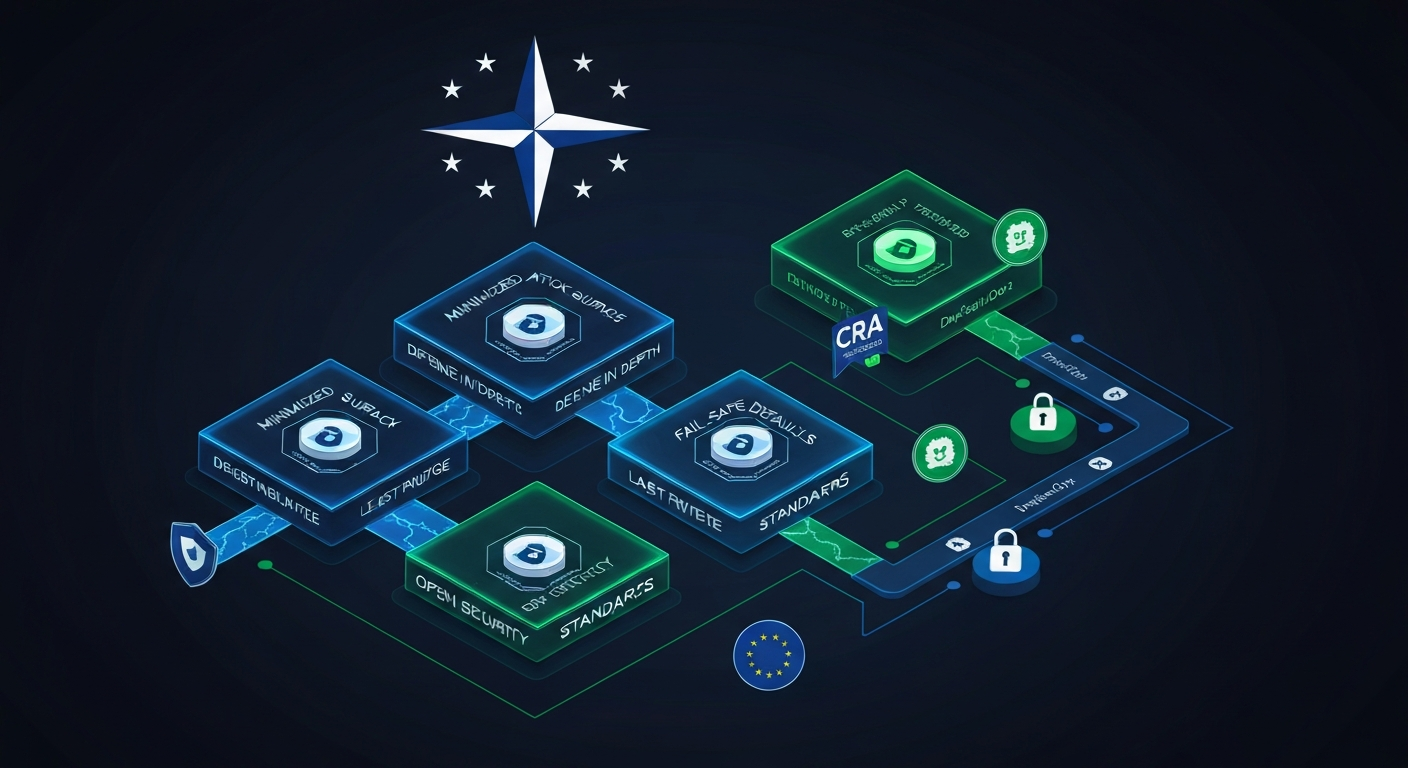
The EU Cyber Resilience Act (CRA) enters full application in September 2026. At its core is a deceptively simple mandate: products with digital elements must be shipped secure by design. That phrase appears 7 times in the CRA text — and the European Union Agency for Cybersecurity (ENISA) has spent the past two years turning it into something actionable.
This post walks through ENISA's Secure by Design (SbD) framework as it applies to SaaS developers building products for the EU market. We cover the underlying principles, map them to CRA Annex I essential requirements, and give you a concrete 22-checkpoint implementation guide you can start on today.
If you're deploying on US-owned infrastructure, there's a layer of complexity in the tooling section you'll want to read — because the same CLOUD Act exposure that makes US PaaS risky for data also extends to your DevSecOps pipeline.
Why Secure by Design Is Not Optional
The CRA's essential cybersecurity requirements (Annex I, Part I) are not best-practice recommendations. They are mandatory conformity requirements. Products placed on the EU market that fail them can be:
- Withdrawn from the market by national surveillance authorities
- Fined up to €15 million or 2.5% of worldwide annual turnover (Art.64)
- Subject to import bans if systemic non-compliance is found (Art.53)
The CRA's Article 12 on "security by design" requires manufacturers to:
- Design, develop, and produce products with no known exploitable vulnerabilities
- Implement security by default configurations
- Minimize attack surfaces
- Apply least-privilege principles to system design
- Ensure data minimization and encryption of stored/transmitted data
ENISA's role under the CRA is to develop technical guidance that translates these legal requirements into engineering practice. The SbD Playbook is that translation layer.
The ENISA Secure by Design Framework: Five Core Pillars
ENISA structures its SbD guidance around five interconnected security engineering principles. These predate the CRA but have been updated to align precisely with CRA Annex I requirements.
Pillar 1: Minimized Attack Surface
What it means: Every interface, feature, protocol, and credential that is not strictly necessary should not exist. Attack surface is proportional to exploitable opportunity.
CRA mapping: Art.12(3)(a) — "minimize the attack surface"
Practical implications for SaaS:
- Disable unused API endpoints (not just unauthenticated — unused)
- Remove debug interfaces, management consoles, and development flags from production builds
- Enforce IP allowlisting on admin interfaces
- Use feature flags to cleanly disable beta functionality in production tenants
- Audit open ports on every deployment — containerized services should expose exactly what they serve
A common failure pattern: a SaaS product ships with a /debug/info endpoint that returns environment variables, dependency versions, and internal service topology. That endpoint is never documented. It's also never secured. ENISA SbD requires a deliberate decision for every exposed interface.
Pillar 2: Defense in Depth
What it means: No single security control is assumed to be perfect. Controls are layered so that the failure of one does not result in a breach.
CRA mapping: Art.12(1) — products "shall be delivered without any known exploitable vulnerabilities" — which implicitly requires that the absence of a vulnerability patch doesn't create total exposure.
Practical implications for SaaS:
- Network segmentation between frontend, backend, and data tiers
- WAF + application-level input validation (not one or the other)
- Rate limiting at load balancer AND application layer
- Secrets management not relying solely on environment variable injection
- Backup authentication factor for admin actions even behind SSO
The threat model here is adversarial: if an attacker bypasses your WAF rules, what stops them at the application layer? If they steal a service account token, what prevents lateral movement?
Pillar 3: Least Privilege
What it means: Every component, user, service, and process should have exactly the permissions required to perform its function — no more.
CRA mapping: Art.12(3)(b) — "limit access rights on a need-to-know basis"
Practical implications for SaaS:
- Database service accounts with table-scoped permissions, not schema owner
- CI/CD pipelines with deploy-only credentials, not admin credentials
- Microservices calling only the APIs they need, not shared service tokens
- User roles that cannot escalate themselves (no "grant yourself any permission" patterns)
- Kubernetes RBAC with namespace isolation, not cluster-admin service accounts
The ENISA playbook specifically calls out IAM misconfigurations as the leading cause of cloud breaches covered by CRA-relevant incidents. Most SaaS developers think about least privilege for user roles. ENISA extends this explicitly to machine identities, service accounts, CI/CD systems, and infrastructure automation.
Pillar 4: Fail-Safe Defaults
What it means: When in doubt, systems should fail toward security, not functionality. Default configurations should be the most secure configuration.
CRA mapping: Art.12(2) — "ensure that security is provided by default"
Practical implications for SaaS:
- Default to DENY for authorization checks (allowlist, not blocklist)
- Default to HTTPS-only with no HTTP fallback
- Default to email verification before account activation
- Default to minimal data collection (no telemetry opt-in by default)
- Default to session timeout after inactivity, with user-configurable extension
The fail-safe principle also applies to error handling: when a security check fails (rate limiter throws, auth service times out), the default response must be deny, not allow. This is a common SaaS bug — "if auth service is unreachable, pass the request through."
Pillar 5: Open Security Standards
What it means: Security should rely on published, peer-reviewed cryptographic primitives and protocols — not proprietary implementations.
CRA mapping: Art.12(3)(c) — "use the most secure communications protocols that are state of the art"
Practical implications for SaaS:
- TLS 1.3 (minimum TLS 1.2 with hardened cipher suites)
- JWT with RS256/ES256, not HMAC-SHA256 with a weak shared secret
- PKCE for OAuth 2.0 authorization code flows
- Argon2id for password hashing (bcrypt as fallback minimum)
- AES-256-GCM for symmetric encryption at rest
- No custom crypto, no deprecated algorithms (MD5, SHA-1, DES, RC4)
CRA Annex I Mapping: From Legal Text to Engineering Checklist
The following table maps CRA Annex I, Part I essential requirements to ENISA SbD pillars and concrete engineering controls.
| CRA Requirement | ENISA SbD Pillar | Engineering Control |
|---|---|---|
| Art.12(1): No known exploitable vulnerabilities | All pillars | Automated SAST/DAST in CI; SCA for dependencies; patch cadence SLA |
| Art.12(2)(a): Secure by default | Fail-Safe Defaults | Security-first defaults in all config; opt-in for less-secure modes |
| Art.12(2)(b): No unnecessary attack surface | Minimized Attack Surface | Interface inventory; disabled-by-default features; port hardening |
| Art.12(3)(a): Minimize attack surface | Minimized Attack Surface | Automated surface scan; API inventory; unused-service removal |
| Art.12(3)(b): Access control | Least Privilege | RBAC for all resources; MFA for admin access; service account scoping |
| Art.12(3)(c): Strong cryptography | Open Security Standards | TLS 1.3; modern hash algos; key rotation; no deprecated primitives |
| Art.12(3)(d): Data protection | Defense in Depth | Encryption at rest + transit; data minimization; pseudonymization |
| Art.12(3)(e): Supply chain | Defense in Depth | SBOM generation; dependency pinning; vendor security attestation |
| Art.12(4): Security updates | Fail-Safe Defaults | Auto-update mechanism; 24h critical patch SLA; CVE monitoring |
| Art.12(5): Monitoring & logging | Defense in Depth | Security event logging; tamper-resistant log storage; anomaly alerts |
| Art.13(1): Vulnerability disclosure | Open Security Standards | CVD policy; security.txt; responsible disclosure workflow |
| Art.14(1): Active exploitation reporting | Defense in Depth | 24h ENISA/NCA notification; SBOM tracking; patch deployment proof |
The 22-Checkpoint ENISA SbD Implementation Guide
ENISA organizes its SbD implementation guidance into four phases. The following 22 checkpoints are drawn from ENISA's technical guidance documents and mapped to CRA compliance timelines.
Phase 1: Architecture & Design (Checkpoints 1-7)
Checkpoint 1 — Threat Model Exists
- Every product component has a documented threat model (STRIDE or equivalent)
- Threat model reviewed annually or when architecture changes significantly
- CRA link: Art.12(1) no known exploitable vulnerabilities implies known threats
Checkpoint 2 — Attack Surface Inventory
- All exposed interfaces documented (HTTP endpoints, WebSockets, gRPC, admin panels, SSH)
- Each interface has a documented justification for why it must be exposed
- Interfaces without justification disabled before production deployment
Checkpoint 3 — Trust Boundaries Documented
- Data flow diagram shows every trust boundary crossing
- Authentication mechanism documented for each boundary
- No assumed trust between internal services (zero trust architecture for new services)
Checkpoint 4 — Cryptographic Standards Defined
- Company-wide cryptographic standards document published
- Specifies approved algorithms for hashing, encryption, key exchange, signatures
- Review cycle defined (minimum annually, triggered by CVE disclosure for used primitives)
Checkpoint 5 — Authentication Architecture Reviewed
- Password policy enforces minimum entropy (minimum 8 chars, ideally 12+)
- MFA available for all accounts, mandatory for admin/privileged users
- Session management review: token lifetime, rotation, invalidation on logout
Checkpoint 6 — Authorization Model Defined
- RBAC or ABAC model documented with all roles and permissions listed
- Default role for new users defined and confirmed to be minimal
- Privilege escalation paths reviewed and blocked where not needed
Checkpoint 7 — Secrets Architecture Defined
- No secrets in source code, container images, or environment variable injection
- Secrets manager (Vault, AWS Secrets Manager, or equivalent) integrated
- Secret rotation schedule defined and automated where possible
Phase 2: Development & Pipeline (Checkpoints 8-14)
Checkpoint 8 — SAST Integrated in CI
- Static Application Security Testing runs on every pull request
- High/critical findings block merge (not just warn)
- SAST ruleset reviewed against OWASP Top 10 and CRA-relevant vulnerability classes
Checkpoint 9 — SCA/SBOM in Pipeline
- Software Composition Analysis runs on every build
- SBOM (Software Bill of Materials) generated in SPDX or CycloneDX format
- SBOM stored and versioned alongside each release artifact
- CRA link: Art.13(6) requires SBOM for products above class I
Checkpoint 10 — Secret Scanning
- Pre-commit hooks block secrets from entering source control
- Secret scanning runs in CI as independent gate
- Historical repository scan completed (no legacy secrets in git history)
Checkpoint 11 — Dependency Pinning
- All dependencies pinned to exact versions (not ranges)
- Automated PR creation for dependency updates (Dependabot or equivalent)
- Transitive dependencies audited for known vulnerabilities
Checkpoint 12 — Container Image Hardening
- Base images pinned to digest (not tag)
- Images built from minimal bases (distroless or Alpine where possible)
- No packages installed that are not required for application runtime
- Images scanned for CVEs before push to registry
Checkpoint 13 — Security-Focused Code Review
- Security checklist in PR template (input validation, auth, error handling, logging)
- Security-critical components have second-reviewer requirement
- Security review cadence defined for components handling PII, payments, admin functions
Checkpoint 14 — Dependency License Compliance
- All dependency licenses reviewed for EUPL/GPL compatibility
- No GPL-contaminated dependencies in proprietary core
- License inventory updated with each new dependency addition
Phase 3: Deployment & Infrastructure (Checkpoints 15-18)
Checkpoint 15 — Infrastructure Hardening
- CIS Benchmarks applied to OS, container runtime, and cloud provider configurations
- Network security groups/firewall rules follow least-privilege (deny all, allow specific)
- Unused ports, services, and cloud features disabled at account/project level
Checkpoint 16 — Runtime Protection
- Web Application Firewall deployed in front of application endpoints
- Rate limiting enforced at both infrastructure and application layer
- DDoS protection enabled (cloud-native or dedicated service)
- Intrusion detection alerts configured for anomalous traffic patterns
Checkpoint 17 — Secrets Injection (Not Environment Variables)
- Secrets fetched from secrets manager at runtime, not injected as env vars
- Container orchestrator (Kubernetes) configured with external secrets operator
- Secret access logged and auditable
- CRA link: Art.12(3)(d) data protection requires appropriate access controls for credentials
Checkpoint 18 — Immutable Infrastructure
- Production infrastructure managed via Infrastructure as Code
- Manual changes to production prohibited by policy and enforced by IAM
- Change tracking via git for all IaC; approved changes via PR process
- Rollback procedure tested quarterly
Phase 4: Operations & Monitoring (Checkpoints 19-22)
Checkpoint 19 — Security Event Logging
- Authentication events (success, failure, lockout, MFA bypass) logged
- Authorization failures logged with user, resource, and timestamp
- Admin actions logged (configuration changes, user management, data exports)
- Logs tamper-resistant (forwarded to immutable log storage within seconds)
Checkpoint 20 — Vulnerability Management Process
- CVE feed monitored for all production dependencies (automated alerting)
- Patch SLA defined by severity: Critical 24h, High 72h, Medium 30 days
- CRA link: Art.14(1) requires 24-hour ENISA notification for actively exploited vulnerabilities
Checkpoint 21 — Incident Response Plan
- Written IRP covering: detection, triage, containment, eradication, recovery, post-mortem
- Roles and escalation path defined
- Communication templates for customer notification and regulatory reporting (GDPR Art.33, CRA Art.14)
- IRP tested via tabletop exercise at least annually
Checkpoint 22 — Coordinated Vulnerability Disclosure Policy
security.txtfile published at/.well-known/security.txt- CVD policy linked from security.txt with PGP key for encrypted submissions
- Response SLA defined: acknowledgment within 72 hours, status update within 7 days
- CRA link: Art.13(6) requires manufacturers to provide coordinated vulnerability disclosure policy
SaaS-Specific Implementation Priorities
The 22-checkpoint framework applies to all digital products, but SaaS architectures have specific risk patterns that ENISA's guidance addresses with particular emphasis.
Multi-Tenancy Isolation
SaaS products serve multiple tenants from a shared infrastructure. ENISA SbD treats tenant isolation as a first-class security requirement, not a feature:
- Data isolation: Database row-level security (RLS) or schema-per-tenant enforced at the ORM/data layer, not just the API layer. A broken API authorization check must not expose another tenant's data.
- Compute isolation: Shared compute (multi-tenant Kubernetes) must enforce network policies that prevent pod-to-pod traffic between tenant namespaces.
- Configuration isolation: Tenant-specific configuration (API keys, webhooks, integrations) must be stored with tenant-scoped encryption keys where possible.
The most common multi-tenancy security failure is horizontal privilege escalation: GET /api/data?tenant_id=attacker_tenant_id returning another tenant's data because the API only checks if the user is authenticated, not if they belong to the specified tenant.
API Security at Scale
SaaS products expose large API surfaces. The ENISA SbD framework prioritizes:
# ENISA SbD principle: Fail-safe defaults in API authorization
# Wrong: implicit allow
def get_resource(resource_id: str, user: User) -> Resource:
    resource = db.get(resource_id)
    return resource  # No authorization check!

# Wrong: authorization bypass on error
def get_resource(resource_id: str, user: User) -> Resource:
    try:
        authorize(user, resource_id)
    except AuthServiceTimeout:
        pass  # Fail open on service unavailability
    return db.get(resource_id)

# Right: explicit deny, fail-safe on error
def get_resource(resource_id: str, user: User) -> Resource:
    if not authorize(user, resource_id):  # Explicit check
        raise PermissionDenied()
    return db.get(resource_id)

# authorize() must raise/return False on any failure
def authorize(user: User, resource_id: str) -> bool:
    try:
        result = auth_service.check(user.id, resource_id)
        return result.allowed
    except AuthServiceError:
        return False  # Fail closed on any error
Dependency Risk in SaaS Pipelines
SaaS products typically have 200-800 direct and transitive dependencies. ENISA's SbD framework treats the supply chain as a security boundary:
| Risk Category | ENISA Recommendation | CRA Article |
|---|---|---|
| Malicious packages | Registry integrity checks; pinned checksums | Art.12(3)(e) |
| Vulnerable packages | SCA in CI; 24h critical patch SLA | Art.14(1) |
| Abandoned packages | Maintainer health score; forking policy | Art.12(1) |
| License violations | License scanning in CI; legal review process | Art.13(3) |
| Typosquatting | Namespace monitoring; private registry mirroring | Art.12(3)(e) |
The SBOM requirement (Art.13(6) for Class I products, voluntary for others) creates a useful forcing function: if you cannot enumerate your dependencies, you cannot assess their vulnerabilities. ENISA recommends producing SBOM as a CI artifact regardless of product class.
The EU-Sovereign Tooling Problem
Here is a practical problem that ENISA's SbD guidance doesn't resolve but that SaaS developers on US platforms face immediately:
Many of the tools used to implement SbD are themselves US-headquartered and subject to CLOUD Act.
Consider the typical DevSecOps stack:
| Tool | Vendor HQ | CLOUD Act Risk |
|---|---|---|
| Snyk | US (New York) | Yes — source code and dependency data |
| Veracode | US (Burlington, MA) | Yes — source code and scan results |
| Checkmarx | US (New Jersey) | Yes — source code and SAST results |
| GitHub Advanced Security | US (San Francisco) | Yes — source code and vulnerability findings |
| Datadog Security | US (New York) | Yes — runtime security events and logs |
| PagerDuty | US (San Francisco) | Yes — incident and alert data |
| SentinelOne | US (Mountain View) | Yes — endpoint/runtime protection data |
ENISA's guidance acknowledges this tension in its discussions of supply chain security: the tools that protect your software supply chain are themselves part of your supply chain.
For EU-sovereign implementations:
# EU-Sovereign DevSecOps Stack (ENISA SbD Aligned)

SAST:
  - Semgrep (self-hosted, AGPL) — EU deployment, no external data transmission
  - CodeQL (GitHub Actions, EU datacenter region if using GitHub.com/EU)
  - SonarQube Community Edition (self-hosted, LGPL)

SCA/SBOM:
  - Syft (Anchore, OSS, self-hosted) — SBOM generation
  - Grype (Anchore, OSS, self-hosted) — vulnerability matching
  - Trivy (Aqua Security, OSS, self-hosted) — container + code scanning

Secrets Scanning:
  - detect-secrets (Yelp, OSS, pre-commit hook)
  - gitleaks (OSS, self-hosted CI action)

Secrets Management:
  - HashiCorp Vault (Budibase/Exoscale/OVHcloud managed offering)
  - Infisical (EU-deployable OSS, Infisical Cloud EU region)

Runtime Protection:
  - Falco (CNCF, self-hosted) — Kubernetes runtime security
  - Wazuh (Wazuh Inc., Spain-HQ, EU-deployable) — SIEM + intrusion detection

Vulnerability Management:
  - OpenVAS (Greenbone AG, Germany) — network scanning
  - DefectDojo (OSS, self-hosted) — vulnerability tracking

Container Registry:
  - Harbor (CNCF, self-hosted on EU infrastructure)
  - Gitea Container Registry (Germany-hosted Gitea instance)
The key principle: the security tools themselves should not transmit your source code, runtime data, or vulnerability findings to US jurisdictions. Under CLOUD Act, a US government subpoena to a US-headquartered security vendor can require disclosure of your security scan results, vulnerability findings, and potentially source code — without prior notification and without EU legal recourse.
This is not a theoretical risk. Several EU companies have discovered their "security tooling vendor" was the weak link in GDPR compliance audits.
CRA Timeline: What SbD Means for Your September 2026 Deadline
The CRA applies in stages:
| Date | CRA Requirement | What You Must Have |
|---|---|---|
| August 2025 (Live) | Art.14 — Active exploitation reporting | Process to notify ENISA/NCA within 24h of discovered exploitation |
| September 2026 | Full CRA application | All Annex I, Part I essential requirements (the 22 checkpoints above) |
| September 2026 | Annex I, Part II: vulnerability handling | CVD policy, SBOM, update mechanism, user notifications |
Critical path for September 2026:
If you're starting now (May 2026), you have 16 weeks to full CRA application. The ENISA SbD framework suggests a phased approach:
Weeks 1-4 (May-June 2026): Architecture hardening
- Complete checkpoints 1-7 (architecture and design)
- Threat model documentation
- Attack surface inventory
- Cryptographic standards definition
Weeks 5-8 (June-July 2026): Pipeline security
- Complete checkpoints 8-14 (development and pipeline)
- SAST, SCA, SBOM integration
- Container image hardening
- Secret scanning and secrets manager migration
Weeks 9-12 (July-August 2026): Infrastructure and deployment
- Complete checkpoints 15-18 (deployment and infrastructure)
- CIS Benchmark hardening
- Runtime protection deployment
- IaC migration for manual infrastructure
Weeks 13-16 (August-September 2026): Operations
- Complete checkpoints 19-22 (operations and monitoring)
- Security logging pipeline
- Vulnerability management process
- IRP documentation and test
- CVD policy and security.txt
Quick-Start: The SbD Minimum Viable Compliance Checklist
If you have limited time before September 2026, prioritize these 10 controls — they represent the highest-impact CRA compliance actions with the fastest implementation path:
- SBOM generation in CI —
syft . -o spdx-json > sbom.jsonin every release pipeline (Art.13(6) requirement for Class I) - CVD policy + security.txt — Publish
/.well-known/security.txtwith contact, PGP key, and response SLA (Art.13(6)) - SCA in CI —
grype sbom:./sbom.jsonin CI, block on Critical/High (Art.14(1) exploitation reporting requires knowing what's in your product) - 24h exploitation reporting process — Document who receives CVE alerts, who notifies ENISA/NCA, what the escalation path is (Art.14(1))
- No secrets in source code — Secret scanning pre-commit hook + CI gate (Art.12(3)(d))
- MFA for all admin access — Enforce MFA for all users with admin, billing, or infrastructure access (Art.12(3)(b))
- Authorization audit — Verify every API endpoint has explicit authorization check; test with a second tenant (Art.12(2))
- TLS 1.3 enforcement — Disable TLS 1.0/1.1, verify TLS 1.2 cipher hardening (Art.12(3)(c))
- Dependency update automation — Dependabot or Renovate with merge policy for patches (Art.12(1))
- Security logging baseline — Auth events, authorization failures, and admin actions logged to tamper-resistant storage (Art.12(5))
What's Next: The ENISA Secure by Design Series
This post is the foundation layer — the "why" and "what" of ENISA's SbD framework. The remaining four posts in this series go deeper into specific implementation challenges:
| Post | Topic | Focus |
|---|---|---|
| #1349 (this post) | ENISA SbD Playbook Overview | CRA mapping, 22 checkpoints, EU tooling |
| #1350 | Secure by Default: CRA Art.12(2) Hardening | Default configurations, attack surface reduction |
| #1351 | Vulnerability Management & SBOM | CRA Art.14, dependency governance, SBOM workflows |
| #1352 | Security Update Mechanisms | CRA Art.14(4), auto-updates, patch deployment |
| #1353 | ENISA SbD Compliance Stack Finale | Complete developer toolkit, EU-sovereign options |
The sota.io Connection
All five posts in this series assume you're deploying on infrastructure where the security controls you implement actually remain under EU jurisdiction — where your CLOUD Act exposure doesn't undermine the CRA compliance posture you're building.
sota.io runs on Hetzner Germany. No US parent company. No CLOUD Act exposure. Your deployment pipeline, secrets, runtime data, and security logs stay in EU jurisdiction throughout.
The September 2026 CRA deadline doesn't move. Neither does the principle: security starts at the infrastructure layer.
EU-ENISA-SECURE-BY-DESIGN-2026 Series: #1349 ENISA SbD Overview | #1350 Secure by Default | #1351 SBOM & Vulnerability Management | #1352 Security Update Mechanisms | #1353 Compliance Stack Finale
EU-Native Hosting
Ready to move to EU-sovereign infrastructure?
sota.io is a German-hosted PaaS — no CLOUD Act exposure, no US jurisdiction, full GDPR compliance by design. Deploy your first app in minutes.