CrowdStrike EU Alternative 2026: CLOUD Act & GDPR Risk in Endpoint Security
Post #1 in the sota.io EU Security Tools Series
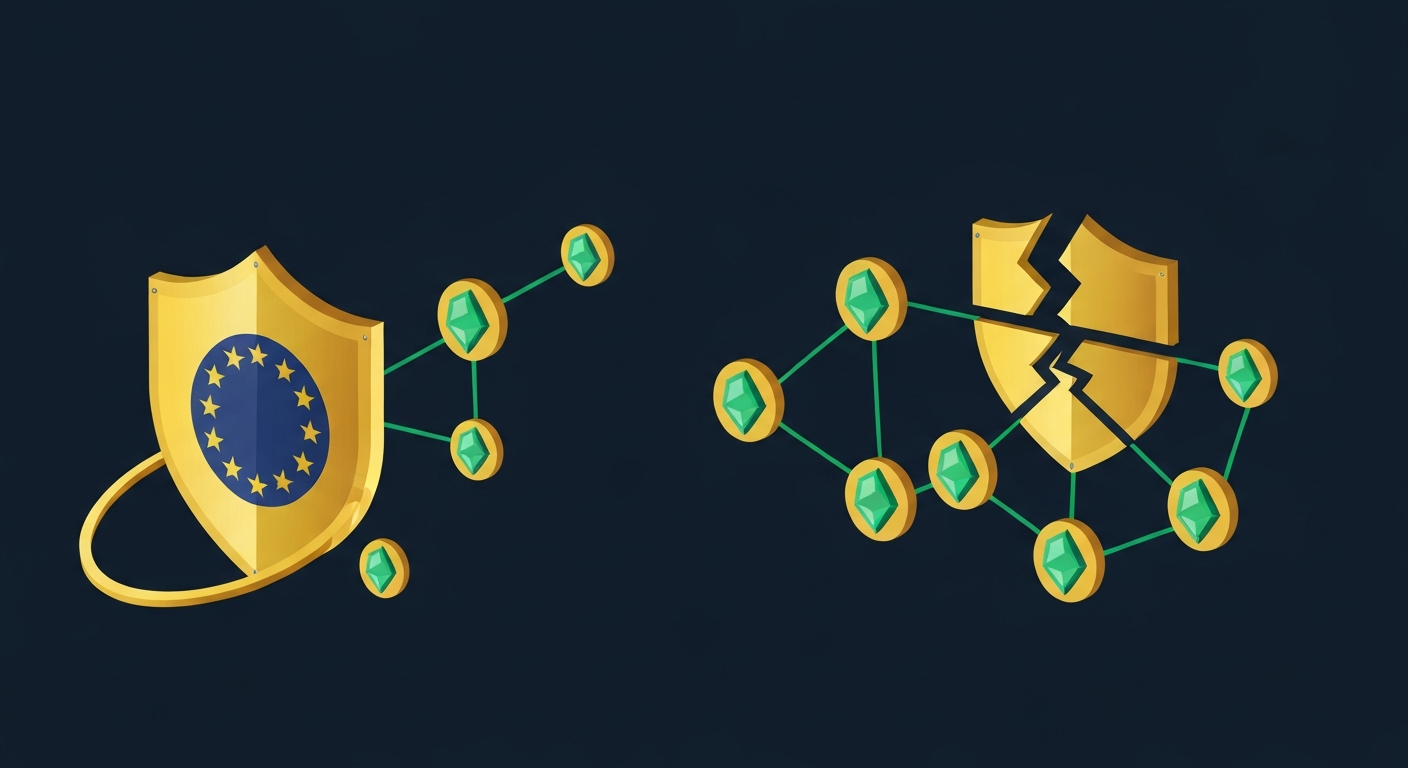
CrowdStrike Falcon is used by over 29,000 organizations worldwide, including many in the EU. The platform is widely regarded as the technical gold standard for endpoint detection and response (EDR). Yet for European companies operating under GDPR, NIS2, DORA, and the EU AI Act, CrowdStrike's corporate structure creates a compliance gap that no contractual Data Processing Agreement can fully close: CrowdStrike Holdings, Inc. is incorporated in Delaware, making every byte of telemetry it processes subject to compelled disclosure under the CLOUD Act (18 U.S.C. § 2713).
This post analyzes the specific CLOUD Act exposure created by CrowdStrike's architecture, scores it against a 25-point GDPR risk matrix, and maps four genuine EU-native alternatives — WithSecure, G DATA CyberDefense, ESET, and Bitdefender — that offer comparable detection capability without US parent-company jurisdiction.
CrowdStrike Holdings, Inc.: Corporate Structure Analysis
Legal entity: CrowdStrike Holdings, Inc. Incorporation: Delaware, United States (C-Corporation) Headquarters: Austin, Texas, USA (relocated from Sunnyvale, CA in 2022) Exchange: NASDAQ: CRWD FY2025 ARR: $4.24 billion Founded: 2011 by George Kurtz, Dmitri Alperovitch, Gregg Marston
CrowdStrike operates a European subsidiary structure (CrowdStrike Services GmbH in Germany, CrowdStrike Ltd. in the UK) and offers EU data residency as an add-on for certain data types. However, the critical legal question is not where the data is stored — it is who controls the data.
Under the CLOUD Act's "possession, custody, or control" standard (18 U.S.C. § 2703(f) and § 2713), US law applies to any data that a US person or US-incorporated entity can access, regardless of where that data physically resides. Because CrowdStrike Holdings, Inc. — the ultimate parent entity — is a Delaware C-Corporation, it is a "US person" under this standard. Any order from US law enforcement can compel CrowdStrike to produce data that its subsidiaries hold in EU data centers.
This is not hypothetical. The US government has successfully used CLOUD Act orders to compel disclosure of data stored in European facilities by US-parent companies. The 2018 United States v. Microsoft Corp. case and subsequent CLOUD Act legislation (passed the same year) created the binding precedent that physical location of data is irrelevant to US compelled-disclosure authority.
The EU Data Boundary is not a CLOUD Act solution. CrowdStrike's EU Data Boundary commitment means data is processed in EU regions. It does not mean the parent company loses the legal ability to respond to a CLOUD Act order. The GDPR transfer ban in Art. 48 prohibits EU controllers from complying with foreign law enforcement orders "unless [they] are based on an international agreement." The EU-US Data Privacy Framework (DPF) covers voluntary commercial transfers; it does not govern compelled CLOUD Act disclosures. This gap creates a compliance Catch-22 for EU data controllers: GDPR prohibits the transfer, but CLOUD Act compels it.
CrowdStrike Falcon Architecture: Why Endpoint Telemetry is the Risk
The Falcon sensor runs on each endpoint and streams telemetry to CrowdStrike's cloud platform. This telemetry includes:
- Process execution data: every process launched on the endpoint, including arguments
- Network connection metadata: source/destination IPs, domains, ports
- File hash and path data: including files that are opened or modified by users
- User identity context: login events, privilege escalation attempts
- Registry and kernel-level events (Windows)
For European organizations, this data often includes personal data under GDPR Art. 4(1) — IP addresses, user activity patterns, and in many cases explicit user identifiers. Processing this data via a US-parent-controlled cloud platform triggers Art. 46 transfer obligations. CrowdStrike offers Standard Contractual Clauses (SCCs) and its own Transfer Impact Assessment (TIA), but neither addresses the fundamental CLOUD Act exposure.
Additionally, CrowdStrike's Threat Graph — the global intelligence database that powers Falcon's detection capabilities — is a US-controlled system. Threat intelligence derived from EU customers' endpoint telemetry feeds into this global graph, which is managed by a US entity.
GDPR Risk Score: CrowdStrike Falcon
| Dimension | Score (0–5) | Rationale |
|---|---|---|
| Corporate jurisdiction | 5/5 | Delaware C-Corporation — maximum CLOUD Act exposure |
| Data transfer mechanisms | 4/5 | SCCs + TIA available but do not resolve CLOUD Act compellability |
| Telemetry & sub-processor chain | 4/5 | Endpoint sensor streams process/network/user data to US-controlled Threat Graph |
| Data residency enforcement | 3/5 | EU Data Boundary offered but not contractually enforced against CLOUD Act orders |
| Incident disclosure (NSL gag orders) | 4/5 | National Security Letter gag orders prevent CrowdStrike from notifying EU customers of government-compelled access |
Total GDPR Risk Score: 20/25 — HIGH RISK for EU data controllers processing personal data
A score of 20/25 indicates that CrowdStrike creates substantial GDPR compliance exposure for EU organizations. This does not mean CrowdStrike is insecure — technically it is among the most capable platforms available. It means the corporate structure creates legal compliance risks that cannot be mitigated by contractual measures alone.
EU-Native Alternative 1: WithSecure (formerly F-Secure)
Legal entity: WithSecure Corporation Incorporation: Finland (Finnish limited liability company — Oy) HQ: Helsinki, Finland Exchange: Nasdaq Helsinki (NASDAQ: WITH) EU member state: Yes — Finland CLOUD Act exposure: None (Finnish corporation, no US parent)
WithSecure separated from F-Secure in 2022 to create a dedicated B2B cybersecurity company. The corporate entity is entirely Finnish — there is no US parent company and no Delaware incorporation in the ownership chain.
Product: WithSecure Elements Endpoint Detection & Response
- Behavioral and threat intelligence-based detection
- Cloud management console hosted in EU (AWS Frankfurt or Azure Netherlands)
- Threat intelligence feeds derived from Finnish/EU telemetry infrastructure
- ISO 27001 certified, GDPR Art. 28 DPA readily available
- Sector experience: financial services, manufacturing, healthcare (NIS2/DORA alignment)
GDPR Risk Score: 4/25 — LOW RISK
The EU data residency is genuine because the controlling entity is Finnish. A US law enforcement CLOUD Act order has no mechanism to compel a Finnish corporation that has no US parent, US subsidiaries, or US-controlled infrastructure.
Technical comparison: WithSecure Elements EDR provides comparable detection coverage to Falcon for known and behavioral threats. The Threat Intelligence graph is smaller than CrowdStrike's (which benefits from 29,000+ global deployments), but for EU-specific threat actor TTPs — including APT28 (Fancy Bear), APT29 (Cozy Bear), and Sandworm — WithSecure's Nordic threat intelligence is well-regarded.
EU-Native Alternative 2: G DATA CyberDefense
Legal entity: G DATA Software AG Incorporation: Germany (Aktiengesellschaft — AG) HQ: Bochum, North Rhine-Westphalia, Germany Ownership: Private — majority-owned by Thorsten Urbanski and founders; no US investors CLOUD Act exposure: None (German AG, no US parent)
G DATA is one of Europe's oldest cybersecurity companies, founded in 1985 in Bochum. It is fully privately owned by German stakeholders with no US parent company or US venture capital in the ownership structure.
Product: G DATA Endpoint Detection & Response
- On-premises management console option (no cloud dependency) — important for air-gapped or restricted environments
- Cloud management via G DATA servers in Germany (Frankfurt data center)
- Dual-scanner engine combining Bitdefender engine licensing + G DATA's own engine
- Deep integration with German BSI (Bundesamt für Sicherheit in der Informationstechnik) recommendations
- DSGVO/GDPR compliance framework built into product
GDPR Risk Score: 3/25 — VERY LOW RISK
The on-premises option eliminates cloud transfer risks entirely. For German public sector and critical infrastructure operators under NIS2, G DATA's BSI relationships and German ownership make it the lowest-risk option.
Technical comparison: G DATA's dual-engine approach (combining two independent scan engines) produces low false-negative rates for signature-based detection. Behavioral EDR capabilities are less mature than Falcon's AI-driven approach, but for organizations primarily concerned with known malware and compliance documentation, G DATA is a strong fit.
EU-Native Alternative 3: ESET
Legal entity: ESET, spol. s r.o. Incorporation: Slovak Republic HQ: Bratislava, Slovakia Ownership: Private — owned by Slovak founders and management EU member state: Yes — Slovakia CLOUD Act exposure: Low — US subsidiary (ESET North America, LLC) handles US market but parent entity is Slovak
Note on ESET's corporate structure: ESET has a US subsidiary (ESET North America, LLC) that markets products in the United States. The data processing for EU customers is handled by the Slovak parent entity. The US subsidiary does not have "possession, custody, or control" of EU customer data processed by the Slovak parent. This creates a lower risk profile than US-parent structures, but EU legal counsel should verify the specific DPA structure.
Product: ESET PROTECT Elite (formerly ESET Enterprise Inspector)
- Comprehensive EDR with XDR capabilities
- Cloud console hosted in EU (Frankfurt)
- ESET LiveGrid threat intelligence — Slovak-controlled global threat intelligence network
- Advanced threat hunting with ESET Inspect (incident response tool)
- Strong ransomware protection track record (TeslaCrypt decryption toolkit, 2016)
GDPR Risk Score: 6/25 — LOW RISK
The primary risk is the US subsidiary — if ESET North America, LLC ever gained control over EU customer data, CLOUD Act exposure would increase. Current DPA documentation from ESET indicates EU data is processed solely by the Slovak entity.
Technical comparison: ESET Protect Elite has a strong detection track record on AV-TEST and SE Labs benchmarks. The XDR capabilities are comparable to Falcon for SME and mid-market organizations. For enterprises requiring 24/7 MDR (Managed Detection and Response), ESET's managed services are available through EU-based partners.
EU-Native Alternative 4: Bitdefender
Legal entity: Bitdefender SRL Incorporation: Romania HQ: Bucharest, Romania Ownership: Private — Florin Talpeș (founder/CEO) holds majority; Vitruvian Partners (UK PE) holds minority EU member state: Yes — Romania US subsidiary: Bitdefender Inc. (Hauppauge, New York, USA) — markets products in North America CLOUD Act exposure: Moderate — US subsidiary exists; EU legal counsel should verify data flow controls
Product: Bitdefender GravityZone Ultra (EDR) + GravityZone XDR
- Cloud management via Bitdefender servers in EU (Frankfurt, Paris)
- Threat intelligence from Bitdefender Labs (Bucharest-controlled)
- Award-winning detection engine: consistent #1 or #2 rankings on AV-TEST, AV-Comparatives
- Ransomware remediation: industry-leading rollback capabilities
- GDPR-ready DPA template with EU/EEA data residency commitment
GDPR Risk Score: 8/25 — LOW-TO-MODERATE RISK
The US subsidiary introduces some uncertainty. If Bitdefender Inc. can access EU customer data (for support, debugging, or management purposes), CLOUD Act compellability increases. Organizations should obtain written confirmation from Bitdefender that EU customer data is processed exclusively by the Romanian entity.
Technical comparison: Bitdefender GravityZone Ultra consistently outperforms CrowdStrike Falcon on AV-TEST's "Real-World Protection" benchmark for known malware. For advanced EDR use cases (threat hunting, behavioral analytics), Falcon still leads. Bitdefender is the strongest EU-native alternative for organizations prioritizing detection accuracy.
5-Tool Comparison Matrix
| Vendor | Jurisdiction | CLOUD Act | GDPR Risk | EDR Maturity | MDR Available | BSI/NIS2 Focus |
|---|---|---|---|---|---|---|
| CrowdStrike Falcon | Delaware, USA | HIGH | 20/25 | ★★★★★ | Yes | No |
| WithSecure Elements | Finland, EU | NONE | 4/25 | ★★★★☆ | Yes | Yes |
| G DATA CyberDefense | Germany, EU | NONE | 3/25 | ★★★☆☆ | Partners | Yes (BSI) |
| ESET PROTECT Elite | Slovakia, EU | LOW | 6/25 | ★★★★☆ | Yes (partners) | Yes |
| Bitdefender GravityZone | Romania, EU | LOW-MOD | 8/25 | ★★★★☆ | Yes | Partial |
GDPR Art. 35 DPIA Trigger Assessment
Under GDPR Art. 35, a Data Protection Impact Assessment is mandatory when processing is "likely to result in a high risk." Using a US-parent EDR platform that streams endpoint telemetry — including personal data about employees — meets several Art. 35(3) criteria:
- Art. 35(3)(a): Systematic and extensive evaluation of personal aspects (behavioral analysis of employee activity patterns)
- Art. 35(3)(b): Large-scale processing of sensitive data (health data in healthcare organizations, financial data in banking)
- Art. 35(3)(c): Systematic monitoring of a publicly accessible area (network perimeter monitoring)
A DPIA for CrowdStrike must include the CLOUD Act transfer risk in its risk assessment. EDPB Guidelines 09/2022 on transfers under Art. 46(2) SCCs require organizations to assess the laws of the third country for "problematic legislation." US CLOUD Act has been explicitly identified by multiple EU Data Protection Authorities (including the French CNIL and Dutch AP) as "problematic legislation" that undermines SCC effectiveness.
Practical consequence: For EU organizations that have completed CrowdStrike DPIAs without addressing CLOUD Act exposure, those DPIAs are likely incomplete under current EDPB guidance.
NIS2 Article 21 Alignment
NIS2 Article 21(2)(h) requires "security of the supply chain, including security-related aspects concerning the relationships between each entity and its direct suppliers or service providers." For operators of essential services and important entities, this supply-chain security obligation includes the jurisdictional risk of their security vendors.
A critical infrastructure operator that uses a US-parent EDR platform faces a supply-chain security risk that NIS2 Art. 21(2)(h) compliance documentation must address. The relevant question for NIS2 supervisory authorities: "Can a US government CLOUD Act order compel your EDR provider to disable endpoint protection or exfiltrate endpoint telemetry on behalf of a foreign government?"
Current NIS2 supervisory guidance from ENISA (ENISA NIS2 Implementation Report, Q1 2026) does not explicitly prohibit US-parent security vendors, but several EU member state NCAs (National Competent Authorities) have issued guidance recommending EU-controlled security tooling for critical sectors.
Migration Guide: CrowdStrike Falcon → EU-Native EDR
Phase 1: Assessment (Weeks 1–4)
- Inventory Falcon sensor deployment: Document all endpoints, operating systems, and integration points (SIEM, SOAR, ticketing)
- Map personal data flows: Identify what employee personal data flows through Falcon telemetry
- Complete DPIA update: Assess CLOUD Act exposure in existing DPIA documentation
- Run EU-native PoC: Deploy WithSecure Elements or ESET PROTECT in parallel on 50–100 endpoints
Phase 2: Parallel Operation (Weeks 5–12)
- Side-by-side detection comparison: Run both platforms for 6–8 weeks; compare alert volume, false positive rates, and detection coverage
- MDR handover planning: If using CrowdStrike Falcon Complete MDR, identify EU-based MDR partners for target platform
- SIEM/SOAR re-integration: Map CrowdStrike API integrations to target platform equivalents
- Staff training: Security operations team training on new console (2–3 days for experienced analysts)
Phase 3: Cutover (Weeks 13–16)
- Phased sensor replacement: Replace Falcon sensors in waves (non-critical endpoints first)
- Retain Falcon in parallel: Keep Falcon active on critical systems until EU-native platform stability is confirmed
- Decommission and data deletion: Request Falcon telemetry deletion per GDPR Art. 17 right to erasure
- DPA update: Revise GDPR documentation to reflect new controller-processor relationship
Typical Migration Costs
| Item | Estimate |
|---|---|
| EU-native EDR license (1,000 endpoints, 1 year) | €80,000–€150,000 |
| Migration project (4–6 months, 1 FTE) | €60,000–€100,000 |
| SIEM/SOAR re-integration | €20,000–€40,000 |
| Staff training | €5,000–€10,000 |
| Total | €165,000–€300,000 |
Note: These costs should be weighed against regulatory risk. A GDPR fine for inadequate data transfer protection under Art. 83(4) can reach €10M or 2% of global annual turnover.
Conclusion: Technical Excellence vs. Jurisdictional Compliance
CrowdStrike Falcon is the most technically capable EDR platform available in 2026. This is not in dispute. The compliance challenge is not CrowdStrike's security technology — it is CrowdStrike's corporate address.
For EU organizations that have completed thorough DPIAs, obtained SCCs, and are comfortable with residual CLOUD Act risk documented as an accepted risk in their GDPR compliance framework, CrowdStrike may remain a reasonable choice. Some organizations will accept this risk, particularly in sectors where CrowdStrike's threat intelligence breadth is considered essential.
For EU organizations in regulated sectors (financial services under DORA, critical infrastructure under NIS2, healthcare under eHealth regulations, public sector under national sovereignty requirements), the CLOUD Act exposure may be an unacceptable compliance gap. For these organizations, WithSecure Elements, ESET PROTECT Elite, G DATA CyberDefense, or Bitdefender GravityZone offer genuine EU data sovereignty combined with enterprise-grade detection capability.
The next posts in this series will analyze SentinelOne (Mountain View, CA — Delaware Corp), Palo Alto Networks (NASDAQ: PANW — Delaware Corp), Wiz (now Google/Delaware), and Zscaler (San Jose, CA — Delaware Corp), completing the picture of EU data sovereignty risk across the enterprise security stack.
Related: EU Security Compliance — CRA Article 13 Security by Design · NIS2 Art. 25-28 Sector-Specific Security · AWS Security Hub EU Alternative · Snyk EU Alternative 2026
EU-Native Hosting
Ready to move to EU-sovereign infrastructure?
sota.io is a German-hosted PaaS — no CLOUD Act exposure, no US jurisdiction, full GDPR compliance by design. Deploy your first app in minutes.