Clerk EU Alternative 2026: GDPR and CLOUD Act Risk in Serverless Auth
Post #1096 in the sota.io EU Cloud Compliance Series
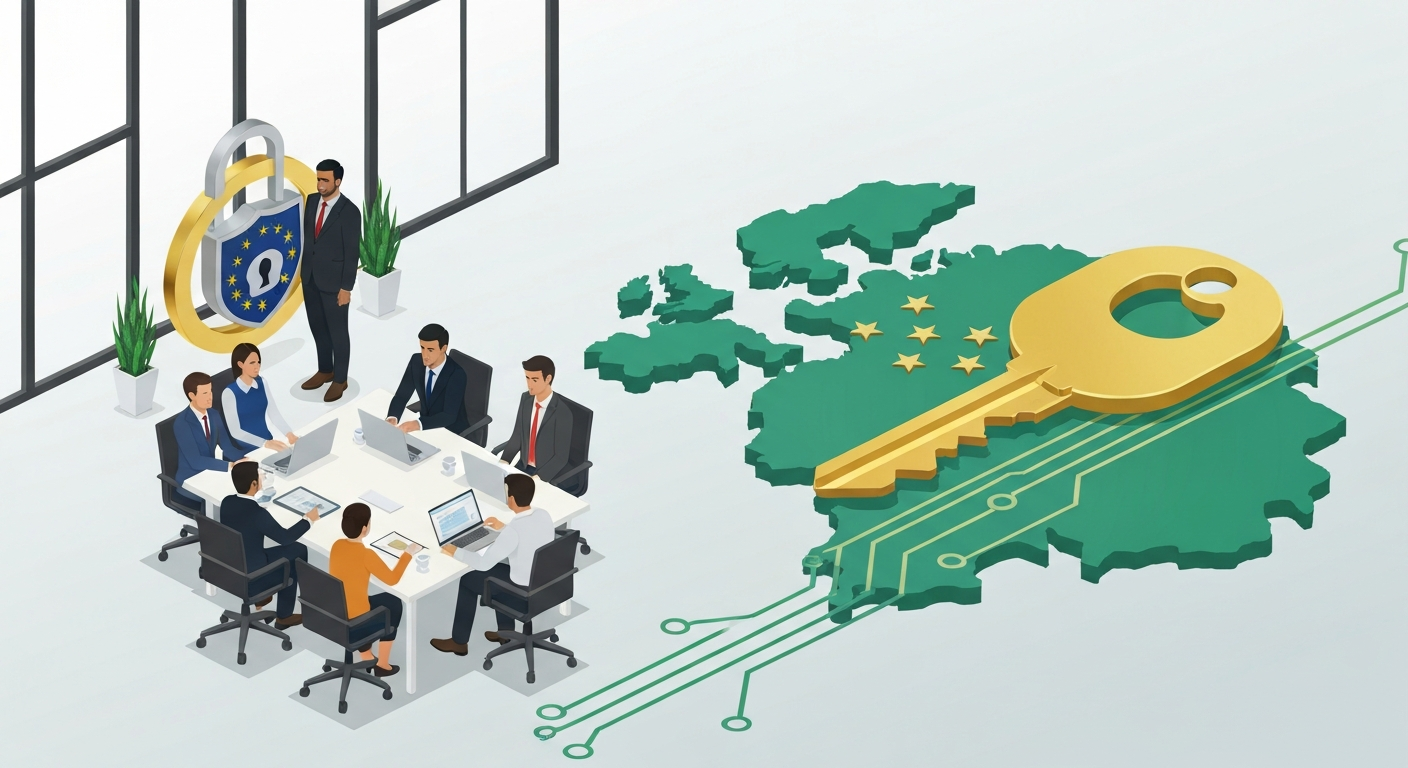
Clerk has become the default auth layer for Next.js, Remix, and modern SaaS stacks. Its developer experience is genuinely excellent — one-line middleware, prebuilt UI components, magic links, social login, JWT templates. But Clerk Inc. is incorporated in Delaware, USA, with venture capital from Andreessen Horowitz, Tiger Global, and Madrona.
That corporate structure creates a GDPR problem that no EU region setting can solve.
What Clerk Stores — And Why It Matters Under the CLOUD Act
Every time a user signs into your application via Clerk, the following data flows through Clerk's infrastructure:
- Session tokens — long-lived JWTs with user identity claims
- User profiles — email, name, phone, profile image, external account links (Google, GitHub, etc.)
- Device fingerprints — browser, OS, IP address, geographic location per sign-in
- Auth events — every sign-in, sign-out, password change, MFA event with timestamps
- Organization memberships — if you use Clerk Organizations (B2B feature)
This is not metadata. This is the authentication backbone of your product. A US government warrant served on Clerk Inc. under 18 U.S.C. §2703 (CLOUD Act, amended Stored Communications Act) gives US federal agencies direct access to all of the above — for every user of every application running on Clerk.
The CLOUD Act does not require notification to the data subject or the application operator. It does not require a treaty. It applies regardless of where Clerk's servers are physically located.
Clerk Inc. Corporate Structure
| Property | Value |
|---|---|
| Legal name | Clerk, Inc. |
| Jurisdiction | Delaware, USA |
| Headquarters | New York, NY, USA |
| Founded | 2021 |
| Funding | ~$170M (a16z, Tiger Global, Madrona, Stripe) |
| EU subsidiary | None (as of 2026-05-16) |
| CLOUD Act applicability | Full — US corporation |
| EU GDPR transfer mechanism | Standard Contractual Clauses (SCCs) |
Clerk's EU region offering processes your users' auth data on servers in Frankfurt or similar EU locations. But the parent company — which holds the signing keys for JWTs, the master user database, and encryption keys — is a US entity fully subject to US jurisdiction.
Server location is irrelevant to CLOUD Act compelled disclosure. What matters is the corporate parent's jurisdiction.
The Schrems II Shadow Over Auth-as-a-Service
The CJEU's Schrems II ruling (Case C-311/18, July 2020) invalidated the EU-US Privacy Shield because US surveillance laws — including FISA §702 and the CLOUD Act — create legal access to EU data that EU authorities cannot effectively challenge.
Standard Contractual Clauses (SCCs), Clerk's current transfer mechanism, require a Transfer Impact Assessment (TIA) for every data transfer to a US-based processor. For auth data, a TIA for Clerk must acknowledge:
- Clerk Inc. is subject to National Security Letters (NSLs) with gag orders
- FISA §702 surveillance can compel data access without individual warrants
- CLOUD Act warrants can reach data held by US corporations regardless of server location
- EU data subjects have no effective judicial remedy under US law (§702(f)(1) explicitly bars challenges)
Under GDPR Art.46(2)(c), SCCs are only valid if "appropriate safeguards" exist in the destination country. For auth providers with US parent companies, regulators in Germany, France, Austria, and the Netherlands have begun scrutinizing whether SCCs alone are sufficient — particularly after the Austrian DSB ruling (2022-01-13) that found Google Analytics to violate Art.44-49 on this exact basis.
Auth-as-a-service with a US parent is structurally identical to the analytics-as-a-service cases that triggered those DPA rulings. Session tokens are more sensitive than page-view cookies.
CLOUD Act Risk Score: 17/25
| Dimension | Score | Rationale |
|---|---|---|
| Corporate domicile | 5/5 | Delaware corp, full US jurisdiction |
| Data sensitivity | 5/5 | Auth tokens + session data + identity = maximum sensitivity |
| Transfer mechanism | 4/5 | SCCs only; no BCRs, no adequacy decision |
| Surveillance exposure | 2/5 | NSL-gag eligible; no public transparency report for auth data |
| EU presence | 1/5 | No EU subsidiary, no EU-resident DPO publicly disclosed |
| Total | 17/25 | HIGH RISK for GDPR-critical deployments |
A score of 17/25 places Clerk in the same high-risk tier as Algolia (15/25) and Upstash (16/25). Auth data is uniquely sensitive — scoring 5/5 on data sensitivity because authentication credentials represent access to everything else your users store in your application.
EU-Native Auth Alternatives
1. Zitadel — EU-Native Identity Platform
Zitadel is developed by Caos GmbH in St. Gallen, Switzerland. Switzerland has an EU adequacy decision for data transfers under GDPR Art.45 — data flowing to Switzerland requires no SCCs or TIA.
| Property | Value |
|---|---|
| Legal entity | Caos GmbH |
| Jurisdiction | Switzerland (EU adequacy decision, Art.45) |
| License | Apache 2.0 (core), Zitadel Enterprise (advanced) |
| Self-hostable | Yes — Docker, Kubernetes, binary |
| Cloud hosted | Zitadel Cloud (EU-hosted options available) |
| CLOUD Act exposure | None |
| CLOUD Act score | 2/25 |
Zitadel supports OIDC/OAuth2, SAML 2.0, machine-to-machine JWT, passkeys/FIDO2, LDAP, multi-tenancy, and organizations. SDKs for Go, Node.js, Python, and a React login UI. Closest feature parity to Clerk in the EU-native space.
Hosted on sota.io (Hetzner Germany): zero CLOUD Act exposure, GDPR Art.44 compliant without SCCs, because no personal data leaves EU jurisdiction.
2. Authentik — German Identity Provider
Authentik is developed by Beryju.io GmbH, incorporated in Germany. The project is fully open source under the MIT license (core), with an enterprise tier.
| Property | Value |
|---|---|
| Legal entity | Beryju.io GmbH |
| Jurisdiction | Germany (EU member state) |
| License | MIT (core) / Enterprise |
| Self-hostable | Yes — Docker Compose, Kubernetes Helm chart |
| CLOUD Act exposure | None |
| CLOUD Act score | 3/25 |
Authentik supports OIDC, SAML, LDAP, SCIM provisioning, a proxy provider (for protecting any HTTP app), and a flow engine for custom auth experiences. Particularly strong for enterprise scenarios with fine-grained policy controls.
3. Keycloak — Enterprise Open Source Auth
Keycloak is developed by Red Hat (IBM subsidiary) as a fully open source project. When self-hosted, your deployment is your jurisdiction — no US data path.
| Property | Value |
|---|---|
| Origin | Red Hat / JBoss (IBM) |
| License | Apache 2.0 |
| Self-hostable | Yes — JAR, Docker, Kubernetes Operator |
| CLOUD Act risk | Zero when self-hosted on EU infrastructure |
| CLOUD Act score | 0/25 (self-hosted) |
Keycloak is the enterprise standard — deployed by European banking, healthcare, and government agencies. Supports OIDC, SAML 2.0, Kerberos, LDAP/AD federation, and fine-grained authorization policies. Highest operational complexity but maximum flexibility.
4. Logto — Clerk-Like DX, Self-Hosted
Logto is an open source OIDC/OAuth2 server designed with developer experience as a first principle. MIT licensed, self-hostable on any EU infrastructure.
| Property | Value |
|---|---|
| License | MIT / AGPL-3.0 |
| Self-hostable | Yes — Docker, hosted cloud |
| Developer UX | Clerk-comparable components + SDK |
| CLOUD Act risk | Zero when self-hosted |
Logto ships prebuilt React sign-in components and Next.js middleware — the closest UX parity to Clerk in the open source space. Ideal for teams migrating from Clerk who want minimal refactoring.
5. Stack Auth — Direct Clerk Replacement
Stack Auth (MIT license) is designed as a drop-in Clerk alternative. Self-hostable, with Next.js App Router support, social login, magic links, and a teams/organizations model explicitly compatible with Clerk's API surface.
EU Alternatives at a Glance
| Provider | Jurisdiction | CLOUD Act | Self-Host | Next.js SDK | Clerk Parity |
|---|---|---|---|---|---|
| Clerk | Delaware, USA | ⛔ 17/25 | No | Native | — |
| Zitadel | Switzerland (EU adequate) | ✅ 2/25 | Yes | Yes | High |
| Authentik | Germany, EU | ✅ 3/25 | Yes | Proxy | Medium |
| Keycloak | Self-hosted (Apache 2.0) | ✅ 0/25 | Yes | OIDC flow | Medium |
| Logto | Self-hosted (MIT) | ✅ 0/25 | Yes | Yes | High |
| Stack Auth | Self-hosted (MIT) | ✅ 0/25 | Yes | Native | Very High |
Migrating from Clerk to an EU-Native Alternative
Step 1: Export Your User Data
Clerk provides a Users export API. Export before migrating:
curl -H "Authorization: Bearer $CLERK_SECRET_KEY" \
  "https://api.clerk.com/v1/users?limit=500" \
  > clerk-users-export.json
Repeat with pagination (&offset=500, &offset=1000, etc.) until you have all users.
Step 2: Choose Your EU Provider
- Next.js-heavy / startup: Zitadel (best SDK + EU adequate) or Logto/Stack Auth (highest Clerk parity)
- Enterprise SAML/LDAP: Keycloak
- Policy-engine / complex flows: Authentik
Step 3: Deploy on EU Infrastructure
On sota.io (Hetzner Germany), Zitadel deploys with:
sota deploy \
  --image ghcr.io/zitadel/zitadel:latest \
  --env ZITADEL_DATABASE_POSTGRES_HOST=$POSTGRES_HOST \
  --env ZITADEL_EXTERNALDOMAIN=auth.yourdomain.eu \
  --port 8080
All auth traffic stays within EU jurisdiction. No US entity in the data path.
Step 4: Replace Clerk Middleware
// Before (Clerk)
import { clerkMiddleware } from "@clerk/nextjs/server";
export default clerkMiddleware();

// After (any OIDC provider — Zitadel, Logto, Keycloak)
import { withAuth } from "next-auth/middleware";
export default withAuth({
  providers: [{
    wellKnown: "https://auth.yourdomain.eu/.well-known/openid-configuration"
  }]
});
Step 5: Update Your GDPR Documentation
- Remove Clerk from your GDPR Art.28 sub-processor list
- Remove the SCCs and TIA covering Clerk
- Your auth data now stays within EU jurisdiction — no transfer mechanism required under Art.44
What GDPR Art.28 Requires of Auth Processors
GDPR Art.28(3) mandates that data processing agreements with auth processors include:
- Geographic restrictions on where data may be processed
- Exhaustive sub-processor lists with approval rights (Art.28(2))
- Right to audit processing operations (Art.28(3)(h))
- Data deletion obligations upon termination (Art.17)
With Clerk, your DPA lists Amazon Web Services (Clerk's infrastructure provider), Clerk Inc., and potentially additional US sub-processors. Each US sub-processor adds CLOUD Act exposure to the entire chain.
With self-hosted Zitadel or Authentik on sota.io: your DPA lists sota.io (EU entity, Hetzner Germany servers) as the sole processor. No US sub-processors in the auth data path.
Why Auth Is Your Highest-Risk Data Processor
Auth-as-a-service is uniquely sensitive for three reasons that distinguish it from other SaaS tools:
1. Session tokens grant access to everything. Compromise the auth layer and you compromise every user account, every session, every API key scoped to a user identity. The auth provider holds the master keys.
2. Identity data is permanent. Email addresses and user IDs persist longer than any other data type in your system — across account deletions, GDPR right-to-erasure requests, and schema migrations. Auth data has the longest retention horizon.
3. Login patterns reveal sensitive behavior. When users authenticate reveals business-sensitive information: which employees logged in before a corporate action, which users churned (stopped logging in), which accounts are dormant. The Austrian DSB explicitly noted in 2022 that login event data constitutes personal data requiring full GDPR Art.44-49 protections.
Choosing a US-based auth provider is not a checkbox decision. It is a foundational architecture choice that determines whether your entire user base's identity is subject to US government surveillance law — with no notification, no judicial oversight visible to EU subjects, and no recourse under EU law.
Practical Next Steps
- Audit your current auth setup — check incorporation address, not just server region
- Run a TIA for Clerk — document the CLOUD Act risk formally for your DPO or legal team
- Evaluate Zitadel or Stack Auth — both have Clerk-comparable developer experience with zero CLOUD Act exposure
- Deploy on sota.io — EU-native PaaS running on Hetzner Germany, no US entity in your infrastructure stack
sota.io deploys Zitadel, Authentik, Keycloak, and Logto with a single command. Your auth layer and application layer both stay within EU jurisdiction — solving the CLOUD Act problem at the infrastructure level rather than patching it with SCCs.
CLOUD Act risk scores use a 5-dimension 25-point rubric (corporate domicile, data sensitivity, transfer mechanism, surveillance exposure, EU presence). All scores reflect public corporate registry information as of 2026-05-16. This post does not constitute legal advice.
EU-Native Hosting
Ready to move to EU-sovereign infrastructure?
sota.io is a German-hosted PaaS — no CLOUD Act exposure, no US jurisdiction, full GDPR compliance by design. Deploy your first app in minutes.