Cisco Secure Access EU Alternative 2026: CLOUD Act 21/25 — Duo, Umbrella, and Talos in SASE
Post #1226 in the sota.io EU Cyber Compliance Series
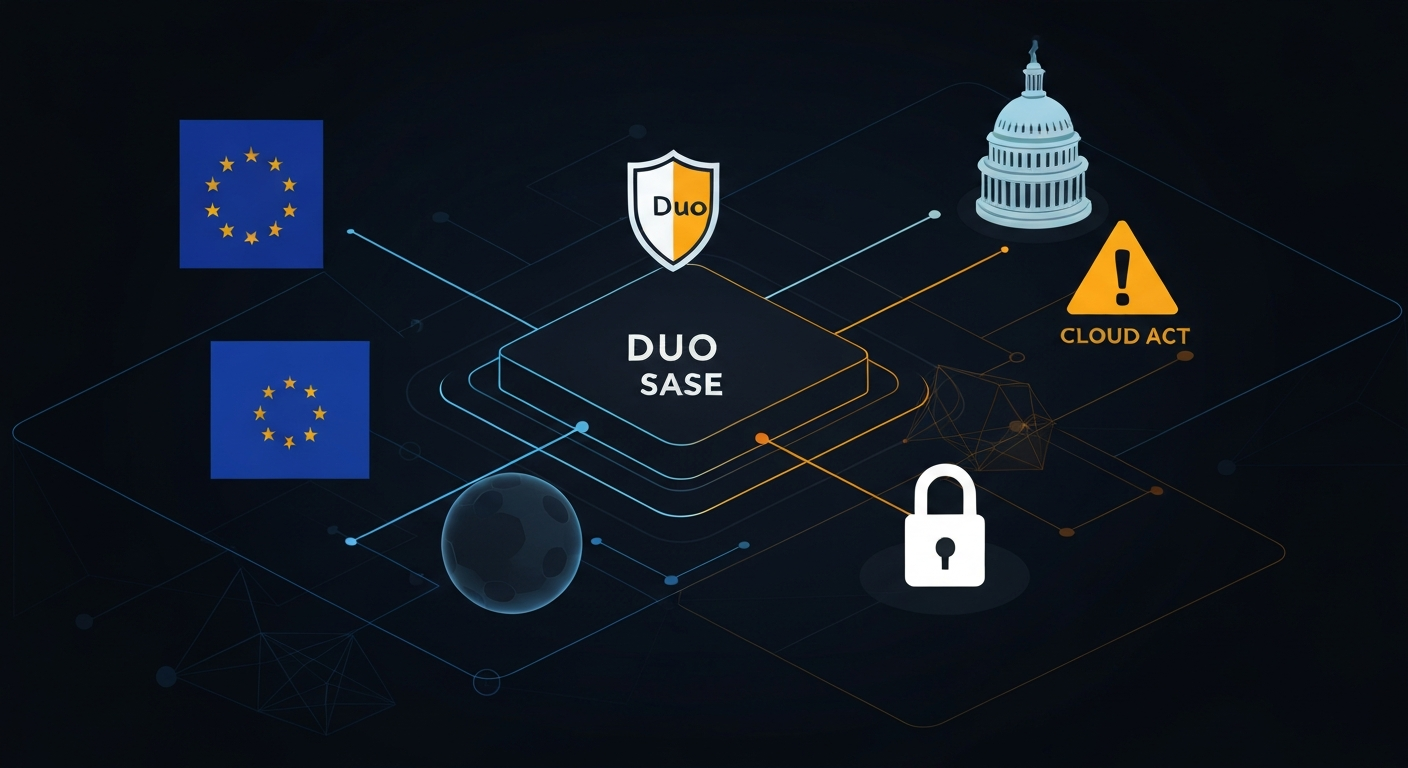
Cisco's go-to-market rebranding of the past three years has consolidated what were once separate products — Duo Security (MFA and zero trust access), Cisco Umbrella (DNS security and cloud secure web gateway), Cisco AnyConnect (now Cisco Secure Client, VPN), and Cisco SD-WAN — under the umbrella of "Cisco Secure Access." The pitch is architectural simplification: one vendor, one control plane, one agent on the endpoint.
The compliance calculus is different. When you deploy Cisco Secure Access, you hand a single US vendor — Cisco Systems, Inc., incorporated in California, traded on NASDAQ:CSCO — control over your employees' authentication flows (Duo), your corporate DNS resolution (Umbrella), your VPN connections (Cisco Secure Client), and your web traffic (Cisco's cloud SWG). Each of those components is a distinct CLOUD Act exposure surface. Combined into SASE, they stack.
We score Cisco Secure Access at 21 out of 25 on our CLOUD Act risk framework — higher than Netskope (20/25) in this EU Zero Trust Networking series, lower than Palo Alto Prisma Access and Cloudflare One (both 23/25). The slightly lower score relative to Palo Alto and Cloudflare reflects Cisco's smaller percentage of revenue from direct US intelligence community contracts. The score is, however, elevated by the unique breadth of employee data that flows through a Cisco Secure Access deployment and by the documented history of NSA-Cisco hardware relationships.
The SASE Merger That Created New Compliance Exposure
Cisco's Secure Access platform is the result of acquisitions and product consolidation:
Duo Security — acquired by Cisco in 2018 for $2.35 billion. Duo handles multi-factor authentication (MFA) and acts as the zero trust access control layer. When a user authenticates to any Duo-protected application — whether corporate SaaS, internal web app, or VPN — the authentication event (username, device fingerprint, IP address, geographic location, authentication result, timestamp) is processed by Duo's infrastructure, now fully integrated into Cisco's cloud.
Cisco Umbrella — DNS security and cloud secure web gateway. Cisco Umbrella resolves DNS queries for corporate users, meaning every hostname lookup made by your employees — not just web browsing, but every application that makes a DNS call — passes through Cisco infrastructure. Umbrella logs DNS queries, applies threat intelligence categorization (drawing on Talos Intelligence), and can block requests in real time. For an enterprise with 500 employees, Umbrella processes millions of DNS requests daily that collectively map an employee's entire activity pattern.
Cisco Secure Client (formerly AnyConnect) — the VPN client that has been the enterprise standard for decades. In a Cisco Secure Access deployment, Cisco Secure Client routes traffic through Cisco's cloud PoPs and acts as the endpoint agent for SASE policy enforcement. While VPN traffic is encrypted in transit, the connection metadata — source IP, destination IP, session duration, bytes transferred — is logged by Cisco's systems.
Cisco Talos Intelligence — Cisco's threat intelligence division, tracking 1.3 million malware samples per day and correlating security telemetry across Cisco's global customer base. When Cisco Secure Access detects a threat event in your environment, it feeds into Talos. Your organization's security incidents contribute to a global threat database operated by a US company with US government relationships.
The compliance problem is not any single component. It is the integration. A Cisco Secure Access customer gives Cisco visibility into:
- Every authentication event across all corporate applications (Duo)
- Every DNS lookup made by every corporate device (Umbrella)
- Every web session, categorized by content type and threat score (Cloud SWG)
- Every VPN connection including source, destination, and duration (Cisco Secure Client)
- Security incident telemetry feeding a global threat database (Talos)
Under GDPR Art.4(1), virtually all of this constitutes personal data relating to identified or identifiable natural persons (your employees). Under Art.32, you are responsible for technical measures to protect that data. Under Art.28, Cisco is your data processor — but a data processor incorporated in the United States with FedRAMP High authorization.
Corporate Structure: California C-Corp, NASDAQ-Listed
Cisco Systems, Inc. is incorporated in the State of California. Unlike many of its Silicon Valley peers that reincorporated in Delaware for investor-friendly corporate governance, Cisco has remained a California corporation throughout its history. The legal entity is headquartered at 170 West Tasman Drive, San Jose, California 95134.
Cisco is publicly traded on NASDAQ under the ticker CSCO. As a US-listed public company, Cisco is subject to SEC disclosure requirements, Sarbanes-Oxley Act compliance, and US federal securities law. Annual revenue exceeds $50 billion. The company employs approximately 85,000 people worldwide.
Key CLOUD Act factors:
18 USC §2703 jurisdiction: Cisco, as a US electronic communication service provider and remote computing service provider, is unambiguously subject to CLOUD Act compelled disclosure for data in its possession or control. There is no structural barrier between Cisco Systems, Inc. and the data processed by Cisco Secure Access, Cisco Umbrella, or Cisco Duo.
Absence of EU legal shield: Cisco does not maintain a separate EU-incorporated entity that holds EU customer data independently of the US parent. Cisco's European subsidiaries are wholly-owned by Cisco Systems, Inc. CLOUD Act requests can target the US parent, which controls the data.
FISA Section 702: Cisco's scale — over 85,000 employees, operations in 165 countries, handling of network infrastructure traffic globally — makes it a plausible target for National Security Letters and FISA Section 702 orders. NSL gag orders would preclude notification to EU customers.
US Government Relationships: FedRAMP High and NSA Hardware History
Cisco's government relationships go significantly beyond standard enterprise vendor certifications:
FedRAMP High Authorization: Cisco Umbrella and several Cisco security products hold FedRAMP High authorization, meaning they are cleared for US federal data at the highest impact level — including CIA, NSA, and DoD classified workflows. FedRAMP High requires extensive government security review and ongoing auditing by federal agencies. Vendors with FedRAMP High are embedded in US federal IT infrastructure in ways that create structural relationships with intelligence and defense agencies.
US Defense and Intelligence Contracts: Cisco is among the largest IT contractors to the US federal government. Cisco networking equipment forms the backbone of DoD networks, classified military networks (SIPRNET, NIPRNET), NSA infrastructure, and intelligence community IT systems. The US government is among Cisco's largest customers globally.
NSA Hardware Implant Program (2013 Snowden Disclosures): In 2013, documents published by Der Spiegel revealed that the NSA's Tailored Access Operations (TAO) unit had intercepted Cisco routers, switches, and servers in transit to overseas customers, installed JETPLOW and SCHOLARHOME firmware implants, and repackaged equipment. Cisco issued a statement saying it was unaware of these activities, which placed the interception as covert rather than cooperative. The exposure established a documented history of NSA interest in Cisco equipment and raised questions about the boundary between Cisco as a commercial vendor and Cisco as a US national security infrastructure component.
Talos Intelligence US Government Relationships: Cisco Talos maintains relationships with US Cybersecurity and Infrastructure Security Agency (CISA), FBI Cyber Division, NSA Cybersecurity Directorate, and US-CERT. Threat intelligence sharing is bidirectional. While this improves detection quality, it means that Talos' threat telemetry — including data derived from Cisco customer security incidents — flows into US government analysis pipelines.
For GDPR Art.32 purposes: when your SASE vendor has FedRAMP High authorization for intelligence community customers and documented NSA hardware program history, the risk assessment for "appropriate technical measures" necessarily includes the possibility that US government access extends beyond what is disclosed in standard transparency reports.
CLOUD Act Risk Dimensions: 21/25
D1 — Jurisdictional Risk (5/5): Cisco Systems, Inc. is a California-incorporated, NASDAQ-listed US corporation. 18 USC §2703 CLOUD Act applies. There is no EU-domiciled holding structure. Warrants and NSLs can target the US parent directly. Maximum exposure.
D2 — Government Contract Depth (4/5): FedRAMP High authorization across Cisco security products. Major DoD, NSA, CIA, and intelligence community customer relationships. US federal government is among Cisco's top revenue segments. Talos Intelligence has bidirectional sharing with CISA, FBI, NSA. NSA hardware implant history (Snowden 2013). Score 4/5 rather than 5/5 because the intelligence community relationships are more infrastructure-layer (hardware, networking) than SaaS-layer (data-as-a-service). However, Duo's MFA data and Umbrella's DNS data represent SaaS-layer personal data exposure.
D3 — Data Architecture and Residency (4/5): Cisco Secure Access processes inline traffic through Cisco cloud PoPs. EU region routing is possible through Cisco's European PoPs, but the corporate entity that operates those PoPs is Cisco Systems, Inc. Cisco does offer data residency configurations for some products (Duo data residency in EU available for certain tiers). Umbrella supports EU data residency for DNS logs. However, residency does not eliminate CLOUD Act exposure — data in EU PoPs operated by a US company is reachable via CLOUD Act warrant. Score 4/5 because Cisco offers better data residency options than some peers, but residency ≠ sovereignty.
D4 — Data Sensitivity (5/5): Cisco Secure Access is a maximally sensitive data category. Duo processes every authentication event — username, device, IP, location, application accessed, authentication result. Umbrella processes every DNS query — the full map of every application, website, and service accessed. Cisco Secure Client processes VPN connection metadata. The combination constitutes a comprehensive behavioral surveillance feed on every employee covered by the deployment. GDPR Art.4(1) personal data is being processed at scale. GDPR Art.32 risk is maximum. Maximum score.
D5 — Transparency and Legal Exposure (3/5): Cisco publishes an annual Transparency Report disclosing the number of government requests received (approximately 100-200 per year globally in recent reports). As a public company, Cisco files 10-K and 10-Q reports with SEC disclosures. Cisco has no warrant canary. The NSA hardware implant history (whether cooperative or not) creates transparency questions that a warrant canary would not address. Score 3/5 — better transparency than private companies, less than fully open-source auditable systems.
Total: 21/25
Specific GDPR Compliance Risks
Duo and GDPR Art.88 (HR Data): When Duo is deployed for employee authentication, every login event constitutes personal data relating to employees. GDPR Art.88 allows Member States to enact national-law provisions for employee data processing — and several EU Member States (Germany, France, Netherlands) have Works Council consultation requirements for workplace monitoring systems that capture employee activity patterns. A Duo deployment in Germany may require prior consultation with the Betriebsrat (works council). The data flows to a US processor without adequacy.
Umbrella DNS and GDPR Art.5(1)(c) (Data Minimisation): Umbrella logs DNS queries by user and device. The aggregated DNS log is a comprehensive record of every website and service an employee accesses. Depending on retention settings and data residency configuration, this may constitute data collection disproportionate to the purpose (threat detection), implicating Art.5(1)(c) data minimisation. Under Art.28, the data processor (Cisco) must process data only on documented instructions — but Talos threat intelligence correlation may extend beyond the original purpose.
GDPR Art.46 Transfer Mechanisms: Standard Contractual Clauses (SCCs) between an EU data exporter and Cisco cover the formal transfer mechanism. However, SCCs do not create legal barriers against CLOUD Act requests. The Schrems II ruling (Case C-311/18, 2020) requires a case-by-case transfer impact assessment (TIA) for US processors. A TIA for Cisco must address FedRAMP High authorization, Talos government intelligence sharing, and NSA hardware program history. Conducting a credible TIA for Cisco Secure Access is non-trivial.
Cisco Duo and GDPR Art.9 (Special Categories): Duo's device trust and authentication risk scoring may indirectly process special category data. If a user's authentication pattern changes due to illness or disability (device access from hospital, unusual hours), the risk score may flag it. Duo's adaptive authentication is not explicitly processing health data, but the behavioral inferences possible from authentication metadata may qualify as special category data processing under Art.9 in certain interpretations.
EU-Native Zero Trust Alternatives
netbird.io (Wiretrustee GmbH, Berlin, Germany)
netbird.io is an open-source, WireGuard-based overlay network and zero trust access platform developed by a Berlin-registered German GmbH. The codebase is fully open source (Apache 2.0 license, GitHub: netbirdio/netbird), meaning EU organizations can self-host the control plane entirely within EU infrastructure with no dependency on the vendor's cloud.
The architecture is peer-to-peer: client devices establish WireGuard tunnels to each other through a coordination server (NetBird Management). Unlike SASE platforms that route all traffic through a vendor cloud, netbird creates a software-defined network where traffic flows directly between endpoints. The vendor's cloud (if used) only handles coordination, not traffic.
CLOUD Act exposure: 0/25 for self-hosted deployment. For managed netbird cloud (netbird.io cloud service): the vendor entity is German, no US parent, no FedRAMP, no US government contracts. GDPR 100% for self-hosted and managed EU deployment.
Limitations: netbird.io is primarily a ZTNA/overlay network. It does not provide DNS security (Umbrella equivalent), cloud SWG, inline content inspection, or CASB. For organizations migrating from Cisco Secure Access, netbird.io covers zero trust access (ZTNA) but not the full SASE feature set.
LANCOM R&S (LANCOM Systems GmbH, Würselen, Germany)
LANCOM Systems GmbH is a German-owned network infrastructure vendor headquartered in Würselen, North Rhine-Westphalia. LANCOM's parent company is Rohde & Schwarz GmbH & Co. KG, a German defense and electronics company with no US parent and no CLOUD Act exposure. LANCOM produces SASE and SD-WAN infrastructure marketed specifically at the EU enterprise and public sector markets.
LANCOM LCOS.X is the operating system for LANCOM SASE solutions. LANCOM offers SD-WAN, cloud-managed security services, and network access control with BSI-approved cryptography. The company is a member of the German IT Security Association (TeleTrusT) and has BSI certification for several products.
CLOUD Act exposure: 0/25. German-owned, no US parent. GDPR 100%. BSI-certified for German public sector. Particularly relevant for German enterprises that need BSI-approved SASE.
Limitations: LANCOM R&S is strong in SD-WAN and network infrastructure but does not have the same maturity as Cisco Secure Access in MFA (no Duo equivalent), DNS security at scale (no Umbrella equivalent), or behavioral threat analytics. Enterprise procurement complexity is higher than pure-cloud SASE vendors.
Systancia Gate (Systancia SAS, Strasbourg and Saint-Egrève, France)
Systancia is a French software company offering ZTNA (Systancia Gate) and PAM (Systancia Cleanroom) solutions. Systancia Gate implements zero trust network access with ANSSI qualification — the French National Agency for Information Systems Security has validated the product for sensitive use cases in French public administration.
ANSSI qualification is meaningful for EU enterprises because it represents independent EU government security verification, rather than FedRAMP authorization from the US federal government. ANSSI-qualified products undergo technical evaluation by a French government agency with no US intelligence community relationships.
CLOUD Act exposure: 0/25. French company, no US parent, no US government contracts. GDPR 100%. ANSSI qualification provides EU government-level security assurance.
Limitations: Systancia Gate is primarily ZTNA, not full SASE. No DNS security equivalent to Umbrella. No endpoint agent at the scale of Cisco Secure Client. Enterprise deployment requires more integration effort.
WALLIX Bastion (WALLIX GROUP SA, Paris, France — Euronext:ALLIX)
WALLIX is a publicly-listed French cybersecurity company (Euronext Growth: ALLIX) specializing in PAM (Privileged Access Management) and zero trust access for privileged users. WALLIX Bastion is the core product, with WALLIX Remote Work extending into broader ZTNA.
WALLIX is ANSSI-certified and holds Common Criteria certifications for multiple products. As a Euronext-listed company, WALLIX publishes financial information under French financial regulation (AMF oversight), not SEC oversight. No US parent, no CLOUD Act exposure.
CLOUD Act exposure: 0/25. French company, Euronext-listed, no US parent. GDPR 100%. ANSSI and Common Criteria certifications.
Limitations: WALLIX is primarily PAM — privileged user access management — rather than universal employee SASE. For organizations primarily concerned with privileged access (administrators, DevOps) rather than general employee internet access, WALLIX may be sufficient. For full SASE replacement of Cisco Secure Access, additional components would be needed.
Migration Considerations
Duo to EU-native MFA: Duo's primary function — multi-factor authentication — can be replaced by EU-native alternatives. Nitrokey (German hardware tokens), LANCOM's integrated MFA, or self-hosted open-source solutions (LinOTP, privacyIDEA, both German) provide MFA without US data processor exposure. For organizations that have already deployed Duo widely, migration requires reconfiguring authentication on every protected application.
Umbrella DNS to EU-native DNS security: Cisco Umbrella's DNS filtering can be replaced by EU-hosted DNS resolvers with threat intelligence. NextDNS (French company) provides managed DNS filtering. LANCOM R&S offers DNS security integrated into their SASE stack. For self-hosted deployments, Pi-hole or Blocky with EU-hosted threat feed subscriptions provide on-premise DNS filtering.
AnyConnect to EU-native VPN/ZTNA: WireGuard-based solutions (self-hosted, or netbird.io for managed zero trust) replace Cisco Secure Client's VPN function. For zero trust access (application-level, not network-level), netbird.io and Systancia Gate provide EU-native alternatives.
Talos Intelligence to EU-native threat feeds: CERT-Bund (German CERT), CERT-EU (European institutions CERT), and commercial EU-native threat intelligence feeds (e.g., from SEKOIA.IO, French, or Recorded Future's EU entity) provide threat intelligence without US intelligence community cross-contamination.
CLOUD Act Risk Comparison: EU Zero Trust Networking Series
| Vendor | Jurisdiction | CLOUD Act | FedRAMP | EU-Native Option |
|---|---|---|---|---|
| Palo Alto Prisma Access | Delaware/NASDAQ | 23/25 | High | No |
| Cloudflare One | Delaware/NYSE | 23/25 | High | No |
| Cisco Secure Access | California/NASDAQ | 21/25 | High | No |
| Netskope | Delaware/PE | 20/25 | Moderate | No |
| netbird.io | Germany (DE) | 0/25 | None | Yes |
| LANCOM R&S | Germany (DE) | 0/25 | None | Yes |
| Systancia Gate | France (FR) | 0/25 | None | Yes |
| WALLIX Bastion | France/Euronext | 0/25 | None | Yes |
What EU Enterprises Should Do
Step 1: Audit current Cisco Secure Access deployment scope. Which Cisco products are deployed — Duo only? Umbrella only? Full SASE? The exposure is proportional to scope. Duo alone is a moderate CLOUD Act exposure. Duo + Umbrella + Cisco Secure Client is maximum exposure.
Step 2: Conduct a Transfer Impact Assessment for each Cisco component. Duo, Umbrella, and Cisco Secure Client are separate data processors with separate data flows. A single blanket TIA for "Cisco" is insufficient under Schrems II requirements. Each product requires individual assessment of data categories, retention, US government access risk, and supplementary measures.
Step 3: Evaluate data residency options within Cisco. For organizations that cannot migrate off Cisco immediately, Duo data residency (EU region available at higher tiers) and Umbrella EU data residency for DNS logs reduce exposure without migration. This does not eliminate CLOUD Act risk but limits the volume of data subject to US jurisdiction.
Step 4: Identify migration paths by function. Zero trust access (Duo) → netbird.io or Systancia Gate. DNS security (Umbrella) → NextDNS or LANCOM. VPN (Cisco Secure Client) → WireGuard self-hosted or netbird.io. The functions are separable; migration can be phased.
Step 5: Consider managed EU PaaS for application workloads. A material portion of SASE risk is about application access — ensuring that applications themselves are hosted in EU jurisdiction. Migrating application workloads to EU-native managed PaaS (such as sota.io, hosted on Hetzner Germany) eliminates the application-layer CLOUD Act exposure that makes SASE necessary in the first place.
Next in the EU Zero Trust Networking series: The EU ZTNA and SASE Landscape Finale — comparing the full competitive field and building the EU-native zero trust architecture stack. All five posts: Palo Alto Prisma Access · Cloudflare One · Netskope · Cisco Secure Access (this post) · EU ZTNA Finale.
EU-Native Hosting
Ready to move to EU-sovereign infrastructure?
sota.io is a German-hosted PaaS — no CLOUD Act exposure, no US jurisdiction, full GDPR compliance by design. Deploy your first app in minutes.