Cisco DNA Center (Catalyst Center) EU Alternative 2026 — CLOUD Act 21/25, Smart Licensing Telemetry, and CX Cloud Surveillance
Post #4 in the sota.io EU Network Monitoring Series
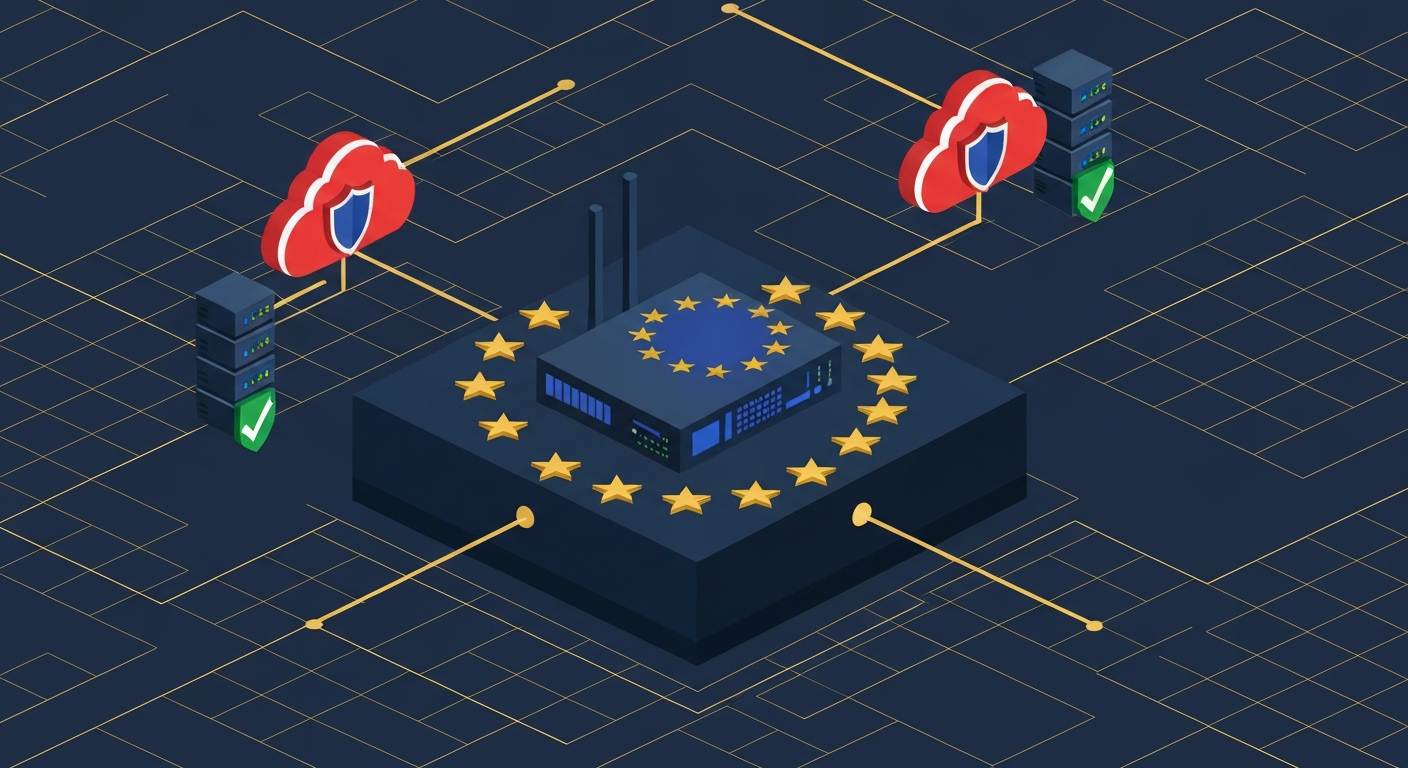
Cisco DNA Center — rebranded as Cisco Catalyst Center in 2023 — is the enterprise network management and automation platform that centralises intent-based networking across Cisco Catalyst switches, routers, wireless access points, and SD-WAN infrastructure. For many EU organisations, it is the single pane of glass through which every network device is configured, monitored, and audited. That makes its legal domicile a data sovereignty question of the highest order.
Cisco Systems Inc. is incorporated in Delaware and headquartered in San Jose, California. It is publicly traded on Nasdaq (CSCO) and has deep, documented relationships with the US federal government: a major DoD contractor, CISA critical infrastructure partner, and member of the Joint Cyber Defense Collaborative (JCDC). Under the CLOUD Act (18 U.S.C. § 2713), US law enforcement can compel Cisco to produce data stored anywhere in the world — including telemetry, configurations, and analytics that DNA Center sends to Cisco's US-operated cloud services.
This guide scores Cisco DNA Center at 21/25 on the CLOUD Act GDPR Risk Matrix — the highest score in the EU Network Monitoring Series — and presents the four EU-native alternatives that score 0/25.
CLOUD Act GDPR Risk Matrix: Cisco DNA Center 21/25
| Risk Dimension | Score | Notes |
|---|---|---|
| US parent jurisdiction | 5/5 | Cisco Systems Inc., Delaware/CA |
| Federal contractor ties | 5/5 | DoD, CISA JCDC, FedRAMP High |
| Cloud telemetry mandatory | 4/5 | Smart License + CX Cloud mandatory in default config |
| Data sensitivity | 4/5 | Network topology, device configs, user policy data |
| Transparency / DPA cooperation | 3/5 | Privacy Shield → SCCs, limited EU DPA audit rights |
| Total | 21/25 | Highest in EU Network Monitoring Series |
Series comparison:
- SolarWinds: 20/25 (SUNBURST, SEC enforcement)
- ManageEngine: 17/25 (Zoho Corp, Austin TX)
- Nagios XI: 15/25 (Nagios Enterprises LLC, Saint Paul MN)
- Cisco DNA Center: 21/25 ← this post
- Finale comparison: Post #5/5
What Is Cisco DNA Center / Catalyst Center?
Cisco DNA Center is the on-premises network management controller that implements intent-based networking across a Cisco-centric network fabric. Key capabilities include:
- Network automation: Zero-touch provisioning, software image management (SWIM), automated configuration templates
- Network assurance: AI-driven health scores for clients, applications, and network devices — built on streaming telemetry (gRPC, Model-Driven Telemetry)
- Security group tagging: TrustSec policy enforcement, micro-segmentation, user-to-device identity binding
- SD-Access fabric: Underlay/overlay management for macro-segmented campus networks
- Intent-based policy: Business intent translated into network configuration via APIs
The platform runs as a 3-node or 7-node cluster of Cisco UCS hardware appliances and communicates with Cisco's cloud services for licensing, analytics, and CX health monitoring.
5 GDPR Risks in Cisco DNA Center
Risk 1: Smart Licensing Telemetry to Cisco US Cloud
Cisco DNA Center requires Smart Software Licensing and communicates with tools.cisco.com — a Cisco-operated US server — for license verification and compliance reporting. By default, every DNA Center deployment phones home to Cisco's US infrastructure.
What this transmits:
- Virtual Account inventory: Device serial numbers, product IDs, and count of licenses consumed
- Organisational identifiers: Cisco Smart Account name, Virtual Account name (often contains company name or department)
- Network scale indicators: Number of managed devices, AP count, node licenses
- Software versions: Running IOS-XE, IOS-XD, and DNA Center versions — revealing patching posture
Under GDPR Art.28 and Art.46, transmitting this data to Cisco US requires either an adequacy decision (none for US), Standard Contractual Clauses (SCCs), or Binding Corporate Rules. Cisco offers SCCs in its Data Processing Addendum — but these do not override the CLOUD Act. US prosecutors can compel Cisco US to produce this data regardless of DPA agreements.
A Smart License Satellite (Cisco SSM On-Prem) can be deployed to intercept license traffic locally. However, this requires additional Cisco hardware, a maintenance subscription, and periodic synchronisation with Cisco's US servers — it does not eliminate the data flow, it delays it.
Risk 2: CX Cloud — Customer Experience Telemetry
Cisco CX Cloud is the post-sales analytics and support platform that became deeply integrated into DNA Center/Catalyst Center starting in DNA Center 2.3.x. It collects:
- Configuration telemetry: Running configurations of managed devices (switches, routers, WLC) are periodically uploaded to Cisco's cloud for "network health" scoring
- Feature utilisation data: Which DNA Center features are used, which workflows are executed — building a profile of your network operations practices
- Device health metrics: CPU, memory, interface utilisation aggregated in Cisco's US analytics cloud
- Open TAC case correlation: CX Cloud links device telemetry to Cisco TAC cases, creating a rich profile combining your network state with support history
CX Cloud explicitly requires internet connectivity to api-cx.cisco.com — a US-hosted endpoint. The data processing occurs in Cisco's US and APAC regions. EU customers relying on SCCs are not insulated from FISA Section 702 collection, which can target Cisco as a US electronic communication service provider.
Risk 3: Assurance Analytics — User-Device Correlation Under US Jurisdiction
DNA Center Assurance uses streaming telemetry from Cisco switches and WLCs to build per-client health scores. The Assurance data model captures:
- Client identity: MAC addresses, IP addresses, device hostname, device type fingerprint (using Cisco DHCP fingerprinting)
- User identity: When integrated with Cisco ISE (Identity Services Engine), Assurance links device identity to Active Directory user accounts
- Application experience: Cisco's Application Experience (AppX) feature tracks application-layer performance per client — mapping employee names to application usage patterns
Under GDPR Art.4(1), IP addresses and device identifiers that can be linked to individuals constitute personal data. When these are transmitted to Cisco CX Cloud or processed in cloud-backed Assurance analytics, they leave EU jurisdiction.
Why this matters for GDPR Art.44–49: Cisco has no EU adequacy decision. SCCs in Cisco's DPA provide contractual protection but do not prevent US government compelled access. The European Court of Justice's Schrems II judgment (C-311/18) held that SCCs alone are insufficient when the recipient country's surveillance law does not meet EU standards. The US Foreign Intelligence Surveillance Act does not meet those standards.
Risk 4: US Federal Contractor Status and Intelligence Community Ties
Cisco holds multiple active US government contracts and is subject to a range of executive-level data access mechanisms beyond the CLOUD Act:
- FedRAMP High Authorised: DNA Center is available for US federal deployments. This certification involves detailed technical reviews by NSA-affiliated agencies.
- JCDC Membership: Cisco Talos is a formal member of CISA's Joint Cyber Defense Collaborative, which coordinates real-time threat intelligence sharing with FBI, NSA, and CIA.
- EO 12333 / FISA 702: These executive authorities allow intelligence community access to data held by US corporations for foreign intelligence purposes — without any court order visible to Cisco's EU customers.
- DoD STIG Baseline: Cisco maintains and publishes DISA STIGs for DNA Center, indicating active engagement with US DoD security requirements.
For EU organisations operating in sectors covered by NIS2 Art.21(2)(d) (supply chain security) or operating critical infrastructure, using a US DoD contractor as the single management plane for all network devices is a documented third-party risk that supervisory authorities are increasingly scrutinising.
Risk 5: TAC Diagnostic Bundles and Device Configuration Export
When Cisco TAC troubleshooting is required, the standard workflow involves uploading a diagnostic bundle from DNA Center. These bundles contain:
- Full running configurations of all managed devices (thousands of lines of IOS-XE config)
- Network topology maps (CDP/LLDP neighbour tables, VLAN topology, routing adjacencies)
- SNMP community strings and SSH key fingerprints (in some export formats)
- User policy tables from ISE integration (user-to-VLAN, user-to-SGT mappings)
These diagnostic bundles are processed on Cisco's US TAC infrastructure. There is no documented mechanism to ensure that EU data protection law governs the handling of these uploads once received by Cisco US support engineers.
Under GDPR Art.32, organisations must implement appropriate technical measures to protect personal data during processing. Uploading network topology data — which may include employee device identifiers and application usage patterns — to US support infrastructure without an Article 46 transfer mechanism in place represents a compliance gap.
EU-Native Alternatives: 0/25 CLOUD Act Exposure
Zabbix — Zabbix SIA, Riga, Latvia (0/25)
Jurisdiction: Latvian company, no US parent, no US cloud services
CLOUD Act score: 0/25
Self-hosting: Mandatory (server runs on your infrastructure)
Zabbix is the most-deployed open source network monitoring platform globally. The Zabbix server (Apache-licensed) runs entirely on your infrastructure — on-premises, private cloud, or EU IaaS. There is no cloud connectivity requirement, no phone-home, no telemetry to vendor servers.
Zabbix covers:
- SNMP v1/v2c/v3 polling for all major network vendors (Cisco IOS, Juniper JunOS, Arista EOS, HP/Aruba, Huawei)
- Cisco-native template library with pre-built items for IOS-XE, NX-OS, IOS-XR
- Network topology discovery (LLDP, CDP auto-discovery)
- Active agent monitoring for servers
- Distributed monitoring via Zabbix Proxy (for remote sites)
- API-based configuration management
For EU organisations replacing DNA Center's monitoring functionality, Zabbix covers the assurance and health-monitoring use cases completely. The automation and zero-touch provisioning use cases require complementary tools (Ansible AWX, NetBox, Batfish).
Hosting: Hetzner (Germany), OVH (France), Scaleway (Paris) — all 0/25
Icinga 2 — Icinga GmbH, Nuremberg, Germany (0/25)
Jurisdiction: German GmbH, no US parent
CLOUD Act score: 0/25
Self-hosting: Mandatory
Icinga is a fork of Nagios (2009) that has grown into a mature, scalable monitoring platform with a modern PostgreSQL/MySQL backend, high-availability clustering, and a rich web interface (Icinga Web 2 + Icinga DB).
Relevant capabilities for network monitoring:
- Network device monitoring via SNMP, NRPE, SSH
- Icinga Director: web-based configuration management UI (replaces raw config files)
- Icinga DB: high-performance event storage (replaces NDO)
- Business process views and SLA reporting
- Built-in notification system (email, PagerDuty, Teams, Slack via plugins)
Icinga's commercial support is provided from Nuremberg, Germany. All data processing is on-premises.
Checkmk — Checkmk GmbH, Munich, Germany (0/25)
Jurisdiction: German GmbH, no US parent
CLOUD Act score: 0/25
Editions: Raw (open source), Standard, Managed Services
Checkmk (formerly Check_MK) is a commercial monitoring platform with a free Raw Edition and paid Standard/Cloud editions. It is designed for larger enterprise environments and competes directly with Nagios/Icinga in the network monitoring space.
Key strengths for Cisco network replacement:
- Auto-discovery: Passive network discovery of Cisco, Juniper, Arista, HP devices via SNMP
- HW/SW inventory: Automated inventory of network device hardware and software versions
- Cisco-specific checks: Pre-built check plugins for IOS, IOS-XE, NX-OS, ASA, Catalyst, Meraki
- Performance dashboards: Built-in time-series storage and graphing (no external TSDB required)
- REST API: Full configuration and monitoring API for automation
Checkmk is used by European KRITIS (critical infrastructure) operators and banks as a Nagios/SCOM replacement. All data stays within your perimeter.
Hosting: Available on-premises or via EU managed hosting partners.
Paessler PRTG — Paessler AG, Nuremberg, Germany (0/25)
Jurisdiction: German AG, no US parent, private company
CLOUD Act score: 0/25
Model: Commercial, perpetual + subscription licensing
Paessler PRTG (Paessler Router Traffic Grapher) is the incumbent commercial network monitoring tool for mid-market and enterprise in the DACH region. PRTG runs as a Windows or Linux server on your infrastructure.
PRTG network monitoring capabilities:
- SNMP v3: Full Cisco SNMP support including Catalyst, ASR, ISR, Nexus, Meraki (via API sensor)
- NetFlow/sFlow/IPFIX: Traffic analysis without sending data to third parties
- Packet sniffer sensor: Deep packet inspection on monitored segments
- CDP/LLDP topology maps: Auto-drawn network maps based on discovery protocols
- REST API sensor: Custom monitoring of Cisco DNA Center APIs without Cisco cloud dependency
- PRTG Enterprise Monitor: Multi-server clustering for large environments
Paessler AG is headquartered in Nuremberg (same city as Icinga GmbH and DISA). The company has no US ownership, no US cloud services, and full data residency on your infrastructure.
Migration Path: From Cisco DNA Center to EU-Native Monitoring
Replacing DNA Center is a phased process because DNA Center bundles monitoring, automation, and assurance into one platform. The monitoring component can be replaced independently of the automation component.
Phase 1: Parallel Monitoring Deployment (Weeks 1–4)
Deploy Zabbix or Checkmk alongside DNA Center without removing existing functionality:
# Example: Zabbix 7.0 LTS on Debian 12 (Hetzner CCX13 — €26/mo)
wget https://repo.zabbix.com/zabbix/7.0/debian/pool/main/z/zabbix-release/zabbix-release_latest+debian12_all.deb
dpkg -i zabbix-release_latest+debian12_all.deb
apt update && apt install -y zabbix-server-pgsql zabbix-frontend-php zabbix-nginx-conf

# Configure SNMP v3 credentials (no plaintext community strings)
# Import Cisco IOS-XE template from Zabbix template library
During Phase 1, configure SNMP v3 on all Cisco devices with local credentials. Do not rely on SNMP community strings stored in DNA Center if the goal is to eliminate US data exposure.
Phase 2: Topology Discovery and Baseline (Weeks 5–8)
Use Zabbix Network Discovery or Checkmk Auto-Discovery to build the network inventory independently of DNA Center:
- Enable LLDP/CDP on all Cisco switches for topology discovery
- Import existing device inventory from DNA Center via its REST API (exported locally — no cloud)
- Build host groups mirroring DNA Center site hierarchy
Validate that the EU-native tool captures all devices that DNA Center monitors. Use this as the baseline for comparison.
Phase 3: Assurance Replacement (Months 3–6)
DNA Center Assurance (client health, application experience) is the hardest to replace because it relies on Cisco-proprietary telemetry (KCFI, gRPC streaming from Catalyst switches). The EU-native replacement stack:
- Grafana + VictoriaMetrics (Grafana Labs EU cloud or self-hosted): Time-series storage for device telemetry
- Telegraf SNMP plugin: Collects interface counters, CPU, memory at 60-second intervals
- NetFlow/IPFIX + ntopng (self-hosted): Application-layer traffic analysis replacing AppX
- Batfish (open source network configuration analysis): Replace DNA Center config compliance checks
Phase 4: Smart Licensing Cut-Off (Month 6)
Once monitoring and assurance are fully migrated to EU-native tools:
- Deploy Cisco Smart License Satellite (SSM On-Prem) to localise license communication
- Disable CX Cloud integration in DNA Center (Settings → Cisco Accounts → CX Cloud → Disable)
- Audit
show license statuson all managed devices — confirm no direct cloud communication - Review and restrict DNA Center outbound firewall rules to block
tools.cisco.comdirect access
Note: Cisco SSM On-Prem still requires periodic "sync" to Cisco US servers (every 90 days). Full elimination of Cisco US communication requires moving to on-premises perpetual licenses rather than subscription Smart Licensing — a commercial negotiation with your Cisco account team.
NIS2 Art.21 Supply Chain Assessment: Cisco DNA Center
Under NIS2 Directive (EU) 2022/2555 Art.21(2)(d), essential and important entities must implement supply chain security measures covering "security in network and information systems acquisition, development and maintenance, including vulnerability handling and disclosure."
For EU organisations using Cisco DNA Center as their primary network management plane:
| NIS2 Requirement | Cisco DNA Center Status | Remediation |
|---|---|---|
| Supply chain risk assessment | GAP — Cisco US jurisdiction not assessed | Complete TPRA with CLOUD Act scoring |
| Vulnerability disclosure | MET — Cisco PSIRT (psirt.cisco.com) | Continue monitoring PSIRT advisories |
| Patching SLA | MET — SWIM automates IOS-XE updates | Verify SWIM is not cloud-gated |
| Access control | GAP — CX Cloud creates implicit third-party access | Disable CX Cloud, review outbound ACLs |
| Incident reporting | GAP — TAC uploads may constitute third-country transfer | Establish local diagnostic procedures |
| Business continuity | RISK — DNA Center single point of failure | Deploy HA cluster + EU-native fallback |
Supervisory authorities (BSI in Germany, ANSSI in France, NCSC-NL in the Netherlands) are beginning to request supply chain risk assessments for critical network management software. A Cisco DNA Center installation that has not been assessed against the CLOUD Act risk dimensions above represents a documented compliance gap as NIS2 national transpositions enter enforcement in 2025–2026.
TCO Comparison: Cisco DNA Center vs EU-Native Stack
| Component | Cisco DNA Center | EU-Native Stack |
|---|---|---|
| Platform licensing | €50k–€500k+ (cluster + DNA Advantage) | €0–€25k (Checkmk Standard) or €0 OSS |
| Hardware appliances | €40k–€200k (Cisco UCS M6/M7) | €500–€5k (commodity server or Hetzner) |
| Smart Licensing subscription | Included in DNA Advantage | N/A |
| CX Cloud | Included (cannot opt out without config change) | N/A |
| Support (5yr) | €30k–€150k | €5k–€30k (Checkmk/Zabbix support) |
| 5-year TCO (100-device network) | ~€200k | ~€25k |
| 5-year TCO (1000-device network) | ~€800k | ~€80k |
The TCO gap is driven primarily by Cisco's hardware appliance requirement (DNA Center runs only on Cisco UCS appliances, not on standard x86 servers) and its tiered licensing model (DNA Essentials vs. DNA Advantage vs. DNA Premier).
Decision Framework: When to Stay vs. When to Migrate
Stay with Cisco DNA Center if:
- Your network is 100% Cisco and you rely on intent-based networking automation (SD-Access fabric)
- You have active US DoD or US federal contracts that require FedRAMP-compliant tooling
- Your DPA has reviewed and accepted the Cisco SCCs + CLOUD Act risk residual
- Your organisation operates under US law and EU GDPR does not apply to the network segment in question
Migrate to EU-native alternatives if:
- You handle EU personal data on the monitored network (essentially all EU corporate networks)
- You operate under NIS2 as an essential or important entity
- You are subject to DORA (financial sector) with third-party risk requirements
- Your supervisory authority has issued guidance on US cloud management plane tools
- You are in a sector where Cisco's DoD/intelligence community ties create a conflict (public sector, healthcare, critical infrastructure)
- You want to eliminate Smart Licensing cloud dependency entirely
Conclusion: 21/25 and the Management Plane Risk
Cisco DNA Center scoring 21/25 on the CLOUD Act Risk Matrix reflects a fundamental tension: the platform is a US-designed, US-licensed, US-supported network management tool that your EU-subject network infrastructure depends on. Smart Licensing connects your network inventory to Cisco US. CX Cloud uploads configurations and health telemetry. TAC diagnostics transmit topology and policy data. Each of these creates a data-transfer channel that GDPR Art.44–49 requires to be legally grounded — and that the CLOUD Act can override regardless of your contractual DPA.
The four EU-native alternatives — Zabbix (Riga), Icinga (Nuremberg), Checkmk (Munich), and Paessler PRTG (Nuremberg) — all score 0/25. They provide SNMP, NetFlow, topology discovery, and dashboard capabilities comparable to DNA Center's monitoring functionality. The automation and intent-based networking components of DNA Center require a separate migration (Ansible AWX, NetBox, Batfish) but are not prerequisites for eliminating the data sovereignty risk from the monitoring plane.
For EU organisations beginning NIS2 compliance work in 2025–2026, auditing the network management plane is a high-priority item. A US-incorporated vendor scoring 21/25 CLOUD Act exposure controlling your entire network fabric — every switch, router, and AP — is the definition of a critical supply chain risk that Art.21(2)(d) was written to address.
Next in the EU Network Monitoring Series: Post #5/5 — Full comparison of all four tools (SolarWinds 20/25, Nagios XI 15/25, ManageEngine 17/25, Cisco DNA Center 21/25) with a decision matrix and migration guide.
EU-Native Hosting
Ready to move to EU-sovereign infrastructure?
sota.io is a German-hosted PaaS — no CLOUD Act exposure, no US jurisdiction, full GDPR compliance by design. Deploy your first app in minutes.