Ceva Logistics' Breach Triggered GDPR Article 33 Notifications at 10+ Companies: What a Cascading Vendor Breach Means for Your Processor Risk
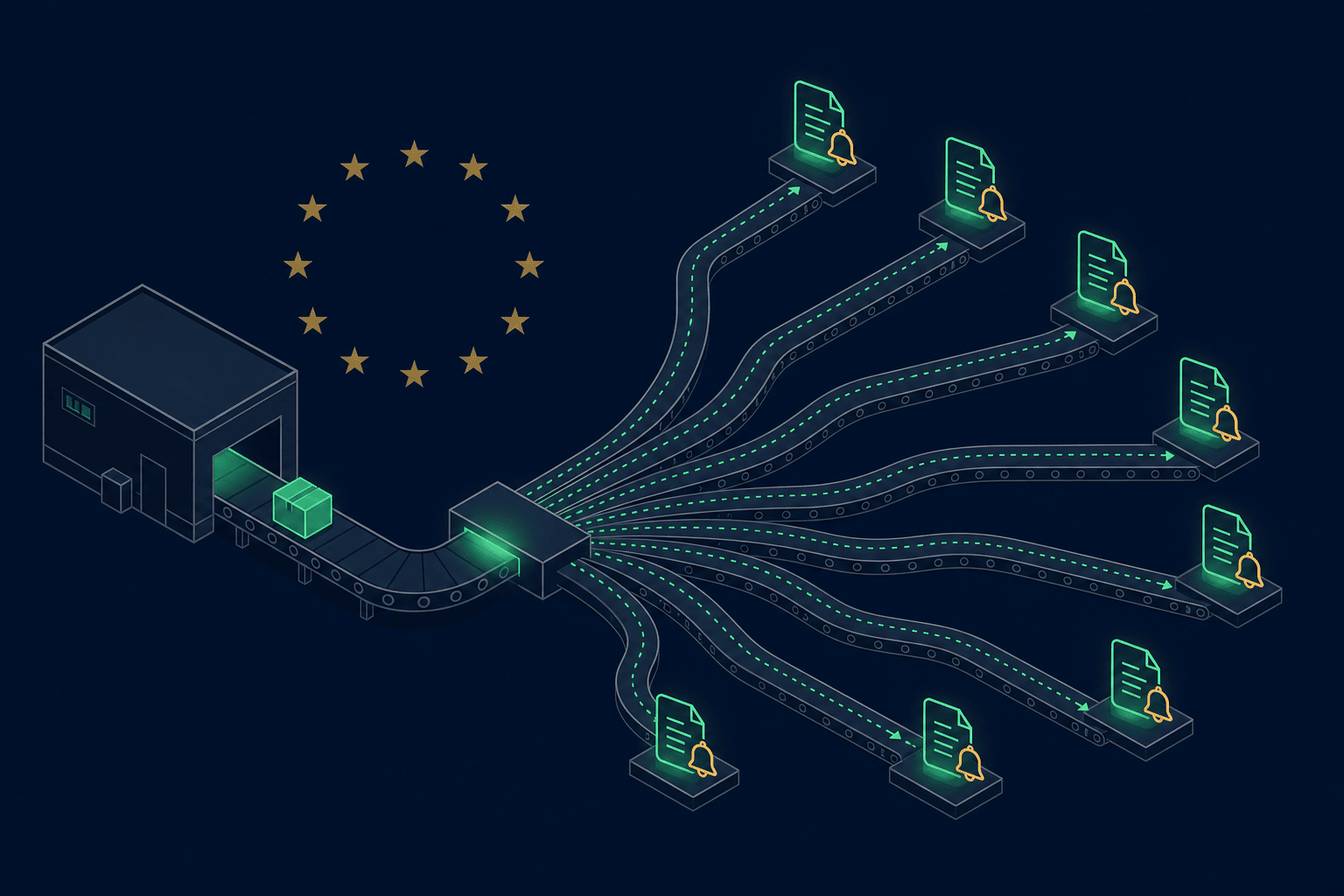
On 29 July 2026, someone broke into systems at Ceva Logistics, a France-headquartered contract-logistics giant that ships roughly 15 million parcels a year out of more than 1,000 warehouses worldwide. By the time the dust had settled two weeks later, the Dutch data protection authority had received breach reports from at least 10 separate organizations — a bank (ING), a football club (Ajax), two retailers (bol and De Bijenkorf), an eyewear brand (Ace & Tate), and Valve's Steam hardware storefront among them. None of these companies were hacked. Their shared fulfillment vendor was.
That is the part of this story worth sitting with if you run a product that outsources any part of its operations to a third party that touches customer data — which, if you use a payment processor, an email provider, a support-ticketing tool, or a warehouse, is all of you. This isn't a hypothetical about "vendor risk." It's a dated, sourced, still-unfolding case of exactly how a GDPR Article 33 obligation propagates outward from one incident to a dozen unrelated companies, at different speeds, with different outcomes — and it happened over the last two weeks, not in a textbook.
What actually happened
Here's the documented timeline, reconstructed from TechCrunch's reporting, BleepingComputer's coverage of the Valve notification, and Dutch trade press covering the bol/De Bijenkorf side of the incident:
- 29 July – 1 August 2026: Attackers gain unauthorized access to order-processing systems at one Ceva distribution center in Europe, eventually affecting eight warehouses. Ceva itself says: "The operational impact is limited to eight warehouses. No other CEVA systems globally were affected, and all other operations continue without incident."
- 1 August: Ceva confirms the incident to bol and De Bijenkorf. Data exposed: names, addresses, postal codes, phone numbers, and order details. No indication of compromised payment data, passwords, or login credentials.
- 3 August: bol reports the incident to the Dutch data protection authority, the Autoriteit Persoonsgegevens — two days after Ceva's confirmation, comfortably inside the 72-hour window.
- 6 August: bol and De Bijenkorf email affected customers directly, citing the need to first establish what had actually happened.
- 7 August: Ceva separately warns its own employees and temp staff that names, birth dates, and contact details may have been exposed — a reminder that Ceva is simultaneously acting as a GDPR controller for its own workforce's data and as a processor for its clients' customer data in the same incident.
- 7 August: Valve says it first learns of the breach — a full week after Ceva had already confirmed the incident to bol.
- 10 August: Valve notifies affected European Steam hardware customers directly, warns them to expect phishing attempts using the stolen shipping details, and confirms it is "pressing CEVA for the full scope of what was taken" while notifying data protection authorities in the countries affected.
By 10 August, a spokesperson for the Dutch DPA, quoted by TechCrunch, confirmed the agency had "received data breach reports from 10 organizations in relation to the incident." Ceva itself has not commented publicly. This is not a CLOUD Act story — Ceva is a European company, headquartered in France, and this is a purely intra-EU processor-chain problem.
Why one breach becomes ten separate legal obligations
The mechanism here is not exotic — it's the ordinary structure of GDPR Article 4, applied at scale. When bol hands Ceva a customer's name, address, and phone number so Ceva can deliver a package, bol is the controller — it determines the purpose and means of that processing (Art.4(7)). Ceva, processing that data purely on bol's instructions to fulfill the delivery, is the processor (Art.4(8)). The same structure repeats independently for every one of Ceva's clients: ING, Ajax, De Bijenkorf, Ace & Tate, and Valve each have their own separate controller relationship with Ceva, governed by their own separate data processing agreement.
Article 28(3)(f) requires that DPA to obligate the processor to "assist the controller in ensuring compliance with the obligations pursuant to Articles 32 to 36" — which includes breach notification. And Article 33(2) is explicit about the processor's own duty: it "shall notify the controller without undue delay after becoming aware of a personal data breach." Only the controller has to notify the supervisory authority (Art.33(1), within 72 hours "where feasible"), but that clock only starts once the controller itself becomes aware — which, in a processor breach, means only once the processor tells it.
That's the structural reason one compromised warehouse system turns into ten independent Article 33 filings instead of one. There is no "master notification" a processor files on behalf of its clients. Each controller has its own clock, its own supervisory authority relationship, and its own legal exposure — even though every one of them is reacting to the exact same underlying incident, discovered by someone else, on someone else's infrastructure.
The Bol timeline is a working example of the clock — and where it doesn't have a number
The bol side of this case is a clean illustration of Article 33(1) working as designed: Ceva told bol on 1 August, and bol notified the Dutch AP on 3 August — well inside the 72-hour window, even accounting for a weekend. That's the part of the GDPR breach-notification machinery that gets the most attention, because it has a hard number attached to it. (For the full mechanics of the 72-hour supervisory-authority clock and the separate, risk-triggered Article 34 individual-notification duty, see our dedicated breakdown linked below — this post isn't trying to re-explain those from scratch.)
The part that doesn't get as much attention is the step before that clock starts: Article 33(2)'s processor-to-controller relay. The statute says "without undue delay." It does not say 24 hours, 48 hours, or any other number. And the Ceva case shows exactly why that ambiguity matters in practice: bol learned of the incident on 1 August. Valve — relying on the same underlying Ceva breach, at the same warehouses, in the same timeframe — says it didn't learn until 7 August. That's a six-day gap between when one client of Ceva's was informed and when another was, about what appears to be substantially the same incident.
To be clear about what we can and can't say from public reporting: we don't know Ceva's internal notification sequence, whether Valve's contract with Ceva routes through a different sub-processor layer, or whether there's a legitimate operational reason for the gap. Neither TechCrunch's nor BleepingComputer's reporting resolves that question, and neither do we. That's precisely the point worth internalizing: "without undue delay" is not a number you can calendar against. If your processor's contractual obligation to notify you stops at that phrase and goes no further, you are trusting your processor's judgment about urgency — not a fixed SLA — to start your own 72-hour clock on time.
Vendor concentration is a compliance risk, not just an operational one
The operational framing of this story — "single point of failure," "one vendor, many warehouses" — is the one that's been getting the headlines. But there's a compliance-specific version of that same risk that's easy to miss: every additional controller relying on the same processor is another independent notification obligation riding on that processor's incident-response discipline. Ceva's clients didn't choose to share risk with ING, Ajax, Bol, De Bijenkorf, Ace & Tate, and Valve. They just happened to share a warehousing vendor, and that shared dependency turned into ten simultaneous, uncoordinated compliance sprints.
This scales down to teams far smaller than any of Ceva's named clients. If your product relies on one payment processor, one email-delivery API, one customer-support platform, and one analytics vendor, you have four separate processor relationships, each one capable of independently triggering your Article 33 clock on a schedule you don't control and usually can't predict. The number of vendors that can start your breach-notification obligation is exactly the number of processors you have — and almost nobody inventories that list with compliance risk in mind, only with "which SaaS bill do we pay this month" in mind.
A practical checklist for the controller side of this relationship
If you're the controller in one of these relationships — which is true anytime you're the one deciding what data gets sent to a vendor and why — here's what the Ceva case suggests is worth checking before you need it:
- Does every processor DPA specify a concrete notification SLA, not just "without undue delay"? A DPA that names a number (e.g., notify within 24 hours of the processor becoming aware) gives you a contractual lever if a vendor drags its feet; one that only repeats the statutory phrase gives you nothing but a lawsuit after the fact.
- Do you know, today, the full list of processors that could start your Article 33 clock? Payment, email, support, analytics, logistics, hosting — anyone touching personal data on your instructions counts, including sub-processors your primary vendor uses without telling you unless your DPA requires disclosure.
- Is your own breach-response playbook triggerable by a third-party notification, not just an internal alert? Many incident-response runbooks assume the trigger is your own monitoring. A vendor email is a valid trigger too, and if your playbook doesn't have that entry point, the first 72 hours start with someone improvising.
- Does your DPA require the processor to disclose its own sub-processors and their locations? Ceva itself has clients and, per its own employee notice, apparently multiple internal data flows — a chain you can only reason about if your contract requires transparency into it.
- Have you separated the Article 33 (supervisory authority, 72h) and Article 34 (data subjects, no fixed hour count but "without undue delay") decision points in your own process? bol's timeline shows these can legitimately land days apart — AP notification on day 2, customer notification on day 5 — because assessing individual risk under Art.34 can take longer than reporting the fact of a breach under Art.33. Conflating the two into a single deadline in your own runbook risks either notifying customers before you actually know what happened, or delaying the SA report while you finish that assessment.
A small tool: tracking your own processor-notification clock
None of the deadlines above are complicated math, but "was this notification within Article 33's window" is exactly the kind of question that's easy to get wrong under pressure, at 11pm, after a vendor email you weren't expecting. A minimal tracker that timestamps the two events that actually matter — when the processor said something, and when you (the controller) actually became aware — removes the ambiguity:
from dataclasses import dataclass
from datetime import datetime, timedelta

SEVENTY_TWO_HOURS = timedelta(hours=72)


@dataclass
class ProcessorBreachEvent:
    processor_name: str
    processor_became_aware_at: datetime | None  # if known/disclosed
    controller_notified_at: datetime            # when YOU actually learned — this starts your clock

    @property
    def sa_notification_deadline(self) -> datetime:
        """Art.33(1): your 72h clock starts when you became aware, not when the
        processor did — the gap between those two timestamps is exactly the
        Art.33(2) relay this post is about."""
        return self.controller_notified_at + SEVENTY_TWO_HOURS

    @property
    def relay_delay(self) -> timedelta | None:
        """How long the processor sat on it before telling you, if disclosed."""
        if self.processor_became_aware_at is None:
            return None
        return self.controller_notified_at - self.processor_became_aware_at

    def status(self, now: datetime) -> str:
        remaining = self.sa_notification_deadline - now
        if remaining < timedelta(0):
            return f"OVERDUE by {abs(remaining)} — Art.33(1) window has closed, notify immediately with a documented delay reason"
        return f"{remaining} remaining until the 72h Art.33(1) deadline"


# Example: reconstructing the bol side of the Ceva timeline
bol_event = ProcessorBreachEvent(
    processor_name="Ceva Logistics",
    processor_became_aware_at=None,  # not publicly disclosed
    controller_notified_at=datetime(2026, 8, 1, 12, 0),
)
print(bol_event.status(datetime(2026, 8, 3, 10, 0)))
# -> "50:00:00 remaining until the 72h Art.33(1) deadline" — bol still had time
#    when it actually filed with the Dutch AP.
The one-line version of what this class encodes: your deadline starts at controller_notified_at, not at the incident date and not at the processor's own discovery date. If your incident-response tooling — or your mental model — is keyed to "when did the breach happen" instead of "when did I, the controller, find out," you will consistently misjudge how much time you actually have, in either direction.
No small-business exemption here
It's worth being explicit about one thing this case does not have in common with some of the size-tiered obligations we've covered elsewhere on this blog. The DSA's systemic-risk provisions only bind platforms above a 45-million-user threshold. NIS2 has essential/important entity size classes with different obligations. GDPR Article 33 has none of that. If you are a controller — meaning you decided what personal data gets collected and why — the 72-hour notification duty applies at any size, with any number of users, the moment you become aware of a qualifying breach. A two-person startup using a logistics processor is bound by exactly the same Article 33(1) clock as bol.
The Ceva case is useful precisely because it's not an edge case or a novel legal theory — it's the plainest possible version of controller/processor mechanics, playing out in public, with named companies, real dates, and a visible gap in how fast the relay actually moved between clients. That gap is the risk. It's also the one thing you can close yourself, in your own vendor contracts, before you're the tenth organization filing a report about a breach you didn't cause.
See Also
- Is Your PaaS a Joint Controller? What CNIL's May 2026 Cloud Guidance Actually Says — the underlying controller/processor/joint-controller classification framework this post's Ceva/bol relationship is a textbook example of.
- EDPB's Common Data Breach Notification Template: What Developers Need to Know Before 5 August 2026 — the structured 126-field format your own Article 33 filing will likely use once the EDPB template is finalized.
- GDPR Art.33-34: Breach Notification — 72h SA Reporting, Data Subject Communication & Breach Register Design — the full mechanics guide for both articles, including the high-risk assessment methodology behind the Art.34 individual-notification decision this post only summarizes.
- GDPR Article 28: Data Processing Agreements — What Every SaaS Developer Must Include in Their DPA — the eight mandatory DPA clauses, including where a concrete processor-notification SLA belongs in your own vendor contracts.
EU-Native Hosting
Ready to move to EU-sovereign infrastructure?
sota.io is a German-hosted PaaS — no CLOUD Act exposure, no US jurisdiction, full GDPR compliance by design. Deploy your first app in minutes.