Buildkite EU Alternative 2026: Australian CI/CD Under Five Eyes — GDPR Risk and EU-Native Options
Post #4 in the sota.io EU DevOps Tools Series
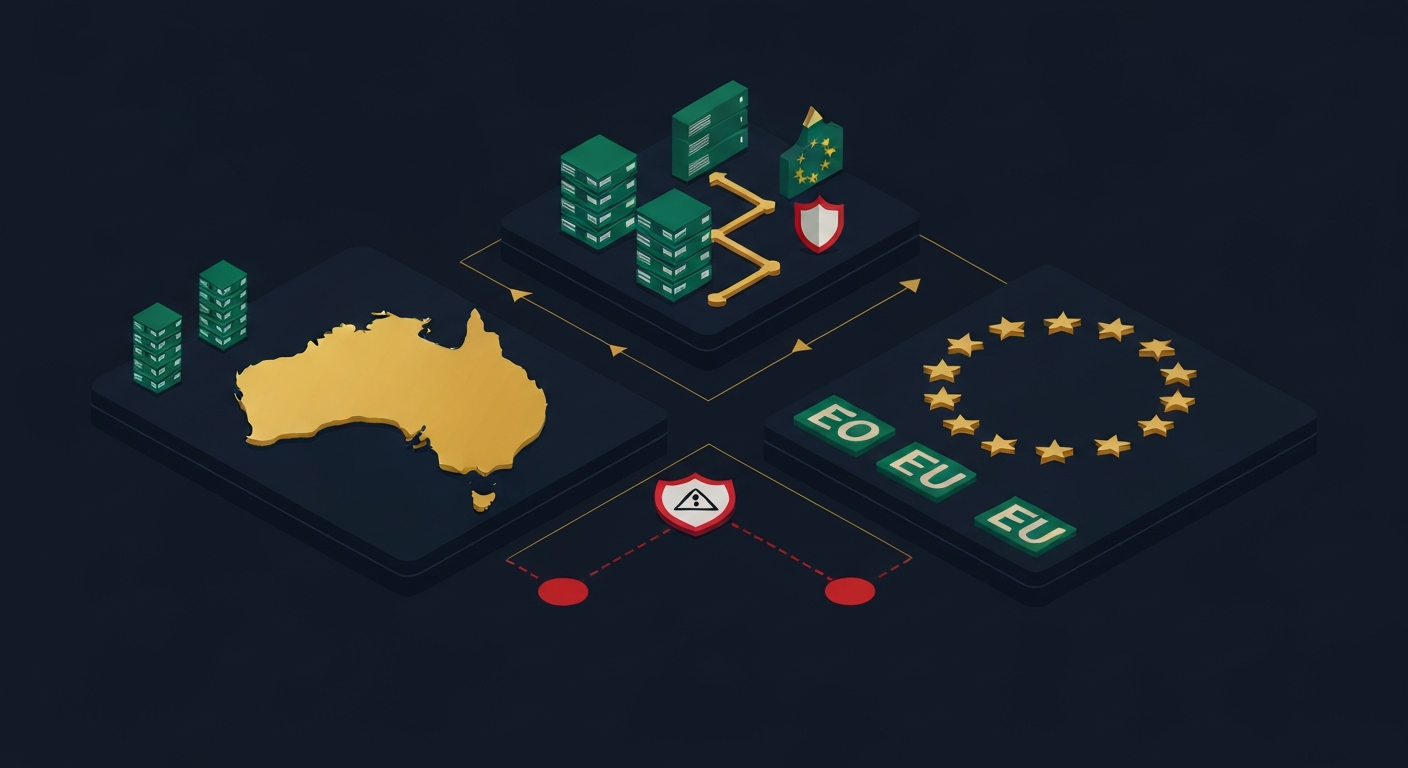
Buildkite is one of the most developer-loved CI/CD platforms in the market. Its agent-based architecture — where you run Buildkite agents on your own infrastructure while the control plane manages orchestration — has made it a popular choice for engineering teams that need flexible, scalable pipelines without managing a fully self-hosted CI server. Shopify, Lyft, Twilio, and PagerDuty are among its well-known customers.
But Buildkite's legal structure creates a compliance problem that many European engineering teams have not fully assessed. Buildkite is headquartered in Melbourne, Victoria, Australia — a member of the Five Eyes intelligence alliance. It operates a US entity (Buildkite Inc.) that adds a second layer of US CLOUD Act exposure. And Australia has no EU adequacy decision under GDPR, meaning that data transfers from the EU to Buildkite's infrastructure require explicit legal instruments — instruments that provide no protection against intelligence-agency requests.
This guide documents the legal structure, the Five Eyes risk, and presents EU-native CI/CD alternatives for teams that need genuine data sovereignty for their build pipelines.
Buildkite: Corporate Structure and Jurisdiction
Buildkite was founded in 2013 by Keith Pitt and Tim Lucas in Melbourne, Australia. The company raised a $21M Series A in 2020 from Nexus Venture Partners and Eight Roads Ventures, and has grown to serve thousands of engineering teams globally.
Legal Entities
Buildkite operates through at minimum two corporate entities:
| Entity | Jurisdiction | Governing Law |
|---|---|---|
| Buildkite Pty Ltd | Melbourne, Victoria, Australia | Australian law (Privacy Act 1988, TIAA 1979) |
| Buildkite Inc. | United States (Delaware C-Corporation) | US federal law (CLOUD Act applicable) |
The Australian parent entity is subject to Australian federal law. The US entity — Buildkite Inc. — is a Delaware-incorporated C-Corporation, which means it falls squarely within the scope of the Clarifying Lawful Overseas Use of Data Act (18 U.S.C. § 2713).
What Data Buildkite Holds
The Buildkite architecture separates the control plane (hosted by Buildkite) from the agent execution environment (which you host). However, the control plane holds data that is critical for EU GDPR compliance assessment:
| Data category | Where it lives | GDPR relevance |
|---|---|---|
| Build logs | Buildkite control plane (AWS) | Full output of every build step, including error messages with internal hostnames, stack traces, and occasionally credentials leaked via misconfiguration |
| Pipeline definitions | Buildkite control plane | YAML/JSON pipeline configs often contain environment variable names, artifact paths, and step configurations |
| Environment variables (secrets) | Buildkite Secret Store or passed at runtime | API keys, database credentials, signing certificates — highly sensitive |
| Webhooks and GitHub tokens | Buildkite control plane | OAuth tokens and personal access tokens for SCM integration |
| Build metadata and annotations | Buildkite control plane | Developer identities (committer names, emails), branch names, commit SHAs |
| Agent registration tokens | Buildkite control plane | Authentication tokens for your self-hosted agents |
Even if your build agents run entirely on EU infrastructure — a deliberate architectural choice that Buildkite enables — the control plane that receives logs, stores pipeline configurations, and manages agent authentication sits outside the EU under Australian and potentially US jurisdiction.
The Five Eyes Problem for European CI/CD Data
The Five Eyes alliance (FVEY) is an intelligence-sharing partnership among the United States, United Kingdom, Canada, Australia, and New Zealand. The legal framework governing Australian intelligence collection is primarily the Telecommunications (Interception and Access) Act 1979 (TIAA) and the Australian Signals Directorate Act 2018 (ASD Act).
Under this framework, the Australian Signals Directorate (ASD) — the Australian equivalent of the NSA — has broad authority to collect signals intelligence. Critically, intelligence collected by ASD is routinely shared with partner agencies including the NSA (US), GCHQ (UK), CSE (Canada), and GCSB (New Zealand) under FVEY agreements.
Why This Matters for EU Build Pipelines
The Five Eyes surveillance perimeter effectively encompasses all five member nations. Data held by an Australian company can be accessed by Australian intelligence and shared with US intelligence — without any legal process that would be visible to a European customer or their DPA.
For a CI/CD platform, this creates a specific risk vector:
Source code and build secrets processed by an Australian CI/CD platform are potentially accessible to five intelligence agencies without any GDPR-enforceable process.
This is not a theoretical risk. In practice, CI/CD platforms hold some of the most sensitive data in a development organisation — deploy keys, container registry credentials, signing certificates, API tokens for third-party services, and database connection strings. A build pipeline that deploys to production necessarily has credentials that provide write access to production systems.
GDPR and the Australia Transfer Problem
The General Data Protection Regulation (GDPR) restricts transfers of personal data to third countries under Chapter V (Articles 44–49). For a transfer to be lawful, one of three conditions must be met:
- Adequacy decision (Art. 45) — the European Commission has determined that the destination country provides an adequate level of protection
- Appropriate safeguards (Art. 46) — typically Standard Contractual Clauses (SCCs)
- Derogations (Art. 49) — consent, performance of a contract, or other specific grounds
Australia Has No EU Adequacy Decision
As of 2026, Australia does not have an EU adequacy decision. The European Commission has evaluated a limited number of countries (including UK, Japan, South Korea, and Israel) but Australia is not among them. This means that transfers of personal data from the EU to Buildkite's Australian infrastructure cannot rely on Art. 45.
This forces European Buildkite customers to rely on Standard Contractual Clauses (SCCs) — but with a critical limitation: SCCs contractually require the data importer to resist government access requests and notify the data exporter if this becomes impossible. Intelligence access under TIAA or Five Eyes sharing is precisely the scenario where an Australian company cannot make this guarantee.
The Schrems II ruling (C-311/18, July 2020) by the EU Court of Justice established that SCCs are not adequate in jurisdictions where government surveillance is not subject to GDPR-equivalent constraints or where the data subject has no effective judicial remedy. Australia's TIAA regime does not provide EU residents with effective judicial remedies against ASD access to their data.
CLOUD Act Exposure via Buildkite Inc. (US Entity)
The US entity — Buildkite Inc. — is a Delaware C-Corporation. Under 18 U.S.C. § 2713 (the CLOUD Act), any US-incorporated company must comply with lawful US government orders for data "regardless of whether such data is stored on premises, in a data center, or in a cloud" and "regardless of where the data is located."
This means that:
- Even if Buildkite stores your build logs and pipeline configurations on AWS infrastructure in EU regions
- Even if your build agents run entirely in Germany or France
- A lawful US government order served on Buildkite Inc. can compel production of that data
The combination of Australian jurisdiction (Five Eyes) and US jurisdiction (CLOUD Act through Buildkite Inc.) creates a double exposure that has no parallel in a genuinely EU-native CI/CD platform.
| Jurisdiction | Legal basis for government access | GDPR-compatible? |
|---|---|---|
| Australia (Buildkite Pty Ltd) | TIAA 1979, ASD Act 2018 | No — no adequacy, no effective remedy |
| United States (Buildkite Inc.) | CLOUD Act (18 U.S.C. § 2713) | No — CJEU Schrems II position unchanged |
Who in Your Pipeline Is a Data Subject?
Under GDPR, personal data is any information relating to an identified or identifiable natural person. In a CI/CD context, data subjects include:
- Developers whose names and email addresses appear in commit metadata
- Employees whose authentication tokens and credentials are used in builds
- End users if build processes access databases containing user data (e.g., for integration tests)
- Third-party contractors whose code contributions trigger pipeline runs
When build logs, pipeline definitions, or webhook payloads are transmitted to Buildkite's control plane — outside the EU — this constitutes a data transfer under GDPR Chapter V. For Australian and US-exposed infrastructure, this transfer lacks a lawful basis under current EU law.
EU-Native CI/CD Alternatives to Buildkite
The market for EU-native CI/CD platforms has matured significantly. The following alternatives provide either full EU jurisdiction or genuinely open self-hosted architectures that eliminate the control-plane problem entirely.
Woodpecker CI — EU-Native Open Source (Recommended)
Woodpecker CI is an open-source CI/CD platform forked from Drone CI and maintained by an active community with strong European participation. Woodpecker has no control plane — you host the server component entirely, with no external data transmission.
| Dimension | Woodpecker CI | Buildkite |
|---|---|---|
| Legal entity | Community project (no commercial entity) | Buildkite Pty Ltd (Australia) + Buildkite Inc. (US) |
| Control plane | Self-hosted (your infrastructure) | Buildkite cloud (Australia/US jurisdiction) |
| Five Eyes exposure | None (no external data transmission) | Yes (Australian company, TIAA applicable) |
| CLOUD Act exposure | None | Yes (US entity, Buildkite Inc.) |
| EU adequacy required | No (data stays in EU) | Yes (and not available for Australia) |
| Pricing | Free (open source) | Per-agent-minute model |
Woodpecker integrates with Gitea, GitHub, GitLab, and Forgejo. Deploying it on Hetzner (Germany) or Scaleway (France) gives you a complete EU-sovereign CI/CD pipeline with no data leaving the EU.
Forgejo Actions — Gitea-Compatible EU-Native CI
Forgejo is an EU-community fork of Gitea that includes built-in CI/CD via Forgejo Actions — compatible with GitHub Actions workflow syntax. Forgejo is governed by a French non-profit (Codeberg e.V. contributes infrastructure) and has no commercial entity.
Hosting Forgejo on EU infrastructure gives you source code management, issue tracking, and CI/CD in a single stack — all under GDPR-compliant EU jurisdiction. The workflow syntax is compatible with GitHub Actions, which reduces migration effort for teams already familiar with YAML-based pipelines.
GitLab Self-Managed (EU Infrastructure)
GitLab Inc. is a Delaware C-Corporation listed on NASDAQ — similar CLOUD Act exposure as Buildkite for GitLab.com (the SaaS version). However, GitLab's Community Edition and Enterprise Edition can be self-hosted on EU infrastructure.
A self-managed GitLab instance on Hetzner or OVHcloud eliminates the US jurisdiction problem entirely. GitLab's CI/CD is mature, widely adopted, and has a large ecosystem of community-contributed runners and templates.
Note: this self-hosted approach is recommended specifically because it eliminates the GitLab.com SaaS jurisdiction. GitLab.com itself remains a US-entity-operated service and does not resolve the CLOUD Act problem.
Drone CI (Self-Hosted on EU Infrastructure)
Drone CI is now developed by Harness, Inc. (San Francisco, California) — a CLOUD Act-exposed US company. However, the open-source Drone runner can be self-hosted, and the self-hosted community edition does not require connecting to any Harness or Drone cloud service.
Self-hosting Drone on EU infrastructure eliminates the jurisdiction problem, but the self-hosted path requires more operational investment than Woodpecker CI, which is designed specifically for self-hosted deployments.
Jenkins (Mature, Self-Hosted, Apache Foundation)
Jenkins is the world's most widely deployed open-source CI/CD automation server, maintained by the Apache Software Foundation — a 501(c)(3) non-profit incorporated in Delaware, but Jenkins itself has no cloud control plane. Every Jenkins deployment is entirely self-hosted.
Jenkins on Hetzner or Scaleway provides full EU sovereignty for your CI/CD data. The trade-off is operational complexity: Jenkins requires more maintenance than managed platforms like Buildkite, and its plugin ecosystem — while enormous — requires careful version management.
Deploying EU-Native CI/CD on EU Infrastructure
All of the above open-source alternatives can be deployed on EU-sovereign infrastructure. The recommended stack for an EU development team moving off Buildkite:
Infrastructure layer:    Hetzner Cloud (Germany) or Scaleway (France)
                         → Guaranteed EU jurisdiction, no US parent
CI/CD server:            Woodpecker CI or self-managed GitLab
                         → No external control plane, data stays in EU
SCM integration:         Forgejo (EU-native) or self-managed GitLab
                         → Source code never leaves EU infrastructure
Secrets management:      HashiCorp Vault (self-hosted) or Infisical (EU-native)
                         → Credentials not transmitted to Five Eyes jurisdiction
Artifact registry:       Harbor (self-hosted) on EU infrastructure
                         → Container images and build artifacts in EU
sota.io can host all of these components — Woodpecker CI, GitLab runners, Forgejo, and Vault — as container workloads on EU-sovereign infrastructure with no US parent company. See the deployment guide →
Assessing Your Current Buildkite Exposure
If you are currently using Buildkite, the practical compliance assessment for your DPO involves:
- Identify data subjects in your builds — developer identities in commits, employee tokens, any user data in integration test databases
- Map data flows to the Buildkite control plane — build logs, pipeline definitions, webhook payloads, agent tokens
- Assess your current transfer mechanism — are you relying on SCCs? Has a Transfer Impact Assessment (TIA) been completed for Australian transfers?
- Evaluate Five Eyes exposure for your threat model — for most development teams building commercial software, intelligence access is low-probability but non-zero
- Assess CLOUD Act exposure via Buildkite Inc. — particularly relevant for teams in regulated industries (finance, healthcare, government)
Conclusion
Buildkite is a technically excellent CI/CD platform, and its agent-based architecture is genuinely flexible. But its Australian headquarters and US corporate entity create a compliance profile that is difficult to reconcile with strict GDPR requirements for EU personal data:
- Australia is a Five Eyes member with intelligence-sharing access to EU build data without court-visible process
- Australia has no EU adequacy decision — SCCs are the only transfer mechanism, but they provide no protection against Five Eyes access
- Buildkite Inc. (US entity) is CLOUD Act-compellable — a second jurisdiction with mandatory data access authority
- Build pipelines carry some of the most sensitive data in your organisation — source code, deploy keys, signing certificates, production credentials
For EU development teams with genuine GDPR compliance requirements, the combination of Five Eyes jurisdiction, CLOUD Act exposure, and no EU adequacy creates a transfer risk that is difficult to mitigate through contractual means alone.
Open-source self-hosted alternatives — Woodpecker CI, self-managed GitLab, or Jenkins — deployed on EU-sovereign infrastructure (Hetzner, Scaleway, OVHcloud) eliminate this risk entirely by keeping all CI/CD data within GDPR-governed EU jurisdiction.
Post #4 in the sota.io EU DevOps Tools Series. See also: GitHub Actions EU Alternative · CircleCI EU Alternative · Travis CI EU Alternative
EU-Native Hosting
Ready to move to EU-sovereign infrastructure?
sota.io is a German-hosted PaaS — no CLOUD Act exposure, no US jurisdiction, full GDPR compliance by design. Deploy your first app in minutes.