Azure Service Bus EU Alternative 2026: CLOUD Act 21/25, PRISM, and GDPR-Compliant Message Queuing
Post #4 in the sota.io EU Message Broker Series
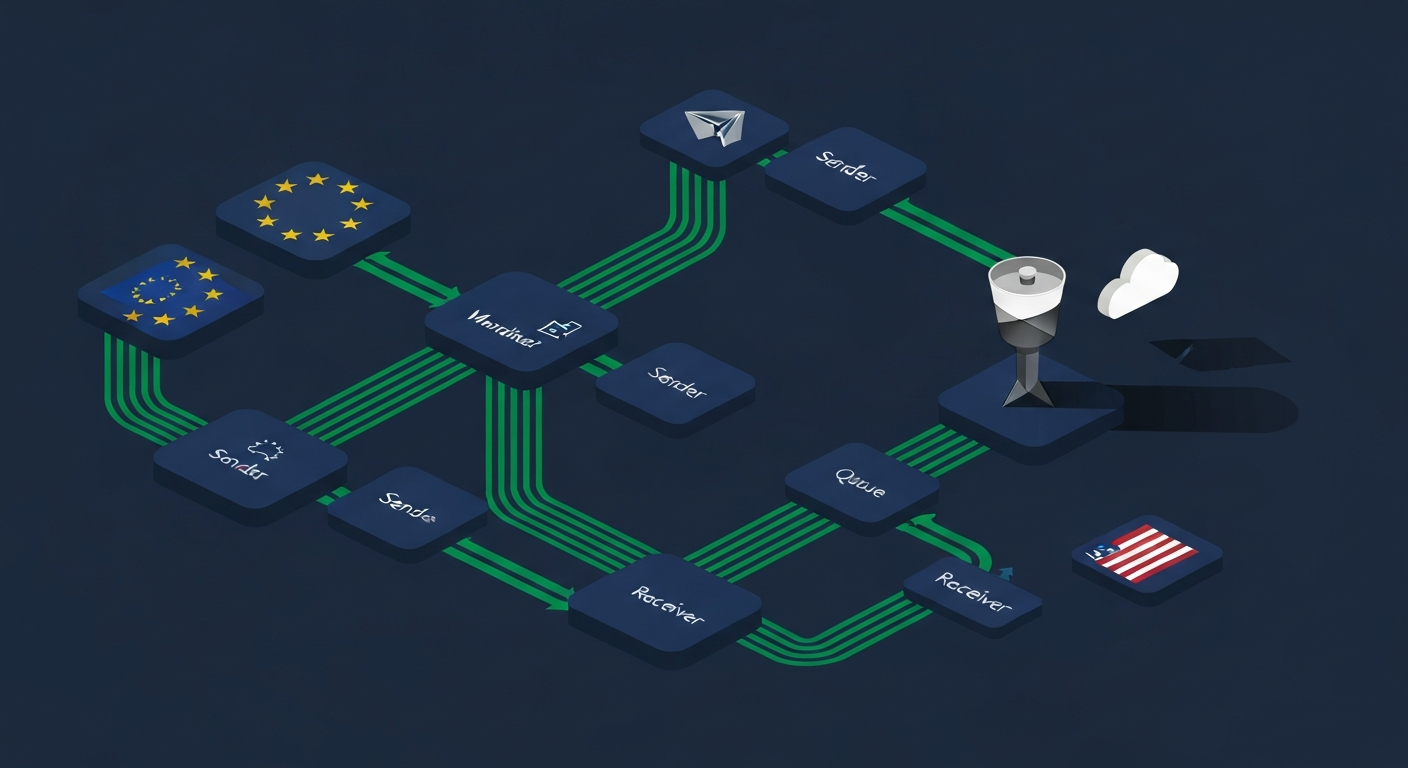
Azure Service Bus is the dominant enterprise message broker on the Microsoft Azure platform, used by thousands of European enterprises for order processing pipelines, event-driven microservices, and inter-service communication. It integrates natively with Azure Functions, Logic Apps, and the broader Microsoft 365 ecosystem — making it the default choice for organisations already running on Azure.
But Azure Service Bus is operated by Microsoft Corporation, headquartered in Redmond, Washington State — a company incorporated in Delaware, a PRISM participant since at least 2007, and one of the largest FedRAMP-authorised cloud providers serving the US government, DoD, and intelligence community. Under the CLOUD Act (18 U.S.C. §2713), Microsoft must comply with US law enforcement data requests regardless of where the data physically resides.
For European enterprises under GDPR, this creates a structural conflict: your message queues, dead-letter content, and namespace access logs are subject to US law enforcement jurisdiction even when hosted in Azure's EU data centres.
Microsoft Corporation: The CLOUD Act Exposure
Azure Service Bus is a service of Microsoft Corporation (NASDAQ: MSFT), incorporated in the State of Delaware and headquartered in Redmond, Washington. The company is a US domestic entity subject to:
- CLOUD Act §2713 (18 U.S.C.): US government can compel Microsoft to produce data stored anywhere in the world, including EU Azure regions
- FISA Section 702: Authorises NSA to collect data from US electronic communications providers — Microsoft has been a PRISM participant since 2007 (per Snowden documents and subsequent court records)
- Executive Order 12333: Broader NSA collection authority beyond FISA
- National Security Letters (NSL): FBI can issue gag-ordered data demands without judicial review
Microsoft's participation in PRISM — the NSA programme that collects internet communications from major US tech providers — is the most significant jurisdictional risk factor for European message broker deployments. Under PRISM, the NSA can access communications content and metadata from Microsoft systems, including Azure infrastructure.
CLOUD Act Risk Matrix: 21/25
| Factor | Score | Evidence |
|---|---|---|
| US parent company (Delaware/WA) | 5/5 | Microsoft Corp. incorporated Delaware, HQ Redmond WA |
| PRISM participant | 5/5 | Documented 2007 PRISM participation, FISA 702 orders |
| FedRAMP High authorised | 3/5 | Azure Government FedRAMP High, DoD IL2/IL4/IL5 |
| DoD/NSA/FBI/CIA contracts | 5/5 | JEDI successor (JWCC $9B), Azure Government Secret/Top Secret |
| Gag-order compliance (NSL) | 3/5 | NSL compliance confirmed, limited transparency reports |
| Total | 21/25 | Same as AKS (#1111), Azure API Mgmt (#1138) |
The 21/25 score is the highest CLOUD Act exposure rating in the EU Message Broker Series alongside Azure API Management. It reflects Microsoft's deep integration with US government infrastructure across all classification levels including Top Secret/SCI.
Azure Service Bus Architecture: Where Personal Data Lives
Azure Service Bus offers two service tiers — Standard and Premium — with different namespace isolation models. Understanding which components process personal data under GDPR Art.4 is essential for transfer impact assessments.
Namespace and Queue Metadata
Every Azure Service Bus deployment creates a namespace (e.g., mycompany.servicebus.windows.net) with associated queues and topics. This metadata is managed by Azure Resource Manager and stored in Microsoft's global control plane:
- Namespace DNS records: Registered in Microsoft's global DNS infrastructure, not isolated to EU regions
- Queue/topic names: Often encode business context (e.g.,
customer-orders-eu-west,user-registration-events) — these names can constitute personal data under GDPR Art.4(1) when they reference identifiable individuals or processes - Shared Access Signature (SAS) tokens: Authentication tokens scoped to namespaces or entities, stored in Azure Active Directory (now Entra ID) — Microsoft Corp. jurisdiction
- RBAC assignments: Azure Service Bus uses Azure Role-Based Access Control managed by Microsoft Entra ID (formerly Azure AD) — US entity
Message Content and Payload
Azure Service Bus messages can contain arbitrary binary or text payloads. In typical enterprise deployments, these include:
- Order data: Customer names, addresses, purchase amounts, payment reference IDs
- User events: Registration confirmations, login events, session tokens
- Healthcare HL7/FHIR messages: Patient identifiers, clinical codes (Art.9 special categories)
- Financial transaction records: Bank account references, IBAN fragments, amount + counterparty data
Under GDPR Art.4(1), any message payload containing data that can directly or indirectly identify a natural person is personal data. Azure Service Bus does not provide end-to-end encryption of message content by default — Microsoft's platform encryption covers data at rest, but Microsoft holds the encryption keys.
Dead-Letter Queues: The GDPR Art.17 Problem
Dead-letter queues (DLQ) are a critical GDPR compliance risk in Azure Service Bus deployments. When a message exceeds its delivery count or fails processing, it is automatically moved to the dead-letter queue ($DeadLetterQueue) associated with the source queue or subscription.
The GDPR implications:
-
Retention: DLQ messages have a configurable TTL (default: 14 days maximum lock duration, but the message itself remains until explicitly deleted). Messages containing personal data may persist far beyond the intended processing window, violating GDPR Art.5(1)(e) storage limitation.
-
Access control: DLQ access requires the
Listenclaim on the entity — in many deployments, DLQ access is granted more broadly than intended, exposing personal data to additional processors. -
Right to erasure (Art.17): When a customer requests data deletion, DLQ contents are often overlooked in erasure workflows. Messages in dead-letter queues containing the customer's data must also be located and deleted — technically complex in high-throughput systems.
-
Audit logging: Azure Monitor logs DLQ operations including message counts and metadata — these logs flow through Azure Monitor's global infrastructure.
Azure Service Bus Insights and Diagnostics
Azure Service Bus Premium includes Service Bus Insights powered by Azure Monitor. When enabled, this captures:
- Message throughput metrics (messages/second per queue/topic)
- Dead-letter queue depth and age
- Active message counts and session counts
- Connection and operation error rates
These metrics flow through Azure Monitor, which is a global Microsoft service. Even when the Service Bus namespace is in Azure West Europe (westeurope) or North Europe (northeurope), Azure Monitor's data ingestion infrastructure spans multiple regions including US regions.
GDPR Art.44 transfer risk: When Azure Monitor ingests operational metrics from EU-region Service Bus namespaces, this can constitute a transfer of personal data (queue names containing individual identifiers, message counts revealing user activity patterns) to third countries.
Azure Service Bus Premium: Private Endpoints
Azure Service Bus Premium supports Azure Private Endpoints, which allow namespaces to be accessed exclusively through private IP addresses within a VNet — preventing public internet exposure.
However, Private Endpoints address network-level exposure, not jurisdictional exposure:
- The Service Bus namespace is still registered and managed by Microsoft's control plane (US entity)
- Azure Resource Manager operations (create queue, modify topic, grant access) traverse Microsoft's global management infrastructure
- Diagnostic logs and metrics still flow through Azure Monitor
- CLOUD Act §2713 still applies: Microsoft can be compelled to produce data regardless of the private endpoint configuration
Private Endpoints reduce the attack surface but do not reduce CLOUD Act exposure. This is a common misunderstanding in European enterprise architectures: network isolation ≠ jurisdictional isolation.
Microsoft EU Data Boundary: What It Doesn't Fix
Since January 2023, Microsoft has offered the EU Data Boundary — a commitment to store and process data for European customers within the EU and EFTA. Azure Service Bus Premium namespaces in EU regions can participate in the EU Data Boundary.
However, there are critical limitations:
What the EU Data Boundary covers
- Data at rest (message payloads, namespace configuration) stored in EU regions
- Many Azure service operations processed within the EU
What the EU Data Boundary does NOT cover
- CLOUD Act §2713 exemption: The EU Data Boundary does not create a legal shield against US government data requests. Microsoft has stated explicitly that it would "use all legal means to oppose" US government requests for EU customer data, but this is a litigation commitment, not a legal exemption.
- PRISM programme: FISA Section 702 orders for national security purposes are not governed by the EU Data Boundary agreement — Microsoft cannot and does not claim the EU Data Boundary limits NSA access
- NSL gag orders: Microsoft receives National Security Letters with gag orders that prohibit disclosure — these circumvent customer notification
- Transfer Impact Assessment (TIA): Under Schrems II (CJEU C-311/18), EU organisations must conduct a TIA before any personal data transfer to the US. The EU Data Boundary does not eliminate the need for a TIA — the EDPB has stated that the EU-US Data Privacy Framework does not resolve all FISA/EO12333 risks
EDPB Opinion on US Cloud Providers
The European Data Protection Board has consistently held (most recently in the June 2023 Opinion 5/2023) that:
"The existence of data protection guarantees in a third country does not eliminate the need for a transfer impact assessment when US intelligence authorities retain access to data."
This applies directly to Azure Service Bus deployments: even with the EU Data Boundary, a TIA is required, and the TIA must account for FISA 702/PRISM exposure that the EU Data Boundary does not address.
GDPR Compliance Analysis by Article
GDPR Art.28 — Data Processor Agreement
Microsoft offers a Data Processing Agreement (DPA) as part of the Microsoft Products and Services Data Protection Addendum (DPA). For Azure Service Bus, this DPA is applicable when Service Bus is used to process personal data.
Key gaps in the Microsoft DPA for EU Message Broker use cases:
- The DPA acknowledges CLOUD Act exposure and states Microsoft will "notify" customers "to the extent permitted by law" — but NSL gag orders legally prohibit notification
- Sub-processor chains: Azure Service Bus uses Microsoft's global infrastructure including services operated by Microsoft subsidiaries in the US. The DPA lists sub-processors including Microsoft Ireland Operations Ltd., but the global control plane operations involve US-based Microsoft entities
GDPR Art.44/46 — Third-Country Transfers
Azure Service Bus deployments in EU regions that use:
- Azure Monitor for diagnostics → potential Art.44 transfer
- Azure Active Directory / Entra ID for authentication → Art.44 transfer (AAD global service)
- Azure Resource Manager for management operations → Art.44 transfer (global control plane)
Appropriate safeguards under Art.46 applicable to Azure:
- Standard Contractual Clauses (SCC): Microsoft's EU DPA incorporates 2021 SCCs. However, post-Schrems II, SCCs alone are insufficient without a TIA confirming they are "effective" in practice
- EU-US Data Privacy Framework (DPF): Microsoft is DPF-certified. The DPF provides a legal basis for transfers, but the EDPB and some national DPAs have raised concerns about its adequacy in light of FISA 702 access rights
GDPR Art.5(1)(e) — Storage Limitation
Azure Service Bus messages persist until explicitly consumed or TTL expires. Default TTL configurations:
- Queue message TTL: 14 days (configurable)
- Dead-letter TTL: Same as source entity (often 14 days)
- Session state: Until explicitly cleared
For GDPR compliance, organisations must implement explicit TTL policies aligned with data minimisation requirements. In high-throughput deployments, this requires monitoring DLQ depth and implementing automated purge processes — an operational overhead that EU-native alternatives often eliminate through shorter default retention.
GDPR Art.25 — Data Protection by Design
Azure Service Bus does not offer message-level encryption with customer-managed keys as a default feature (available only with Premium tier + Azure Key Vault integration). Standard tier deployments lack the ability to encrypt individual message payloads with keys unavailable to Microsoft — a core Data Protection by Design requirement for sensitive message content.
EU-Native Alternatives to Azure Service Bus
1. Axual Platform — 0/25 CLOUD Act (Best EU Alternative)
Axual BV — Amsterdam, Netherlands. Founded 2018. Fully EU-owned (Netherlands company, no US parent).
Axual is an enterprise Kafka platform built specifically for European financial institutions and regulated industries. It is used by ING Bank, Rabobank, NN Group, and other Dutch/European financial institutions.
Architecture:
- Apache Kafka-based (battle-tested, CNCF project)
- Axual Management Platform (AMP): Self-service portal for topic management, schema registry, access control
- Event Catalog: Governed data product cataloguing for Kafka topics
- Tenant isolation: Hard namespace separation between business units
CLOUD Act score: 0/25
- Dutch company, no US parent company
- No FedRAMP/DoD/US government contracts
- EU data residency guaranteed (Axual runs on customer's own infrastructure)
- Software licence + managed service on customer cloud (Hetzner, OVHcloud, on-premise)
GDPR advantages over Azure Service Bus:
- No CLOUD Act jurisdiction
- No PRISM exposure
- Customer-owned encryption keys by default
- No Azure Monitor/global telemetry
- GDPR Art.25 by design: topic-level access control, schema enforcement, audit trail
Price comparison:
| Tier | Axual | Azure Service Bus Standard |
|---|---|---|
| Entry | POC licence (contact) | ~€0.01/million messages |
| Enterprise | Contact (€20k-€80k/year range) | Premium: €10.94/hour (~€7,876/month) |
| Self-hosted | Open source Kafka + Axual licence | N/A |
Axual is best for: financial institutions, healthcare, regulated industries requiring zero CLOUD Act exposure and auditable topic governance.
2. Aiven for Apache Kafka — 3/25 CLOUD Act
Aiven Oy — Helsinki, Finland. Listed on Nasdaq Helsinki. Finnish company, no US parent.
Aiven provides managed Apache Kafka on customer's choice of cloud (AWS, GCP, Azure, DigitalOcean, Hetzner) with EU data residency options.
CLOUD Act score: 3/25
- Finnish parent company: 0 CLOUD Act
- Underlying infrastructure: AWS eu-central-1 / Hetzner (if BYOC) — AWS sub-processor adds minor CLOUD Act exposure (3/25)
- Aiven itself has no US government contracts
Kafka compatibility: Full Apache Kafka 3.x API compatibility. Migration from Azure Service Bus requires protocol translation (Azure Service Bus uses AMQP 1.0; Kafka uses its own binary protocol). Tooling: MirrorMaker 2 for cross-cluster replication, Azure Event Hubs Kafka endpoint for incremental migration.
EU regions: Frankfurt (AWS), Amsterdam (AWS), Finland (Azure), Helsinki (Hetzner BYOC)
Pricing vs Azure Service Bus:
| Config | Aiven Kafka | Azure Service Bus Premium |
|---|---|---|
| 3-node cluster, 3GB RAM | €118/month | N/A (per-namespace + messages) |
| 6-node, 14GB RAM | €480/month | ~€2,000/month equivalent |
| 9-node, 30GB RAM HA | €990/month | ~€4,500/month equivalent |
For most EU enterprises migrating from Azure Service Bus Standard, Aiven Kafka on Hetzner BYOC costs 60-75% less than Azure Service Bus Premium with better GDPR posture.
3. Scaleway Queues and Topics (Messaging) — 1/25 CLOUD Act
Scaleway SAS — Paris, France (subsidiary of Iliad SA, French telecom group). Fully EU-owned, no US parent.
Scaleway Messaging and Queuing (formerly Scaleway Queues) offers SQS-compatible and NATS-compatible message queuing natively within Scaleway's European infrastructure.
CLOUD Act score: 1/25
- French parent: Iliad SA (listed on Euronext Paris). No US parent.
- French data centres (Paris/Amsterdam) — no third-country transfer
- 1/25 for minor US-tech dependencies (CDN for web console) — core messaging infrastructure fully EU
Azure Service Bus API compatibility: Scaleway Messaging supports SQS-compatible API, not AMQP 1.0. Significant migration effort for Azure Service Bus Standard queuing workloads. For pub/sub patterns, Scaleway supports SNS-compatible topics — closer to Azure Service Bus Topics but not identical.
Pricing:
| Metric | Scaleway | Azure Service Bus Standard |
|---|---|---|
| Per million messages | €0.40 | €0.80 |
| Storage per GB/month | €0.03 | €0.05 |
| Namespace | Free | €0.10/hour |
Scaleway is best for: price-sensitive EU workloads needing SQS/SNS compatibility, already on Scaleway infrastructure.
4. RabbitMQ Self-Hosted on Hetzner — 0/25 CLOUD Act
Self-hosted RabbitMQ on Hetzner Online GmbH (Gunzenhausen, Germany) — 0/25 CLOUD Act.
RabbitMQ (VMware/Broadcom Open Source, Mozilla Public Licence 2.0) running on Hetzner Cloud VMs gives full GDPR control:
- Hardware: Hetzner CX22 (€3.79/month) for development; CX32 (€6.29/month) for production
- Clustering: RabbitMQ clustering with quorum queues (replicated durable queues, Raft consensus)
- AMQP 1.0 compatibility: RabbitMQ 3.x supports AMQP 1.0 via plugin — Azure Service Bus SDK clients can connect with minor configuration changes
- Management: RabbitMQ Management UI or CloudAMQP (if using managed RabbitMQ — see Blog #1141 for CloudAMQP GDPR analysis)
TCO comparison (3-node cluster, 18-month horizon):
| Component | Hetzner+RabbitMQ | Azure Service Bus Premium (1 unit) |
|---|---|---|
| Infrastructure | €20/month (3× CX22) | €10.94/hour = €7,877/month |
| Licensing | €0 (open source) | Included |
| Operations FTE | 0.1 FTE | 0 FTE |
| Total 18 months | ~€360 + FTE | ~€141,786 |
For typical EU enterprise message volumes (<50 million messages/month), self-hosted RabbitMQ on Hetzner is 200-400× cheaper than Azure Service Bus Premium with zero CLOUD Act exposure.
5. Apache Kafka Self-Hosted on Hetzner — 0/25 CLOUD Act
For high-throughput event streaming workloads currently using Azure Service Bus Topics with large fan-out (>10 subscriptions, >1M messages/day), self-hosted Apache Kafka on Hetzner delivers Azure Service Bus-grade reliability at a fraction of the cost.
Recommended setup: 3-node KRaft cluster (Kafka 4.0, no ZooKeeper dependency)
- Hardware: 3× Hetzner CCX23 (4 vCPU, 16GB RAM, €12/month) = €36/month
- Storage: Hetzner Volume 500GB = €22.50/month
- Total: ~€60/month for production HA cluster
Kafka KRaft mode (Kafka 4.0+): Native Raft consensus, no ZooKeeper, simpler operations. Schema Registry: Karapace (Aiven open source, AGPL 3.0) for Avro/JSON Schema/Protobuf schema governance.
Migration Guide: Azure Service Bus → EU-Native
Phase 1: Assessment (Week 1)
- Inventory all namespaces:
az servicebus namespace list --output table - Map personal data flows: For each queue/topic, identify if message payloads contain personal data (GDPR Art.4)
- Document DLQ policies: Identify all dead-letter queue configurations and current message TTL settings
- Identify Azure Monitor dependencies: Export current metrics dashboards and alert rules
- Assess protocol compatibility: Azure Service Bus uses AMQP 1.0. Kafka uses Kafka binary protocol. Assess translation layer needs.
Phase 2: Parallel Run (Weeks 2-4)
For RabbitMQ migration:
- Deploy RabbitMQ cluster on Hetzner with quorum queues
- Enable AMQP 1.0 plugin:
rabbitmq-plugins enable rabbitmq_amqp1_0 - Run Azure Service Bus SDK clients against RabbitMQ — AMQP 1.0 compatibility allows near-drop-in replacement for queue/receive patterns
- Mirror critical queues: Run parallel publishers to both Azure Service Bus and RabbitMQ during transition
For Kafka migration:
- Deploy Kafka on Hetzner (3-node KRaft)
- For Azure Service Bus Topics (pub/sub pattern): Map to Kafka topics with consumer groups
- Use Azure Event Hubs Kafka endpoint as intermediate bridge (Azure Event Hubs is Kafka-compatible) to test consumer compatibility before full migration
- Migrate producers first (write to both), then consumers
Phase 3: Cut-over (Week 4-6)
- Stop new message production to Azure Service Bus queues
- Drain remaining messages (consume until empty)
- Process dead-letter queue backlog — apply GDPR Art.17 erasure to any identified personal data
- Update DNS/connection strings in all consumer services
- Decommission Azure Service Bus namespaces
- Delete Azure resource groups containing Service Bus resources
GDPR Art.17 Checklist (Pre-Cut-over)
Before decommissioning Azure Service Bus:
- Export all dead-letter queue contents and review for personal data
- Apply erasure requests to DLQ messages referencing deleted users
- Revoke all SAS tokens and RBAC assignments
- Confirm Azure Monitor log retention expiry (default 90 days — request expedited deletion if Art.17 applies)
- Update Data Processing Register (Article 30) to reflect new processor
6-Dimension Risk Summary
| Dimension | Azure Service Bus | Axual (0/25) | Aiven Kafka (3/25) | Hetzner+RabbitMQ (0/25) |
|---|---|---|---|---|
| CLOUD Act exposure | 21/25 🔴 | 0/25 ✅ | 3/25 ✅ | 0/25 ✅ |
| PRISM / FISA 702 | Yes (Microsoft) 🔴 | No ✅ | No (Finnish HQ) ✅ | No (self-hosted) ✅ |
| EU data residency | EU Data Boundary (limited) 🟡 | Customer-controlled ✅ | EU regions ✅ | Hetzner Germany ✅ |
| DLQ GDPR compliance | Complex, manual 🔴 | Full control ✅ | Full control ✅ | Full control ✅ |
| AMQP 1.0 compatibility | Native 🟢 | Via Kafka AMQP | Via Kafka AMQP | Native plugin ✅ |
| Cost (enterprise) | High (€7,877/mo Premium) 🔴 | POC/Enterprise licence 🟡 | €480-990/mo ✅ | €60-100/mo ✅ |
Decision Framework
Choose Azure Service Bus if:
- Full Microsoft 365 / Azure Functions native integration is non-negotiable
- You have accepted CLOUD Act exposure in your DPA and TIA
- Your legal team has confirmed PRISM/FISA 702 risk is acceptable for your data category
- You are in Standard tier and volume is <10 million messages/month (cost is manageable)
Choose Axual if:
- You are in financial services, healthcare, or public sector with strict sovereignty requirements
- You need enterprise Kafka with EU auditable governance (topic cataloguing, access controls)
- CLOUD Act exposure is a hard blocker (0/25 mandatory)
Choose Aiven Kafka if:
- You need managed Kafka without operational overhead
- EU data residency is required but 3/25 CLOUD Act via AWS sub-processor is acceptable
- You are migrating from Azure Service Bus Topics (pub/sub) to event streaming patterns
Choose self-hosted RabbitMQ/Kafka on Hetzner if:
- Cost optimisation is the primary driver (200-400× savings vs Premium)
- You have DevOps capacity to manage message broker infrastructure
- CLOUD Act 0/25 is required and managed services are not acceptable
What This Means for Your GDPR Compliance
Azure Service Bus is a deeply embedded component of the Microsoft Azure ecosystem. For European enterprises, the 21/25 CLOUD Act score places it in the highest risk tier alongside Azure AKS, Azure API Management, and Azure DevOps — all Microsoft services carrying the same fundamental jurisdictional exposure.
The EU Data Boundary reduces data-at-rest location risks but does not address FISA 702 / PRISM access, CLOUD Act §2713 compelled disclosure, or NSL gag-order compliance. A Transfer Impact Assessment under GDPR Art.46 + Schrems II is mandatory for any Azure Service Bus deployment processing personal data — and the TIA must honestly account for the limitations the EU Data Boundary does not resolve.
For organisations where messaging infrastructure carries sensitive personal data (financial transactions, healthcare events, user authentication flows), the migration calculus is straightforward: EU-native alternatives like Axual, Aiven Kafka, or self-hosted RabbitMQ/Kafka on Hetzner deliver comparable or superior technical capability at zero CLOUD Act exposure — and often at 10-200× lower cost than Azure Service Bus Premium.
EU Message Broker Series:
- Post #1: Confluent Cloud (CLOUD Act 18/25)
- Post #2: RabbitMQ / CloudAMQP (CLOUD Act 3/25)
- Post #3: Google Pub/Sub (CLOUD Act 21/25)
- Post #4: Azure Service Bus (CLOUD Act 21/25) — this post
- Post #5: EU Message Broker Comparison Finale
EU-Native Hosting
Ready to move to EU-sovereign infrastructure?
sota.io is a German-hosted PaaS — no CLOUD Act exposure, no US jurisdiction, full GDPR compliance by design. Deploy your first app in minutes.