Anthropic Claude API EU Alternative 2026: CLOUD Act Jurisdiction Risk and GDPR Art.46 Compliance
Post #2 in the sota.io EU AI Infrastructure Series
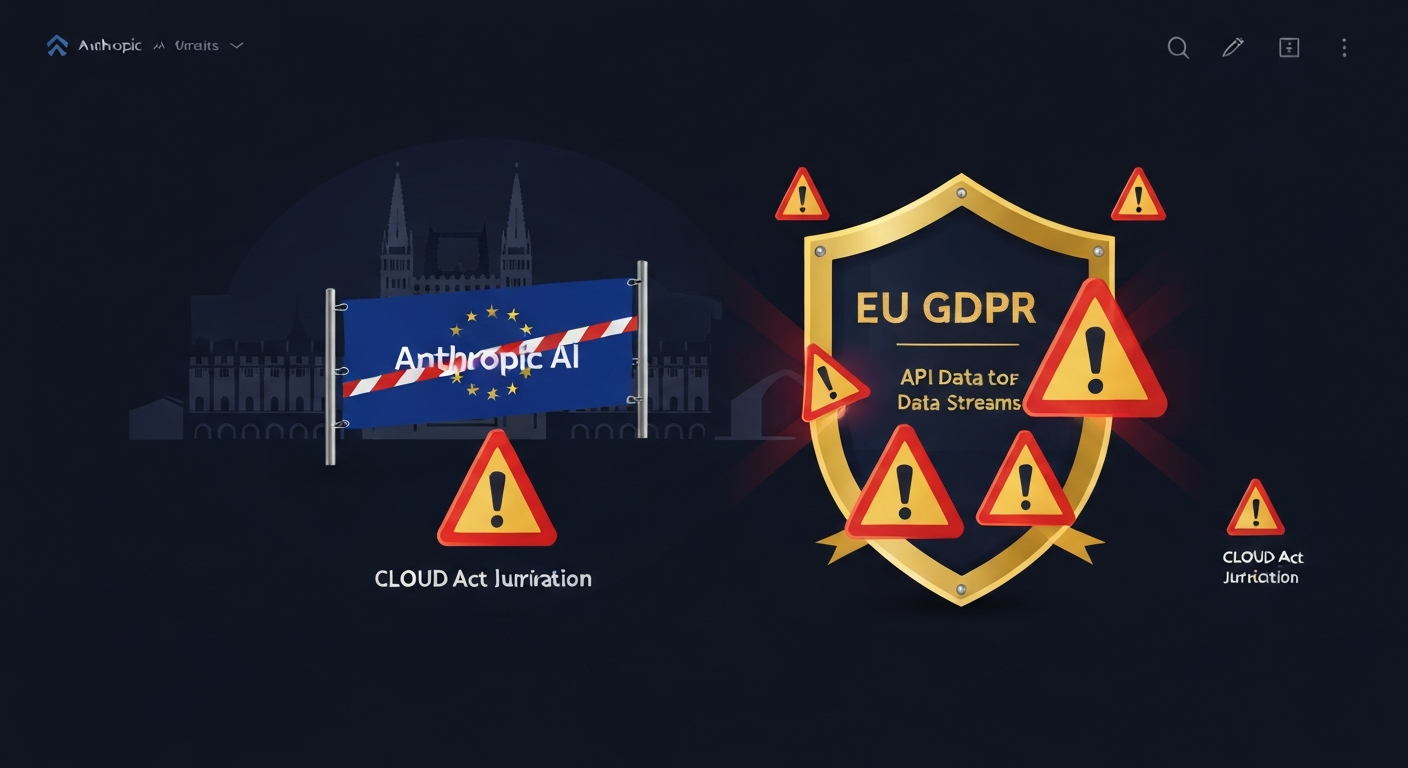
Anthropic's Claude API has become a foundational tool for EU developers building AI-powered applications. Claude 3.5 Sonnet, Claude Opus 4, and the Claude 3 family offer state-of-the-art reasoning, code generation, and document analysis. But for EU developers — particularly those handling personal data, healthcare records, financial information, or regulated enterprise data — Anthropic's corporate structure creates a compliance problem that no data processing agreement can fully resolve.
The core issue: Anthropic PBC is a US corporation subject to the CLOUD Act. Every API call you make sends data to Anthropic's US-controlled infrastructure. Under 18 U.S.C. § 2713, US law enforcement can compel Anthropic to produce that data — even if it's stored on EU servers — without notifying you or your users.
This post explains exactly what CLOUD Act jurisdiction means for Claude API users in the EU, which EU alternatives offer genuinely sovereign AI infrastructure, and how to migrate your AI application stack to EU-native providers without losing Claude's capabilities.
Anthropic's Corporate Structure: A US PBC Under CLOUD Act Jurisdiction
Anthropic was founded in 2021 by Dario Amodei, Daniela Amodei, and other former OpenAI researchers. It is incorporated as Anthropic PBC — a Public Benefit Corporation under Delaware law, headquartered in San Francisco, California.
What "US Corporation" Means Under CLOUD Act
The Clarifying Lawful Overseas Use of Data Act (CLOUD Act, 18 U.S.C. § 2713) became law in 2018. Its key provision: US government agencies can compel disclosure of electronic communications and data stored by US-incorporated providers, regardless of where that data physically resides.
For Anthropic, this means:
| Factor | Status |
|---|---|
| Incorporation | Delaware C-Corp (PBC) |
| Headquarters | San Francisco, CA, USA |
| CLOUD Act applicability | Yes — compelled disclosure possible |
| NSL (National Security Letter) gag orders | Applicable — Anthropic cannot disclose receipt |
| Data physically in EU | Does not exempt from CLOUD Act |
| EU Standard Contractual Clauses | Reduce transfer risk but do not block CLOUD Act |
Anthropic's Funding and Strategic Context
Anthropic has raised approximately $7.7 billion from investors including Google ($300M + $2B commitment), Amazon ($4B commitment), and Spark Capital. Amazon's investment came with a commercial agreement: AWS is Anthropic's primary cloud partner, meaning Claude models run predominantly on AWS infrastructure (us-east-1, eu-west-1).
Key implication: Even if Anthropic routes your API calls through eu-west-1 (AWS Ireland), AWS itself is a US corporation subject to CLOUD Act. The hosting jurisdiction provides no meaningful CLOUD Act protection when the tenant (Anthropic) and the cloud provider (AWS) are both US entities.
What Data Does the Claude API Process?
Before analyzing GDPR implications, you need to understand exactly what data flows to Anthropic when you call the API:
Data Sent in Every API Request
- Prompt content — Your system prompt + user message. If users paste documents, emails, contracts, or support tickets, that content flows to Anthropic's servers.
- Message history — For multi-turn conversations, all previous turns are included in each request.
- Files and images — Documents, screenshots, and images uploaded for analysis.
- Metadata — API key identifier, model version, timestamp, usage parameters.
What Anthropic Processes (per their Privacy Policy)
Anthropic's API documentation states:
- Prompts and completions are not used to train models by default (API usage, not Claude.ai consumer)
- Data is retained for 30 days for trust & safety review, then deleted
- Anthropic employees may review conversations for safety purposes
- Enterprise plans offer enhanced data handling commitments
The 30-day retention period means every EU personal data element sent via the API is accessible to Anthropic (and potentially US law enforcement) for at least one month.
GDPR Analysis: Three Critical Compliance Problems
Problem 1: Art.46 Transfer Mechanism — SCCs Don't Block CLOUD Act
Sending personal data from the EU to Anthropic's US servers requires an Art.46 "appropriate safeguard." Anthropic's Data Processing Agreement (DPA) uses Standard Contractual Clauses (SCCs) — the EU Commission's 2021 model clauses.
However, following the Schrems II ruling (CJEU C-311/18, July 2020), SCCs alone are insufficient when:
- The recipient is subject to surveillance laws incompatible with EU fundamental rights
- Those laws allow access without the data subject's knowledge
- The recipient cannot notify the data exporter of government access requests
The CLOUD Act creates precisely this scenario. NSL gag orders mean Anthropic cannot tell you when it receives a government demand for your users' data. Five EU data protection authorities have held that similar US surveillance law exposure renders SCCs alone insufficient for Google Analytics data transfers — the same logic applies to Claude API.
What this means in practice: Your DPA with Anthropic does not provide legally sufficient Art.46 safeguards if you're processing EU personal data in regulated sectors (health, finance, legal).
Problem 2: Art.13/14 Transparency — Can You Tell Users Where Their Data Goes?
GDPR Art.13 requires you to inform data subjects about:
- Recipients of personal data (Art.13(1)(e))
- Transfers to third countries and safeguards (Art.13(1)(f))
If a user sends a support ticket, medical query, or financial question through your Claude-powered chatbot, and that data flows to Anthropic's US servers, you must disclose this in your privacy policy and inform users at collection time. You must explain that US law enforcement could access this data under CLOUD Act without notification.
This disclosure obligation is real, enforceable, and creates reputational risk. Many enterprise customers and regulated sector users will simply not accept this.
Problem 3: Art.25 Data Minimisation — Can You Limit What Goes to Anthropic?
GDPR Art.25 requires privacy by design and by default — only processing personal data that is necessary for the specific purpose. When you use the Claude API for a feature like "summarize this customer complaint," the entire complaint text (potentially containing PII) flows to Anthropic's servers.
You can implement PII scrubbing before API calls, but this:
- Degrades model performance (Claude can't analyze what it can't see)
- Requires additional processing (which introduces its own compliance surface)
- Doesn't solve the problem if the use case inherently requires personal data (e.g., "analyze this patient record")
EU AI Act Compliance Layer
The EU AI Act (in force since August 2024, full application August 2026) adds another dimension. EU developers using the Claude API to build AI systems must:
Provider Disclosure Requirements (Art.52)
Systems using Claude must disclose to users that they are interacting with an AI. If you build a general-purpose AI system on Claude, you take on deployer obligations under the EU AI Act.
High-Risk AI System Requirements (Annex III)
If your Claude-powered application falls into high-risk categories (recruitment, credit scoring, medical device software, critical infrastructure), you must:
- Maintain technical documentation of the AI system (including Claude model version)
- Conduct conformity assessments
- Register in the EU AI systems database
- Log system interactions and decisions
The CLOUD Act problem compounds here: if your audit logs, interaction records, and conformity documentation contain personal data, they face the same GDPR Art.46 transfer exposure when stored with Anthropic.
GPAI Provider Obligations (Art.53)
Anthropic itself faces EU AI Act obligations as a GPAI (General-Purpose AI) model provider offering Claude to EU developers. Anthropic must:
- Publish a model card with training data sources and evaluation results
- Maintain an incident register for serious AI incidents
- Comply with transparency and copyright obligations
For Claude 3/4 models with "systemic risk" classification (above 10^25 FLOPs training compute threshold), additional Anthropic obligations apply that affect the compliance posture of EU applications built on Claude.
Where EU Data Residency Falls Short
Anthropic offers EU data residency as an enterprise option (available on Teams and Claude.ai Enterprise). Data is routed through and stored in AWS eu-west-1 (Ireland) and eu-central-1 (Frankfurt).
This sounds promising. The data stays in the EU. But does it help with CLOUD Act?
It does not. Here's why:
Your EU App → Anthropic EU endpoint → AWS eu-west-1 (Ireland)
                     ↑                        ↑
              US corporation            US cloud provider
          (CLOUD Act applies)        (CLOUD Act applies)
Both Anthropic PBC and AWS Inc. are Delaware corporations. The CLOUD Act authorizes US courts to compel disclosure from US corporations for data they "possess, custody, or control" — regardless of storage location. A US magistrate judge can issue an order to Anthropic requiring production of data from their EU-hosted servers. Anthropic cannot legally refuse and cannot notify you.
EU data residency solves:
- ✅ GDPR Art.44 (transfer to third countries) — if you can argue the data stays in EU
- ✅ Latency for EU users
- ✅ Some enterprise procurement requirements ("data must not leave the EU")
EU data residency does NOT solve:
- ❌ CLOUD Act jurisdiction (US corporate compelled disclosure)
- ❌ NSL gag orders (Anthropic can't tell you about government access)
- ❌ Schrems II adequacy concerns (DPA vs DPF status)
- ❌ NSA/FBI access under Section 702 FISA
EU-Native Claude Alternatives: What Actually Works
The only complete solution to CLOUD Act exposure is using AI infrastructure that is not under US corporate jurisdiction. Here are the viable options for EU developers who need Claude-class capabilities:
1. Mistral AI (Paris, France) — Best EU-Native Option
Mistral AI SAS is incorporated under French law (Société par Actions Simplifiée), headquartered at 15 Place de la République, Paris 75011, France. It raised €385M from Andreessen Horowitz, General Catalyst, and others — but remains French-incorporated with no US parent company.
Key models:
- Mistral Large 2 — Competitive with Claude 3.5 Sonnet for reasoning, code, analysis
- Mistral Small — Efficient for classification, extraction, short-form generation
- Codestral — Code generation specialist
- Mistral Embed — EU-native embeddings
CLOUD Act status: Mistral AI SAS is a French company → CLOUD Act does not apply → No compelled disclosure to US authorities → No NSL gag orders.
La Plateforme API:
from mistralai import Mistral

client = Mistral(api_key="YOUR_MISTRAL_API_KEY")

response = client.chat.complete(
    model="mistral-large-latest",
    messages=[{"role": "user", "content": "Analyze this contract for GDPR compliance issues."}]
)
Infrastructure: Mistral's API runs on EU-based infrastructure (OVHcloud, Scaleway). No US hyperscaler dependency.
Pricing comparison (per 1M tokens):
| Model | Input | Output |
|---|---|---|
| Mistral Large 2 | €2.00 | €6.00 |
| Claude 3.5 Sonnet | $3.00 | $15.00 |
| Mistral Small | €0.20 | €0.60 |
| Claude Haiku 3.5 | $0.80 | $4.00 |
Mistral is significantly cheaper AND EU-native.
2. Aleph Alpha (Heidelberg, Germany)
Aleph Alpha GmbH is a German limited liability company headquartered in Heidelberg. It developed the Luminous model family and operates Pharia, a sovereign AI platform designed for regulated industries.
- Models: Pharia-1-LLM-7B-control (EU sovereign, on-premise available)
- Target: Enterprise/government customers requiring maximum data sovereignty
- Deployment: Can be licensed for on-premise EU deployment
- Use case: When you need to contractually guarantee zero external data access
3. Self-Hosted Open Models on EU Infrastructure
For maximum control, deploy open-weight models on EU-native cloud infrastructure:
Models competitive with Claude:
- Llama 3.3 70B (Meta, open weights) — Strong general purpose
- Qwen 2.5 72B (Alibaba, open weights) — Excellent at code and reasoning
- Mistral 7B / 8x7B (open weights) — Efficient and EU-developed
- DeepSeek-R1 (open weights) — State-of-the-art reasoning
EU cloud providers for GPU inference:
- Hetzner Cloud (Germany, DE/FI data centers) — GPU instances from €10/month
- OVHcloud (France) — H100 GPU instances, EU data centers
- Scaleway (France) — H100 GPU clusters
Deployment with Ollama on sota.io:
# Deploy Ollama on EU-native sota.io
# All traffic stays on Hetzner Germany infrastructure
sota deploy --region eu-central \
  --image ollama/ollama:latest \
  --env OLLAMA_MODELS=llama3.3,mistral-7b
4. Azure OpenAI EU Regions — Partial Solution
Microsoft Azure offers Claude models (via Anthropic partnership) and GPT-4 via Azure OpenAI Service in EU regions (westeurope, swedencentral).
Important caveat: Microsoft is a US corporation (Redmond, WA, Delaware incorporation). Azure EU regions do NOT exempt you from CLOUD Act jurisdiction. Microsoft's PRISM program participation is documented. Azure EU data residency provides the same partial protection as Anthropic's EU data residency — it doesn't solve the CLOUD Act problem.
Migration Path: From Claude API to EU-Native AI
If you're currently using the Claude API and need to migrate to EU-compliant infrastructure, here's a practical approach:
Step 1: Classify Your Use Cases by Risk Level
| Use Case | Risk Level | Recommended Action |
|---|---|---|
| Processing anonymous/synthetic data | Low | Claude API acceptable |
| User-generated content (no PII) | Medium | Evaluate SCCs + Anthropic DPA |
| Personal data in prompts | High | Migrate to Mistral or self-hosted |
| Healthcare / financial records | Critical | EU-native only (Mistral/Aleph Alpha/self-hosted) |
| Internal enterprise data | High | Self-hosted on EU infra |
Step 2: API Compatibility
Mistral's API is largely compatible with the OpenAI API format. If you're using an OpenAI-compatible client with Claude, migration is straightforward:
# Before (Anthropic SDK)
import anthropic
client = anthropic.Anthropic(api_key=ANTHROPIC_API_KEY)
message = client.messages.create(
    model="claude-3-5-sonnet-20241022",
    max_tokens=1024,
    messages=[{"role": "user", "content": "Analyze this document..."}]
)

# After (Mistral SDK — EU-native)
from mistralai import Mistral
client = Mistral(api_key=MISTRAL_API_KEY)
response = client.chat.complete(
    model="mistral-large-latest",
    messages=[{"role": "user", "content": "Analyze this document..."}]
)
# Response structure is similar — easy migration
Step 3: Data Processing Agreement Update
When you switch to Mistral AI:
- Sign Mistral's DPA (available at console.mistral.ai)
- Mistral AI SAS acts as your data processor under GDPR Art.28
- No Art.46 transfer mechanism needed (EU-to-EU, no third country transfer)
- Update your privacy policy to remove Anthropic from processor list
Step 4: Infrastructure for AI Applications
Deploy your AI application itself on EU-native infrastructure to complete the sovereignty chain:
User in EU → EU domain (Cloudflare EU-only)
           → sota.io (Hetzner Germany, no US parent)
           → Mistral API (French company, EU infra)
           → EU database (Supabase EU / Neon EU)
Every link in this chain is EU-native. No CLOUD Act exposure anywhere.
Practical Compliance Checklist
For EU developers currently using the Claude API, work through this checklist:
Immediate Actions (This Week)
- Identify all prompts that include EU personal data
- Review your current privacy policy — does it disclose Anthropic as a US data processor?
- Check your Anthropic DPA — do you have SCCs in place?
- Assess your regulated sector exposure (healthcare, finance, legal, public sector)
Short-Term Actions (Next Month)
- Implement PII scrubbing for API calls that don't require personal data
- Request Anthropic's EU data residency if on Enterprise plan
- Conduct Data Protection Impact Assessment (DPIA) under GDPR Art.35 for high-risk processing
- Evaluate Mistral API for use cases with personal data
Medium-Term Migration (Next Quarter)
- Migrate high-risk use cases to Mistral API or self-hosted models
- Update data processing agreements and privacy notices
- Test model performance parity (Mistral Large 2 vs Claude 3.5 Sonnet)
- Deploy AI application infrastructure on EU-native cloud (sota.io)
The Jurisdiction Question: Why This Matters in 2026
The EU is actively enforcing data sovereignty principles. In 2025-2026:
- French CNIL issued guidance that CLOUD Act exposure creates an "essentially equivalent" protection failure
- German DSK (Data Protection Conference) issued guidance that US surveillance law exposure requires supplementary measures beyond SCCs
- EDPB is developing binding guidelines on AI model training data and personal data processing by US-based AI providers
- EU AI Act enforcement begins with high-risk system compliance from August 2026
Using EU-native AI infrastructure is not just a compliance preference — it's increasingly a regulatory requirement for companies processing EU personal data in regulated sectors.
Anthropic is an excellent AI research company building impressive models. But as an EU developer, "excellent models" and "GDPR-compliant infrastructure" are orthogonal requirements. You can have both by running EU-native models (Mistral, self-hosted Llama) on EU-native infrastructure (sota.io on Hetzner Germany).
The technical gap between Claude and EU-native alternatives is narrowing rapidly. Mistral Large 2 scores within 2-3 percentage points of Claude 3.5 Sonnet on major benchmarks. The compliance gap — CLOUD Act jurisdiction — doesn't narrow. It's structural.
Summary: Anthropic Claude API vs EU-Native Alternatives
| Dimension | Anthropic Claude API | Mistral API | Self-Hosted (sota.io) |
|---|---|---|---|
| CLOUD Act risk | High — US Corp, compelled disclosure possible | None — French SAS | None — You control infra |
| NSL gag orders | Yes — Cannot notify you | No | No |
| GDPR Art.46 transfer | SCCs required (Schrems II limitations) | Not needed — EU to EU | Not needed — fully internal |
| EU data residency | Available (Enterprise), doesn't solve CLOUD Act | Native by default | Native by default |
| Model quality | Claude 3.5/4 — state of art | Mistral Large 2 — very competitive | Llama 3.3 70B / Qwen 72B |
| Cost | $3.00/$15.00 per 1M tokens | €2.00/€6.00 per 1M tokens | Compute cost only (~€0.20/1M) |
| Privacy policy burden | Must disclose US processor | EU processor, simpler | Internal — no third party |
Deploy Your EU-Native AI Application on sota.io
If you're building an AI application that needs to be genuinely GDPR-compliant — no CLOUD Act exposure, EU-native infrastructure, data that never touches US corporate systems — sota.io provides the deployment layer.
sota.io runs on Hetzner's EU data centers (Germany and Finland) with no US parent company, no CLOUD Act applicability, and no data transferred outside EU jurisdiction. Combine sota.io with the Mistral API and an EU Postgres provider, and every component in your AI application stack is EU-sovereign.
# Deploy your EU-native AI app
sota deploy --region eu-central \
  --env MISTRAL_API_KEY=your_key \
  --env DATABASE_URL=postgres://eu-native-postgres \
  # No CLOUD Act. No US jurisdiction. Full GDPR compliance.
Start with the sota.io free tier — EU infrastructure, GDPR-native, no US parent company.
EU-Native Hosting
Ready to move to EU-sovereign infrastructure?
sota.io is a German-hosted PaaS — no CLOUD Act exposure, no US jurisdiction, full GDPR compliance by design. Deploy your first app in minutes.