Algolia EU Alternative 2026: Why Your Search-as-a-Service Has CLOUD Act Exposure
Post #1094 in the sota.io EU Infrastructure Series
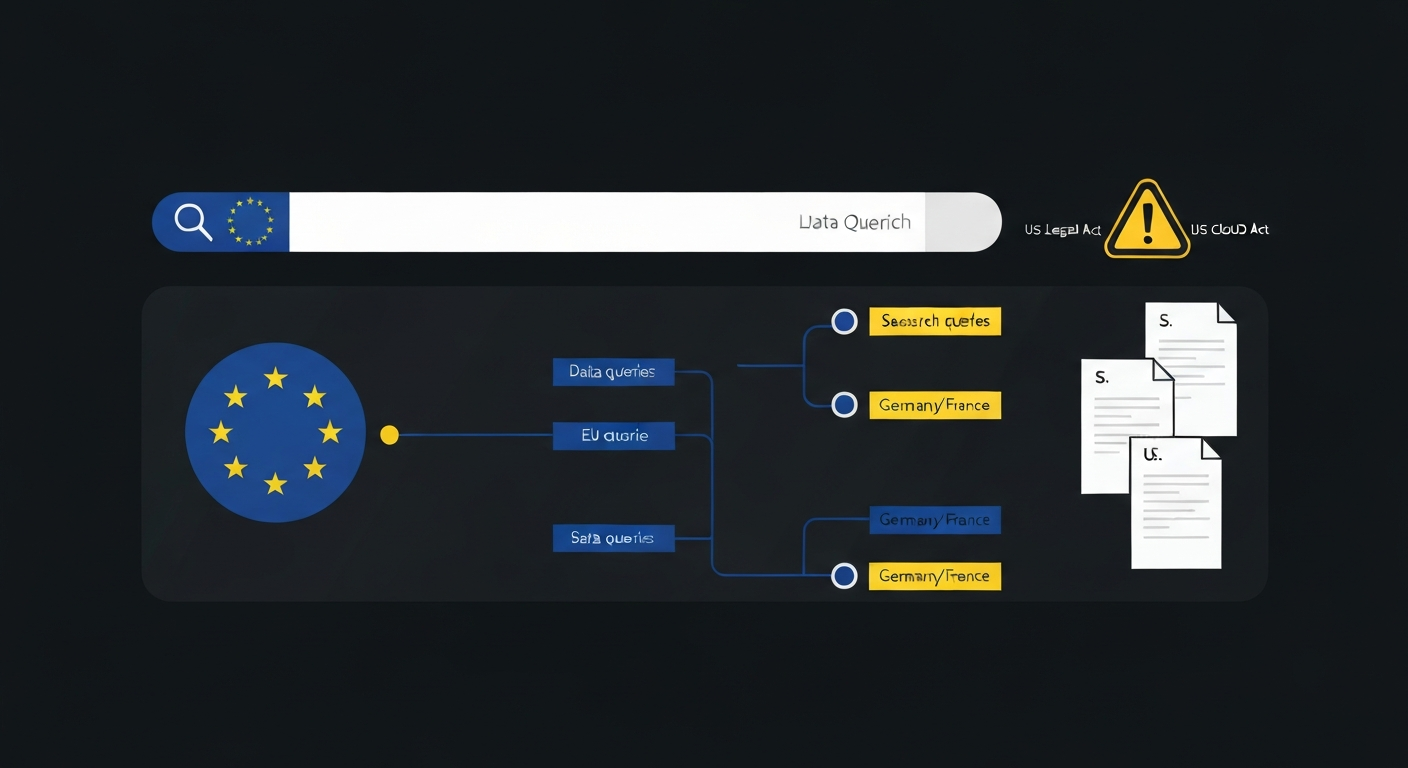
Algolia was founded in Paris in 2012 by Nicolas Dessaigne and Julien Lemoine. By 2014, the company had moved its headquarters to San Francisco and incorporated as Algolia Inc., a Delaware corporation. Today, Algolia processes over one trillion search operations per year for companies like Stripe, Twitch, Lacoste, and Under Armour.
For EU-based companies, that Delaware incorporation creates a legal problem that EU data residency options cannot solve.
The CLOUD Act Problem
The Clarifying Lawful Overseas Use of Data Act (CLOUD Act, 18 U.S.C. § 2713) requires US-incorporated companies to produce data to US law enforcement regardless of where that data is stored. Algolia's EU data centers in Germany and France are irrelevant under CLOUD Act — what matters is that Algolia Inc. is a US company.
A US government agency can issue a legal process to Algolia Inc. requiring disclosure of EU customer data stored on EU servers. Algolia cannot legally refuse this request based on GDPR alone.
What Data Algolia Processes
Before assessing the risk, understand what search infrastructure actually handles:
| Data Type | GDPR Classification | Algolia Exposure |
|---|---|---|
| Search queries | Behavioral/Personal data | Stored + analyzed |
| User identifiers | Personal data (Art. 4(1)) | Required for personalization |
| Click analytics | Behavioral profiles | Stored per-user |
| Conversion events | Business-sensitive | Full access |
| Product catalog | May contain PII | Indexed + stored |
| A/B test results | User behavior | Aggregated + stored |
Search queries are particularly sensitive. A user searching for "divorce lawyer Berlin" or "HIV medication side effects" on a healthcare or legal platform reveals deeply personal information. Under GDPR Article 9, health-related search terms may constitute special category data.
GDPR Art. 28 DPA Requirements
Algolia serves as a Data Processor under GDPR Article 28 — any EU company using Algolia must execute a Data Processing Agreement (DPA). Algolia provides a standard DPA.
However, the DPA creates a conflict:
- Algolia's DPA commits to GDPR compliance
- GDPR Art. 46 prohibits transfers to third countries without adequate safeguards
- Algolia relies on Standard Contractual Clauses (SCCs) for EU→US transfers
- SCCs require a Transfer Impact Assessment (TIA) — which must honestly assess CLOUD Act risk
- Under CLOUD Act, US courts can compel Algolia to produce EU data
- A rigorous TIA must disclose this risk
The Schrems II decision (CJEU Case C-311/18) invalidated Privacy Shield precisely because of US surveillance law. SCCs survive Schrems II only when supplementary measures effectively prevent US government access. For a US company like Algolia Inc., those measures are structurally impossible.
CLOUD Act Risk Score
| Factor | Score | Notes |
|---|---|---|
| US corporate domicile | 5/5 | Delaware corporation |
| Search query storage | 4/5 | Direct personal data |
| Behavioral analytics | 4/5 | Click-through, conversion tracking |
| Personalization data | 3/5 | User profiles for ranking |
| EU server option | -1 | Reduces but doesn't eliminate risk |
| Total | 15/20 | High risk |
Assessment: 15/20 — High CLOUD Act exposure. EU servers reduce data egress risk but not legal jurisdiction risk.
EU-Native Alternatives to Algolia
1. Meilisearch — The EU-Native Answer
Meilisearch SAS was founded in Paris in 2018 by Thomas Payet and Clément Renault. It is a French Société par Actions Simplifiée (SAS) — a pure EU-native company with no US parent, no US investors with control rights, and no CLOUD Act exposure.
Technical comparison:
| Feature | Algolia | Meilisearch |
|---|---|---|
| Typo tolerance | Excellent | Excellent |
| Faceted search | Yes | Yes |
| Geosearch | Yes | Yes |
| AI-powered search | Yes (Neural Search) | Yes (Hybrid + vectors) |
| Self-hosted option | No | Yes (open source) |
| Cloud hosting | Yes | Yes (Meilisearch Cloud) |
| EU legal entity | No | Yes (French SAS) |
| CLOUD Act exposure | Yes | No |
| Pricing (starter) | €1.00/1000 search units | €25/mo flat |
Meilisearch's query language is compatible with Algolia's in many cases. The instantsearch.js library that Algolia created has community adapters for Meilisearch, making migration achievable without rewriting frontend components.
Meilisearch Cloud EU regions: Paris (CDG), Frankfurt (FRA) — hosted on infrastructure without US ownership.
2. Typesense — Open Source, Self-Hostable on EU Infrastructure
Typesense Inc. is a US company (Palo Alto) — so not CLOUD Act-free on its hosted cloud. However, Typesense is fully open source under the GPL license, which means you can self-host it on EU infrastructure of your choice.
On sota.io or Hetzner Cloud (German company, no US parent), a self-hosted Typesense instance has zero CLOUD Act exposure.
# Deploy Typesense on EU infrastructure
docker run -d \
  -p 8108:8108 \
  -v /data/typesense:/data \
  typesense/typesense:26.0 \
  --data-dir /data \
  --api-key=your-api-key \
  --enable-cors
Migration effort: Medium. Typesense has a migration guide from Algolia and is API-compatible in core search operations.
3. OpenSearch — Self-Hosted on EU Infrastructure
OpenSearch is the AWS-fork of Elasticsearch (Apache 2.0 license). As a self-hosted option, it runs anywhere — including on EU-native infrastructure.
OpenSearch on Hetzner or OVHcloud (both EU companies) has no CLOUD Act exposure. It's more operationally complex than Algolia/Meilisearch but handles advanced analytics use cases.
# docker-compose.yml for OpenSearch on EU infra
services:
  opensearch:
    image: opensearchproject/opensearch:2.17
    environment:
      - discovery.type=single-node
      - plugins.security.disabled=true
    volumes:
      - opensearch-data:/usr/share/opensearch/data
    ports:
      - "9200:9200"
4. Elasticsearch Self-Hosted (Elastic)
Elastic N.V. is a Dutch company — however, Elastic's cloud service (Elastic Cloud) operates as an Elastic Inc. (US Delaware) subsidiary. For GDPR compliance, self-hosted Elasticsearch on EU infrastructure is the safe path.
Elastic provides ELSER (Elastic Learned Sparse EncodeR) for semantic search without external API calls.
GDPR Risk Comparison
| Solution | Legal Entity | CLOUD Act Exposure | Data Sovereignty | Self-Host Option |
|---|---|---|---|---|
| Algolia | Algolia Inc. (Delaware) | HIGH | None | No |
| Meilisearch Cloud | Meilisearch SAS (Paris) | None | Full EU | Yes |
| Typesense Cloud | Typesense Inc. (US) | HIGH | None | Yes (self-host) |
| Typesense self-hosted | — | None | Full | Yes |
| OpenSearch self-hosted | — | None | Full | Yes |
| Elasticsearch self-hosted | — | None | Full | Yes |
Migration Guide: Algolia → Meilisearch
Step 1: Export your Algolia indices
# Export Algolia index to JSON
curl -X GET \
  "https://your-app-id-dsn.algolia.net/1/indexes/your-index/browse" \
  -H "X-Algolia-API-Key: $ALGOLIA_ADMIN_API_KEY" \
  -H "X-Algolia-Application-Id: $ALGOLIA_APP_ID" \
  > algolia-export.json
Step 2: Create Meilisearch index
# Add documents to Meilisearch
curl -X POST "https://your-instance.meilisearch.io/indexes/products/documents" \
  -H "Authorization: Bearer $MEILI_MASTER_KEY" \
  -H "Content-Type: application/json" \
  --data-binary @algolia-export.json
Step 3: Update your search UI
If you're using Algolia's InstantSearch.js library, switch to the Meilisearch adapter:
npm install @meilisearch/instant-meilisearch instantsearch.js
import { instantMeiliSearch } from "@meilisearch/instant-meilisearch";

const { searchClient } = instantMeiliSearch(
  "https://your-meilisearch-instance.com",
  "your-search-api-key"
);
The searchClient interface is compatible with InstantSearch.js — most configurations require minimal changes.
Step 4: Configure facets and filters
// Algolia facets → Meilisearch filterable attributes
await client.index("products").updateFilterableAttributes([
  "category",
  "brand",
  "price",
  "in_stock"
]);

await client.index("products").updateSortableAttributes([
  "price",
  "created_at",
  "popularity"
]);
Pricing Comparison (2026)
| Plan | Algolia | Meilisearch Cloud |
|---|---|---|
| Free | 10K search ops/mo | 100K docs + 10K search ops/mo |
| Starter | €1.00/1K search units | €25/mo flat |
| Growth | Custom | €49/mo flat |
| Enterprise | Custom + DPA negotiation | Custom + DPA negotiation |
For EU companies doing 1M search operations per month, Algolia costs approximately €1,000/month. Meilisearch Cloud starts at €49/month flat with no per-search billing.
Technical Decision Matrix
Choose Meilisearch Cloud if:
- You need a hosted solution with zero GDPR negotiation overhead
- You want drop-in Algolia replacement with EU legal entity
- Simplicity and fast deployment matter
Choose Typesense (self-hosted) if:
- You have DevOps capacity to manage infrastructure
- You need cost optimization at scale
- You want maximum data control
Choose OpenSearch (self-hosted) if:
- You're already in the Elasticsearch ecosystem
- You need advanced analytics alongside search
- You have complex ranking requirements
Choose sota.io to deploy self-hosted solutions: Typesense, Meilisearch, and OpenSearch all run as Docker containers. sota.io deploys any Docker container to Hetzner Germany — so your search infrastructure stays on EU-native, GDPR-compliant infrastructure. No CLOUD Act exposure. No US parent company.
# Deploy Typesense on sota.io (Hetzner Germany)
sota deploy --image typesense/typesense:26.0 \
  --env TYPESENSE_API_KEY=your-key \
  --region hetzner-nbg1
Checklist: Assessing Your Current Algolia Exposure
Before migrating, audit your current state:
- Is your Algolia DPA signed and stored? (Required under GDPR Art. 28)
- Have you completed a Transfer Impact Assessment for Algolia? (Required post-Schrems II)
- Does your privacy policy disclose Algolia as a data processor?
- Are you storing user-identifying data (user IDs, emails) in Algolia events?
- Are any search queries in your logs health-related, legal, or otherwise sensitive?
- Do you have a copy of user search data you could provide if requested?
If any of these reveal gaps, migration to Meilisearch or a self-hosted option eliminates the exposure entirely.
Conclusion
Algolia is excellent search infrastructure. But its Delaware incorporation creates CLOUD Act jurisdiction that no contractual clause, EU server location, or DPA provision can eliminate.
For EU companies handling personal data through search — which is nearly all e-commerce, marketplace, healthcare, legal, and financial platforms — the risk is real and regulatory pressure is increasing.
Meilisearch is the closest like-for-like replacement with a French legal entity and no CLOUD Act exposure. For organizations with DevOps capacity, self-hosted Typesense on EU infrastructure achieves full data sovereignty.
The search box on your platform processes behavioral data. Make sure the company receiving that data is subject to EU law.
Running search infrastructure on EU-native cloud? sota.io deploys any Docker container to Hetzner Germany with one command. No US parent. No CLOUD Act. GDPR-compliant by infrastructure.
EU-Native Hosting
Ready to move to EU-sovereign infrastructure?
sota.io is a German-hosted PaaS — no CLOUD Act exposure, no US jurisdiction, full GDPR compliance by design. Deploy your first app in minutes.