1Password Secrets Automation EU Alternative 2026: Five Eyes Intelligence Sharing and Your CI/CD Credentials
Post #4 in the sota.io EU Secret Management Compliance Series
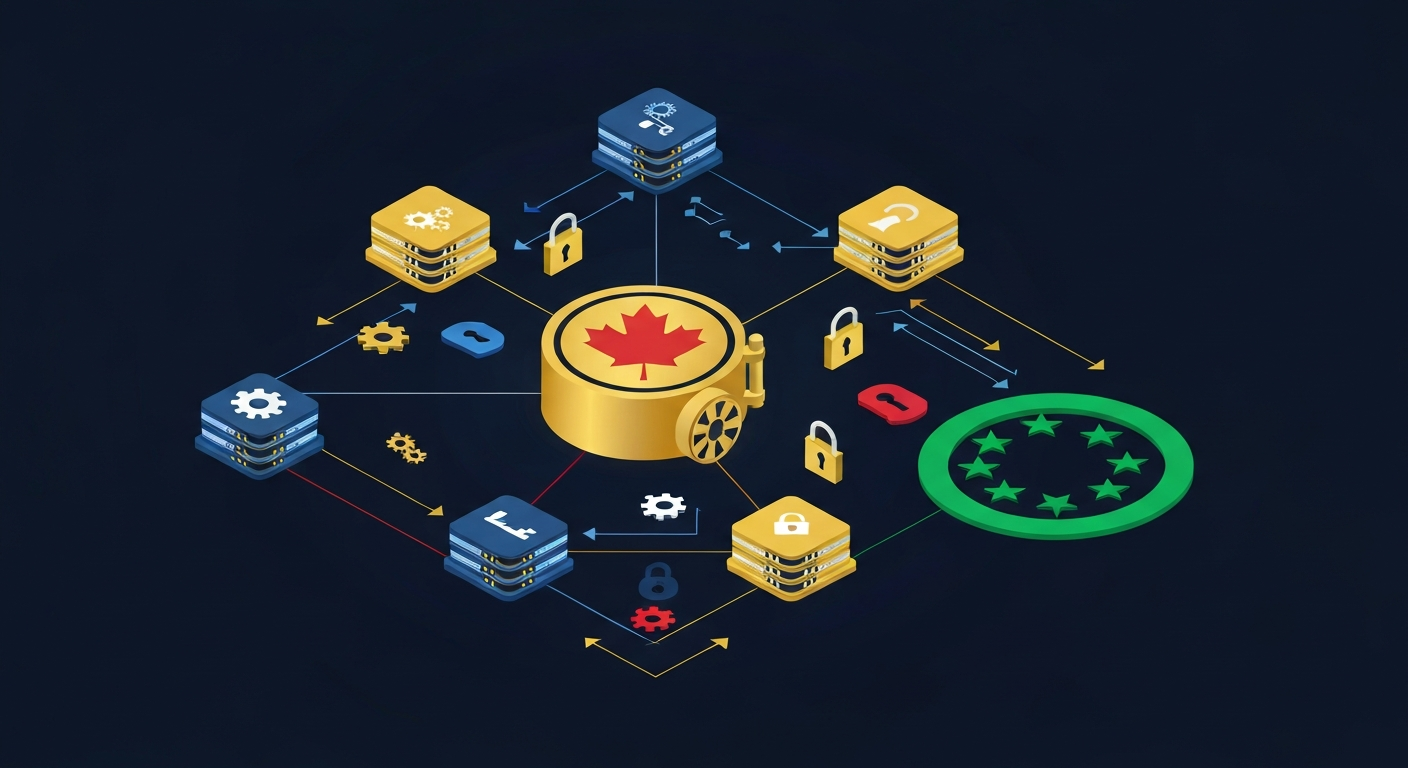
1Password has become the default choice for enterprise secrets management at two levels simultaneously: human credentials in password vaults, and machine credentials through 1Password Secrets Automation. For engineering teams, this convergence is genuinely useful — one platform handles both the developer's personal vault and the CI/CD pipeline's service account secrets.
For EU-based organisations, however, the Secrets Automation product introduces a compliance dimension that differs meaningfully from the password manager. The issue is not encryption — 1Password's zero-knowledge architecture for vault content is genuinely well-engineered. The issue is jurisdiction and intelligence access, and specifically the distinction between GDPR Article 44 data transfer adequacy and Five Eyes intelligence-sharing treaties.
This guide focuses exclusively on 1Password Secrets Automation: the CLI (op), the SDKs (Python, JavaScript, Go, Ruby), 1Password Connect for Kubernetes and Docker, and service account-based machine identity. Coverage of 1Password Teams and Business as a password manager — and the broader AgileBits Canada Five Eyes analysis — is in a separate post in the EU Password Manager Compliance Series.
What 1Password Secrets Automation Actually Does
1Password Secrets Automation is a separate product tier from the password manager. Where 1Password Teams manages human credentials — login passwords, secure notes, credit card data — Secrets Automation manages machine credentials: the secrets that your applications, pipelines, and infrastructure need at runtime.
Core components:
1Password CLI (op): A command-line tool that injects vault secrets into shell environments, .env files, Docker containers, and CI/CD pipeline steps. Developers run op run -- command and secrets are injected as environment variables without ever touching disk in plaintext.
1Password SDKs: Native language libraries for Python, JavaScript (Node.js), Go, Ruby, and Java. Applications authenticate as service accounts and retrieve secrets programmatically at runtime. This replaces hardcoded credentials or environment variable injection with dynamic secret fetching.
1Password Connect: A self-hosted integration server that runs inside your infrastructure — Kubernetes cluster, Docker Swarm, or VM — and proxies secret requests to 1Password's cloud. Applications and Kubernetes Secrets Operators authenticate to Connect locally; Connect holds a Connect Token that authenticates to 1Password's cloud API.
Service accounts: Machine identities with vault access that are not associated with any human user. CI/CD pipelines (GitHub Actions, GitLab CI, Jenkins, CircleCI) authenticate as service accounts to retrieve secrets without human interaction.
What secrets typically flow through this infrastructure:
- Database connection strings and passwords (PostgreSQL, MySQL, MongoDB)
- AWS, Azure, GCP API keys and service account credentials
- Stripe, Twilio, SendGrid, and other SaaS API keys
- GitHub, GitLab, and Bitbucket access tokens for automated deployments
- TLS private keys and certificate management credentials
- Kubernetes service account tokens and cluster credentials
- Internal API authentication tokens between microservices
This list is important for understanding the risk profile. These are not static credentials that could survive a breach without consequence. They are hot credentials — live authentication material actively used by running production systems.
AgileBits Inc.: The Corporate Structure
AgileBits Inc. is a private Canadian corporation incorporated in Ontario, Canada. It is not a US entity, does not have a Delaware incorporation, and is not a US legal person under the definitions relevant to the CLOUD Act (18 U.S.C. § 2713).
Key corporate facts:
- Headquarters: Toronto, Ontario, Canada
- Incorporation: Ontario, Canada (private corporation)
- Founded: 2005 by Dave Teare and Roustem Karimov
- Employees: Approximately 1,000+ globally
- Revenue: Private; estimated in the hundreds of millions USD annually
Investment structure: AgileBits raised a single external funding round in 2019: a $200 million Series A led by Accel Partners (Palo Alto, CA) with participation from Sequoia Capital (Menlo Park, CA) and TCV (Menlo Park, CA). All three lead investors are US venture capital firms. AgileBits had previously operated as a bootstrapped company since 2005.
The US VC investor composition creates an indirect US corporate nexus. US VC funds are subject to US law; their portfolio companies can face pressure through their investors' jurisdictional exposure even when the operating company itself is non-US. This is a softer nexus than direct US incorporation but is nonetheless relevant for risk assessment.
US operations: AgileBits maintains significant US operations, including engineering and sales staff based in the United States. Whether these operations constitute a US legal subsidiary subject to direct CLOUD Act orders is not publicly documented. The company's privacy policy and terms of service are governed by Canadian law (Ontario), and data protection is handled under PIPEDA.
The Five Eyes Framework: Not CLOUD Act, But Comparable Risk
Here is where the 1Password Secrets Automation compliance analysis diverges from the other posts in this series. HashiCorp Vault Enterprise (IBM), Doppler, and CyberArk Conjur are US companies directly subject to the CLOUD Act (18 U.S.C. § 2523). AgileBits is a Canadian company; it is not directly subject to the CLOUD Act.
Canada has a separate — but functionally comparable — intelligence apparatus.
Five Eyes (UKUSA Agreement): The UKUSA Agreement, formalized in 1946 and extended over subsequent decades, established a signals intelligence sharing framework between the United States (NSA), United Kingdom (GCHQ), Canada (CSE — Communications Security Establishment), Australia (ASD — Australian Signals Directorate), and New Zealand (GCSB — Government Communications Security Bureau). The agreement provides for real-time sharing of intercepted communications, metadata, and derived intelligence.
The practical implication: signals intelligence collected by CSE about targets of interest to NSA — or vice versa — flows between the agencies under the UKUSA framework. Unlike legal process (court orders, government access requests), SIGINT sharing operates through classified intelligence channels and does not require judicial authorisation in the receiving country.
Canadian Intelligence Law: The CSIS Act (Canadian Security Intelligence Service Act) and the CSE Act (Communications Security Establishment Act, 2019) authorise broad signals intelligence collection and sharing with Five Eyes partners. Unlike the US CLOUD Act, Canadian intelligence law does not create a clear legal compulsion mechanism for private companies analogous to NSL (National Security Letters) with gag orders. However, the practical effect of intelligence collection targeting AgileBits' infrastructure is similar: access without notification to the data subject.
The Key Legal Distinction — And Why It Matters Less Than You Think: The CLOUD Act creates a legal compulsion mechanism: a US government agency can issue a court order requiring a US company to produce data stored anywhere in the world. Five Eyes intelligence sharing is not a legal compulsion on AgileBits specifically — it is government-to-government signals intelligence exchange.
In practice, however, the intelligence risk for your CI/CD secrets is comparable:
- NSA/GCHQ intelligence collection targeting AgileBits' cloud infrastructure does not require a court order
- SIGINT collection has broader scope and less oversight than CLOUD Act legal process
- There is no notification requirement (unlike CLOUD Act orders, which have some transparency mechanisms through declassified statistics)
- The legal basis is classified; affected organisations are typically unaware of collection
The Adequacy Paradox: PIPEDA Compliance ≠ Intelligence Immunity
Canada holds a European Commission adequacy decision under GDPR Article 45, originally granted in 2002 under Commission Decision 2002/2/EC, covering organisations subject to Canada's PIPEDA (Personal Information Protection and Electronic Documents Act). This adequacy decision makes transfers of personal data from the EU to AgileBits (a PIPEDA-covered entity) legally valid under GDPR Article 44.
This is where the compliance analysis becomes nuanced — and important for DPOs and security architects to understand.
What the PIPEDA adequacy decision covers:
- Commercial data processing requirements (consent, purpose limitation, access rights)
- Data subject rights under PIPEDA
- Enforcement through the Office of the Privacy Commissioner of Canada
- Transfers under GDPR Article 44 without additional safeguards (SCCs not required)
What the PIPEDA adequacy decision does not cover:
- National security intelligence collection under the CSIS Act and CSE Act
- Signals intelligence access by Canadian intelligence agencies
- Sharing of intelligence with Five Eyes partners under the UKUSA Agreement
- Any government access that occurs outside PIPEDA's commercial scope
The adequacy decision was evaluated against PIPEDA's commercial data protection framework. It was not evaluated against Canada's intelligence laws or Five Eyes participation. This is structurally identical to the problem identified in Schrems I (2015, C-362/14): the Safe Harbor framework did not account for US national security surveillance, rendering it invalid. The adequacy framework for Canada has not been similarly litigated, but the structural argument is equivalent.
Regulatory analysis — GDPR Article 46 gap: If your legal basis for transfer to AgileBits is adequacy (Article 45), you are relying on the Commission's assessment of Canada's equivalence. If that assessment fails to account for Five Eyes intelligence access — which it does not, based on the 2002 decision's scope — you may be transferring sensitive secrets to a jurisdiction with intelligence access that your DPA would find problematic under GDPR recital 141 (transfers that undermine the level of protection).
This is not a settled legal issue. It is a risk factor that careful DPOs should document in their Records of Processing Activities (RoPAs) and Transfer Impact Assessments (TIAs).
The Hot Credential Problem: Why Secrets Automation Is Uniquely Sensitive
1Password Secrets Automation handles a category of data that is qualitatively different from the personal data typically analysed in GDPR compliance reviews.
Human credentials vs. machine credentials — the distinction:
A password vault (1Password Teams/Business) contains human credentials: login passwords, secure notes, payment data. If a government access event occurs — whether through CLOUD Act, SIGINT, or other means — the affected organisation can, in principle, rotate all exposed passwords. The breach is serious but containable.
Machine credentials managed through Secrets Automation are different in three ways:
1. Live Production Access API keys, database passwords, and service tokens stored in 1Password Secrets Automation vaults are actively used by running systems. They are not archive copies — they are the live credentials that your Stripe integration, your database connection pool, your AWS services use right now. Exposure means immediate, live access to your production infrastructure.
2. The Rotation Race Problem With legal process (CLOUD Act orders, court orders), there is at least some disclosure mechanism. With intelligence collection, there is none. If Five Eyes agencies access your CI/CD service account credentials through AgileBits' infrastructure via SIGINT channels, you will not be notified. You cannot rotate credentials you do not know are compromised. The Rotation Race Problem: you cannot win a race you do not know you are in.
3. Credential Aggregation — The Blast Radius A single 1Password Secrets Automation vault accessed by a CI/CD pipeline may contain credentials for AWS, your database, your SaaS providers, your internal APIs, and your Kubernetes cluster. The intelligence value of accessing one vault is the aggregate intelligence value of all systems those credentials access. For an adversary — state or otherwise — this is a high-value target.
This aggregation effect means the risk profile for DevOps secrets stored in Secrets Automation is higher than the risk profile for individual human password vaults, even though the cryptographic protection is identical.
CLOUD Act Exposure Score: 14/25
Using the same scoring framework applied throughout the EU Secret Management series, with the modification that Canada's risk profile is indirect (Five Eyes + US investor nexus) rather than direct CLOUD Act exposure.
| Dimension | Score | Analysis |
|---|---|---|
| D1: Corporate Jurisdiction | 3/5 | Canadian corporation, not US. No Delaware incorporation. BUT: US VC investors (Accel/Sequoia/TCV) with significant ownership stakes; possible US subsidiary for operations (not publicly documented). Direct CLOUD Act applicability: unclear. Five Eyes adjacency: confirmed. |
| D2: Government Nexus | 3/5 | Canada is a Five Eyes founding member. CSE Act authorises SIGINT collection. No FedRAMP authorisation. No US federal contracts documented. Intelligence access risk comparable to CLOUD Act through bilateral sharing, rather than through legal compulsion. |
| D3: Data Sensitivity | 5/5 | CI/CD service account credentials, database passwords, AWS IAM keys, Stripe/Twilio/SendGrid API keys, Kubernetes cluster credentials, internal service tokens. Live production secrets = maximum data sensitivity. Access = full production infrastructure compromise. |
| D4: Data Location | 2/5 | 1Password's cloud sync infrastructure runs on AWS. Region selection not publicly documented for Secrets Automation backend. 1Password Connect provides self-hosting option, reducing cloud exposure significantly. Score reflects cloud-mode deployment as default. |
| D5: Legal Safeguards | 1/5 | Zero-knowledge architecture for vault content (genuine protection against voluntary disclosure). Metadata, vault structure, and service account access patterns not zero-knowledge. PIPEDA adequacy covers commercial transfers; does not address intelligence access. No CMEK option for cloud sync infrastructure. No customer-controlled key management for the cloud service. |
Total: 14/25
This score is the lowest in the EU Secret Management series, reflecting Canada's non-US jurisdiction. For comparison: HashiCorp Vault Enterprise (IBM) scored 18/25, Doppler scored 15/25, and CyberArk Conjur scored 18/25. The 14/25 score does not mean 1Password Secrets Automation is safe for EU regulated industries — it means the risk mechanism is different (Five Eyes intelligence rather than CLOUD Act legal compulsion), and the D3 score of 5/5 means the data itself is maximally sensitive regardless of the legal mechanism.
NIS2, DORA, and CRA: Regulatory Implications
NIS2 Directive — Article 21(2)(e): Security in acquisition, development and maintenance of network and information systems
NIS2 requires essential and important entities to implement technical and organisational measures for supply chain security, including the security of their software development tools and infrastructure. A CI/CD pipeline that uses 1Password Secrets Automation to manage deployment credentials is part of the software development and maintenance supply chain under NIS2 Article 21. The Five Eyes intelligence exposure of those credentials is relevant to a NIS2 Article 21 supply chain risk assessment.
DORA — Article 28: ICT Third-Party Risk Management
Financial institutions subject to DORA must assess and manage ICT third-party risks, including risks arising from software and service providers. AgileBits' intelligence exposure profile should appear in the DORA Article 28 ICT Third-Party Risk Register for any financial institution using Secrets Automation for production credential management.
CRA — Article 13: Security Requirements for Products with Digital Elements
The Cyber Resilience Act, entering into force progressively from 2026, requires manufacturers of products with digital elements to manage the security of their software build processes, including secret management. Build pipelines that use 1Password Secrets Automation to inject signing keys, build credentials, and deployment tokens are within scope. The intelligence access risk to those build secrets is relevant to CRA Article 13 compliance documentation.
EU-Native Alternatives: 0/25 When Self-Hosted
The following alternatives provide comparable functionality to 1Password Secrets Automation with zero cloud Act exposure when deployed on EU-controlled infrastructure.
Infisical
What it is: Open-source secrets management platform (MIT licence). Provides CLI, SDKs (Python, Node.js, Go, Java, Ruby), and a self-hosted server.
Corporate structure: Infisical Inc., a Y Combinator W23 company incorporated in Delaware, US. Self-hosted deployments on EU infrastructure are subject to the operator's (your) jurisdiction, not Infisical Inc.'s US jurisdiction. For cloud-hosted Infisical: full CLOUD Act exposure. Use self-hosted only for 0/25.
Feature parity with 1Password Secrets Automation:
- Native CLI with environment injection (
infisical run -- command) - Kubernetes Operator for automatic Secrets sync
- Docker integration
- GitHub Actions, GitLab CI, Jenkins, CircleCI native integrations
- Service token-based machine authentication
- Secret versioning and audit logs
Self-hosting: Docker Compose or Helm chart for Kubernetes. PostgreSQL + Redis backend. EU-deployable on your infrastructure.
OpenBao
What it is: Linux Foundation fork of HashiCorp Vault OSS (post-BSL relicensing), maintained under MPL 2.0. Provides the full Vault API and secrets engine ecosystem.
Corporate structure: Linux Foundation project. No single corporate owner. No US government nexus. 0/25 when self-hosted.
Feature parity:
- KV secrets engine (dynamic key-value store)
- Database secrets engine (dynamic database credentials with automatic rotation)
- AWS, Azure, GCP secrets engines (dynamic cloud credentials)
- Kubernetes auth method and Kubernetes secrets injection
- PKI secrets engine (TLS certificate generation and rotation)
- Full API compatibility with HashiCorp Vault — migration path available
Self-hosting: Kubernetes via Helm chart, or standalone binary. High-availability mode available.
HashiCorp Vault OSS
What it is: Open-source edition of HashiCorp Vault, now under BSL (Business Source Licence) — free for most use cases, commercial restriction only for competing SaaS products. IBM/Red Hat owns HashiCorp but the OSS code is self-deployable.
CLOUD Act Score (self-hosted): 0/25 — code is open-source; the risk arises only if using HashiCorp Cloud Platform (HCP Vault), which is a US service. Self-hosted on EU infrastructure: 0/25.
Feature parity: Identical to OpenBao for self-hosted deployment. Extensive documentation and community.
Bitwarden Secrets Manager
What it is: Open-source secrets management product from Bitwarden (separate from the Bitwarden password manager). Provides CLI, SDKs, and machine accounts.
Corporate structure: Bitwarden Inc., a US company incorporated in Delaware. Self-hosted deployments use the Bitwarden Unified Server, which is MIT-licensed.
CLOUD Act Score (self-hosted): 0/25 when self-hosted on EU infrastructure. Cloud-hosted (bitwarden.com): CLOUD Act exposure.
Feature parity: Secrets injection CLI, GitHub Actions integration, machine accounts for service authentication. Less feature-rich than Vault/OpenBao for complex secrets engineering (no dynamic secrets, no secrets engines).
Decision Framework: CI/CD Secrets for EU-Regulated Environments
| Requirement | Recommendation | Notes |
|---|---|---|
| GDPR Art.44 only (SME, low-risk data) | 1Password Secrets Automation acceptable | PIPEDA adequacy covers commercial transfer. Document Five Eyes risk in RoPA. |
| NIS2 essential entity | Self-hosted OpenBao or Infisical required | Five Eyes intelligence risk insufficient for essential entity supply chain security. |
| DORA financial institution | Self-hosted OpenBao or HashiCorp Vault OSS required | ICT Third-Party Risk Register must document intelligence exposure; better to eliminate. |
| CRA product manufacturer | Self-hosted OpenBao or Infisical | Build secrets (signing keys, artefact credentials) require full sovereignty. |
| Startup / fast-moving team | 1Password Secrets Automation + self-hosted Connect | Connect reduces cloud exposure significantly; practical starting point before full migration. |
| Maximum sovereignty | OpenBao + EU-hosted infrastructure | Linux Foundation governance, no corporate owner, MPL 2.0. |
Migration Path from 1Password Secrets Automation:
- Audit current Secrets Automation usage: Identify all vaults, service accounts, and secrets in scope
- Deploy Infisical or OpenBao on your existing EU Kubernetes cluster or VM infrastructure
- Migrate secrets: Use Infisical CLI or Vault CLI to import; 1Password does not provide a direct export API for service account secrets (manual reconstruction required)
- Update CI/CD pipelines: Replace
op run --withinfisical run --or Vault agent injection; most integrations are one-line changes - Rotate all migrated credentials immediately after migration; treat the migrated 1Password vaults as potentially read by any party with access to AgileBits' infrastructure over their lifetime
- Decommission service accounts in 1Password after confirming all pipelines are migrated
The rotation step is not optional. Historical access to your Secrets Automation vaults — across the months or years you used the product — cannot be retroactively protected. New credentials, new control.
Summary
1Password Secrets Automation is the most compliance-friendly of the four vendors analysed in this EU Secret Management series. AgileBits is a Canadian corporation, not a US entity directly subject to the CLOUD Act, and Canada's PIPEDA adequacy decision makes data transfers legally valid under GDPR Article 44.
The residual risk comes from two directions: Five Eyes intelligence sharing (real, undisclosed, comparable in practical effect to CLOUD Act for sensitive data), and the nature of the secrets themselves. CI/CD credentials, database passwords, and API keys are live production material — uniquely high-value targets for intelligence collection, with no notification mechanism and no rotation opportunity if accessed through classified channels.
For SMEs handling non-sensitive data, 1Password Secrets Automation with self-hosted Connect is a reasonable choice — better than any US-based competitor in this series. For NIS2 essential entities, DORA-regulated financial institutions, and CRA product manufacturers, the combination of Five Eyes exposure and maximally sensitive D3 data creates a risk profile that requires EU-sovereign infrastructure.
OpenBao (Linux Foundation, MPL 2.0) and self-hosted Infisical provide feature-equivalent alternatives at 0/25 intelligence exposure when deployed on EU-controlled infrastructure. The migration complexity is real but achievable in a focused sprint for most engineering teams.
Next in the EU Secret Management Series: EU Secret Management Comparison Finale 2026 — a full decision matrix across all five vendors (HashiCorp Vault Enterprise, Doppler, CyberArk Conjur, 1Password Secrets Automation) with EU-native alternatives scoring 0/25.
EU-Native Hosting
Ready to move to EU-sovereign infrastructure?
sota.io is a German-hosted PaaS — no CLOUD Act exposure, no US jurisdiction, full GDPR compliance by design. Deploy your first app in minutes.